


 SA
SA  KW
KW  IE
IE AU
AU UAE
UAE UK
UK USA
USA  CA
CA DE
DE  QA
QA ZA
ZA  BH
BH NL
NL  MU
MU FR
FR 



















At some point, almost everyone has imagined space travel as something effortless. No roaring rockets. No massive fuel burns. Just a smooth ride upward. For decades, that idea stayed locked inside science fiction but now things feel different.
Governments, private space companies, and research labs are thinking about building infrastructure for space, and somewhere in that conversation sits one of the most fascinating ideas ever proposed: Space elevators.
It sounds unreal at first. A structure connecting Earth directly to space? Almost like a bridge between two worlds, but this concept isn’t new, and more importantly, it’s not being dismissed anymore.
Thanks to the advent of the technological revolution that everything is accessible now – even space! While we are using stargazing apps successfully, researchers and scientists are trying their best to make space elevators a reality. This concept exists, and the brainiest of people are working to make it come to life.
So, without beating around the bush, let us understand what are space elevators. Also let’s also look at some of the most impressive tech developments and discuss titular structure in detail.
The Rise of Technologies That Make the Impossible… Possible in 2026
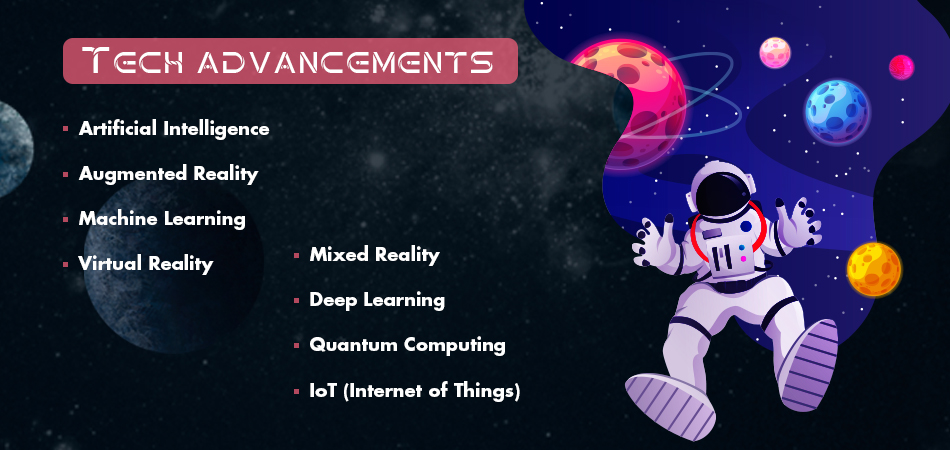
What’s making ideas like space elevators feel less fictional today isn’t just ambition; it’s the quiet, consistent rise of powerful technologies working behind the scenes. Each of these technologies is solving a piece of a much larger puzzle.
And as we begin to understand what are space elevators and how complex they truly are, it becomes clear that these technologies are essential.
1. Artificial Intelligence (AI)
Artificial Intelligence is no longer limited to chatbots or automation tools. In 2026, AI is deeply embedded in decision-making systems. From predicting structural failures to optimizing complex engineering models, AI is helping scientists simulate scenarios that would otherwise take years to test physically.
For large-scale concepts like space elevators, AI can analyze massive datasets, identify risk patterns, and improve design accuracy. This is exactly why businesses today are investing heavily in AI app development to build systems that don’t just respond, but think, learn, and evolve.
2. Machine Learning (ML)
Machine Learning, a subset of AI, plays a more specialized role. It focuses on learning from data over time.
In the context of space infrastructure, ML models can continuously learn from environmental conditions, material behavior, and system performance. This allows predictive maintenance, spotting issues before they become failures.
The same principle is widely used in modern applications, where ML-driven systems improve user experience, automate processes, and enhance efficiency without constant human intervention.
3. Internet of Things (IoT)
Now imagine a structure that stretches tens of thousands of kilometers into space. Monitoring it manually? Impossible.
This is where IoT becomes critical.
Sensors embedded across the structure could provide real-time data on temperature, pressure, vibration, and structural integrity. These connected systems ensure constant monitoring and immediate response to any anomaly.
This growing reliance on connected ecosystems is why IoT app development has become essential for businesses looking to build intelligent, data-driven environments.
4. Augmented Reality (AR)
Augmented Reality adds a layer of digital information over the physical world.
For engineers and scientists, AR can be used to visualize complex structures like space elevators in real-world environments. It allows teams to interact with designs, identify flaws, and make adjustments before actual construction begins.
Today, AR app development is helping industries like retail, healthcare, and real estate create immersive and interactive user experiences but its role in engineering and simulation is just as transformative.
5. Virtual Reality (VR)
While AR enhances reality, Virtual Reality creates an entirely new one.
VR enables engineers to step inside a fully simulated environment. They can test scenarios, simulate extreme conditions, and explore how a space elevator would behave under different circumstances – all without physical risk.
This ability to experiment in a controlled digital space is why VR app development is gaining traction across industries that rely on precision, training, and simulation.
6. Quantum Computing
Still in its early stages, Quantum Computing has the potential to revolutionize how complex problems are solved.
Traditional computers struggle with calculations involving massive variables, something unavoidable in projects like space elevators. Quantum systems, however, can process these calculations at unprecedented speeds.
From material discovery to structural optimization, quantum computing could unlock solutions that are currently beyond our reach.
What are Space Elevators?
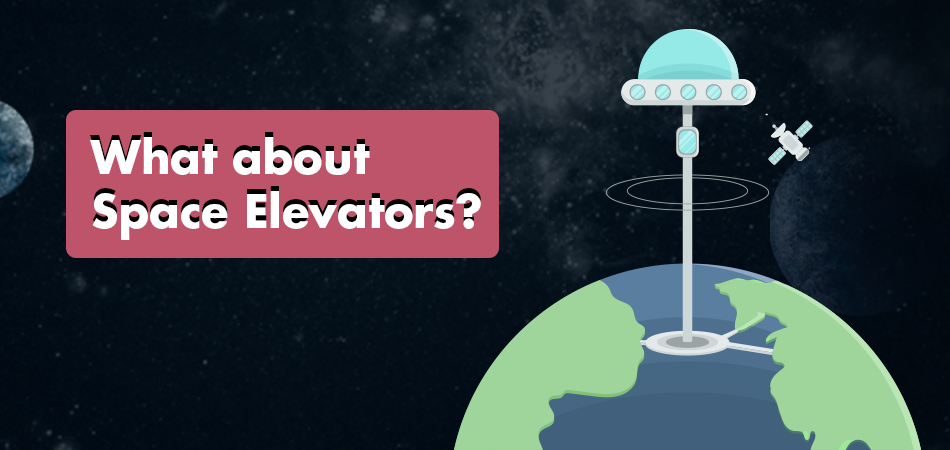
Now the topic for which you are here-
So, the name itself establishes that the concept isn’t only interesting but awe-inspiring too. And honestly, once you go deeper into understanding what are space elevators, the idea feels even more fascinating.
Why? Because scientists’ efforts to make it a reality and the fact that such an idea occurred to people and the wish to make it a reality! Nonetheless, if a space elevator ends up getting built – it will prove to be immensely helpful, cost and energy-saving.
Let us get to know how.
So, it all began back in 1865 when for the first time, a Russian scientist, Konstantin Tsiolkovsky, thought about this concept. Let us briefly discuss what his proposal was.
Konstantin proposed building a free-standing tower reaching from the earth’s surface to the height of the geostationary orbit. For those who don’t know what geostationary orbits are, don’t worry. They are the orbits at the height of 36,000 km from the earth’s equator. They are best known for satellites – used for different kinds of telecommunications. Because of the satellites placed in this orbit, signals from satellites can be sent all across the world!
So, what are space elevators made of?
It has four major components –
- Anchor – A base station on Earth
- Tether – A cable extending thousands of kilometers into space
- Climber – A transport system moving along the tether
- Counterweight – A structure positioned beyond geostationary orbit
Let us go back to Konstantin’s proposal to understand the structure – a free-standing tower from earth to space. Here, the anchor will be a structure placed on the earth surface and the counterweight will be a structure in space. The tether will connect the two and the climber will move up the tether with the payload, shuttle, etc. that have to be launched.
If you still find it difficult to understand, imagine tying a rope to a rock placed on the surface and then tying the loose end to another rock that’s in the air (of course, imagine holding it in hand). Basically, the structure is analogous to an actual elevator. The difference is, the floors are thousands of kilometres apart.
Why Are Scientists Planning To Build Such A Complex Structure, After All?
There are several reasons for researchers and scientists to build such an elevator from earth to space. But the primary reason is saving money, fuel and energy.
You might be thinking about how such a difficult infrastructure project can save cost and energy? Let me explain! Of course, building such a structure will cost billions. But it will save a lot once it gets made! The fuel to launch shuttles etc., costs exorbitantly high – escaping earth’s gravity isn’t easy after all!
So, if an elevator gets built, the climber can take the space vehicle to the geostationary orbit and from there, it can move in the loop – the orbit where other satellites, etc., move or are made to move! Thus, it will become super easy to take huge payloads into space easily and safely!
Impressive, right? But there are many hurdles in making it a reality.
The Challenges That Still Stand in the Way
Understanding what are space elevators also means understanding the scale of challenges involved.
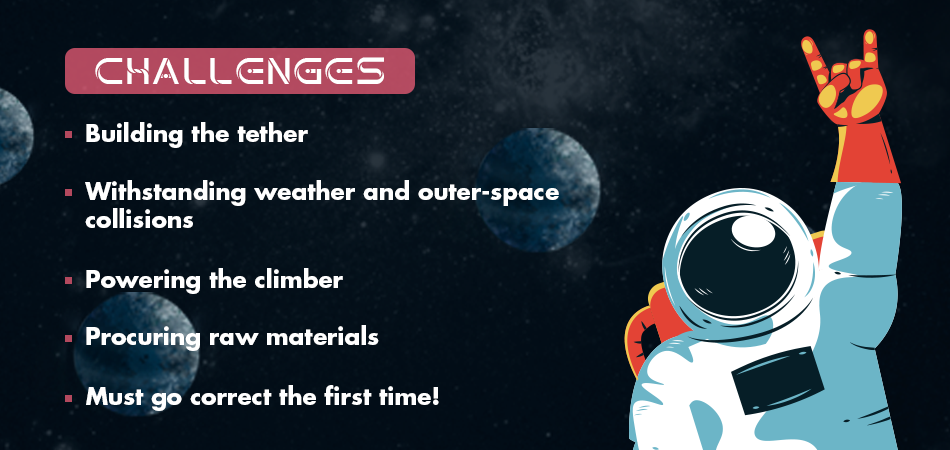
Building the tether – BIG question!
The first challenge is related to the tether, which is a long cable extending from earth’s surface to the centre of mass at GEO at the height of over 35, 500 km. The biggest hurdle is building this long tether.
Graphene and diamond nano-threads are honourable mentions, but they also can’t deliver! We don’t have any existing elements that can provide the required stability and strength to the tether.
How to withstand weather and outer-earth collisions?
This long cable extending to the space must be sturdy enough to survive weather and space challenges as there is space debris too. The turbulence at such a height is constant as well!
Apart from that, the tether cannot break as it will bring the entire elevator structure to shambles!
Powering the climber-but how?
It will anyway take days to reach the counterweight and climb through the tether. The main issue is how to power the climber so that it can carry all kinds of space vehicles and payloads.
There are several questions like – do we need a nuclear reactor on the elevator carriage? If not, what else? How will a huge amount of energy be produced to support the climber?
Procuring the raw material?
How and from where to procure the raw material to build such a long cable over 35,000 km long? This question has gotten the tongues of researchers and scientists worldwide!
There is no try here!
Yes! We HAVE to do it right – scientists cannot afford to try!
Because if the tether breaks from either the anchor or the climber, it will be disastrous. Therefore, there are plans to build such a structure on the moon first!
How Modern Technologies Are Bridging the Gap
This is where things start to get interesting again.
Technologies like AI, IoT, and immersive simulations are quietly solving pieces of the puzzle.
- AI models can simulate stress, predict failures, and optimize design structures
- IoT systems can monitor real-time conditions across the entire structure
- AR/VR environments allow engineers to visualize and test designs before building them
These are not small contributions; they are foundational. In fact, the same technologies are being used across industries to build scalable, intelligent systems. Businesses today are investing in IoT apps, AI apps, and AR/VR often in collaboration with a top mobile app development company, to create solutions that are future-ready and adaptable.
And that crossover? It’s important.
Because innovation in one domain often fuels breakthroughs in another.
So… Are Space Elevators Still Science Fiction?
Not entirely.
But not quite reality either.
Since we are in mobility, we cannot build a space elevator as our “mobility” isn’t extra-terrestrial. But what we do and can do is build amazing solutions to complement the bigger ones!
So maybe the real question is no longer just what are space elevators, but how soon they can move from concept to reality.
What we can do is inform our readers and clients about the important technological advancements and developments in the world and motivate them in any way possible to take action.
Take the example of space elevators, for instance, it is a highly interesting concept but equally difficult too. This doesn’t reflect on the difficulty level of this project but the fact that we have conceived an idea of this level – we will make it happen one day!
So, when we can reach a limitless and majorly unknown domain, why should anyone shy away from choosing amazing business options and even better solutions for those enterprises?! Am I right or am I right?
So, let’s take inspiration from the domain we all love – tech – and get better and more tech-advanced.
Link in with us if you wish to build an enterprising application or solution – Techugo is here to help in the best way possible.

Get in touch
We'd love to hear from you.