

 SA
SA  KW
KW  IE
IE AU
AU UAE
UAE UK
UK USA
USA  CA
CA DE
DE  QA
QA ZA
ZA  BH
BH NL
NL  MU
MU FR
FR 






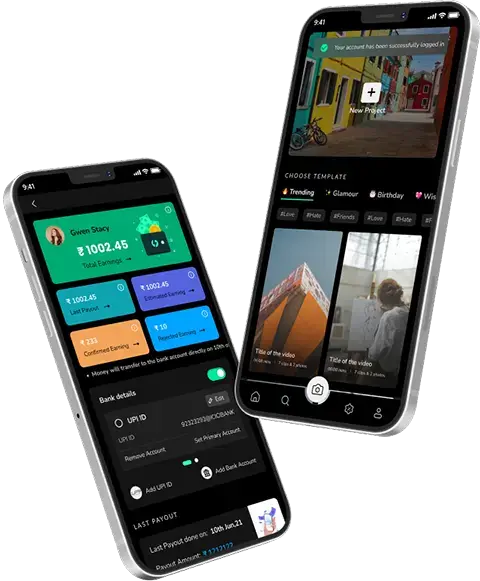






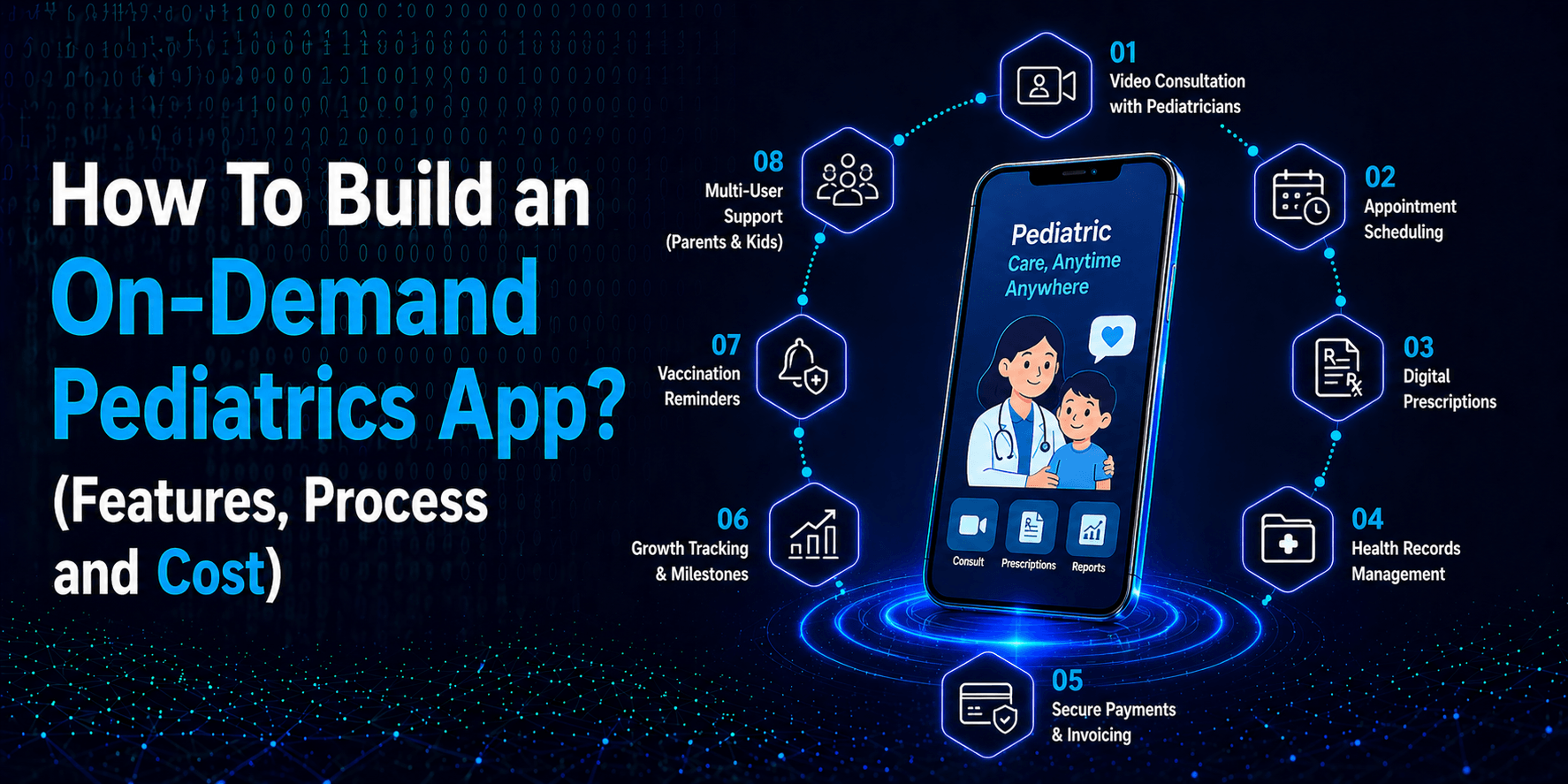


Since our world is rapidly shifting towards digital convenience, the routine that we once followed has now taken a different direction, and we are adapting to solutions that are smarter, and more accessible. No prize for guessing, on-demand mobile apps have witnessed a strong uptick in usage, and it is because users now expect ease, speed, and comfort at every step. And here, on-demand pediatrics app development is becoming more important than ever, because the demand for telemedicine app development and pediatric telehealth apps continues to grow.
Considering the numbers, and the way user expectations have been evolving, it is clear that on-demand healthcare apps, especially pediatric apps, are not just an option anymore but a promising business opportunity that you must explore. It is not only about convenience, but also about accessibility, and therefore, it creates a strong impact on how healthcare services are delivered today.
So, let’s dive into this journey, and understand what all it takes to make a successful pediatrics on-demand app.
Why Invest in Telemedicine Apps in 2026
The telemedicine market is expected to grow rapidly, reaching over $455 billion by 2030, driven by increasing demand for digital healthcare solutions and remote consultations (Grand View Research).
- Rising user demand: Patients prefer faster, remote access to doctors, reducing dependency on physical visits.
- Scalable business model: Telemedicine apps enable healthcare providers to serve more patients with lower operational costs.
- Growth in emerging markets: Regions like India are witnessing strong adoption due to smartphone penetration and digital health initiatives.
- Advanced technologies: AI, remote monitoring, and cloud infrastructure are making telehealth apps more efficient and reliable.
How to build an on-demand pediatrics app? (Step-by-step process)
Here is a step-by-step process for on-demand pediatric app development in 2026. Let’s take a look…
Step 1. Study your competitors
Yes, this is one of the vital elements to build a mobile app, as it allows your app to find out what is trending and what is not in the market, especially in the telemedicine app development space. We believe that your competitors are your best teachers, and they can teach you want to pick and what to not. You don’t need to pick what they offer as it is, as it will never bring any good to your app, but you need to understand what they offer, that is helping their users to stay glued to, and what is disturbing them. Henceforth, you need to avoid what is not helping their users and get inspired to create something unique and different from the existing solution to captivate your users’ attention at large.
Step 2. App wireframe
On a larger scale, an app wireframe can be called as a blueprint of your app. Here there is no need for colors or accurate features to be shown, but there has to be a navigation to show how the app will work. After this app wireframe, it helps developers, designers, and the client to take a much closer look at the functioning of the app and add or remove any other feature in the platform.
Step 3. App development
Most of us think that app development is largely all about coding and technology that sums up to make an app. But this is the half of the fact, as there is much more that goes beyond the technical spectrum, and makes an app. Within this process, different teams from the front, backend, QA, and designers come forward to make a pediatric telehealth app with advanced capabilities.
Step 4. App launch
Once you are all set to make a difference in the app world, you need to study the guidelines offered by specific OSs to deploy the app. Yes, you got it right, every app market has a different need and you need to follow every guideline carefully, so your app does not get rejected, especially when building a HIPAA compliant healthcare app.
Step 5. After maintenance
If you think your job is done after the app deployment, then you need to understand the fact that publishing an app is just one chapter of this journey, and after this, another chapter starts. Here you need to maintain the app, as there can be bugs that need to be fixed, customers’ feedback you need to pay attention to, or simply the app update, that needs to be done on the regular basis to grab the attention of the users in a competitive mHealth app development ecosystem.
A mobile app is all about convenience and comfort offered to the users, and when it comes to dealing with the child’s care, then there has to be a series of special features within the app. Indeed, it is not easy to build an app catering to the needs of the kids, as their demands are different. Therefore, we have brought you a range of essential features that are required to build an on-demand pediatrics app development solution with strong scalability.
Now, let’s dive into the features that are essential to building a scalable on-demand doctor’s app.
Features required to develop an on-demand pediatrics app
A well-structured on-demand pediatrics app development solution must include features across three key panels to ensure seamless communication and care delivery within a pediatric telehealth app.
Patient’s Portal
This portal is dedicated to the patients, enabling them to schedule their appointments, reach out to the doctor, and carry out other required actions.
Doctor search
Every parent wants to have the best possible healthcare for their kids, and they cannot compromise with the doctors. Your app must allow parents to search for specific doctors such as ENT, child psychiatrist, or any other category without any issue involved. Your app must have an easy search option where parents can search for the doctors through easy keywords.
Appointment scheduler
For an on-demand pediatrics app, this feature is highly crucial, as it lets the users check the availability of the required doctor and book an appointment as per the convenience. Also, the remainder of the appointment helps the parents to set reminders for their appointments. So they can be available much before the time, letting other patients in the queue see the doctor at their scheduled time.
Prescription delivery
Although it is one of the advanced features, adding it within your on-demand pediatric app will change the game. With this feature, users don’t need to go to a pharmacist to get the prescribed medicines, as they can simply get it delivered right at their doorstep, which once again encourages the social distancing concept to curb the spread of the deadly virus.
In-app chat
It is worth mentioning that for the pediatrics app; the integration of in-app chat features holds the maximum worth. It gives an option to the users to get in touch with the doctors and discuss the health condition and get the required treatment or dose without any hassle.
Virtual appointment
Indeed, this feature is a great aspect, helping parents to set the virtual appointment, wherein doctors can examine and diagnose the symptoms and suggest the best treatment plan over the video chat.
Doctor’s Portal
With this very portal, it becomes easy for doctors to manage their schedules and help patients.
In-app Chat
This is a must-have feature, helping doctors to get in touch with the parents about the baby and chat with them in case of any emergency. They can prescribe the medicines, get some treatment plan, or simply share their health updates with the doctor, for the next action.
Video call
Amid the COIVD-19, this very feature has proven its worth to another level, wherein taking babies out of the home brings the risk. Here, the video app feature brings ease, letting parents communicate with a doctor through video calls, and show them what’s troubling their baby, and get the right treatment.
Accept/ reject appointment
The doctor’s app must have the option to accept or reject the appointment, as there can be any unseen situation, where they might have to go in an emergency and that can disturb their proper schedule.
Admin Portal
As the name suggests, this portal is handled by Admin, where all different types of activities like managing patients, doctors, and appointments can be handled effortlessly.
Check availability
With this very feature, it becomes easy for the admin to check the doctor’s availability and book an appointment for the patient. Further, if there is any sort of cancellation or rescheduling, the admin can check for other available time slots and book an appointment for later.
Manage doctors
To manage different doctors on the app platform is a demanding task, and this is where this feature comes into practice. Here, the admin gets the option to add or remove any doctor as per the requirements. Also, admin can view the relevant information such as doctor’s profiles, type of doctor, and other required details.
Patient database
With this very feature, the patient’s database can be stored in one place, which further can be utilized and admin can keep a track of patient information, medical history as well as appointments.
Wondering how to turn your idea into a scalable healthcare solution? With proven expertise in healthcare app development services, Techugo helps you build secure, user-friendly, and high-performing pediatrics apps tailored to modern user needs.
Connect with our experts and take the first step towards building your healthcare app today.
Tech Stack for on-demand pediatric app development
Utilizing the right technology helps your mobile app to reduce the development time, and cuts the unnecessary cost, and enhances the app performance to a greater extent. Let’s have a quick look at the right technologies that can help your app to grow out of bounds.
| Category | Technology / Tools |
| Frontend Development | Cross-Platform Development – React Native |
| iOS – Swift | |
| Android – Java | |
| Backend Development | Server – Apache |
| Framework – Laravel | |
| Database – MySQL | |
| Cloud Hosting | AWS |
| Notifications | Twilio / Push.io |
| Payment | Braintree / PayPal |
Benefits of On-Demand Pediatrics App Development
- Improved access to care
Parents can connect with the doctors anytime, and it becomes easier because they do not have to visit hospitals again and again, so that the overall experience is more flexible. - Faster consultations
It helps you get quick medical advice, and therefore, children’s health concerns are handled without much delay, which is important. - Convenience for parents
From booking the appointments, and managing prescriptions, everything is available in one place, and it makes things simpler, but also more organized. - Better patient engagement
There have been regular follow-ups, and reminders as well, so that continuous care is maintained, and the child’s health is not ignored. - Scalable business opportunity
Healthcare providers are able to expand their reach, and they can serve more patients, because the system supports growth and flexibility. - Cost efficiency
It reduces the travel, and also the operational efforts, so overall healthcare expenses are lower, for both users and providers, which is beneficial.
Cost to Build an On-Demand Pediatrics App
The cost to build an on-demand pediatrics app development solution depends on multiple factors, and it is not a fixed number, because features, integrations, and compliance requirements play a major role in defining the final budget.
On average, a telemedicine or pediatric healthcare app can cost anywhere between $60,000 to $300,000+, depending on the complexity and scale of the platform.
| App Type | Estimated Cost |
| Basic MVP App | $60,000 – $100,000 |
| Mid-Level App | $100,000 – $200,000 |
| Advanced App | $200,000 – $300,000+ |
What Affects the Cost?
- Features and functionality – The more features you add, like video consultations, chat, and e-prescriptions, the higher the cost becomes, because development effort increases.
- Compliance and security – Building a healthcare app is not simple, because regulations like HIPAA add extra layers of security and cost.
- Third-party integrations – Integrations with EHR systems, payment gateways, and APIs increase complexity, and therefore, the overall budget.
- Platform choice – Whether you build for iOS, Android, or both, it impacts cost, but cross-platform development can reduce expenses to some extent.
- Maintenance and updates – Post-launch, the app requires continuous updates, and it usually costs around 15–25% of the initial development cost annually (Taction Software).
So, the cost is not just about building the app, but also about maintaining it, scaling it, and ensuring compliance, and therefore, it is always better to start with an MVP, and then expand gradually based on user needs.
Latest Trends in Pediatric Telehealth Apps
The pediatric telehealth market is growing rapidly, and it is expected to reach nearly $149 billion by 2030, driven by increasing demand for digital care and remote consultations (Grand View Research).
- AI-powered diagnosis and assistance
Healthcare apps are now using AI, and it helps in faster diagnosis, but also improves accuracy, so that better care can be delivered. - Remote patient monitoring (RPM)
With wearables and connected devices, children’s health can be tracked in real-time, and therefore, doctors can take action much earlier. - Real-time virtual consultations
Live video consultations are becoming standard, because they replicate physical visits, and parents prefer immediate interaction with doctors. - Shift towards continuous care
Telehealth apps are not just for one-time visits anymore, they are used for regular follow-ups, and long-term care management. - Integration with digital health ecosystems
Modern apps are now connected with EHRs, cloud platforms, and other systems, so that the care experience becomes more seamless and efficient.
How to Monetize a Pediatrics App
Monetizing a pediatrics app is not just about charging users, but about creating value that parents are willing to pay for, because healthcare is a sensitive space, and trust plays a big role. There are multiple ways through which a pediatrics app can generate revenue, and usually, a mix of models works better than relying on just one.
- One of the most common models is the subscription-based approach, where users pay a monthly or yearly fee to access services like unlimited consultations, priority bookings, or continuous health monitoring. It works well because parents prefer consistency, and they are more likely to stick to a platform that offers ongoing care for their children.
- Another effective method is the pay-per-consultation model, where users are charged for each doctor interaction. This gives flexibility to the users, as they only pay when they need the service, and therefore, it becomes easier to attract a wider audience who may not want long-term commitments.
- You can also integrate a commission-based model, especially if your app connects patients with multiple healthcare providers. In this case, the platform earns a percentage from each consultation or service booked through the app, and it creates a steady revenue stream as the user base grows.
- Additionally, pharmacy and prescription delivery integration can open another monetization channel. By partnering with pharmacies, the app can earn commissions on medicine orders, and it also enhances user convenience, which indirectly improves retention.
- Some platforms also explore premium features, such as advanced health tracking, personalized care plans, or priority doctor access. These features are not necessary for every user, but for those who need more control and insights, they are willing to pay extra.
So, monetization is not a one-size-fits-all approach, and it depends on your target users, but combining these strategies thoughtfully can help you build a sustainable and scalable pediatrics app business.
Are you ready to enter the Next-Gen solution?
Now, when you have collected the required information, the next big question comes: what would be the cost to build an on-demand pediatric app? And the answer is, it depends, because every app is different, and the features, integrations, and scale define the final cost.
The total cost of a mobile app depends on a variety of factors, and companies that claim to give you an estimated cost without understanding your app concept are often just making a selling pitch, so you need to be careful.
So, don’t fall for it, and instead, share your idea so that you can get a more accurate estimate, and a solution that actually fits your needs.
Wondering where to start?
With strong expertise in healthcare mobile app development services, Techugo helps you build scalable, secure, and user-focused pediatrics apps that are aligned with modern healthcare needs.
Just get in touch with us, and take the first step forward.

Get in touch
We'd love to hear from you.