

 SA
SA
 KW
KW
 IE
IE AU
AU UAE
UAE UK
UK USA
USA
 CA
CA DE
DE
 QA
QA ZA
ZA
 BH
BH NL
NL
 MU
MU FR
FR














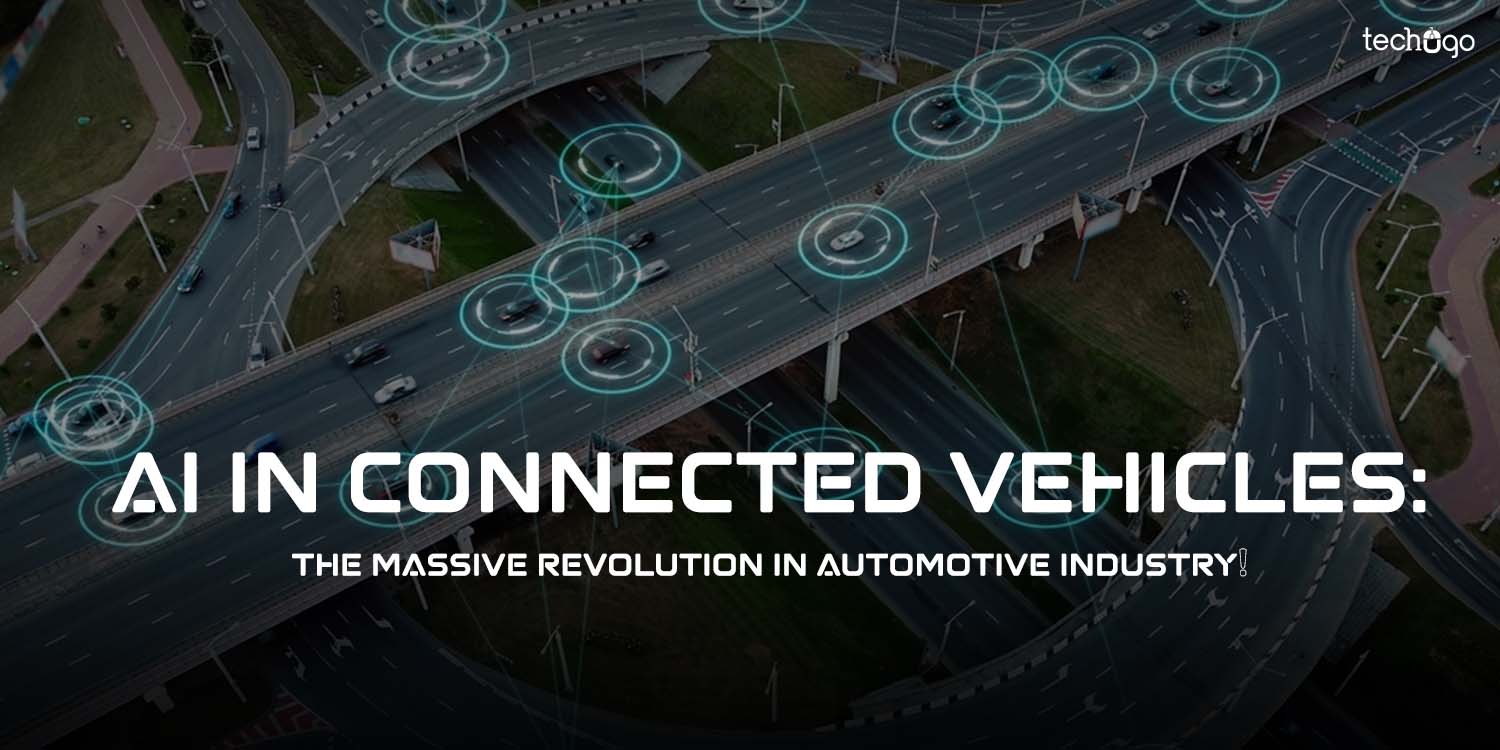


Another year, another revolution.
And honestly, it no longer feels surprising when we see innovation shaping the way we live and move.
Indeed, the internet has transitioned the manner we communicate and carry out our daily jobs in this digital world. Don’t you think the world is now much more ‘CONNECTED’ than it was before?
Today, people are constantly connected through smart devices and cloud platforms. So, if everything around us is connected, why should vehicles be any different?
The new tech is called connected car technology, which has now set the new standards in the automotive industry. Modern vehicles are no longer just machines for transportation. They are becoming intelligent systems powered by data, connectivity, and artificial intelligence in automotive applications.
So, what will the future of connected car technology look like?
Can AI-driven systems help manage dense traffic conditions and improve road safety?
We are too excited to share how connected cars and AI-powered vehicle systems are transforming transportation and what this evolution means for drivers and businesses alike. So, hop on to unveil some exhilarating revelations today.
Also Read: Integrating Generative AI with IoT and Sensor Data in Smart Vehicles
Introduction to Connected Cars
In the simplest terms, a connected car is a vehicle that can connect to the internet through a Wireless Local Area Network (WLAN). Not only this, but the connected car data can be shared with devices inside and outside the car, which allows real-time communication and smarter mobility solutions.
But what precisely does the tech do?
Notably, automobile companies have put two kinds of mechanisms in action in connected vehicle technology: Embedded Systems and Tethered Systems.
An embedded system is installed directly within the vehicle and comes equipped with its own chipset and antenna. On the other hand, a tethered system is one incorporated with external hardware that can be connected to the driver’s phone.
Any connected vehicles with these systems enable sending/receiving data, downloading updates, connecting with other devices via Internet of Things, and providing in-car WiFi connectivity to passengers.
Also Read: Autonomous Vehicle Ecosystem: The Role of AI-Driven Apps in Saudi Mobility
Key Features and Capabilities of AI-Powered Connected Cars
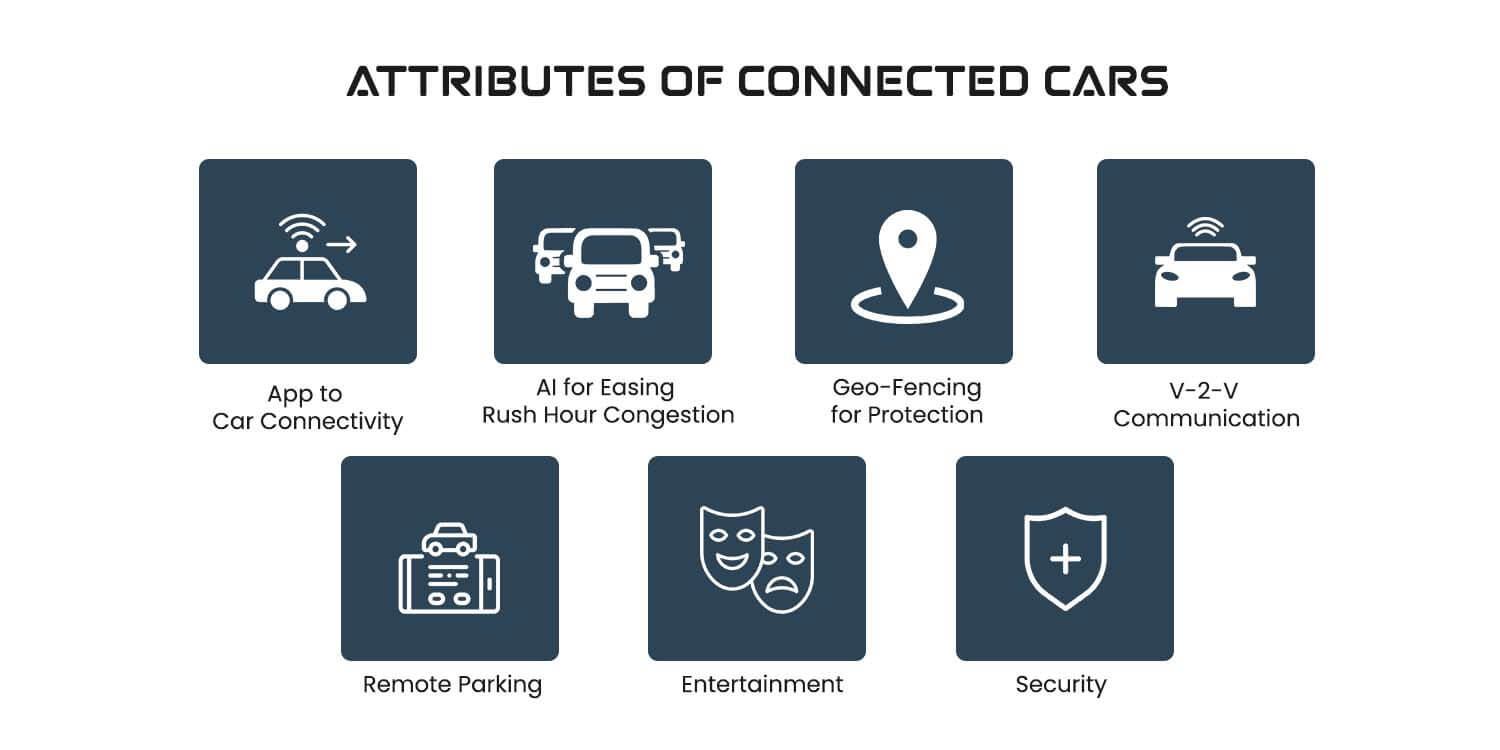
Connected cars come equipped with several AI-powered and IoT-enabled features that enhance the overall driving experience and create a strong safety and communication ecosystem. These connected vehicle features improve traffic efficiency, vehicle security, and driver convenience. Some of the most important capabilities are listed below:
1. App to Car Connectivity
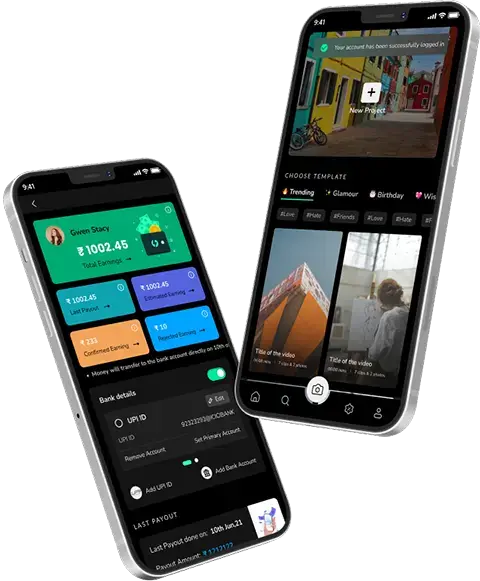
Car manufacturers are now emphasizing the development of a dedicated mobile app that can build a connection with the car via a wireless network and IoT connectivity. Such an app is used to operate the functions of a car remotely, including engine start/stop, opening/closing the rooftop, locking/unlocking the doors, and whatnot.
AI algorithms help personalize these controls based on driver behavior and usage patterns, making connected car apps more intelligent over time.
If you don’t know, Tesla’s mobile app allows users to unlock vehicles, control temperature, track location, and monitor charging status remotely using connected car technology.
2. AI for Easing Rush Hour Congestion
AI in automotive industry has a tremendous benefit to offer. What is it?
Notably, AI in connected cars can highly reduce traffic congestion by eliminating instabilities in a traffic flow that occurs due to human driving behavior.
In connected vehicles, artificial intelligence analyzes traffic data collected from sensors, cameras, GPS, and cloud platforms to predict congestion and recommend alternative routes in real time.
AI helps stabilize traffic flow by reducing sudden braking and unpredictable driving patterns caused by human behavior. This improves road efficiency and lowers fuel consumption.
Google Maps and Waze use AI-based traffic prediction models that adjust routes dynamically based on real-time congestion data shared by connected vehicles and smartphones.
3. Geo-Fencing for Protection
Geo-fencing is one of the most useful vehicle security features in connected cars, which fabricates a geographical boundary and alerts the owners if the vehicle is going beyond the predefined area. The feature is easily accessible within the app built for connected cars, and is especially useful for monitoring young drivers, rental vehicles, or fleet operations. AI systems analyze movement patterns and trigger alerts when unusual activity is detected.
Did you know? Hyundai and MG Motor provide geo-fencing features in their connected car apps that alert owners when the vehicle enters or exits a specific zone.
4. V2V and V2X Communication (Vehicle-to-Vehicle and Vehicle-to-Everything)
Vehicle-to-vehicle (V2V) and vehicle-to-everything (V2X) communication enables connected vehicles to exchange data about road conditions, traffic signals, accidents, and hazards with other vehicles and infrastructure.
AI processes this shared data to support collision avoidance, lane change warnings, and real-time traffic optimization.
For example, Audi uses V2I (vehicle-to-infrastructure) communication in some regions to provide traffic signal timing information, helping drivers avoid unnecessary stops.
5. Remote Parking with AI Assistance
Did you ever think you could park your vehicle remotely?
Connected cars will now provide you the opportunity to do so. Users can use the smartphone app and instruct their vehicle to get parked in the desired spot without sitting inside the car.
AI and sensor data help detect obstacles, calculate parking space dimensions, and guide the vehicle safely into the desired spot. The feature will be most suitable for people not confident with their parking skills or will help especially in crowded parking spaces and tight urban areas.
If you don’t know, BMW’s Remote Parking Assist lets drivers park and retrieve their vehicles using a smartphone app in narrow parking areas.
6. Connected Car Entertainment Systems
A connected vehicle also allows passengers to connect with entertainment apps/services to listen to music, podcasts, access internet radio, or stream videos.
AI-driven recommendation engines personalize content based on user preferences and travel history. These infotainment systems also integrate voice assistants for hands-free control.
Mercedes-Benz’s MBUX system uses AI-based voice commands and personalized media recommendations for in-car entertainment.
7. Vehicle Safety and Emergency Assistance
Connected cars are not just about connectivity with entertainment or other vehicles. It also comes equipped with advanced security features, such as real-time location sharing, emergency SOS alerts, roadside assistance, and crash detection systems. AI continuously analyzes sensor data to identify accidents or dangerous driving behavior and automatically send alerts to emergency services.
For example, Apple CarPlay and OnStar systems automatically notify emergency responders when a serious collision is detected.
8. Predictive Maintenance Using AI
AI in connected vehicles enables predictive maintenance by monitoring engine performance, battery health, tire pressure, and brake systems in real time. Machine learning models detect early signs of mechanical failure and notify drivers before a breakdown occurs.
This reduces repair costs and improves vehicle lifespan.
For example, Tesla vehicles use AI-driven diagnostics to notify drivers about battery and system issues before they become critical.
9. Personalized Driving Experience
AI-powered connected cars can recognize driver profiles and automatically adjust seat position, mirrors, climate settings, and infotainment preferences. These systems learn from past driving behavior and continuously optimize comfort and usability.
Volvo and BMW vehicles offer driver profile-based personalization that adapts car settings based on individual users.
These connected car capabilities rely heavily on artificial intelligence, IoT connectivity, and cloud-based data processing to function efficiently.
As these technologies continue to grow and update, they form the foundation for safer autonomous driving systems and intelligent transportation networks.
Now that you’re familiar with the key features and capabilities of connected vehicles, the next big question asked by many is the role of Artificial Intelligence technology in making autonomous cars safer.
Are you intrigued too? Then, continue reading.
How AI in Connected Cars Helps Reduce Traffic Congestion
The integration of artificial intelligence with connected vehicle systems is proving to be an effective solution for reducing traffic congestion and improving traffic flow efficiency. Research initiatives such as the CIRCLES program demonstrate how AI-driven coordination between vehicles can minimize congestion caused by unpredictable human driving behavior.
According to the study, specially designed AI algorithms in autonomous and connected vehicles can significantly reduce phantom traffic jams—a phenomenon that occurs when drivers brake suddenly without any real obstruction on the road.
This conclusion was inspired by an experiment conducted in Japan, where 20 vehicles were instructed to drive around a circular track at a constant speed. Within minutes, traffic patterns became unstable: some vehicles slowed down unnecessarily while others were forced to brake, creating artificial congestion.
This situation mirrors what drivers commonly experience on highways. When one vehicle applies sudden braking, all vehicles behind it are forced to react, which leads to stop-and-go traffic and reduced road efficiency.
Researchers found that if even 5% of vehicles on the road were connected and capable of wireless communication, overall traffic congestion could be noticeably reduced.
By sharing real-time speed and position data, connected cars can maintain smoother acceleration and braking patterns.
In addition, modern vehicles are now equipped with AI-powered adaptive cruise control systems. These systems allow drivers to set a constant speed while the vehicle automatically adjusts acceleration and braking based on traffic conditions and the movement of vehicles ahead. This reduces unnecessary braking, improves fuel efficiency, and contributes to more stable traffic flow.
Together, these advancements show how artificial intelligence, vehicle connectivity, and automated driving assistance systems are transforming traffic management and paving the way for intelligent transportation networks.
Also Read: AI in Automotive Industry: 6 Trends Shaping Saudi Arabia’s Mobility Future
How Techugo Supports AI-Driven and Connected Vehicle Solutions
As a leading mobile app development company, Techugo specializes in building intelligent digital solutions for the automotive and electric vehicle ecosystem. With deep expertise in AI integration services and connected system development, Techugo helps automotive brands, EV startups, and mobility enterprises design smarter, safer, and more efficient vehicle platforms.
As an experienced EV software development company, Techugo delivers end-to-end solutions that power modern electric and connected vehicles, including:
- AI-driven driver assistance and predictive analytics systems
- Connected car mobile applications for real-time vehicle monitoring and control
- EV battery management and charging software solutions
- Fleet management platforms with AI-based optimization
- In-car infotainment and navigation systems powered by machine learning
Techugo’s AI integration services enable automotive systems to process real-time data from sensors, GPS, cameras, and cloud platforms to support traffic optimization, vehicle diagnostics, and personalized driving experiences. These intelligent solutions improve road safety, operational efficiency, and overall user experience across connected and electric vehicle platforms.
By combining expertise in mobile technologies, artificial intelligence, and automotive software architecture, Techugo empowers businesses to build scalable connected vehicle applications and next-generation EV software solutions aligned with the future of intelligent transportation.
To Sum Up!
Undoubtedly, the scope for AI in multiple industries is terrific, and automotive tops the charts! So, what is your idea of building a dedicated app that works exceptionally with the connected cars system?
Need further assistance with your app idea? The best mobile app development company has got you!
So, what are you waiting for?
Get, Set, Go!

Get in touch
We'd love to hear from you.