

 SA
SA  KW
KW  IE
IE AU
AU UAE
UAE UK
UK USA
USA  CA
CA DE
DE  QA
QA ZA
ZA  BH
BH NL
NL  MU
MU FR
FR 










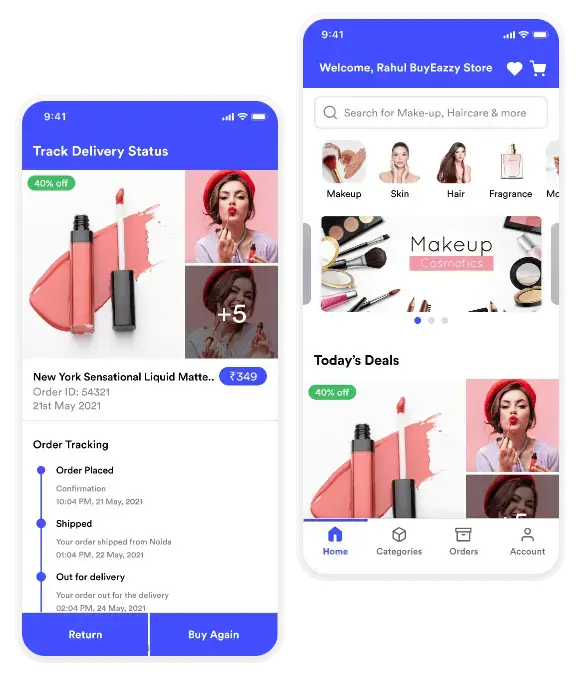



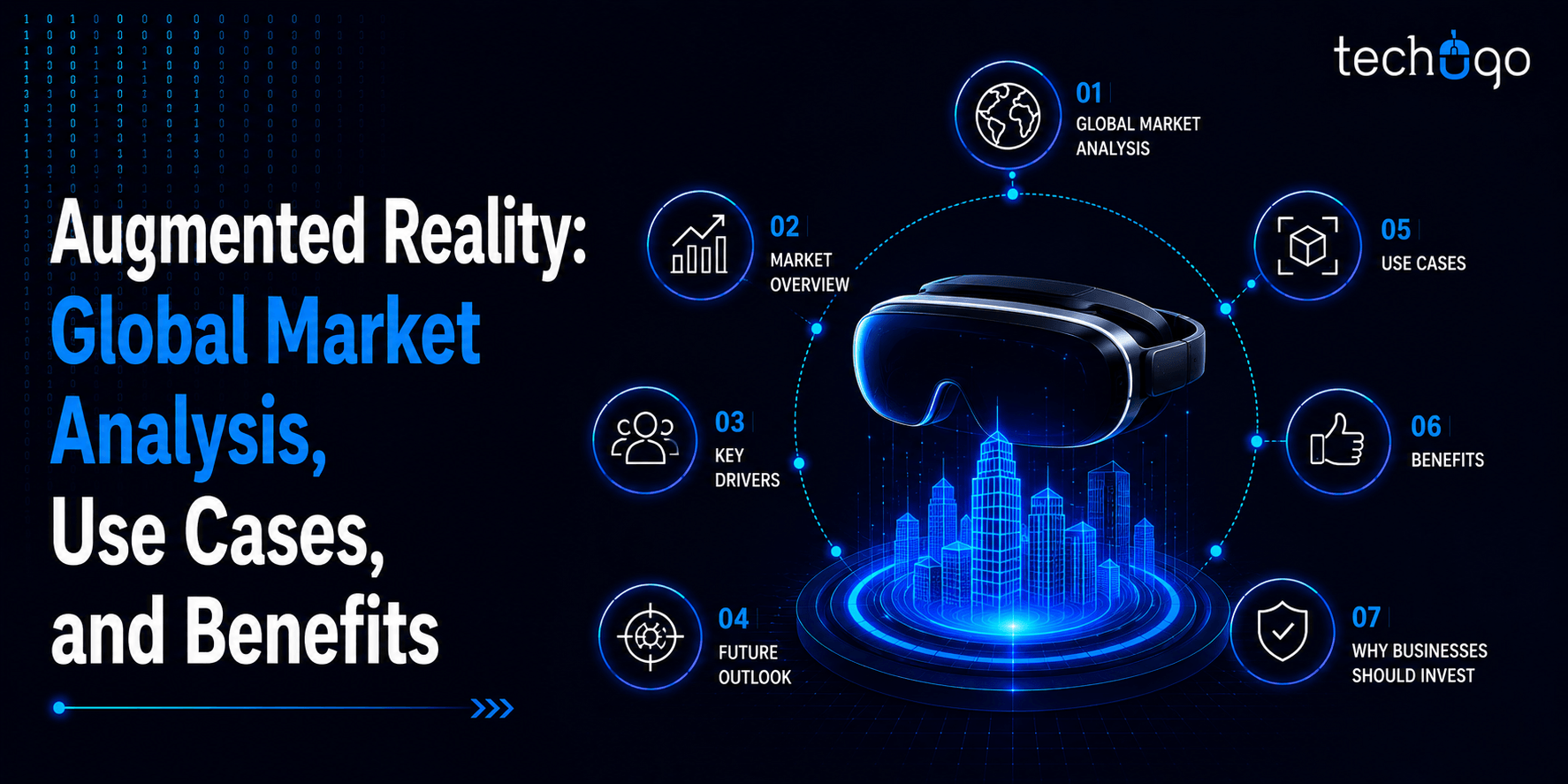


AR (Augmented Reality) has emerged as one of the most transformative technologies in the digital space. It changes the way users interact with digital and physical environments. The commercial support AR received from the industry giants like Microsoft, Amazon, Apple, Meta (Facebook), and Google, has marked a difference. This has accelerated AR adoption and innovation.
Although AR is often discussed alongside virtual reality (VR), it has steadily built its own strong identity. AR captures significant attention across industries; as a result, augmented reality applications are on the rise in both consumer and enterprise spaces.
Over time, AR has moved beyond being just an experimental technology and has become a practical driver of digital transformation. Its growing scope now spans multiple industries, including manufacturing, healthcare, retail, gaming, real estate, and automotive, that allows more immersive and interactive augmented reality use cases.
AR has the ability to enhance visualization, improve decision-making, and create engaging user experiences so it continues to attract strong global investments and is becoming a key part of modern digital strategies.
Global Augmented Reality (AR) Market
According to global augmented reality insights from Statista, mobile AR adoption has crossed the billion-user mark. This is driven by rapid smartphone integration and the widespread use of AR-enabled apps across both consumer and enterprise environments.
Industry research from Grand View Research estimates that the global augmented reality market size was valued at approximately USD 60+ billion in 2023. The market is further projected to grow at a compound annual growth rate (CAGR) of over 30%, with expectations to reach well above USD 500 billion by 2030 as AR becomes deeply embedded in enterprise workflows and consumer applications.
A major turning point in the AR journey was the global success of Pokémon GO, which demonstrated how AR could seamlessly blend digital experiences with real-world environments. It set a new benchmark for interactive engagement and introduced millions of users to augmented reality in a highly accessible way.
Since then, AR has evolved far beyond entertainment. The introduction of AR-enabled smartphones, smart glasses, and enterprise headsets has transformed how businesses visualize data, train employees, and interact with digital systems in real time.
Today, AR is no longer limited to experimental use cases. It is actively reshaping industries through immersive visualization, remote collaboration, and real-time guidance systems.
Expert Insight
Industry experts suggest that AR is gradually becoming a “layer of interaction” between humans and digital systems rather than just a standalone technology. As digital transformation analysts from leading AR adoption studies highlight:
“Augmented Reality is shifting from being a novelty experience to becoming an operational technology that directly improves efficiency, decision-making, and customer engagement.”
Another key observation from enterprise technology research is:
“The real value of AR lies not just in visualization, but in its ability to reduce complexity and bridge physical-digital workflows in real time.”
Techugo’s Perspective as an expert AR app development company
From a strategic standpoint, the AR ecosystem is now moving toward deeper integration with artificial intelligence, IoT, and spatial computing. This convergence is enabling businesses to build more intelligent, context-aware applications that respond to real-world conditions dynamically.
As a result, AR is no longer just about enhancing visuals. It is becoming a core enabler of next-generation digital transformation across industries.
This evolution has led to a continuous rise in AR-based projects, with businesses increasingly investing in immersive applications to improve productivity, customer experience, and operational efficiency.
Different use cases of Augmented Reality across industries
Augmented Reality (AR) is fun to watch, as it pushes the limits of how users perceive physical spaces and objects, and this has enabled this technology to become an indispensable part of users’ lives. It has let the digital images be a part of the real world, which can be touched and felt as integrated into everyday life.
Let’s take a closer look at the different augmented reality use cases across industries and how they are delivering real business value:
Gaming sector
As we all know, AR gained massive global attention with Pokémon GO, which completely changed the way users interact with mobile gaming. It introduced location-based AR gameplay at scale and proved the commercial potential of immersive gaming experiences.
Today, AR continues to dominate the augmented reality gaming industry, with developers integrating real-world interaction, spatial tracking, and multiplayer AR environments.
Modern AR gaming is also expanding into wearable devices and console integration, making gameplay more immersive than ever before. Titles like Harry Potter: Wizards Unite further strengthened the demand for AR-based storytelling experiences.
Enterprises
Enterprises are among the biggest adopters of augmented reality applications today. Industries such as manufacturing, logistics, retail, healthcare, and education are using AR headsets and smart glasses to improve productivity and decision-making in real time. For example, companies like Boeing use AR-powered smart glasses for aircraft wiring and assembly guidance, significantly reducing human error and improving operational efficiency.
AR is also widely used for:
- Remote assistance in field service operations
- Real-time data visualization in logistics
- Employee training simulations in manufacturing environments
This makes AR a key enabler of modern enterprise digital transformation.
Today, enterprises are not only adopting AR for operations but are also expanding into immersive digital ecosystems that combine multiple technologies. Alongside augmented reality applications, many organizations are also investing in VR app development services to build end-to-end digital experiences for training, simulation, remote collaboration, and customer engagement.
Healthcare
Well, healthcare has become one of the strongest use cases for augmented reality in healthcare applications. There has been a constant evolution in this field. AR technology provides guidance to the surgeons and helps them to get the information in the operating room. For instance, AccuVein uses AR-based imaging to help medical professionals visualize veins in real time, making injections and IV placements more precise.
In the medical education sector, the use of AR technology is the best way to offer immersive virtual training environments for medical students. They can learn every bit of surgery before working on real patients. This combination of safety, precision, and training efficiency is making AR a valuable tool in modern healthcare systems.
Since adoption of AR across industries is rising, businesses are increasingly partnering with experts in AR/VR mobile app development services to ensure seamless integration of AR features into scalable, user-friendly applications.
Safety and monitoring systems
AR is increasingly being used in security operations and monitoring systems by integrating it with IoT and real-time analytics. Security personnel can use AR-enabled glasses to access live surveillance data, facial recognition alerts, and threat detection overlays directly in their field of view.
In healthcare environments, ICU monitoring systems use AR dashboards to track patient vitals in real time, helping medical staff respond faster to critical situations. This makes AR a powerful tool for real-time decision-making and situational awareness.
Real-estate and home decor
The real estate and home décor are the two most benefitted sectors from AR technology. This very technology allows the users to get interactive walkthroughs in mixed or virtual reality environments, or check that expensive couch how it would look in their living room.
The real estate and interior design industries are heavily benefiting from augmented reality applications in real estate. For example, IKEA allows users to visualize furniture in their homes using AR before making a purchase.
Buyers can:
- Take virtual property walkthroughs
- Visualize interiors in real time
- Experiment with furniture placement and design layouts
This improves buyer confidence and reduces purchase hesitation, making AR a strong conversion-driving technology in real estate.
Also Read: Virtual Reality in Real Estate: How VR Apps Are Changing Property Buying
Travel & Tourism
The travel and tourism industry is using AR to enhance visitor experiences and rebuild confidence post-pandemic. But with the integration of Augmented Reality, travel agencies can give a quick and interactive look to the users, and show them how far secure and safety measures are taken for their safe and pleasant journey.
Tourism apps now allow users to:
- Explore destinations through interactive AR previews
- Access real-time navigation overlays at historical sites
- View cultural and historical information through mobile cameras
For example, museums like the Smithsonian National Museum of Natural History use AR to provide interactive exhibits that bring artifacts and exhibits to life. This makes travel experiences more informative, engaging, and immersive.
Automotive industry
Yes, this is another beautiful integration of AR technology, wherein the self-directed vehicles are gaining more popularity. Companies like BMW are using AR in vehicle design visualization and assembly guidance to improve precision and reduce production errors.
AR is also powering:
- Heads-up displays (HUDs) in modern vehicles
- Navigation overlays on windshields
- Driver assistance systems with real-time alerts
With the rise of autonomous and connected vehicles, AR is becoming a critical part of future mobility ecosystems.
Benefits of Augmented Reality for businesses
Augmented Reality (AR) is no longer just an innovation for experimentation—it has become a powerful driver of business efficiency, customer engagement, and digital transformation. Companies across industries are actively leveraging augmented reality applications to solve real operational challenges and create better user experiences.
Below are some of the key benefits AR delivers to modern businesses:
Enhanced customer engagement
AR enables businesses to create highly interactive and immersive experiences that capture user attention more effectively than traditional digital formats. Whether it is product visualization, virtual try-ons, or interactive demos, AR significantly increases customer engagement time and brand recall.
For example, brands like IKEA use AR to let customers visualize furniture in their real environment before purchase, improving engagement and purchase confidence.
Better product visualization
One of the strongest augmented reality use cases in business is real-time product visualization. Customers can see how a product will look, fit, or function in their real-world environment before making a decision.
This reduces uncertainty and helps businesses deliver a more confident buying journey, especially in industries like retail, real estate, and automotive.
Increased conversion rates & reduced returns
By allowing customers to “try before they buy” in a digital environment, AR reduces mismatched expectations. This directly leads to higher conversion rates and fewer product returns, especially in eCommerce and fashion industries.
Improved training and workforce efficiency
AR is widely used for employee training in industries such as manufacturing, healthcare, and logistics. It enables real-time, hands-on learning without requiring physical risk or high-cost setups.
For instance, companies like Boeing use AR-based systems to guide technicians during complex assembly processes, improving accuracy and reducing training time.
Real-time decision making
With AR-powered data overlays, businesses can access real-time insights directly within their working environment. This is especially useful in fields like healthcare, security, and field services, where quick decision-making is critical.
Competitive advantage in digital transformation
Early adoption of augmented reality technology gives businesses a strong competitive edge. It not only improves operational efficiency but also positions brands as innovation leaders in their industry. As AR continues to evolve alongside AI and IoT, it is becoming a core part of next-generation digital ecosystems.
Indeed, gaming is likely to grab the bigger chunk of the revenue when it comes to integrating AR technology, but other industries such as healthcare and enterprises among others would also gain benefits out of it.
With the rapid rise in augmented reality market size and applications, businesses that adopt AR early will gain a significant competitive advantage.
Building future-ready Augmented Reality solutions with Techugo
As businesses increasingly adopt augmented reality applications to enhance customer experience and operational efficiency, the demand for a reliable technology partner has grown significantly. AR is no longer just about visual innovation. It requires deep engineering expertise, scalable architecture, and real-world problem-solving capability.
This is where Techugo stands out as a top augmented reality app development company, helping enterprises and startups transform ideas into immersive, high-performance AR solutions.
With experience across industries such as healthcare, retail, real estate, automotive, and enterprise mobility, Techugo focuses on building AR-powered products that go beyond visuals. The approach is centered around delivering measurable business outcomes—whether it’s improving user engagement, enabling virtual try-ons, supporting remote assistance, or building interactive training environments.
What makes Techugo different is its strong focus on AI-first engineering combined with immersive technology expertise. This allows the team to build AR solutions that are not only visually advanced but also intelligent, scalable, and future-ready.
From concept to deployment, Techugo supports businesses through:
- AR strategy and product consulting
- Custom AR app development
- Integration with AI, IoT, and cloud systems
- Cross-platform AR experiences for mobile and wearable devices
- Enterprise-grade AR solutions for training and operations
By combining innovation with execution, Techugo helps businesses unlock the full potential of augmented reality technology and stay ahead in an increasingly competitive digital world.
For organizations looking to adopt AR at scale, having the right development partner is critical and that’s where Techugo continues to deliver value through experience, innovation, and engineering excellence.

Get in touch
We'd love to hear from you.