

 SA
SA  KW
KW  IE
IE AU
AU UAE
UAE UK
UK USA
USA  CA
CA DE
DE  QA
QA ZA
ZA  BH
BH NL
NL  MU
MU FR
FR [ LET’S TALK AI ]
X
Discover AI-
Powered Solutions
Get ready to explore cutting-edge AI technologies that can transform your workflow!



Get ready to explore cutting-edge AI technologies that can transform your workflow!







Talking about the most promising JavaScript frameworks in today’s world, developers often face the dilemma of choosing between React and Vue.js.
Why?
Are the two frameworks really that popular?
Indeed, both React and Vue frameworks hold immense significance in the JavaScript ecosystem and are efficient technologies for both small and large-scale web applications.
Choosing between React and Vue depends on your project size, hiring plans, performance needs, and ecosystem maturity. Both frameworks have grown considerably over the years, and the right choice today is not the same as it was in 2020.
So, what’s the criteria for choosing one amongst the two for working on a particular project since the two are similar in a lot of ways?
If such questions have crossed your mind lately, it’s time to take a backseat instead of rushing into a decision. Therefore, give this article a thorough read to articulate the strong points and shortcomings of these two technologies.
This article explores the key differences, strengths, and real-world use cases of React and Vue to help you choose the right JavaScript framework for your web application development needs.
Keep scrolling…
To start with, why are the two frameworks being compared?
One of the primary reasons is the time! As mentioned above, both mechanisms offer exceptional results, are well-liked in the community, and are used by big brands. However, their differences highly affect the learning curve, overall implementation time, and use cases.
If you’re a developer, you must know the sweat and blood it takes to learn about dynamic technology and successful app development.
Any business would want to make decisions or pick the best choices considering the amalgamation of tech. However, having little or no knowledge will not make you a jack of all trades!
Debuted in May 2013, React is an open-source JavaScript library developed by Facebook and is well-known for working on user interfaces. It is primarily used for creating single-page applications (SPAs) but is also widely adopted in custom web application development and cross-platform app development.
React uses a virtual DOM to efficiently update and render only the components that change, improving performance and user experience. Its component-based architecture allows developers to reuse code across different parts of an application, making React a preferred choice for scalable web application development and enterprise-grade frontend solutions.
Some of the most important features of React that make it popular for modern web and mobile app development include:
React offers a powerful and flexible approach to building modern web and mobile interfaces. Its component-based structure, performance optimization techniques, and rich ecosystem make it a preferred JavaScript library for scalable web application development and interactive user experiences.
Below are the major benefits of using React for frontend and cross-platform app development:
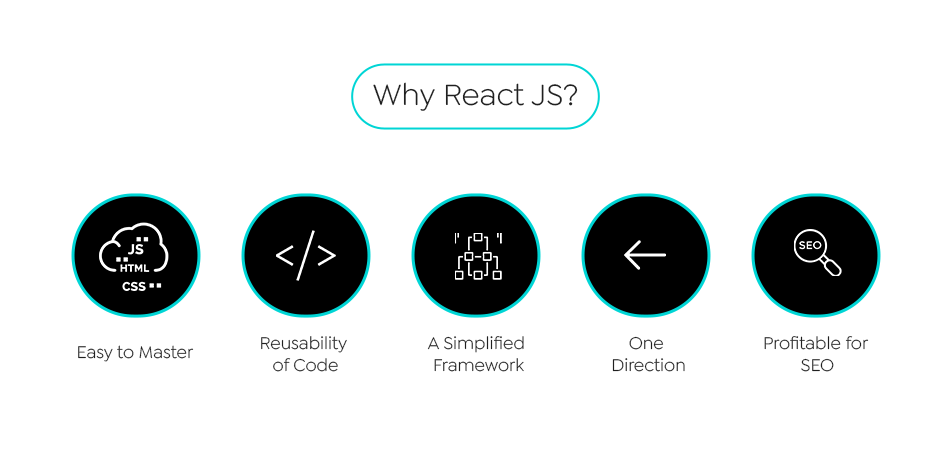
Take a look at its best advantages:
React is an easy programming language to learn when compared to other front-end languages, especially for budding developers. All it needs is a basic knowledge of HTML and CSS.
The React code is reusable, and developers can use the components of various levels while working on a specific project.
Amongst all other front-end frameworks, React follows a component-based approach and is considered a simplified framework.
The mechanism utilizes an extraordinary syntax called JSX that enables using both JavaScript and HTML.
ReactJS enables the flow of data in a single direction which is downloaded. The icing on the cake is that one set of data does not impact the other set, making it possible to make alterations hassle-free.
React supports server-side rendering, which helps improve page load speed and search engine visibility. This makes React suitable for building SEO-optimized web applications and content-driven platforms.
React’s virtual DOM updates only the elements that change instead of reloading the entire page. This improves performance and ensures smooth user interactions, even in data-heavy applications.
React has a large developer community and a mature ecosystem of tools and libraries. This makes it easier to find support, integrations, and long-term updates for enterprise and startup projects alike.
With React Native, developers can reuse a significant portion of React code to build Android and iOS applications, reducing mobile app development time and cost while maintaining near-native performance.
React is backed by a strong open-source community and continuous updates, making it a reliable choice for building long-term digital products and scalable business applications.
After a year of React’s debut, Vue came into the picture and became one of the prominently utilized JavaScript frameworks. Vue focuses primarily on the view layer, making it suitable for developing single-page applications (SPAs) as well as dynamic and responsive web interfaces.
Vue.js is designed to be lightweight, flexible, and easy to integrate into existing projects. Its progressive framework architecture allows developers to use Vue for both small UI components and full-scale web application development, making it a practical choice for startups and businesses looking for fast and efficient frontend solutions.
Some of the most important features of Vue.js that contribute to its popularity include:
Vue.js is commonly adopted in web application development services for creating lightweight, flexible, and fast-to-deploy user interfaces. It is designed to simplify frontend development while maintaining flexibility and performance. Its clean structure, lightweight architecture, and developer-friendly approach make it a strong choice for building modern web applications, especially for startups and small to mid-scale projects that need faster development cycles and easy maintenance.
Below are the key benefits of using Vue.js for web application development:
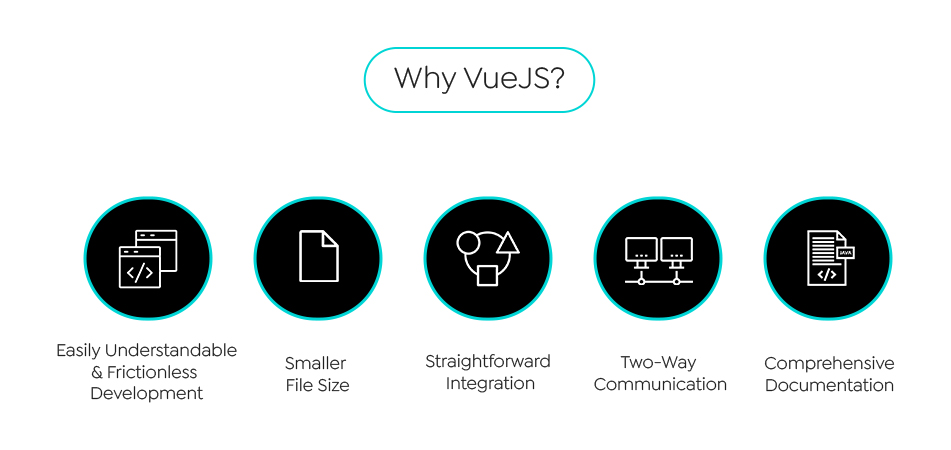
Take a look!
Vue.js incorporates large-scale templates and is easily understandable. Its entire structure is uncomplicated and enables easy detection of errors in blocks.
One of the top-notch advantages offered by Vue.js is its smaller file size, which comprises about 18KB to 20KB. It enables users to easily segregate the template-to-virtual-DOM compiler along with the run time.
A distinguishing factor between Vue.js and other frameworks is its ability to develop single-page apps and the contribution of components to existing applications.
Vue.js provides the benefit of two-way communication that speeds up the HTML block handling process. Additionally, it also keeps up with the one-way flow to enable working with various components.
If you’re looking for a segment where Vue.js excels over React.js, it is comprehensive documentation. If you’ve just started as a developer, basic knowledge of JavaScript and HTML is enough.
Vue’s virtual DOM and reactive system ensure efficient rendering and smooth user interactions, even in applications with frequent data updates.
Although Vue is often chosen for smaller projects and MVPs, it can also scale effectively with proper architecture and tooling, making it suitable for business web applications and internal systems.
Vue has an active global community that contributes plugins, tools, and continuous updates, ensuring long-term framework stability and improvement.
One of the primary differences between React and Vue is the development of the view layer. As mentioned above, Vue uses HTML templates by default; however, it can also be written in JSX.
On the other hand, React only uses JSX.
For a detailed comparison between the two, continue reading!
To measure the popularity and support of the two frameworks, Stack Overflow surveyed the developers and here’s their take on the same:
Upon asking developers about their preferred and non-preferred frameworks, both are equally supported and loved. Therefore, if a business is looking forward to developing a complex mobile app, roping in the best mobile app development company is a must for acquiring enhanced digital solutions.
React.js has a lot to offer, and the credit goes to its incredible community that enables the building of multi-page apps. But, notably, it cannot offer ready-made solutions, which is why it is essential to hire third-party libraries for the same.
On the other hand, Vue can instantly import its library and execute the framework to the existing applications. Moreover, it comes with ready-made scaffolding that enables starting a new project in a jiffy!
Not to forget mentioning that upon installation of project dependencies, they are implemented as plugins. Therefore, the dependency has to be updated even if the standards change.
Comparing the documentation of the two frameworks, React is much behind Vue, considering accessibility and structure. Moreover, React’s ecosystem has no overview; however, there’s an improved version of React documentation, available as a Public Beta currently.
On the other hand, Vue holds an active community and organized documentation, making it simpler to acquire solutions to issues.
Sure, an application can be developed using any of the two frameworks; however, what matters is the development speed and cost.
Talking about the speed of app development, it’s the same for both mechanisms but there are numerous additional frameworks, libraries, etc., that enable rapid app building. Therefore, it entirely depends on the development team’s coding skills and experience, considering which time can be estimated.
Similarly, the cost of app development ropes in the contribution of multiple factors, including the developer’s experience, location, and more.
In the cross-platform development field, React Native has won the battle, letting developers re-use 99% of codes. This further helps in creating companion apps for Android/iOS with a native look and performance. On the other hand, Vue fails to compete with RN, but its component-based architecture enables developers to write code that can easily be rendered on the web, iOS, and Android.
No doubt, React is considered to be lightweight, but Vue is even smaller than React.
Sure, there’s no business that wouldn’t be curious to know the popular use cases of the two popular frameworks. Therefore, if you are willing to know more about it, you’re in for a treat!
Understanding the practical use cases of React and Vue.js helps businesses choose the right JavaScript framework based on scalability, performance, and long-term product goals.
Both frameworks are widely used in modern web and mobile app development, but their strengths vary depending on project type and business requirements.
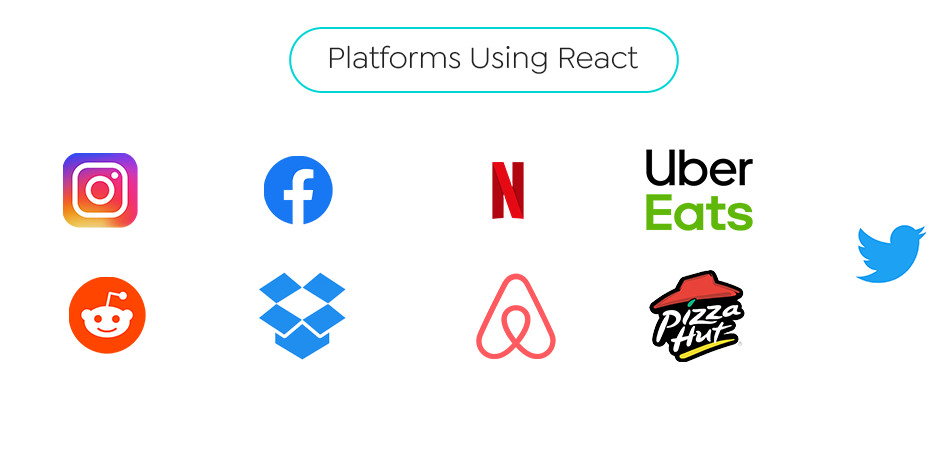
React is widely preferred for building large-scale, high-performance applications that require frequent UI updates and long-term scalability.
Best use cases of React include:

Vue.js is preferred for building lightweight, flexible, and quick-to-deploy applications, especially where development speed and simplicity matter.
Best use cases of Vue.js include:
| React is better suited for: | Vue.js is better suited for: |
| Large-scale enterprise applications | MVP and startup projects |
| Long-term scalable platforms | Rapid web application development |
| Mobile app development using React Native | Small to medium business applications |
| High-traffic applications | Interactive UI components |
| SaaS and eCommerce products | Internal dashboards and admin panels |
This practical distinction helps businesses decide the right framework based on product vision, budget, and development timeline.
No, we are not exhausted at all.
Vue and React are both exceptional tools for developing interactive interfaces. Therefore, choosing one demands emphasizing multiple factors, including use cases, your business needs and objectives, ecosystem, budget, an accurate app development team, and whatnot.
To make decision-making simpler for you, opt for ReactJS if you’re willing to build a large mobile application with a frictionless experience.
On the other hand, if you’re looking forward to building a simple mobile app with the finest documentation, VueJS is your shot!
Still unsure whether React or Vue fits your product?
Our experts at Techugo can evaluate your idea and suggest the right framework based on performance, budget, and future scalability.
Get in touch with our team of technocrats to make your development choice clear.
Yes, React is generally considered better suited for large-scale applications that require long-term scalability and complex architecture. Its component-based structure, vast ecosystem, and strong community support make it ideal for enterprise-level web applications and SaaS platforms.
React also integrates easily with advanced tools, state management libraries, and backend services, which is essential for handling high traffic and frequent UI updates. Vue can be used for large applications as well, but React offers more flexibility and proven scalability for complex business solutions.
Vue.js is generally easier to learn for beginners compared to React. Its syntax is closer to traditional HTML, CSS, and JavaScript, making it more approachable for developers with basic frontend knowledge.
React has a steeper learning curve due to concepts like JSX, hooks, and state management. However, once mastered, React provides greater control and extensibility for building advanced web and mobile applications.
Yes, Vue.js is still relevant in 2026 and continues to be actively maintained and adopted, especially for small to mid-scale projects and startup applications. With Vue 3 and its Composition API, the framework has improved performance, modularity, and developer experience.
React remains more dominant in enterprise adoption and mobile app development through React Native, but Vue continues to be a strong choice for lightweight applications, dashboards, and MVP development.
Startups can use either React or Vue, depending on their product roadmap and development priorities. Vue is often preferred for MVP development because of its simplicity, faster setup, and lower development time.
React is more suitable for startups that plan to scale quickly or expand into mobile app development later. Its ecosystem and reusability with React Native make it a good long-term investment for growing digital products.
React is better for mobile app development because it supports React Native, which allows developers to reuse a significant portion of code to build Android and iOS applications with near-native performance. This reduces development cost and time while ensuring consistent UI across platforms.
Vue does not have an equivalent mature mobile framework like React Native. Although Vue can be used with hybrid solutions, React remains the preferred choice for cross-platform mobile app development.

Every single day, healthcare companies submit millions of both insurance claims and accounts receivable (A/R) claims. However, when it comes to claims..


Millions of people open mobile apps every day without thinking about what it actually takes to make those apps work. They scroll, swipe, watch videos,..


Write Us
sales@techugo.comOr fill this form