

 SA
SA  KW
KW  IE
IE AU
AU UAE
UAE UK
UK USA
USA  CA
CA DE
DE  QA
QA ZA
ZA  BH
BH NL
NL  MU
MU FR
FR 
















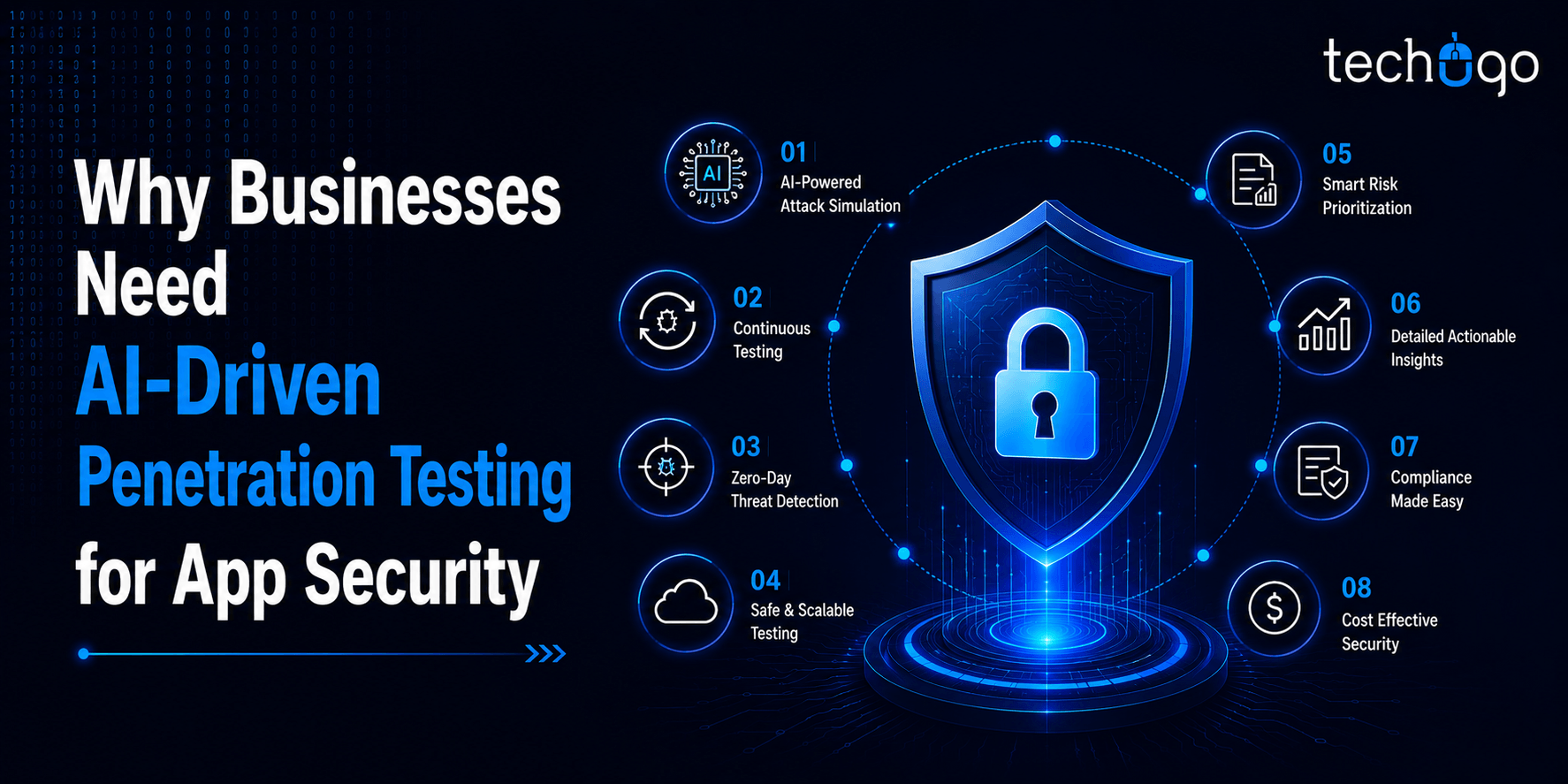


Do You Know – Your users’ systems can be hacked to make your business more secure.
That’s exactly what penetration testing is—a simulated cyberattack conducted by ethical experts to uncover hidden vulnerabilities in systems before real hackers can exploit them. Think of it as a security check that helps identify, fix, and strengthen weak points without causing any damage.
AI- Artificial Intelligence is nothing less than a blessing for businesses, services, and users. This tech-stack has transformed the simple process of business operations into an automated process. This has unfolded different layers of convenience to the service providers.
However, in this run of the constant tech revolution, AI has made a remarkable presence in one more sector, and that is Penetrative Testing.
The very concept of penetrative testing is quite different from the vulnerability scan.
In simpler words, a penetration test, colloquially known as a pen test, pentest or ethical hacking, is an authorized simulated cyberattack on a computer system. This test is performed to evaluate the security of the system of any business type.
Let’s dive into this post further to understand more about penetrative testing.
A quick word about Penetrative Testing
Well, first and foremost you must understand that penetrative testing is far different from vulnerability scanning. With a vulnerability scan, you are able to identify, rank, and report vulnerabilities only. However, with the penetrative testing, you can exploit vulnerabilities and remove the hurdles of security controls and features of a system.
In simpler words, it can be stated that penetrative testing is an authorized and proactive effort to assess the security of an IT infrastructure. It ensures to run multiple tests to bring out any possible security issues hidden within the operating system. It identifies carefully the misconfigurations, service errors, and unsafe end-user behaviors, to ensure that your business runs smoothly without facing any backlash of security glitch at any possible step.
Why Businesses Need Penetration Testing in 2026
As the environment of technology has evolved, the goal of professional or amateur hackers to steal information has also evolved. They can steal some important data just to make some money out of it or even to sabotage your company’s reputation. In this run, many businesses think that they have already integrated the security shield with firewalls and they regularly update their passwords. But not many of us know that is it not SUFFICIENT!
The high-skilled hackers can easily invade your security shield and get all the necessary information out of it. Henceforth, every business, organization, or corporation must consider getting their system security tested regularly and integrate penetrative testing to avoid the glitch of hacking.
Penetration testing stages
There are 5 stages that pen testing process consists of:
- Planning – This is the first stage, where the scope and goals of a test are defined. Further, requirement gathering is conducted to understand how a target works and its potential vulnerabilities.
- Scanning– In this stage, it is decided how the target application will respond to various intrusion attempts.
- Gaining Access– Here, different web application attacks are conducted to unleash the possible vulnerabilities. These threats are further studied by the testers to understand the damage they can cause.
- Maintaining access– With this stage testers, identify how far vulnerability can be used to achieve a persistent presence in the exploited system.
- Analysis– Lastly, the gained information is analyzed by security personnel to help configure a robust application security solution to protect against future attacks.
Penetration testing methods
- External testing– As the name suggests, this test targets the assets of a company that are visible on the internet.
- Internal testing– Within the internal test, a tester gets access to an application behind its firewall, and identifies the attack by a malicious insider.
- Blind testing– In this test, a tester is only given the name of the enterprise that’s being targeted.
- Double-blind testing– Here, tester has no prior knowledge of the simulated attack.
- Targeted testing– In this both the tester and security personnel work together and keep each other updated about their movements.
Benefits of Penetration Testing
- Detects and arranges security threats
- Monitors necessities and removes penalties
- Protects customer loyalty and company image
- Ensures to maintain the cost of security testing
How AI is affecting penetration testing?
- AI and ML have a lot to offer to penetration testers
Indeed, AI-powered penetration testing is the most effective method to test, which combines threat intelligence, vulnerability scanning, and machine expertise to validate the vulnerability.
With the integration of Artificial Intelligence trends, businesses can improve productivity and alleviate the success rate. Although, it is still in the nascent stage, but it has a lot more to offer.
As stated by Javier Avila- a cybersecurity analyst for AGS Alpama Global Services, “Standard penetration tests consist of seven phases. AI and ML can assist in vulnerability analysis and exploitation by extracting information from services running on target systems. You have to be careful about executing scripts that would affect the performance of the systems or the integrity of the data or that would render an application unavailable. Even in other phases of the standard penetration test, AI and ML can help generate metrics, discover network infrastructure, and report the results according to the steps applied.”
Security testing at its best!
The testing tools cannot guarantee the scope of security testing for your project. But with the AI-based penetration testing, it becomes a highly reliable and affordable option for security. It triggers the faster report generation where human error is minimized to a larger extent.
Enhances testing speed to another level
A testing strategy consists of various automatic scanning tools, which can get hiccups in performing their tasks. Also, the testing tools are fast, but here can be chances of generating a high false-positive rate, which can be inefficient and inconvenient. But this is where AI-enabled penetrative testing comes into the picture and helps the testing process to run efficiently. It helps in identifying the genuine vulnerabilities in the real environment.
Tools and Technologies Used in Penetration Testing Today
Penetration testing today is not just about manual effort or ethical hackers trying to “break in” like before. It is now a smart mix of tools, automation, and advanced technologies that help identify security gaps faster and with better accuracy.
Automated vulnerability scanning tools
These tools quickly scan systems, apps, and networks to detect common security flaws. From outdated software to misconfigurations, they help highlight issues that could be easily exploited.
Network analysis tools
These are used to understand how data flows within a system. They help security testers spot unusual activity, weak points in communication, and potential entry paths for attackers.
Web application testing tools
These tools are focused on websites and applications. They help detect issues like broken authentication, SQL injection, and cross-site scripting that can directly impact user data and security.
Exploitation tools
These are used to simulate real attack scenarios in a controlled way. They help understand how a vulnerability can actually be used and what level of damage it could cause.
Password and authentication testing tools
These tools check how strong login systems are by testing passwords and access controls. They help identify weak credentials and insecure authentication methods.
AI-based security tools
In 2026, AI is playing a major role in penetration testing. These tools help predict threats, reduce false alerts, and improve testing speed by learning from previous attack patterns.
Cloud security testing tools
With most businesses moving to the cloud, these tools help check cloud setups for misconfigurations, data exposure risks, and access control issues.
All these tools together make penetration testing more effective, helping businesses detect risks early and stay one step ahead of modern cyber threats.
Difference Between Penetration Testing and Vulnerability Scanning
| Aspect | Penetration Testing | Vulnerability Scanning |
| Purpose | Simulates real cyberattacks to actively exploit security weaknesses | Identifies and lists known security vulnerabilities in a system |
| Approach | Manual and strategic, often performed by ethical hackers | Automated scanning using security tools |
| Depth of Analysis | Deep analysis of how far a vulnerability can be exploited | Surface-level detection of potential issues |
| Risk Simulation | Mimics real-world attack scenarios | Does not simulate actual attacks |
| Output | Detailed report showing exploit paths, impact, and risk level | Report listing vulnerabilities with severity ratings |
| Human Involvement | High involvement of cybersecurity experts | Mostly tool-driven with minimal human input |
| Frequency | Usually done periodically or before major releases | Can be done frequently or continuously |
| Goal | To test real security strength of systems | To detect known security gaps quickly |
| Cost & Time | More time-consuming and expensive | Faster and more cost-effective |
| Best Use Case | Critical systems, high-security environments, compliance testing | Regular security monitoring and baseline checks |
Final thoughts
We all would agree on one point that data breaches are costly and bring down your reputation in the market. Hence, every business needs to invest in enhanced security practices that would be more than the regular testing process.
Here, the AI-enabled penetrative testing really changes the game and brings an environment into existence, that is safer and stronger from any security vulnerabilities. So let’s take a pro-active approach to evade the formidable malicious attacks on your business operations with ever-flourishing Artificial Intelligence trends.
Partner with Techugo to turn possibilities into performance and build solutions that truly lead the future.
FAQ
1. How is penetration testing different from normal app testing?
Normal testing focuses on app performance and bugs, while penetration testing focuses on security risks. It checks how easily a hacker could break into your app or misuse its features.
2. Will penetration testing affect my live app or users?
No. It is done in a controlled and safe environment. Ethical hackers simulate attacks without causing any real harm to your app or user data.
2. How does penetration testing help improve user trust?
When users know their data is protected, they are more likely to trust your app. Strong security directly improves brand credibility and customer retention.
3. Can penetration testing prevent data breaches completely?
It cannot guarantee 100% prevention, but it significantly reduces risks by identifying and fixing vulnerabilities before attackers can use them.
4. How often should I test my mobile app security?
It depends on your app updates and complexity, but most businesses conduct penetration testing at least once or twice a year, or after major changes.
5. Is penetration testing expensive for startups?
It depends on scope, but it is far cheaper than dealing with a data breach. Many startups consider it a necessary investment in long-term security.

Get in touch
We'd love to hear from you.