

 SA
SA  KW
KW  IE
IE AU
AU UAE
UAE UK
UK USA
USA  CA
CA DE
DE  QA
QA ZA
ZA  BH
BH NL
NL  MU
MU FR
FR 















📌 Key Takeaways
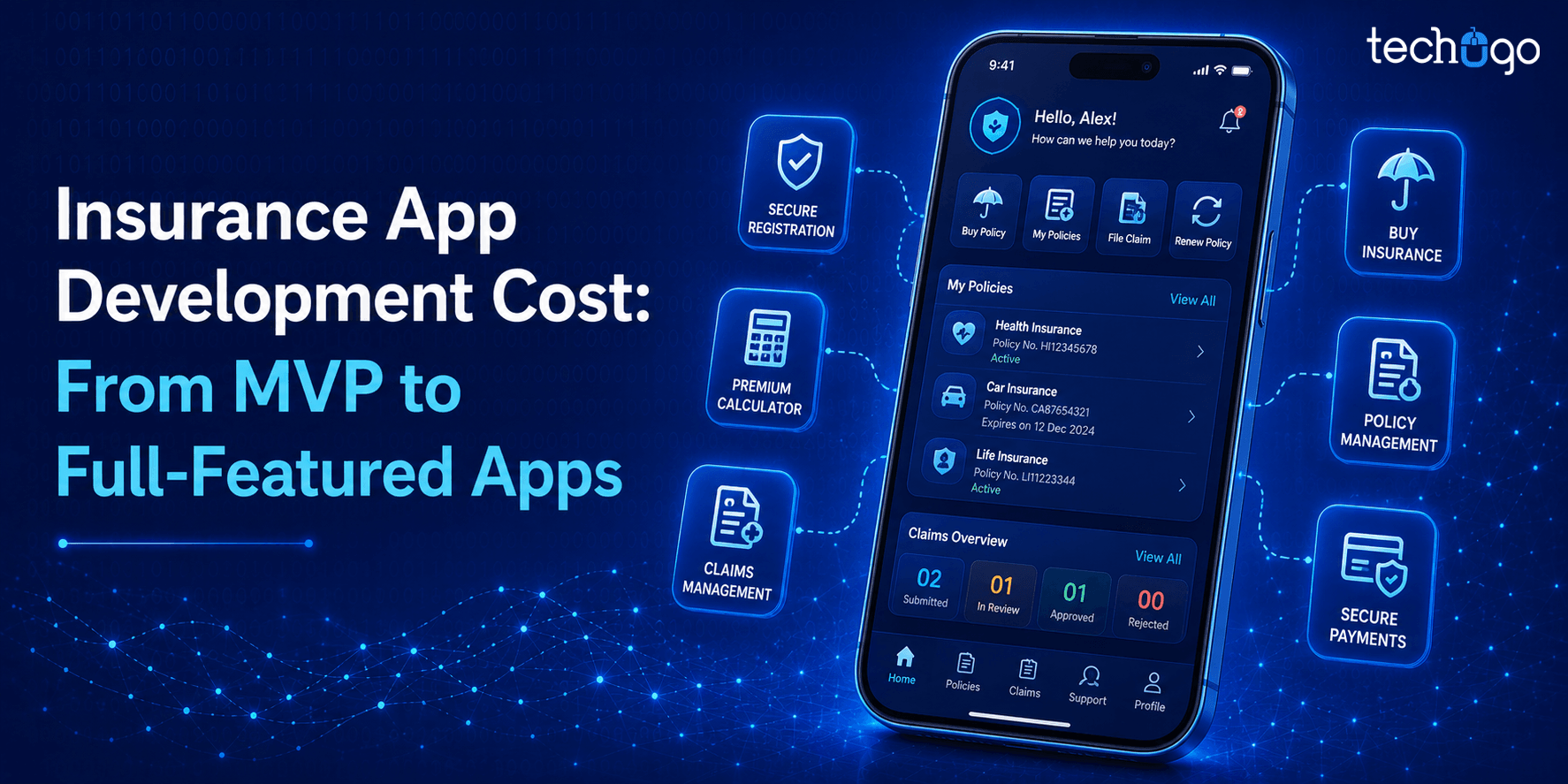
- Insurance app development costs range from $30K to $400K based on app complexity and features.
- MVP apps cost less, while AI-powered insurance apps require higher investment.
- Mobile insurance apps improve claims processing, customer experience, and operational efficiency.
- Their key features include policy management, instant claims, AI support, and secure payments.
- AI, automation, analytics, and telematics are becoming major differentiators in modern insurance apps.
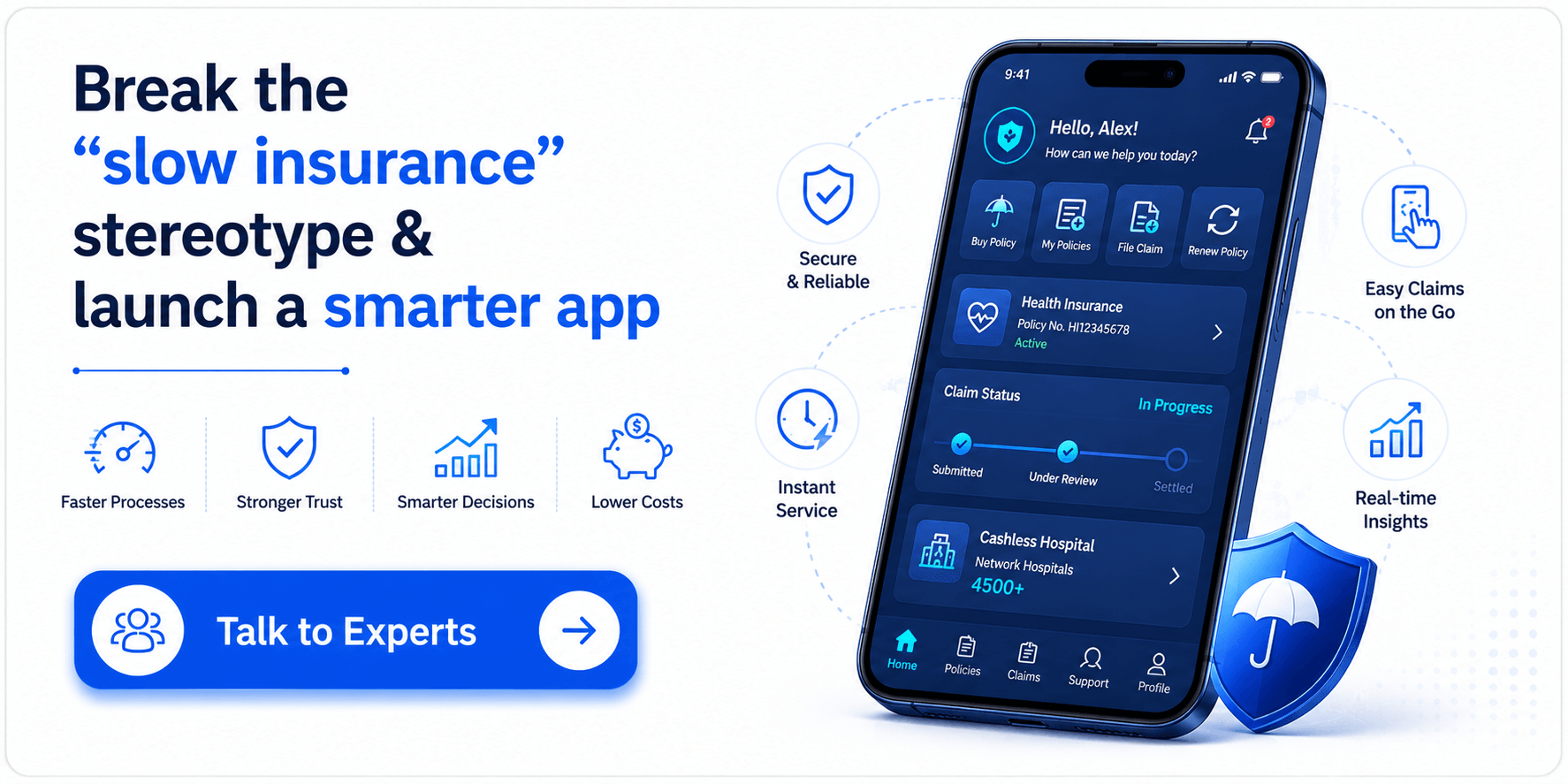
Companies losing time and money on slow insurance processes are switching to mobile solutions in 2026. Of course, it’s fast, but there are plenty more reasons.
Insurance apps let your clients manage policies, submit claims, and get updates instantly, reducing operational overhead and improving customer satisfaction.
But how much does it cost to keep up?
In the USA market, the insurance app development cost can start from $30,000–$400,000. But this is for a basic app with core features like policy management and claims tracking. More advanced apps with AI-powered claim automation, chatbots, or analytics dashboards can easily exceed $400,000. Understanding how to build an insurance app isn’t just about technology; it’s about creating a tool that users trust, engage with, and rely on daily.
This car insurance app development guide breaks down everything you need to know. We will break down what goes into an insurance app, the costs involved, the development process, and the tech stack to build one that stands out in a crowded market.
Let’s take a closer look.
Why are modern insurers investing in mobile solutions?
A slow process is expensive. And this is what insurance companies deal with daily.
Urgent insurers are resorting to mobile solutions due to the fact that clients want to be able to be fast, transparent, and convenient. Mobile applications allow consumers to review policies, file claims, and get up-to-date information in real-time, minimizing frustration and irritation. In addition to enhancing customer experience, apps reduce paperwork, reduce error and simplify workflow.
As an illustration, it used to take days or weeks to process claims that are currently processed within hours, and the remaining staff is now able to concentrate on more valuable activities. The result? Satisfied customers, quicker turnaround, and quantifiable increase in business productivity.
But the advantages are not limited to the inside. Insurance applications enable businesses to obtain actionable insights based on analytics and reporting. AI-powered push notifications, in-app changes, and automatic reminders enhance customer engagement and retention, and the data provided by app use can assist insurers in comprehending trends and client needs like never before.
Mobile solution investment also makes companies a progressive and competitive provider of services in a digital-first environment, appealing to technologically-oriented clients and partners. Simply put, mobile applications are not a luxury – they are a driving force that will contribute to growth, efficiency, and customer satisfaction at the same time.
Must-have features that make automotive insurance app development worth it
Insurance used to mean long calls, piles of paperwork, and endless waiting.
That’s why modern companies are investing in features of automotive insurance apps that put control in the hands of clients and speed up processes for businesses.
Here are the features every car insurance app should have:
1. Policy management
Nobody desires to make a call to support to inquire about a policy. Powerful policy management option provides users with full control – they can see coverage, download documents, update personal information, as well as renew policies at any time. This reduces its dependency on manual assistance, reduces the amount of work in the operations, and ensures the customers are always in the know of their coverage. With insurers, it will decrease the number of repeated questions and simplify the work process.
2. Instant claims submission
The greatest aggravation with insurance? Slow claims. That can be addressed with instant submission of claims, since with the help of the app, you can take a photo, fill in the details of the incident, and send it all within minutes. This eliminates paperwork, reduces the number of trips in and out, and hastens the entire process. It makes it easier and quicker with a direct impact on customer satisfaction. To insurers, it increases accuracy, claim cycles, and boosts the ease and speed of the process.
3. Real-time notifications
Not knowing what to do with a claim is an unnecessary stressor. Live updates ensure that the user is notified at every phase, like confirmation of submissions, status updates, approvals or renewal notifications. Customers develop trust and are retained under such transparency. At the same time, it reduces the inbound support requests, which enables the teams to focus on other more significant activities than answering status queries.
4. AI-powered assistance
Clients will not be happy to wait on the phone to respond to simple questions. AI-based chatbots and assistants are able to give real-time assistance and support in claims, and respond to questions that are often asked 24/7. This increases the responsiveness and consistency in communication. Being an insurer, it significantly reduces the workload on the customer service and yet offers a hassle-free experience to customers.
5. Driving insights & telematics
Not all drivers need to pay the same amount of premium. With telematics, the insurers can track driving (speed, braking, distance) and use the data to offer customized pricing. This will enhance safer driving and help companies to make a better determination of risk. It is also beneficial in the long-run as it provides useful information that can be used to improve the underwriting practices and products.
6. Secure document uploads
It takes a lot of time to seek the documents through email or hard copy. The in-app uploads are safe, and one can upload IDs, photos, and claim-related documents instantly. This speeds up the verification process, reduces the number of human errors, and ensures compliance with data security requirements. It also simplifies the process significantly with the opportunity to store everything in one place.
7. In-app payments
The cumbersome payment systems lead to drop-offs and delays. In-app payment will be integrated so that the user can conveniently pay premiums, renew policies, and conduct transactions with ease and in a few minutes. This improves customer ease and effective payments to the insurers. It also makes the whole journey a lot easier, which makes the app more reliable and functional.
8. Emergency & roadside assistance
When an accident or a breakdown happens, the users need a helping hand, rather than instructions. Roadside and emergency assistance is one-tap access to help, whether it be towing, repairs, or immediate advice. This gives it an actual, physical value to the app and creates trust in the crisis, which strengthens the relations with customers in the long-term.
The insurance app development process explained (Step by step)
The development of the insurance app will appear easy until you start working on it.
The user expectations, complicated workflow, and security requirements can become
complex quickly. This is why it is important to have a clear insurance app development process. It can save you the money of making expensive mistakes, keep you on track, and create something that users really want to use, not just use once.
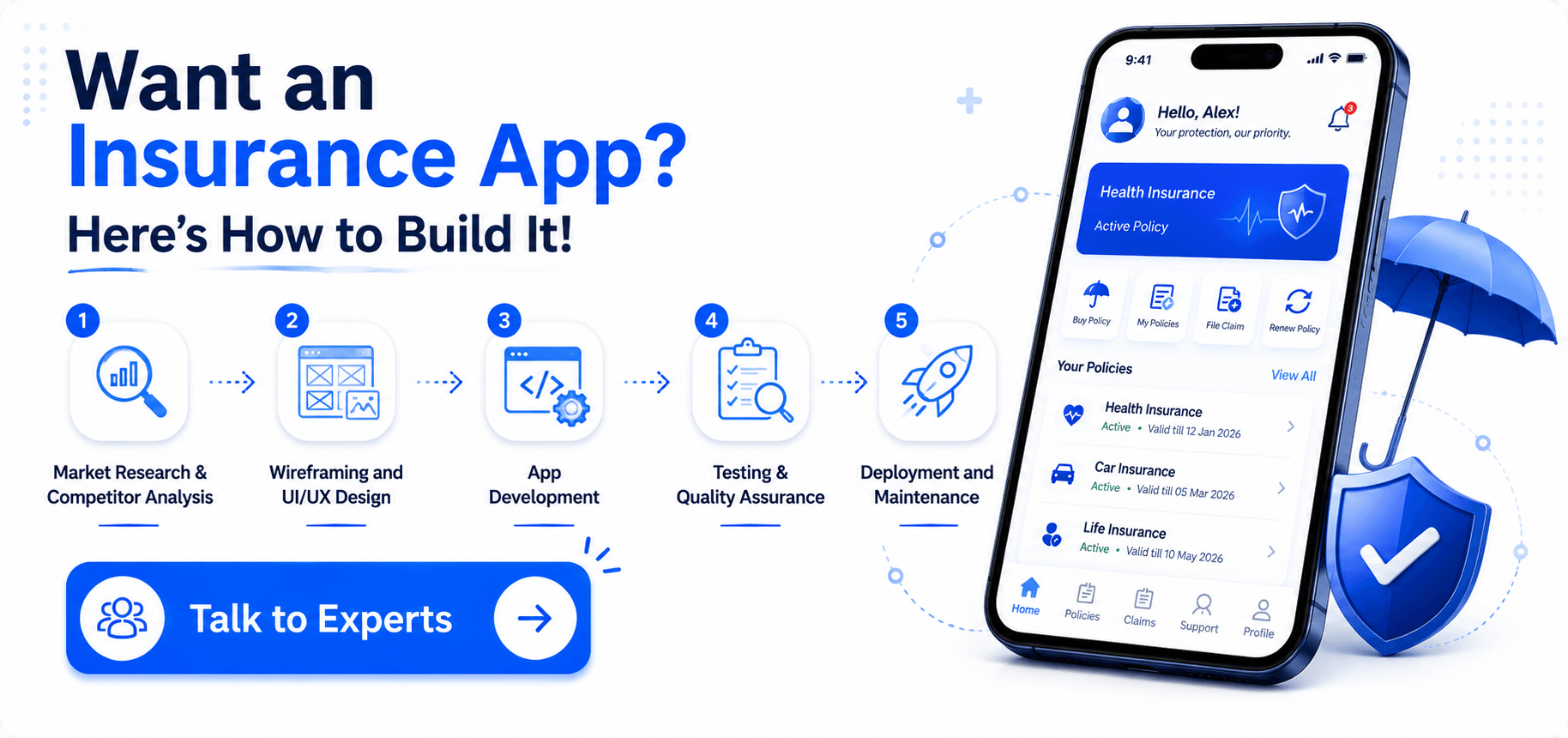
Step 1. Market research & competitor analysis
Any successful application begins with the knowledge of the market. Get to know your intended audience before you write a single line of code: what they need, what annoys them, and how they already use insurance services.
Look at competitors as well. Research top insurance applications to determine their strengths and weaknesses. This will assist you in identifying gaps in the market and formulating characteristics that can make your app have a competitive advantage. It is also at this point that you will determine what purpose your app will be dedicated to: claims, policy management, or a full-service insurance solution.
Step 2. Wireframing and UI/UX design
After defining the strategy, the next thing to do is to transform ideas into structure. Wireframing assists in the mapping of the layout, user flow, and important screens of the app prior to actual development. It is the outline of your application.
User experience is formed in the field of UI/UX design. An easy-to-use, clear interface will make the app easy to navigate without problems. Simplicity in insurance apps is paramount, and users must be non-frictionate and free to file claims, check policies, or make payments. A good design at the beginning saves drops and makes long-term engagement.
Step 3. App development
It is at this point where actual build starts. Based on your requirements, developers choose the right tech stack and start coding the app’s frontend and backend. The implementation of key integrations (such as payment gateways, APIs, and security systems) also takes place at this stage.
When the development stage is robust, the app will be scalable, perform well, and be secure: attributes that cannot be compromised under insurance apps that process sensitive user information.
Step 4. Testing & quality assurance
Any app must not be released without testing. All features should be tested in terms of performance, security, and usability. User trust can be severely affected by bugs, crashes, or slow load times.
Exhaustive testing will make the app run well on devices and in various situations. It also assists in early detection of problems, which saves on time and expense in the long term.
Step 5. Deployment and maintenance
After all tests have been done, the application is now ready to be rolled out on applications such as the App Store or Google Play. Deployment is not the game-changer.
Regular updates, bug fixes, and performance improvements are essential to keep the app relevant. Monitoring user feedback and usage patterns helps refine features and improve the overall experience over time.
What it costs to build an insurance app
Building an insurance app isn’t expensive; building the wrong one is.
The real challenge isn’t just budgeting, it’s understanding where your money goes. The insurance app development cost can range anywhere from $30,000 to $400,000, depending on the features, platform, and complexity of your app. Working with a mobile app development company in USA may involve a higher initial investment, but it typically delivers better quality, scalability, and long-term value.
Here’s how the costs typically break down:
Cost breakdown at a glance
| Component | Estimated Cost Range |
| Basic MVP App | $30,000 – $60,000 |
| Mid-Level App | $60,000 – $150,000 |
| Advanced / Enterprise App | $150,000 – $400,000+ |
| Single Platform (iOS/Android) | $25,000 – $100,000 |
| Cross-Platform App | $40,000 – $150,000+ |
| Maintenance (Annual) | 15–20% of the total cost |
MVP vs full-featured app
The largest cost driver is the scope of your app. An MVP involves the fundamental functionality, such as policy management, claims submission, and user authentication. This is best to test your idea and is generally between $30,000-$60,000.
A mid-level application will have other capabilities such as real-time notifications and in-app payments, and simple integrations, priced between $60,000 and $150,000.
To companies that are scale-focused, an advanced or enterprise-level app is provided with AI-based claims processing, analytics dashboard, third-party integrations, and increased security controls. The cost of these apps can be between $150,000 and $400,000 or more, depending on complexity and customization.
iOS vs Android development cost
The overall cost of developing the insurance apps is also influenced by platform choice. Single-platform (iOS or Android) building will allow the initial investment to be lower and develop faster.
Nevertheless, when both platforms are targeted, it becomes more costly because development and testing have to be done separately. To strike a chord between the cost and reach, many businesses opt to use cross-platform solutions, particularly when venturing into competitive markets.
Additional costs (Maintenance & updates)
Only a part of the total investment is the initial one. Maintaining it is normally 15-20% of the initial development cost per annum.
This includes bug fixes, performance optimization, security updates, and adapting the app to new OS versions. It is critical to update your app regularly to make it competitive and in tandem with the expectations of the users.
Tech stack for insurance apps: Frontend to backend
The appropriate tech stack is what is going to make or break your insurance app. It has a direct effect on performance, scalability, security, and maintenance in the long run. The goal is not to pick the “latest” tech; it is to select what fits your app’s complexity and growth plans.
A typical insurance app relies on multiple layers working together seamlessly:
User (Mobile App)
↓
Frontend (React Native / Flutter / Swift / Kotlin)
↓
Backend (Node.js / Django / Ruby on Rails)
↓
Database (PostgreSQL / MongoDB / MySQL)
↓
Cloud (AWS / Google Cloud / Azure)
↓
Integrations (Payments / APIs / Telematics / Analytics)
↓
Security (Auth / Encryption / Compliance)
React Native or Flutter, among other technologies on the frontend, provide a responsive user experience across platforms. The backend manages business logic, data processing, and user authentication and policies, and user information is safely stored in databases.
Cloud services are scalable and performant, and functionalities are added via integrations such as payment gateways or analytics. To top it all, a robust security layer will guarantee the protection and compliance of data, which is vital to any insurance application.
How Techugo can help you build a successful insurance app
Looking for a mobile app development company for your insurance app? Let Techugo guide you.
At Techugo, we start by understanding your business, your users, and what you actually need to build, so you’re not just investing in features, but in something that works.
Our team handles everything end to end. From research and UI/UX design to development, testing, and launch. We focus on creating smooth user journeys, secure integrations, and scalable systems that perform reliably as your app grows.
What makes us different is how we approach development. We don’t overcomplicate things. Instead, we combine strong design thinking with modern technologies to build apps that are intuitive, fast, and built for real users, while adding advanced features like analytics or automation where they actually make an impact. At the end of the day, we’re not just helping you launch an app, we are helping you build a product your users trust and your business can scale with.
So, thinking big for your insurance business? Techugo’s got you covered, reach out today!
FAQs
1. What is the insurance app development cost?
Ans) The cost basically depends on the features, platform type, integrations, and complexity, the insurance app development cost may be 30,000 to 400,000.
2. What is the time taken to develop an insurance app?
Ans) The average development time of an insurance app is 3 to 9 months, depending on your project: MVP or full-fledged.
3. What are the features of an insurance app?
Ans) Key features include policy management, instant claims submission, real-time notifications, secure document uploads, in-app payments, and customer support. State-of-the-art applications can also incorporate AI and intelligence.
4. How do I choose the right tech stack for insurance apps?
Ans) Insurance apps’ tech stack must be scalable, secure, and also based on the complexity of your app. Popular options are React Native or Flutter on the frontend, Node.js or Django on the backend, and cloud services such as AWS or Azure.

Get in touch
We'd love to hear from you.