

 SA
SA  KW
KW  IE
IE AU
AU UAE
UAE UK
UK USA
USA  CA
CA DE
DE  QA
QA ZA
ZA  BH
BH NL
NL  MU
MU FR
FR 






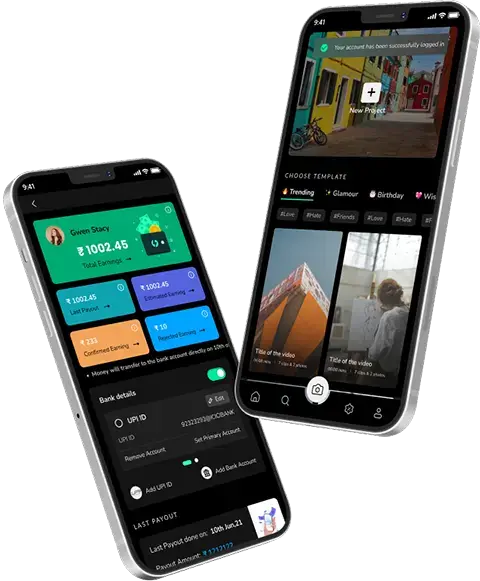



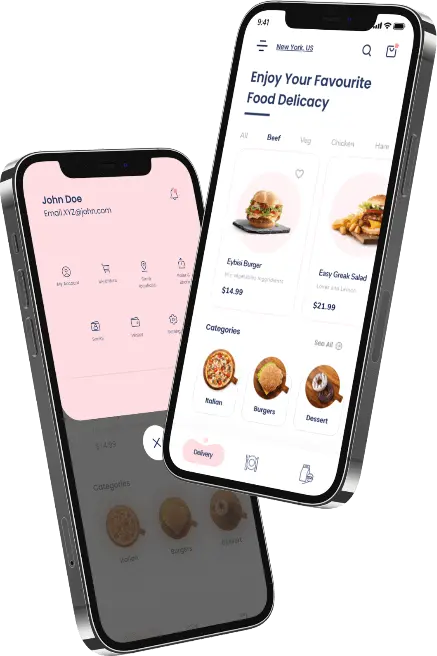

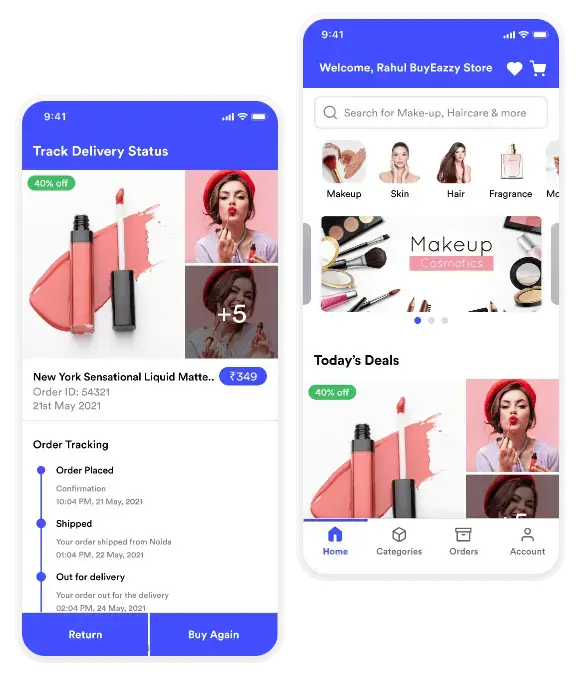




Much before we proceed further, we must know that mobile app usage and user engagement are largely based upon habit formation, which has got nothing to do with goals. The power of cue-based habits could be physical, natural, social, technological, or any other.
Have you wondered why certain apps are liked by us, and others are not?
When you decide to build a mobile app, you have high hopes and dreams of driving millions of downloads, improving user retention, and getting featured as one of the most promising apps. But eventually, to beat the standing of millions of other apps requires something extra and additional, which is much beyond mobile app design and UX design.
So here we are to help you add the flavor of UNIQUENESS within your app, and that is the habit-driven Hook Model for mobile apps.
Yeah, you heard me right, the science and psychology behind crafting an app that grabs everyone’s attention has a lot more to do with this mobile app engagement strategy.
Curious what this is all about???
Let’s read this post to glean insights about this Hook Model in mobile app development.
What Is the Habit-Driven Hook Model?
Let’s accept the fact that we all are driven by a certain level of FOMO when it comes to decision-making and often proceed with solutions that can build or break the image of our business. A mobile app is a strong digital identity for any business and gives it an edge over competitors in today’s digital marketplace. But for an app to truly succeed, it needs strong user engagement and retention elements that can consistently hook users and bring them back.
The Habit-Driven Hook Model in mobile apps explains how successful apps are designed around behavioral psychology to build user habits. It focuses on creating a loop of engagement where users are naturally encouraged to return, interact, and stay active within the app ecosystem.
Instead of relying only on features or design, this model helps businesses understand how habit-forming mobile apps are built through psychology-driven experiences that improve long-term usage.
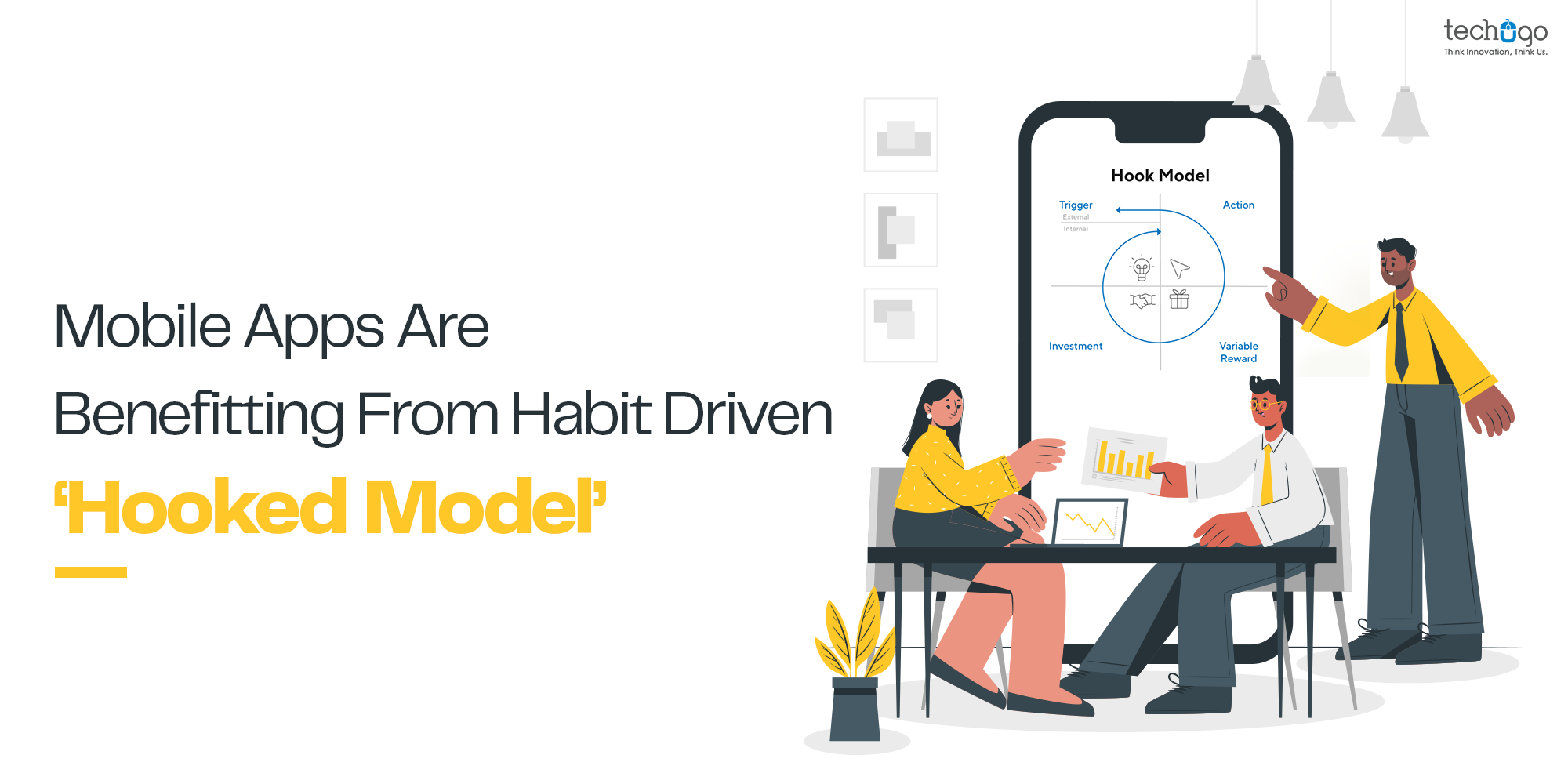
The Hook Model Cycle: How It Works
- Trigger
- Action
- Reward
- Investment
Trigger
To make your app an irresistible piece, you need to take note of Trigger in the Hook Model for mobile apps.
Yes, Trigger is a required factor to make users go drool over your app and improve mobile app engagement and user retention. However, there are two types of triggers: External and Internal. Below we have brought you the detailed information. Please keep scrolling further…
External Trigger
As the name suggests, these triggers are totally based on outside inputs. This type of information can be a notification, ad image, rating or review, emails, theme, color, recommendation, or app button among many others. These elements work on your users’ psychology and encourage them to utilize different mobile app features and functionality and drive user engagement in mobile apps.
Internal Trigger
TBH, these triggers are the core factor in habit-forming mobile app design and decide the real reason behind building a mobile app. For instance, an app like Instagram is not just a social media platform, but its feeds are a great resource to beat boredom or loneliness.
These triggers are two sides of the same coin and work together to increase user engagement and retention in mobile apps, keeping users hooked and consistently active in a mobile app engagement strategy.
Action
Hmm, you cannot give a miss to the next step to make the most out of this model, and that is Action.
Once you have created the trigger in and around your mobile app, the next thing that comes is to take the intended action.
Action depends on motivation and ability. It motivates a user to take any action that complements their ability. Let us cite an example to understand it clearly:
Being a user you start a collaboration app to perform a certain activity, but due to a low internet connection, the app fails to load or takes longer than usual to show the data. This situation depicts that motivation to use the app is high, but the ability to make it work is low. You can understand it with an opposite scenario as well, where you want to share a snap with your friend and in a jiffy of a moment it is sent and shared with your loved ones. This is the case of high motivation and high ability to perform it.
Once you have understood the fusion of motivation and ability, the next step you need to do is to ensure that the app holds maximum hooks to keep the user connected. You can utilize creativity to be a part of your app and bridge the gap between motivation and ability with some micro-interactions. For instance, when users find it difficult to achieve the task due to poor network or any other issue, give them sufficient reasons to stay hooked. Snapchat is a good example when users face friction while sharing snaps, it offers filters and creative tools to keep them engaged.
Reward; don’t mess with it
Rewarding users after completing any action is a simple way to inform them that you appreciate them and give them their deserving attention. A simple like or an emoji received on your social post encourages you to do better in the future, and this is one of the simplest forms of rewarding your users in habit-forming mobile apps. You can reward users in multiple ways, such as:
- Giving them a cashback voucher
- Sharing their memories feed
- Serving them with more engaging content based on their last search
Investment; a result of engagement
Do you know what users prefer to do when they are hooked to your app? They start investing in it. They invest their time, data, and sometimes money into using your app, which helps improve user engagement, retention, and long-term app loyalty, while helping you achieve supreme customer satisfaction.
Instagram – A Quick Synopsis of the Case Study
Instagram, an internet-based photo-sharing app for web and mobile, is one of the most popular social media apps. It was founded in October 2010, and within 10 years, it reached 1 billion+ total monthly active users. This clearly reflects how powerful habit-forming mobile apps can become when built on the right engagement system.
But above all, do you know why this app could go viral?
Yes, the credit falls into the lap of the Hook Model.
Hook Model for Instagram
Internal Triggers
It serves as a platform for users to capture their moments, express emotions, and share them with friends and followers. It also helps users deal with boredom, loneliness, and the need for social validation.
External Triggers
Facebook and Twitter cross-posting, notifications, and social sharing act as external triggers that bring users back to Instagram.
Action
Instagram allows users to tap and upload a photo or video with minimal friction, supporting smooth user engagement in mobile apps.
Reward
Instagram provides instant social feedback through likes, comments, and shares, which creates a strong feedback loop and improves mobile app engagement.
Investment
It not only allows individuals to capture moments and create memories but also enables businesses to promote and sell services. Today, millions of businesses actively use Instagram as a growth platform, strengthening long-term user retention and app dependency.
Other Popular Apps Using the Hook Model
While Instagram is one of the strongest examples, several other habit-forming mobile apps also successfully use the Hook Model to drive engagement:
- Uses notifications, friend activity, and content feeds as triggers
- Action is simple scrolling, liking, and sharing
- Rewards come through social validation and engagement
- Investment increases as users build profiles, networks, and content history
TikTok
- Strong internal trigger: boredom and entertainment seeking
- External triggers: push notifications and viral content
- Action: effortless infinite scrolling
- Reward: unpredictable, high-engagement video feed (dopamine loop)
- Investment: likes, follows, and content creation
Spotify
- Internal trigger: mood, activity, and emotional state
- External trigger: curated playlists and recommendations
- Action: one-tap listening experience
- Reward: personalized music discovery and playlists
- Investment: saved songs, playlists, and listening history
Ankit Singh, COO at Techugo says –
“All these apps succeed because they don’t just offer features but they also create habit loops that are driven by the Hook Model in mobile app development, which helps improve long-term user engagement and retention in mobile apps.”
How Businesses Can Apply the Hook Model in Mobile Apps
The Hook Model is not just a theory used by big platforms, and it is also not something limited to social media apps, because it is a practical framework that businesses can use so that they can build habit-forming mobile apps and therefore improve user engagement and retention in mobile apps.
When you are building a mobile app, the way you design the user journey matters a lot, and the Hook Model helps you structure that journey in a way that users keep coming back.
1) Design onboarding as a strong trigger system
The onboarding process is the first interaction, and it is important because it works as an external trigger in mobile app engagement strategy. You can design onboarding so that it:
- Shows the app value clearly and quickly
- Helps users understand what they should do next
- Removes confusion and unnecessary steps so that users do not drop off
Therefore, a strong onboarding flow has been used by many social media app development companies to improve first-time user experience.
2) Simplify user actions for better engagement
Action is what users do inside your app, and it depends on how simple or difficult it is for them. If the app is easy to use, then users are more likely to stay, but if it is complex, then they leave quickly.
So you should reduce steps and friction and improve UX and mobile app usability. You should also make interactions fast and smooth. This directly improves mobile app engagement and user retention, because users are able to complete actions without effort.
3) Build reward systems that keep users engaged
Reward is the part that keeps users emotionally connected, and it is important in habit-forming mobile app design. You can build rewards such as:
- Personalized recommendations
- Likes, comments, and instant feedback
- Gamification elements like points and badges
Because of these rewards, users feel valued, and therefore they come back again and again.
4) Encourage user investment in the app
Investment means what users put into the app, and it can be time, data, or even content. When users invest more, it becomes harder for them to leave the app, and therefore retention increases. You can encourage investment by:
- Saving user preferences and activity history
- Allowing profile customization and content creation
- Building features where users contribute data over time
This is a key part of mobile app retention strategies and mobile app engagement strategy.
5) Align UX with behavioral psychology
The Hook Model works best when UX design and behavioral psychology are combined together, because users behave based on emotion and habit. Therefore, when you design your app, you should consider:
- Emotional triggers like curiosity and boredom
- Smooth UX flows that reduce friction
- Psychological patterns that support repeat usage
This is how modern habit-forming mobile apps are built in real-world mobile app development services.
The Hook Model in mobile apps helps businesses move beyond just downloads, and it helps them focus on long-term user engagement, retention, and mobile app growth strategy, so that users do not just install the app but actually keep using it over time.
Conclusion
The Hook Model is one of the most engaging and worth practicing strategies. It works closely on human psychology and helps in crafting a mobile app that keeps users engaged and coming back.
If you are really looking forward to creating an app that leaves a strong impression on your target audience, then you must get in touch with Techugo that offers customized mobile app development services.
We are quite proficient in building apps that become a HABIT for your users.
Give us a call and secure your FREE 30-minute app consultation today!

Get in touch
We'd love to hear from you.