

 SA
SA  KW
KW  IE
IE AU
AU UAE
UAE UK
UK USA
USA  CA
CA DE
DE  QA
QA ZA
ZA  BH
BH NL
NL  MU
MU FR
FR 














📌 Key Takeaways
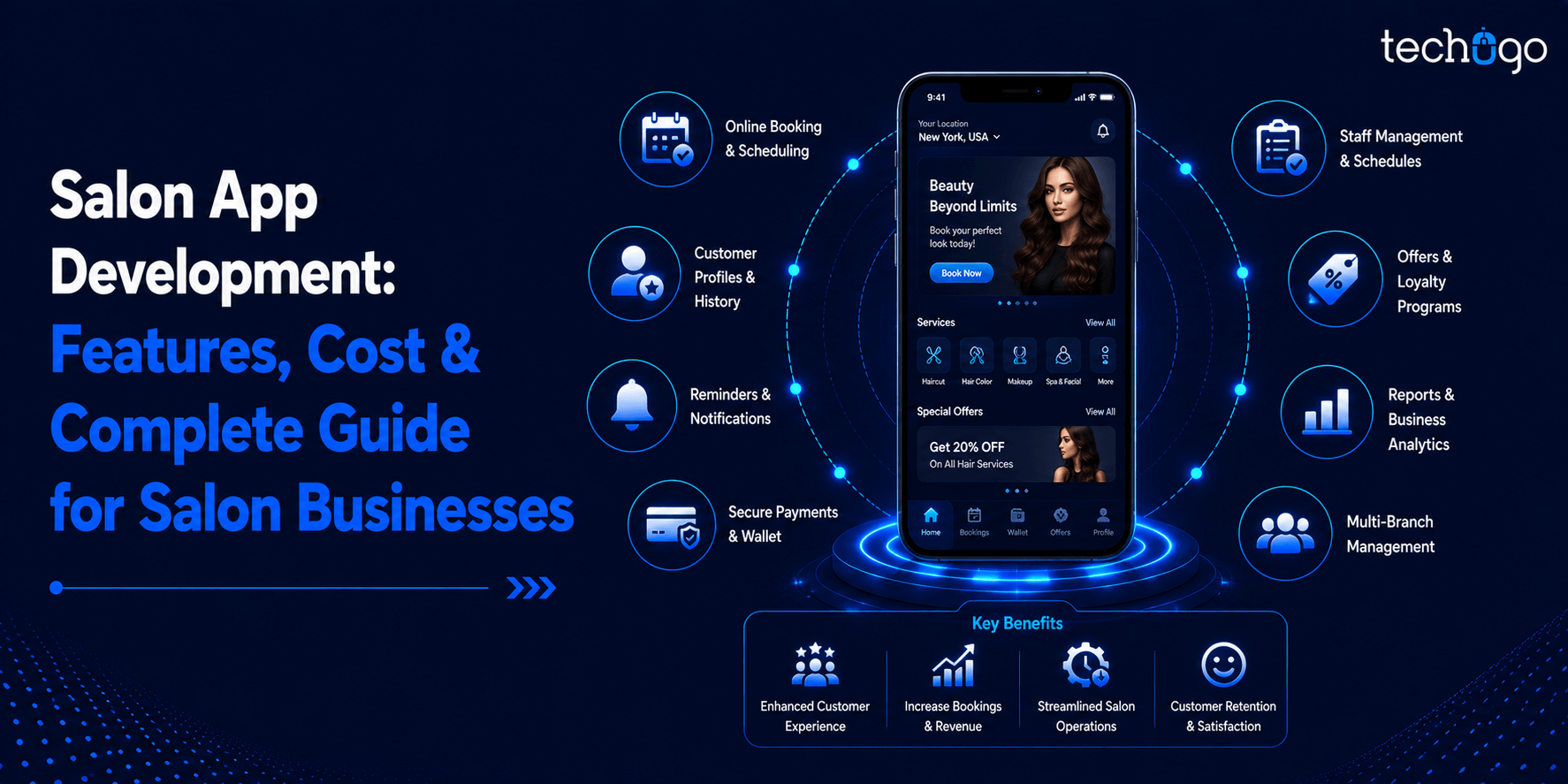
- Salon apps help businesses improve customer engagement and bookings.
- Online appointment scheduling makes salon management easier.
- Features like payments and notifications enhance user experience.
- Mobile apps help salons increase customer retention and loyalty.
- Digital transformation helps salon businesses grow and scale faster.
The salon sector has been growing steadily. In 2025, the global professional beauty services market was valued at $233.56 billion, now it is expected to reach $432.62 billion by 2034 (Source: Fortune Business Insights).
So, what does this mean for you? It means a mobile app development for salon business is no longer just an option, but something you need to stay visible and relevant.
A salon booking app keeps your services accessible, every time a user picks up their phone, and that small shift actually drives bookings. Also, the industry is moving towards digital and on-demand services (Grand View Research), so businesses that adapt are the ones that grow.
If you are looking to increase bookings, and build better customer loyalty, then investing in on-demand salon app development can be a practical step.
In this post, we have covered the key salon app features and the salon app development cost, so that you can understand what it really takes to get started.
Why salon businesses are investing in mobile apps in 2026
Salon businesses are investing in mobile apps because customer behavior has clearly shifted, and it’s not slowing down. Today, around 72% of clients prefer online booking, and 55% book directly through mobile devices, so if your salon is not available digitally… you are already missing demand.
Nearly 75%+ users now book salon services via apps regularly, and these users generate up to 60% more repeat bookings. So yes, apps are not just bringing customers in, they are bringing them back.
The industry itself is also moving fast. Over 78% of salons globally have already adopted online booking systems, and mobile bookings have grown significantly in recent years. That means your competitors are already adapting, and customers are expecting the same from you.
A large number of bookings now happen outside business hours, which means if your salon is not bookable 24/7, you lose potential clients without even realizing it.
So, it’s not really about “should you invest in a salon app”… it’s more about how soon you do it, because the market has already moved there.
What is salon app development?
Salon app development is the process of building a mobile app for salon business that allows users to discover services, book appointments, and interact with salons or individual stylists.
It is not just about booking anymore, because modern salon booking apps are designed to handle everything, from scheduling and payments to customer engagement and personalized recommendations. So, in a way, it becomes a complete digital system for running and growing a salon business.
And because customer expectations have changed, these apps are now built with a focus on convenience, speed, and real-time access which is why more businesses are investing in on-demand salon app development.
Types of salon apps you can build
There isn’t just one type of salon app, and that’s where things get interesting. Depending on your business model, you can choose what fits best.
1. Single Salon App
This is built for one salon brand, where users can book services, view pricing, and manage appointments directly. It works well if you want to build your own customer base and brand identity.
2. Aggregator Salon App (Like Urban Company)
This model connects multiple salons and stylists on one platform. Users can compare services, check reviews, and book instantly. It’s ideal if you want to create a marketplace.
3. Freelance Stylist App
Here, individual beauty professionals can register, showcase their work, and accept bookings. It’s more flexible, and supports the growing gig economy.
4. On-Demand Home Service App
This type focuses on at-home services, where users can book beauty professionals to visit them. And because convenience is a big factor now, this model is growing fast.
Top salon apps in the market in 2026
Looking at what’s already working in the market can give you a clearer direction, because these apps have already figured out what users want.
Urban Company
One of the most popular on-demand beauty services apps, offering salon services at home with verified professionals and real-time booking.
Booksy
A widely used salon booking app that helps businesses manage appointments, payments, and customer relationships in one place.
StyleSeat
Focused on independent professionals, this app allows stylists to build their brand, manage bookings, and attract clients.
Fresha
A fast-growing platform that offers appointment scheduling, POS, and marketing tools for salons and spas, all in a single system.
Benefits of salon app development
Bring your services and products in front of the global audience.
Investing in salon app development brings multiple advantages, not just for your business but also for your customers, and that’s where the real impact starts to show.
- Bring your services and products in front of a wider, even global audience, because a mobile app for salon business is not limited by location.
- Schedule appointments online, so that users don’t have to call or wait, and everything feels quicker and easier.
- Offer salon services at home, which is becoming more popular, especially with on-demand salon apps.
- Track inventory in real-time, and manage products better without confusion.
- Enable easy online payments, so users can pay through their preferred method and you don’t deal with manual hassles.
- Get better user attention, because your app stays right on their phone, and they keep coming back.
- Get nearby salons listed through location-based features, which improves discoverability.
- No more queue hours for customers, and that alone improves their overall experience.
- And yes, improved sales because when booking becomes easy, conversions naturally increase.
Challenges in the salon business
Running a salon business is not always as simple as it looks, because there are multiple moving parts, and managing everything together can get difficult over time.
- Managing and scheduling appointments becomes complicated, especially when bookings increase, and manual tracking starts to create confusion.
- Engaging customers consistently is another challenge, because users today expect quick responses, offers, and personalized experiences.
- Expanding your business is not easy, as it requires visibility, and reaching the right audience at the right time.
- Connecting with more beauty experts and skilled professionals can also be a slow process, if you don’t have the right platform.
- Improving brand recognition takes time, and without a strong digital presence, it becomes even harder to stand out.
And because of these challenges, many businesses are now moving towards salon app development, so that they can manage operations better, and grow without constant friction.
Must-have features for a salon booking app in 2026
A modern salon booking app is not just about appointments anymore, because users expect more convenience, speed, and personalization. And so, the features you include… they directly impact how your app performs.
To make things work smoothly, a salon app development solution is usually divided into different panels, where each user type gets its own functionality.
- User panel
- Salon panel
- Individual stylist panel
- Admin panel
User app panel
This is where customers interact with your app, and therefore it needs to be simple, fast, and easy to use. Features like signup/login, browsing nearby salons, booking appointments, online payments, chat, and reviews are essential here.
- Signup and login- Although, it is one of the most basic steps, but you have to ensure that it is the easiest for the users. And give them an option to login through social media channels as well. Also, you must not forget to keep the process as simple and short as possible.
- View nearby salons or beauty expert– This feature is based on a local search option where users can see nearby salons and book their appointment as per their required services.
- Book an appointment- In this feature, the user can book an appointment through search filters. And as per their convenience, they can book/reject the appointment.
- Payment feature- The integration of payment gateway, lets the users make the payments as per their preferred mode. They can make payment through credit/debit/ net banking, or mobile wallets.
- View schedules– This feature lets the users view their schedules in their profiles.
- Chat feature- To bring comfort level to another level, users can chat with their stylist or salon services to know more about schedule or offer.
- Review and Ratings- Here, users get the option to leave the ratings and reviews on their availed services and this enables other users to pick the salon services depending upon the reviews and feedback.
Salon owner panel
This panel is for salon owners, where they can manage services, pricing, bookings, schedules, and customer interactions. It helps them stay organized, and also respond to users in real-time.
- Registration– In this feature, the salon owner registers the salon using a simple process or social media accounts.
- List services & timings- Here, the salon owner needs to list salon services, timings, prices, packages, offers, and anything else that can capture users’ attention.
- Manage portfolio- This feature enables salon owners to add and manage their portfolio and showcase their services.
- Manage calendar- This helps the owner to manage their own booking calendar, as a consequence, users can schedule the bookings.
- Manage bookings- They can view users’ bookings, accept/reject bookings, reschedule bookings, etc.
- Payments feature- It lets the salon owner receive the payments from clients via mobile wallet.
Individual beauty stylist panel
This is for freelance or in-house stylists, where they can manage their profiles, availability, and bookings, and connect directly with users.
- Registration- It lets stylists register in the app with the help of email or social media accounts.
- Manage portfolio- This section lets the stylist manage their portfolio and present the best of their works.
- Service listing- This feature lets stylists list services, prices, packages, and other seasonal offers.
- Bookings- With this feature, the stylist can access and view user bookings, requests, chats, etc.
- Approve/Reject request– Stylist has the authority to approve or reject user requests.
- Manage calendar- Stylists can manage calendars to reflect their availability.
- Payment feature– It lets stylists receive payments from clients via mobile wallet.
Admin panel
The admin panel controls everything, and it helps manage users, salons, stylists, payments, and reports, basically, the entire system from one place.
- Management of User, salon, and stylist portal- In this feature admin takes care of every other portal.
- Approve/Reject requests- Here, admin has the access to approve/reject the stylist registration.
- Charts & reports- Admin can view all the business reports, requests, payment information, services availed, booking number, and any other stat that helps in running the salon business.
- Payment management- Admin has all the rights to govern every single transaction process happening.
- Advertising management- With this feature admin can control all the promotional activities such as advertisements and monitor its report.
Advanced features that make your salon app stand out
Basic features can get you started, but they are not enough anymore, because users expect more… and they notice the difference quickly. So, if you want your salon booking app to actually stand out, adding advanced features is where things start to change.
- AI-based recommendations- Suggest services based on user history and preferences, so that bookings feel more personal, and less random.
- AR virtual try-ons- Let users preview hairstyles or makeup looks before booking, which builds confidence, and reduces hesitation.
- Smart scheduling- Automatically manage slots, reduce gaps, and optimize stylist availability… It saves time, and avoids overbooking.
- Loyalty programs and rewards- Give users points, discounts, or exclusive offers, because retention matters just as much as new bookings.
- Subscription models- Offer monthly packages or memberships, so that you can create recurring revenue, and users stay connected.
- In-app chat and support- Allow real-time communication between users and salons, which makes the experience smoother, and more reliable.
- Push notifications- Send reminders, offers, and updates, but not too much… because too many notifications can push users away.
- Multi-payment integration- Support wallets, cards, UPI, and more, so that users can pay the way they prefer, without friction.
And when you combine these features with strong salon app development, the app doesn’t just function. It starts to feel like a complete experience.
Just Read : Why You Need A Salon & Beauty Mobile App in UAE?
How much does it cost to build a salon booking app in 2026?
The salon booking app development cost is indeed an investment for your business, and it can bring long-term returns if planned correctly. And because the gig economy has been growing, more users now prefer on-demand services at home, which is creating new opportunities for salon businesses to expand and generate higher ROI.
When it comes to the cost of salon app development, there is no fixed number, because it depends on your app idea, and what exactly you want to build. The cost varies based on multiple factors such as features, functionalities, platforms (iOS or Android), technologies, and overall complexity.
So, it is not really possible to give one exact figure without understanding your concept. But to give you a rough idea, the cost to build a salon booking app can range from $20,000 to $120,000 or even more, depending on the scope and the level of customization involved.
Also, if you plan to include advanced features like AI recommendations, real-time tracking, or on-demand services, then the cost can increase further which is expected.
Estimated salon app development cost breakdown
| App Type / Complexity | Features Included | Estimated Cost (USD) |
| Basic Salon App | Login, booking, payments, basic UI | $20,000 – $40,000 |
| Mid-Level Salon Booking App | Advanced filters, chat, notifications, analytics | $40,000 – $80,000 |
| Advanced On-Demand Salon App | AI features, real-time tracking, multi-panel system | $80,000 – $120,000+ |
Cost based on development factors
| Factor | Impact on Cost |
| Features & Functionalities | More features = higher cost |
| Platform (iOS, Android, Both) | Cross-platform increases budget |
| UI/UX Complexity | Custom design adds to development time and cost |
| Third-party Integrations | Payment gateways, APIs, etc. increase cost |
| Development Team Location | Cost varies by region (US > Europe > India) |
To get an accurate estimate, you would need to share your app requirements with an experienced salon app development company, so that they can evaluate your idea and provide a more precise cost based on your goals.
How to build a salon app (Step-by-step process)
Building a salon booking app is not just about development, it’s a process… and each step matters more than it seems. If you skip clarity in the beginning, things usually get messy later.
1. Define your app idea and business model
Start with the basics – what kind of app are you building? A single salon app, an aggregator platform, or an on-demand service app. Because your entire salon app development process depends on this decision.
2. Research the market and competitors
Look at what other apps are doing, what users like, and what they complain about. This step helps you avoid common mistakes, and also gives you direction.
3. List down features and create an MVP
Don’t try to build everything at once. Start with essential salon app features like booking, payments, and notifications and keep advanced features for later.
4. Design UI/UX
Now comes the experience part. Your app should be simple, clean, and easy to use, because if users get confused, they leave. It’s that simple.
5. Choose the right technology stack
This includes backend, frontend, database, and integrations. And yes, the tech stack directly impacts your salon app development cost and performance.
6. Start development
This is where the actual build happens – frontend + backend + APIs. It takes time, and coordination, so having an experienced team helps.
7. Testing and quality assurance
Before launch, test everything. Bookings, payments, notifications because even small bugs can affect user trust.
8. Launch and deployment
Once everything is ready, launch your app on app stores. But launching is not the end, it’s just the beginning.
9. Maintenance and updates
After launch, you need to keep improving the app, fix issues, and add new features based on user feedback, otherwise growth slows down.
And that’s how a salon app development process usually flows. It may look straightforward, but each step needs attention, because that’s what decides whether your app succeeds or not.
How to monetize a salon booking app in 2026
In 2026, building a salon booking app is one part, but making money from it – that’s where strategy comes in. And the good thing is, there isn’t just one way to monetize, you can combine multiple models depending on your app type.
Commission on bookings
Charge a percentage from every booking made through your app. This works well for aggregator or on-demand salon apps, and grows as your user base grows.
Subscription plans
Offer monthly or yearly plans to salons or stylists for using your platform, with added benefits like better visibility or analytics.
Featured listings and promotions
Allow salons to pay for better placement in search results, or to promote their services because visibility always sells.
In-app advertisements
You can run ads for beauty products or related services, but it needs to be balanced, otherwise it can affect user experience.
Service charges or convenience fees
Add a small fee on each transaction, which users usually accept if the experience is smooth.
Loyalty programs and premium memberships
Offer exclusive deals, discounts, or early access to premium users, so that they stay engaged, and keep booking.
Product sales integration
Let salons sell beauty products directly through the app, turning it into a small eCommerce channel as well.
And in most cases, successful apps don’t rely on just one model. They mix 2–3 strategies, and adjust over time.
Why connect with Techugo for salon booking app development?
Indeed, the rapid growth of technology in the salon industry has been remarkable, and it continues to evolve. With new tools, platforms, and user expectations coming in, the way salon businesses operate has completely changed and so has the way apps are built.
At Techugo, as a trusted on-demand app development company, the focus is not just on development, but on creating a salon booking app that actually works for your business. Something that users find easy, and something that helps you grow over time.
If you are still exploring the benefits of salon app development, or not sure where to start, then this is where the right team can make a difference because building an app is one thing, but building the right app is a different thing.
We’d love to hear your idea, understand your vision, and share practical insights so that it can turn into a REAL-WORLD product.
So, if you are planning to build a mobile app for salon business, you can connect with the Techugo team and get started.
Give us a call today and secure a FREE 30-minute app consultation.
FAQs
Q 1: Why does a salon business need a mobile app?
A salon app helps businesses manage appointments, improve customer engagement, increase bookings, and provide better customer experiences.
Q 2: What features should a salon app include?
Essential features include appointment booking, online payments, notifications, customer profiles, service listings, and loyalty programs.
Q 3: How can a salon app improve customer retention?
Salon apps improve retention through personalized offers, loyalty rewards, appointment reminders, and better customer engagement.
Q 4: Can salon apps support online payments?
Yes, salon apps can integrate payment gateways to enable secure online payments and seamless transactions.
Q 5: How does a salon app help business growth?
A salon app improves operational efficiency, increases bookings, enhances customer satisfaction, and supports digital business growth.

Get in touch
We'd love to hear from you.