


 SA
SA
 KW
KW
 IE
IE AU
AU UAE
UAE UK
UK USA
USA
 CA
CA DE
DE
 QA
QA ZA
ZA
 BH
BH NL
NL
 MU
MU FR
FR


















For a startup, building visibility, attracting customers, and generating revenue at the same time is never an easy journey. The market is already crowded, competition is intense, and every decision feels like it carries extra weight, especially when budgets are tight but the real challenge is not just entering the market. It is entering it the right way.
Today, in 2026, having a mobile app is no longer a “nice-to-have” for startups. It has become a core part of customer engagement, brand building, and long-term growth. The problem, however, starts when development time and costs begin to stretch beyond what early-stage businesses can afford.
Startups often find themselves stuck between two extremes: fast delivery with compromised quality, or high-quality apps with slow timelines and heavy investment, so the question becomes simple: is there a smarter way to build? That’s where React Native changes the conversation.
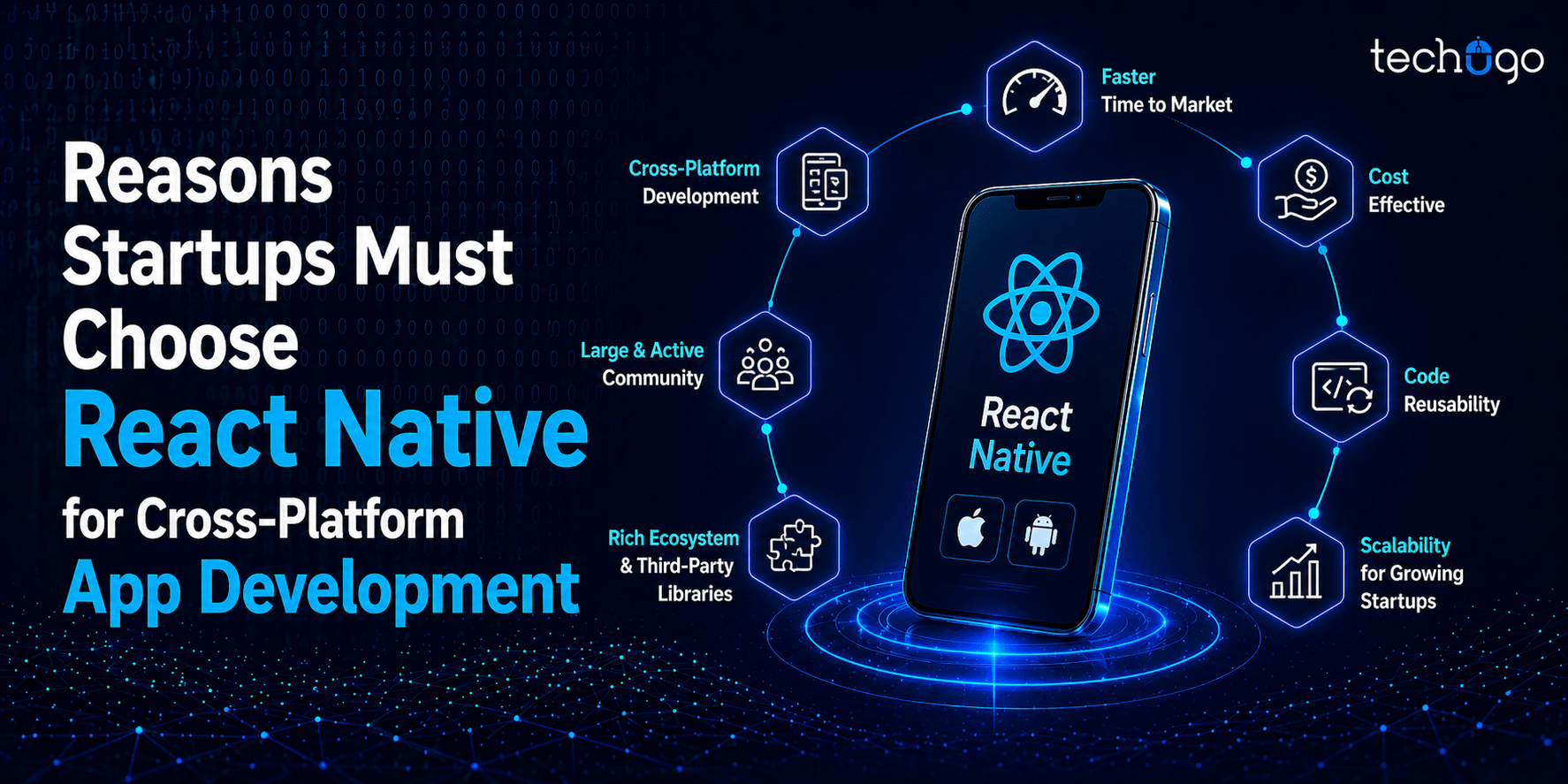
By enabling cross-platform app development using a single codebase, React Native app development allows startups to build apps for both Android and iOS without doubling development effort or cost. It brings together speed, efficiency, and near-native performance in a way that fits perfectly with startup realities.
This is exactly why React Native app development has become one of the most preferred choices for startups looking to launch faster, validate ideas through MVPs, and scale without unnecessary overhead, and once you look deeper, the reasons go far beyond just cost savings.
Let’s break them down.
Understanding React Native for Startups
React Native is an open-source framework used for building mobile applications using a single codebase. It allows developers to create apps for both Android and iOS without writing separate code for each platform.
For startups, this becomes a practical advantage right from the beginning.
Instead of investing in two different development teams or doubling the effort, businesses can rely on cross-platform app development to speed up the entire process. This not only reduces development time but also helps in controlling early-stage costs, which is often a major concern for new businesses.
At its core, React Native app development is about efficiency. It enables developers to reuse code across platforms while still delivering a near-native user experience. This means startups do not have to compromise heavily on performance or design, even when working with limited resources.
Another important aspect is flexibility. React Native supports integration with native modules whenever required, which allows startups to add advanced features without rebuilding the entire application.
In simple terms, React Native gives startups a balanced approach – faster development, lower cost, and scalable architecture, all within a single framework.
Why Startups Prefer React Native Development
Startups operate in a very different environment compared to large enterprises. Every decision is tied to speed, budget, and how quickly an idea can be validated in the market. This is exactly where React Native app development naturally fits in.
One of the biggest reasons startups prefer React Native is the pressure to launch faster. Early-stage businesses cannot afford long development cycles. They need to build, test, and iterate quickly. React Native supports this by enabling cross-platform app development with a single codebase, which significantly reduces build time.
Another key factor is limited resources. Most startups work with small teams and restricted budgets. Hiring separate teams for Android and iOS development increases cost and complexity. With React Native, a single team can manage both platforms, making the entire development process more efficient and cost-effective.
Startups also prefer React Native because of its flexibility during the MVP stage. When the goal is to test a product idea quickly, MVP app development becomes critical. React Native allows rapid prototyping without compromising too much on performance or user experience.
There is also the advantage of easier scaling. As the product grows, startups can continue improving the same codebase instead of rebuilding applications from scratch. This helps reduce long-term maintenance effort and keeps development cycles predictable.
In short, startups choose React Native because it aligns with their core needs – speed, affordability, flexibility, and scalability, all within a single framework.
Key Benefits of React Native for Startups in 2026
Below are the top benefits of react native for startups, let’s look at them…
-
Pocket-friendly option
As a startup, you don’t want to take on excessive financial burden when you are already working with tight budgets and multiple priorities. This often makes you slightly skeptical while choosing an app development solution for your business. However, this challenge is reduced with the React Native (RN) framework, which significantly lowers the cost of building two separate applications. The code reusability helps you save both time and money, allowing you to build apps for Android and iOS at a much more affordable cost.
-
Expedites development process
Launching an app in the market at a much faster rate is what every entrepreneur wants to achieve. However, due to technical complexities, development often cannot move as quickly as expected (though there are exceptions). To address this, the React Native framework opens up new opportunities by enabling developers to complete the development process at a much faster pace. This helps entrepreneurs launch their services in the market at a rapid speed.
-
One codebase for two platforms
Every startup wants to capture a maximum audience base, and building apps for both platforms plays a key role in scaling growth. With React Native, startups get the opportunity to build apps using a single codebase, which not only saves time but also reduces development costs significantly.
-
Seamless compatibility with 3rd party plugins
It is highly important for developers to include additional plugins in the app to make it function as required. Since React Native is an open-source framework, it supports a wide variety of third-party plugins. This allows developers to add features and functionalities easily, making the app more useful and feature-rich.
-
Exceptional UI experience
For a successful app, a balanced combination of features and UI always makes a difference. Seamless UI integration is highly achievable with a React Native-enabled app solution. Here, designers can use CSS and Flexbox to structure layouts efficiently. This helps in creating a visually appealing and responsive app experience across devices.
-
Native-app like features
With the React Native framework, you can easily include native-like features in your app. This gives your application a refined look and feel and helps it stand out in a competitive market. Developers can also integrate Swift or Java modules into the project when adding advanced functionality. This enables users to experience modern and trending features seamlessly.
React Native for MVP Development
For startups, launching a product idea quickly is often more important than building a fully polished application from day one. This is where MVP (Minimum Viable Product) development becomes critical, and React Native app development plays a strong role in making it faster and more efficient.
An MVP helps startups test their idea in the real market with essential features, gather user feedback, and make improvements before investing heavily in full-scale development. The goal is simple – validate the idea early and reduce risk.
React Native supports this approach by enabling cross-platform app development with a single codebase. This means startups can build and launch an MVP for both Android and iOS at the same time, instead of developing separate apps for each platform.
It also speeds up the development cycle because reusable components and pre-built libraries reduce the need to build everything from scratch. As a result, startups can focus more on core functionality and user experience rather than complex backend duplication.
Another advantage is flexibility. As the product grows and user feedback comes in, changes can be implemented quickly within the same codebase. This makes iteration easier and helps startups adapt faster to market needs.
In short, React Native simplifies MVP development by making it faster to build, easier to test, and more cost-effective to scale when the idea gains traction.
React Native vs Native App Development
| Factor | React Native App Development | Native App Development |
| Development Approach | Single codebase for both Android and iOS | Separate codebases for Android and iOS |
| Development Speed | Faster due to code reusability | Slower as platforms are built separately |
| Cost | More cost-effective for startups | Higher due to separate teams and development efforts |
| Performance | Near-native performance for most apps | Highest performance, fully optimized for each platform |
| Maintenance | Easier and faster updates across platforms | More complex maintenance for multiple codebases |
| UI/UX Experience | Consistent UI with flexible design support | Highly optimized platform-specific UI |
| Code Reusability | High (up to 90% shared code) | Very low or none |
| Third-party Integration | Strong support via plugins and libraries | Direct and highly stable integrations |
| Scalability | Good for most startup and mid-scale apps | Best for highly complex, performance-heavy apps |
| Ideal Use Case | MVPs, startups, cross-platform apps, business apps | High-performance apps, gaming, AR/VR, system-heavy apps |
Overall, React Native offers a strong balance of speed, cost-efficiency, and performance, making it a practical choice for most startups and mid-scale applications. Native development, on the other hand, is better suited for apps that demand maximum performance and deep platform-specific optimization.
Limitations of React Native
While React Native app development offers several advantages for startups, it is not without limitations. Understanding these challenges helps in making a more informed decision before choosing it as a primary development framework.
- One of the main concerns is performance in highly complex applications. Although React Native delivers near-native performance for most use cases, it may not match the efficiency of fully native apps in graphics-intensive or computation-heavy applications such as gaming or advanced AR/VR solutions.
- Another limitation is its dependency on third-party libraries. In some cases, developers may need external packages to implement certain features. If these libraries are not well-maintained, it can lead to compatibility or security issues over time.
- React Native may also require native modules for advanced functionalities. While the framework allows integration with Swift or Java, this can reduce the simplicity of using a single codebase and may introduce additional development complexity.
- Debugging and performance optimization can also become challenging as the application grows in scale. Larger apps may require deeper native-level understanding to resolve performance bottlenecks effectively.
Despite these limitations, React Native remains a strong choice for startups when the focus is on faster development, cost efficiency, and MVP-first strategy rather than extremely complex system-level performance.
Real-World Use Cases
React Native app development is widely used across industries where startups and businesses need faster delivery, cross-platform reach, and cost efficiency without compromising user experience.
- One of the most common use cases is in e-commerce applications. Startups in retail and online shopping prefer React Native because it allows them to launch Android and iOS apps quickly while maintaining a consistent shopping experience across devices.
- It is also popular in on-demand service apps, such as food delivery, ride booking, and home services. These apps require fast updates, real-time features, and smooth performance, all of which can be efficiently handled using a single codebase.
- Another strong use case is social media and community-based apps. React Native helps in building interactive interfaces, handling user engagement features, and scaling applications as the user base grows.
- Many startups also use it for SaaS-based mobile applications, where dashboards, analytics, and customer management tools need to work seamlessly across platforms with frequent updates.
- In addition, MVP development for startups remains one of the strongest use cases. It allows businesses to validate ideas quickly, test market response, and improve features based on real user feedback before scaling.
Overall, React Native fits best in projects where speed, scalability, and cross-platform consistency are more important than highly specialized native performance requirements.
When Should Startups Choose React Native?
From an industry standpoint, React Native app development is not a “default” choice for every product. It is a strategic decision that works best under specific startup conditions.
- Startups should consider React Native when the primary goal is to launch quickly and validate an idea in the market. In early-stage environments, speed to market often determines whether a product survives or fails. React Native enables faster MVP delivery through a single codebase, which significantly reduces build time.
- It is also a strong choice when startups are operating with limited engineering resources or tight budgets. Instead of maintaining separate Android and iOS teams, businesses can work with a unified development structure, improving efficiency without sacrificing core functionality.
- React Native becomes even more relevant when the product requires cross-platform availability from day one. If reaching both Android and iOS users is essential for user acquisition or revenue generation, the framework helps ensure consistent deployment across platforms.
- Another key scenario is when the application is feature-driven but not performance-intensive at the system level. For most business apps, SaaS platforms, marketplaces, and consumer-facing applications, React Native provides more than sufficient performance.
However, startups should evaluate alternatives if the product demands heavy graphics processing, complex animations, or advanced hardware-level integrations, where fully native development may be more appropriate.
In essence, React Native should be chosen when the startup priority is a balanced mix of speed, scalability, and cost efficiency, rather than ultra-specialized performance engineering.
The Bottom Line
The year 2026 is set to witness rapid digital transformation across nearly every industry and business sector. In this evolving landscape, making a startup available on a mobile app platform is no longer a trend; it has become a necessity for growth and customer engagement.
The benefits discussed above clearly show why React Native app development continues to be one of the most suitable choices for startups looking to build scalable and cost-efficient digital products.
If you are ready to make a difference in your specific business domain with modern technology and reliable mobile app development services, get in touch with us.
We are proud to work with some of the most established enterprises and disruptive startups across the globe, helping them find their niche with powerful mobile applications.
Give us a call, and we will help you reach your goals.

Get in touch
We'd love to hear from you.