 SA
 KW
 IE
 AU
 UAE
 UK
 USA
 CA
 DE
 QA
 ZA
 BH
 NL
 MU
 FR

















📌 Key Takeaways
- By linking applications that would otherwise work separately, API integration services help businesses simplify workflows & reduce manual data handling.
- Regular maintenance helps integrations remain reliable as software and business requirements change.
- The best integration approach is the one that your team can actually maintain once the project is live.
- Proper planning, testing and monitoring help keep integrations secure.
Currently, corporations rely on many software systems to conduct their operations, communicate with their customers and process information.
However, when systems do not share data with each other, delays occur and extra work is added. As stated by Grand View Research, the worldwide API management market was valued at $8.6 billion (in 2025) and is expected to expand at a CAGR of 20.3% in the period from 2026 to 2033. This progression indicates that connectivity is becoming more vital for many software applications.
But how do these integrations work and what separates the ones that succeed from the ones that don’t?
In the sections ahead, we’ll explore everything from how API integration services work to the benefits they offer, the types available and what it takes to implement one.
An overview of API integration services
Companies often use many applications but they sometimes do not integrate well together. API integration services can connect these applications so that they can share information and function as a single unit.
Basically, APIs act as a link between different applications so that they can pass data back and forth on their own. In some cases, though, the ready-made connections just aren’t right for what you do. Because of this, some businesses opt for custom API development.
Need API Integration Services for Your Business?
Connect your existing systems or build custom APIs to streamline workflows and improve data exchange across your business.
API integration and API development: Key differences
Although related, API integration and API development aren’t the same.Here’s what separates API integration from API development.
| Basis | API integration | API development |
| Purpose | Connects existing applications through APIs | Creates APIs for applications to communicate |
| Process | Uses existing APIs to exchange data | Designs, builds and tests APIs |
| Focus | Connecting different systems | Creating communication interfaces |
| Example | Connecting a CRM with an email marketing platform | Building a custom API for a payment application |
| When needed | When businesses want existing systems to work together | When existing APIs don’t meet specific business requirements |
Why do businesses need API integration services in 2026?
More than 8 in 10 organizations use APIs within their systems, according to Gartner’s 2024 API Strategy Survey, with 82% of respondents reporting internal API use and 71% using third-party APIs.
Considering the vast number of applications being used, organizations need an effective way to connect them with one another to allow for effective transfer of data and API integration services help with exactly that.
Well, here’s why businesses are investing in them in 2026.
1. Minimize manual data entry
Automated data transfer between programs results in less time spent by employees filling in data for the same system again and lowers the chances of mistakes.
2. Better customer experience
Customers expect businesses to respond quickly, perform transactions smoothly and provide assistance without long waits. API integration facilitates interaction between the company’s CRM, payment portal and support tools, thus allowing it to operate without delays.
3. Easier business growth
As a company gets bigger, it may be necessary to include more applications and software to process more work. API integration solutions allow for the connection of new software without violating the existing infrastructure.
4. Better use of business data
By linking different platforms, business API integration helps teams maintain consistent customer, sales and performance data. This helps them base decisions on reliable data instead of relying on scattered records.
What are the different types of API integration?
APIs come in different types, each serving a specific purpose. Here are the most common ones:
1. REST APIs
Applications can communicate with each other using REST (Representational State Transfer) APIs via standard HTTP methods like GET, POST, PUT and DELETE. They tend to be implemented using JSON to pass data back and forth and are fairly easy to incorporate into web and mobile app development.
For example – an eCommerce application can use a REST API to retrieve product details, update customer information or process orders.
2. SOAP APIs
SOAP (Simple Object Access Protocol) APIs are standardised APIs that exchange structured information through a standardised messaging protocol among applications. Usually use XML and have very strict rules for communication, security and data formatting.
In enterprise applications, especially banking and other sectors where data exchange needs to be structured and security protocols are paramount, SOAP APIs are frequently employed.
3. GraphQL APIs
GraphQL is a query language that allows applications to request specific data from a server. Instead of receiving a fixed response, the requesting application can specify exactly which information it needs.
For example – a mobile shopping app can request product names, prices and availability in a single query rather than making separate requests for each piece of information.
4. WebSocket APIs
WebSocket APIs establish a persistent, two-way connection between applications, allowing them to exchange data in real time without repeatedly opening new connections.
They are useful for applications that need continuous updates, such as live chat platforms, stock market dashboards and real-time tracking systems.
5. RPC APIs
Remote Procedure Call (RPC) APIs allow one application to request a function or operation from another application as if it were a local function call. They are commonly used for communication between services that need to exchange data or execute operations quickly.
For example – an application can use an RPC API to request a payment service to verify a transaction or process a payment.
One thing to consider with API integration for businesses is which systems need to connect. The best way to go about it will depend on their needs and security requirements. Software integration services are able to assist in linking these systems and facilitate seamless data sharing.
Common business use cases for API integration solutions
The use of API integration services in 2026 makes it possible for industries to link various applications as well as process data in an effective way. Here are five common examples of how companies can benefit from these technologies.
1. Payment processing & e-commerce
With the help of these services, companies can connect their sites and online shops with gateways, inventory management systems and logistics platforms. This way, online shoppers can make payments without any trouble, while companies can manage their transactions and orders and check the availability of goods automatically.
2. Customer relationship management
Having CRM software linked with tools for sales, marketing and customer support keeps businesses’ customer records updated. Teams can follow up on interactions, take control of leads, and gain access to related customer data from a single location, in order to better coordinate their activities.
3. Healthcare management
Electronic health records (EHRs), appointment scheduling software, and billing systems can be integrated into healthcare providers’ systems. The interconnections allow staff to view relevant patient information, manage appointments and coordinate billing tasks between various applications.
4. HR and payroll management
The linking of human resource management systems with systems for payroll, employee management and attendance would eliminate duplication in data entry. The applications can exchange employee data and attendance automatically.
5. Inventory management
Businesses can connect inventory management software with eCommerce platforms and warehouse systems. This allows stock levels to update automatically as orders are placed, processed or fulfilled.
Top benefits of API integration services for modern businesses
Linking your apps together is the least of what API integration gets you. The capabilities of such technology help companies streamline their day-to-day operations. Here are several of the main benefits that users can gain from implementing these solutions –
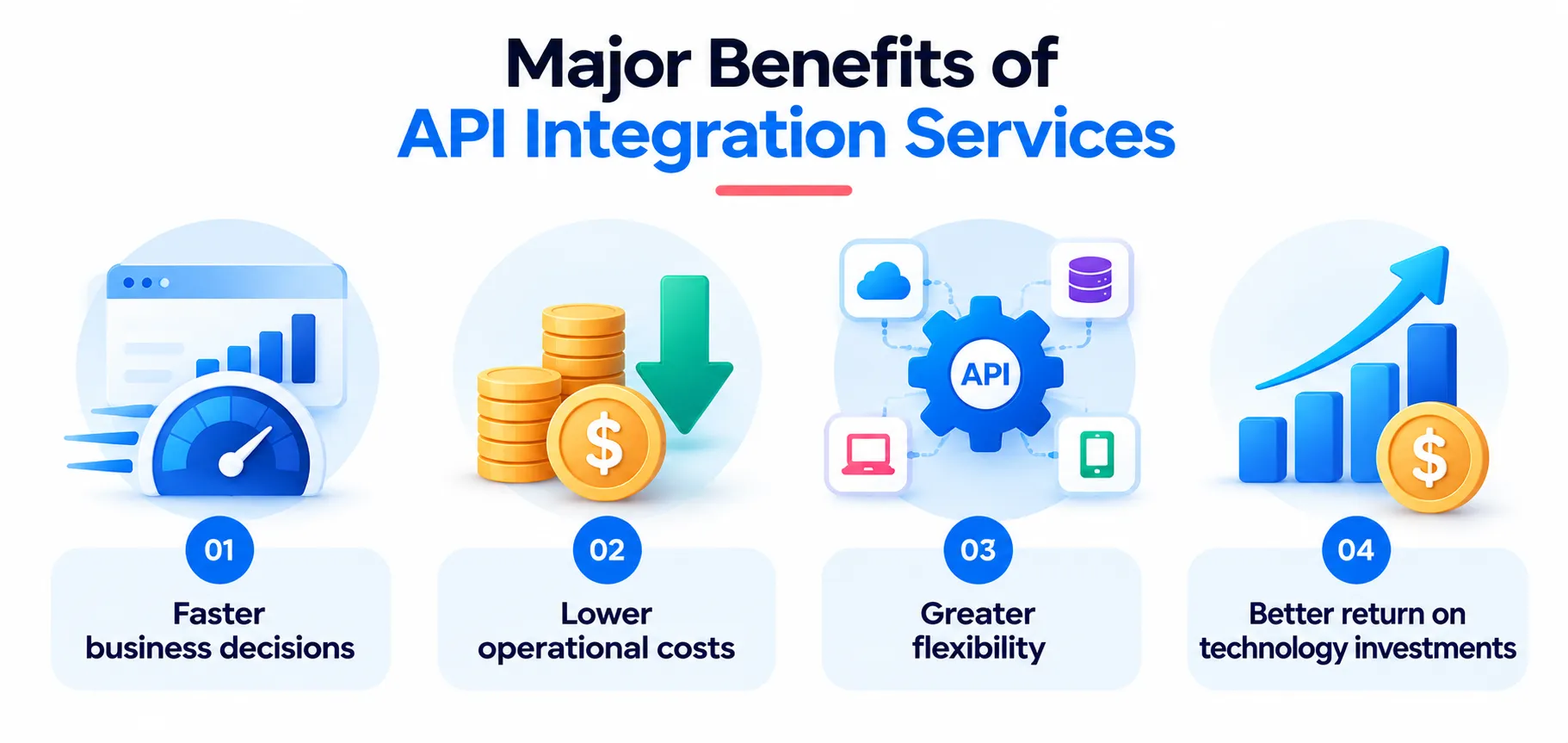
1. Faster business decisions
The integration of different tools gives teams an opportunity to better understand the performance of their business. This makes it easier to identify problems, analyze the outcomes and figure out what requires their focus.
2. Lower operational costs
API integration services limit the amount of time and effort needed to manage disconnected systems. This, in turn, means that users can devote this time and effort to more important processes.
3. Greater flexibility
As the business outgrows its current setup, connected applications make it easier to introduce new tools and adapt existing workflows without rebuilding everything from scratch.
4. Better return on technology investments
Rather than investing in entirely new software, businesses can work with an API integration company to get their existing applications working together.
The API integration process: from design to deployment
There are several stages involved in API integration, including requirement analysis, API selection, integration planning, development, testing and deployment.
In order for this process to be effective, it must be completed in a series of steps (this allows different applications to exchange information without difficulty). But how can you make that happen? Well, a well-planned API integration process can help you improve performance and keep your data secure.
Let’s look at the steps you need to follow.
1. Define requirements
To get started, you have to identify the business goals, the existing systems and the information to be exchanged. It allows you to understand what kind of APIs meet your requirements.
2. Choose the right APIs
Now that you know what you need, evaluate available APIs based on functionality, documentation, scalability, security and compatibility with your existing technology stack.
3. Plan the integration
Define how systems will communicate, establish authentication methods, map data fields and decide how errors will be handled.
4. Develop & integrate
Then comes the actual building. Connect the selected APIs with your applications and configure data exchange between systems. Businesses can use professional API integration services to simplify this stage and address technical challenges.
5. Test the integration
Make sure the data transfer process is accurate, authentication is efficient, and the integrated systems operate properly in various environments.
6. Ensure reliability & compatibility
Check how the integration handles third-party API downtime, request limits and failed connections. Set up retries and timeouts to deal with failed requests, and use circuit breakers to stop repeated attempts from overwhelming a struggling service. Idempotency can help prevent the same action from being processed more than once. Also, ensure API updates don’t break existing integrations.
(Use logs and tracing to identify problems when they occur).
7. Deploy & monitor
Launch the integration in the production environment, monitor its performance and resolve any issues that arise.
In case you’re developing connected mobile applications, mobile app development services can help support the API in functioning well with the features. Regular maintenance and upgrades will ensure that the integration remains secure and can keep adapting to the ever-changing requirements of the business.
Avoid these API integration challenges that can disrupt your workflow
By now, you have a fair idea of how API integration works. However, challenges are inevitable when integrating APIs. Issues, such as compatibility and security, can pose problems for businesses if they are not handled in time. Some of the most frequent challenges of API integration, which must be kept in mind when doing API integration procedures, are:
1. Compatibility issues
There are various data types, formats & protocols used by applications – and this can create an obstacle for the exchange of information between applications. This complicates the integration process significantly. So if you want to avoid this issue, it is crucial to analyze the technical needs of the systems and select corresponding APIs.
2. Security vulnerabilities
APIs transmit sensitive information related to business operations and customers. As a result, breaches in security become a major concern for companies. Weak authentication mechanisms, poor access controls, and unencrypted transfer of data might lead to threats. Thus, using reliable methods of authentication and encryption is necessary.
3. Data inconsistencies
When connected systems use different data structures or formats… information may not transfer accurately. It’s proper data mapping and validation that help maintain consistency across applications.
4. Performance and scalability issues
As data flows, poorly optimized integrations can lead to slow response times, delays, and system overloads. To ensure reliability, API performance monitoring and planning for increasingly heavy workloads are essential.
5. Managing integration complexity
If you think the job is done once your applications are connected, there’s more to consider. You’ll still need to troubleshoot issues and maintain those connections, and API integration services can help with that.
API integration security best practices for businesses
Every API endpoint can create a potential entry point that businesses need to secure. At the very same time, APIs can expose systems to security threats if proper safeguards aren’t in place. The following are key practices that may help achieve safe API integrations –
1. Use strong authentication and access controls
Make sure only the right people and systems can reach your APIs. Strong authentication plus role-based access means folks only see what they need to.
2. Encrypt sensitive data
Encrypt data while it is being transferred between applications. That way, even if someone intercepts it, they can’t read your business or customer info.
3. Test APIs regularly
Regular security testing and API activity monitoring can help identify vulnerabilities and suspicious activity before they cause bigger problems.
4. Keep APIs updated
Update APIs and address known vulnerabilities to reduce security risks as your business systems evolve. Professional API integration development services can help businesses implement these measures and maintain reliable API integration security.
API integration cost in 2026: what should you expect?
The cost of API integration can be as low as $500 and reach $50,000 for standard integrations. Alternatively, for complicated enterprise integrations, the cost may reach even $150,000.
Not Sure What Your API Integration Will Cost?
Get a clearer idea of your API integration costs and find a solution that fits your business needs and budget.
That said, here’s a ballpark estimate for different project types –
| API integration project type | Estimated cost (USD) |
| Basic API integration | $500–$2,000 |
| Custom API integration | $2,000–$10,000 |
| Multi-system integration | $10,000–$25,000 |
| Complex enterprise API integration | $25,000–$150,000+ |
In case you are paying for digital transformation services, you should also consider paying for testing, maintenance and the fees for third-party APIs. For enterprise API integration, both old systems and complicated security require more money to be spent on API integration.
Why do API integration costs vary?
A few key factors can influence your API integration costs. Let’s look at what they are.
1. Number of integrations: More connected software means higher costs.
2. API complexity: Complicated APIs require more effort to build.
3. Customisation: Customised solutions mean a bigger budget.
4. Volume of data: More data transferred means more money spent.
5. Security requirements: Better security costs more.
6. Testing and maintenance: Frequent testing, updates and support escalate total costs.
Note: A lower upfront cost may not always mean lower long-term expenses, particularly when the integration requires frequent updates or maintenance.
What to look for in an API integration services provider
The selection of a suitable API integration services provider can lead to a significant improvement in the synchronization of your systems.
But, given all these choices, what should you be looking for?
1. Technical expertise – Ensure that the provider has the expertise necessary to integrate the API with your project, such as REST, SOAP or GraphQL.
2. Industry experience – When a provider is familiar with your industry, they will know your business needs and systems.
3. Security measures – Review their data encryption, authentication, access control and regulatory compliance procedures.
4. Scalability – Select a group that can develop integrations that will be able to accommodate the expanding data and the development needs of a company in the future.
5. Post-launch support – API integrations should be continuously monitored, updated & troubleshot. Ensure support following deployment.
6. Track record – Go through case studies, customer reviews and past projects to gauge the provider’s capacity to offer dependable solutions.
Future-focused trends in API integration services
From AI-powered automation to real-time data sharing, API integration trends are taking connectivity further. They are doing more than moving data from A to B. So here are a few changes worth knowing about –
1. Real-time data exchange
More and more businesses are moving towards a more event-driven architecture for enhanced communication between applications and for ensuring that data is up to date on multiple platforms.
2. AI-powered API integration
API integration is becoming smarter with the help of AI, which automates processes, identifies errors and enhances data sharing between integrated systems.
3. Low-code & no-code integration
These tools help make API integration methods easier, enabling applications to be integrated with less manual coding and saving time.
4. Greater focus on security and scalability
With increased data handling by businesses, API integration services are becoming even more capable in terms of security, infrastructure flexibility and integration needs.
Key metrics to track API integration success
Before You Call Your API Integration a Success, Check This!
How do you know if your API integration is actually delivering results? Start by tracking a few key metrics:
1. Response time – Measures how quickly an API processes requests and returns data.
2. Error rate – Tracks failed requests and helps identify issues affecting system performance.
3. Data accuracy – Ensures information is exchanged correctly across connected applications.
4. Uptime – Shows how consistently your integrations remain available.
5. Business efficiency – Measures improvements in workflow speed and reductions in manual work.
The types of API integration you use can influence which metrics matter most. Regular monitoring and software maintenance and support also help resolve issues, maintain performance and keep integrations reliable long after the initial setup.
Connect your systems with Techugo’s API integration expertise
If your company uses many different tools, you don’t want to make integrating them another task on your to-do list. The right API integration services can help you exchange information seamlessly, minimize manual work, and make your systems work together as a whole.
At Techugo, we help businesses build reliable API integrations tailored to their existing software and goals. Would you like to implement APIs or make your software work more efficiently? Let’s talk about your API integration needs.
Conclusion
API integration is what helps businesses connect their software, automate data exchange and reduce the manual effort involved in everyday operations. Each of the steps from picking up the best integration method to measuring effectiveness and taking care of the security will help the company boost connectivity and efficiency. With proper API integration services, organizations can create the infrastructure to fulfill current demands and facilitate future development.
FAQs
1. What are API integration services?
API integration services bridge the gap between separate software systems, allowing data to move between them with minimal manual effort.
2. How long does API integration take?
That depends on how complicated the setup is. Linking two straightforward applications might take just a few days, while integrating multiple systems with custom features and security requirements can take weeks (or even months).
3. What are the advantages of API integration for businesses?
API integration helps automate workflows, reduce manual data entry, improve data accuracy, streamline operations, and connect existing software systems.
4. Is API integration secure?
It can be, as long as security isn’t treated as a last-minute consideration. Measures such as data encryption, authentication, access controls, and regular security testing help protect information as it moves between applications.

Get in touch
We'd love to hear from you.