


 SA
SA
 KW
KW
 IE
IE AU
AU UAE
UAE UK
UK USA
USA
 CA
CA DE
DE
 QA
QA ZA
ZA
 BH
BH NL
NL
 MU
MU FR
FR













14 Oct 2026
Food Delivery App Development in UK: Cost, Features & Timeline (2026)

Akshay Gupta



📌 Key Takeaways
-
- Food delivery app development is now a full digital ecosystem, not just a simple ordering app.
- Features like real-time order tracking, push notifications for food apps, and secure payments are now must-haves.
- Building a food delivery app in the UK can range from £20,000 to £200,000 depending on features and scale.
- AI is making food delivery apps a lot more predictable through machine learning.
Ordering food in the UK has quietly shifted from a decision to a habit.
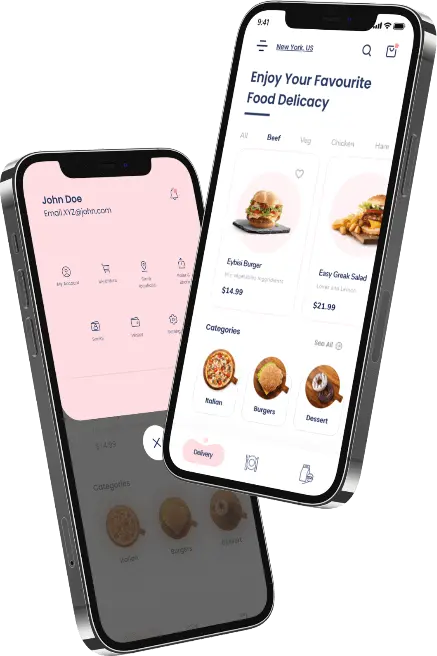
A few taps, a live tracker, and food shows up at your door – all powered by food delivery app development running in the background.
This shift isn’t small either. The UK online food delivery market has jumped from £16.6 billion in 2021 to nearly £28 billion by 2028 (forecast), showing just how deeply food ordering apps, online food delivery platforms, and digital food ordering systems have become part of everyday life.
And because demand isn’t slowing down, restaurants, startups, and cloud kitchens are now racing to build smarter on-demand app development solutions that can handle speed, scale, and customer expectations without breaking. But here’s the part most people don’t talk about: building one isn’t cheap or simple. The cost to build a food delivery app in the UK usually sits between £20,000 and £200,000, depending on how advanced the features, design, and scalability need to be.
In this blog we’ll break down the cost, key features, development process, and role of AI in food delivery apps, so you get a clear picture of how these platforms are built and what really drives their success in the UK market.
Which food delivery app model is right for your business?
Food delivery app development isn’t the same for every business. The way food delivery apps are built really depends on the model behind them, because that’s what decides how orders move, who handles delivery, and how well the whole system can scale over time.
If you get the model wrong, even a good app won’t perform well. If you get it right, everything feels smooth without users even noticing the complexity behind it.
Aggregator model
The aggregator model is the most common setup you’ll see in food delivery applications today. It basically works like a middle layer between customers and restaurants.
Users leverage food ordering apps to explore menus and submit purchases, though the app itself doesn’t manage the actual food preparation or transportation. The establishment is responsible for cooking, while independent delivery services manage the transportation to the consumer.
From the development point of view, this model is relatively simple to build and scale because you’re not managing kitchens or logistics directly. You’re mostly handling coordination which makes it easier to expand across multiple restaurants.
Platform-to-consumer model
This one takes things a step further.
Here, the platform is much more involved in the actual delivery process. Orders, tracking, and delivery coordination all run through the app, while restaurants focus only on preparing the food.
Because of that, everything runs in real time – assigning riders, updating status, managing routes – so the system has to stay stable even during peak demand.
In food delivery app development, this model is used when businesses want more control over the customer experience instead of relying fully on third-party logistics.
Cloud kitchen model
This model has completely changed how food businesses operate.
There’s no dine-in space at all. Instead, food is prepared in delivery-only kitchens based on online orders coming through the app. It’s built for speed and efficiency. Multiple virtual brands can even run from a single kitchen & that makes operations a lot more scalable. Cloud kitchens rely heavily on scalable food delivery systems because they often deal with high order volumes and need everything to run smoothly without delays.
Hybrid model
The hybrid model is basically a mix of everything. Instead of sticking to a single structure, businesses combine multiple approaches into one system. Everything runs under a single platform – from restaurant listings to cloud kitchen operations and even delivery management. It’s designed to keep all parts of the food ecosystem connected, so nothing works in isolation and the entire process feels more unified and flexible.
Food delivery app monetisation strategies in UK
Building a food delivery app is one thing, but turning it into a profitable business, that is a completely different challenge. The features and the user experience are important because they play a major role in attracting customers, but it is the revenue model that determines whether the platform survives long term.
Most of the successful food delivery apps in the UK have been relying on more than just a single income source, so they combine multiple streams together and because of that, the business remains sustainable as it grows.
So here are six ways that the food delivery apps are making money in UK.
Commission from restaurants
The commission from restaurants is one of the most common strategies that the platforms have been using. It works because restaurants are charged a percentage on every order that was placed through the app and the rate can vary, but it usually depends on the partnership agreement, the order volume, and the level of visibility that was given to the restaurant.
Delivery fees
Delivery fees are also a major source of revenue and it was, and still are, one of the most straightforward ways to generate income. The fees vary because of factors like distance, time, location, and demand, so during peak hours the platform may apply dynamic pricing and it helps to optimise the delivery operations.
Subscription plans
Subscription plans are something that many of the apps have been introducing, and you can benefit from them because they offer things like free delivery, exclusive discounts, or priority service. These memberships are recurring and therefore they create a predictable revenue stream, but they also encourage loyalty.
Featured restaurant listings
Featured restaurant listings are another stream, and it works because restaurants pay for premium placement within the app, so they get better visibility. Sponsored listings and promoted profiles have been used widely, therefore they are now common in markets that are competitive.
In-app advertising
In-app advertising is something that the platform can use because it allows restaurants, food brands, and other businesses to advertise, and the ads were, and are, appearing as banners, sponsored recommendations, or promotional campaigns.
Service and convenience fees
Service and convenience fees are the last stream, but they are definitely not the least important. The fee is typically small, but because it is applied across a large number of transactions, it has been contributing significantly to the overall revenue of the platform.
So by combining all of these streams together, the food delivery businesses in the UK have been building a model that is sustainable, and it continues to deliver value to both the customers and the restaurant partners.
Food delivery app development cost in UK
The cost of food delivery app development in the UK depends a lot on how complex the platform is, what features you’re adding, and honestly how big you want it to go. A simple restaurant-focused build is cheaper, but once you move into a full on-demand food delivery app development system with real-time features and everything connected together, the cost starts going up quite fast, because it’s not just an app anymore.
Below is a clear breakdown of estimated costs:
| App type | Description | Estimated cost (UK) |
| Basic MVP | Simple app with menu listings, ordering, and basic tracking | £20,000 – £50,000 |
| Mid-level app | Multi-restaurant platform with payments, tracking, and admin panel | £50,000 – £120,000 |
| Advanced app development | Full-scale system with real-time tracking, delivery management, and advanced features | £120,000 – £200,000 |
 Now the thing is, the final cost also changes based on UI/UX design, backend structure, third-party integrations, and scalability needs, and all of that. Because once you start scaling, especially in on-demand food delivery apps, you’re dealing with multiple users, live orders, delivery flow, and it all has to work together without breaking.
Restaurant app development usually comes in as the starting point, but as businesses move into more scalable delivery ecosystems, the cost naturally pushes toward the higher range.
Remember: every extra layer – tracking, AI, delivery logic – it all stacks up and that’s exactly what drives the cost higher.
Must-have features for a successful food delivery app in the UK
Real-time order tracking
This is the feature most users rely on without even thinking about it. Once you place an order in food ordering apps, you naturally want to know what’s happening next. Is it being prepared? Has the rider picked it up? How far away is it?
Real-time order tracking answers all of that in one simple flow. It keeps you updated without needing to call anyone or guess what’s going on. And honestly, in food delivery app development, this has become less of a “feature” and more of an expectation now.
Push notifications for food apps
You already know those updates like “order confirmed” or “your food is on the way”: that’s push notifications working in the background.
What actually matters is that they remove the need to keep checking the app repeatedly. Everything just flows in real time, quietly updating you as things move forward. In most food ordering apps, this is less about alerts and more about keeping the experience connected without any friction.
Secure payment integration
Nobody wants payment to feel complicated when they’re just trying to order food. That’s why secure payment integration matters so much.
Whether it’s cards, wallets, or UPI, everything needs to work instantly and safely. If payment feels slow or unsafe, users drop off immediately. So in food delivery app development, this isn’t just about adding payment options – it’s about making the final step feel effortless and trustworthy.
Smart search and filters
Think about how often you open a food app without knowing exactly what you want. That’s where search and filters step in.
Instead of scrolling endlessly, you can narrow things down by cuisine, price, ratings, or delivery time and find something quickly. It just saves time and makes the whole browsing experience feel less overwhelming.
Restaurant dashboard
Now switching sides – for restaurants, things need to be just as smooth.
The restaurant dashboard is where they manage everything: menus, orders, availability, and updates. During busy hours, this becomes really important because even a small delay can mess up the flow. It keeps everything organised so nothing slips through the cracks.
This is also where scalable food delivery systems start to matter more, because as order volume increases, restaurants need a system that doesn’t break or slow down under pressure.
GPS delivery tracking
This is what ties the whole experience together.
Once your order leaves the restaurant, you can literally watch it move toward you in real time. It’s simple but it builds a lot of trust because you’re not left wondering where your food is.
For businesses in food delivery app development, GPS tracking also helps restaurants and delivery partners stay coordinated without confusion. In setups like cloud kitchen app development where multiple orders move from different virtual kitchens, this kind of real-time visibility becomes even more important to keep operations smooth.
Advanced features for food delivery apps
AI-based food recommendations
The AI-powered food recommendations feature, it allows users to find restaurants and food items that align with their tastes – and preferences. The app can use the order history, browsing data and favourite cuisines but it also recommends more relevant foods because the system learns from you. So that the experience feels more personalised as it has been designed to make it easier for users to decide what they want to buy.
Voice search ordering
Voice ordering is a method that lets you use your voice, to search for restaurants food or cuisines. You don’t have to type because the feature was built so that customers can simply speak their request and have the results found in seconds. It are convenient and were designed so that the ordering process becomes more streamlined, but also faster for you.
AI chatbot support
AI chatbots app development company, they offer support on the fly throughout the customer journey and have been available at all times. You can use it to track your order but also it delivers updates and are able to answer payment questions, therefore making things easier. The chatbots were designed so that real-time responses are possible, because it have been shown to enhance customer satisfaction.
Technology stack for food delivery app development
The technology stack determines how efficiently a food delivery app performs, scales, and handles real-time operations.
Common technologies include –
- Frontend: Flutter, React Native app development, Swift, and Kotlin for cross-platform and native app development.
- Backend: Node.js, Python, and Java for managing business logic and APIs.
- Database: PostgreSQL, MySQL, MongoDB, and Firebase for data storage.
- Cloud infrastructure: AWS, Google Cloud, and Microsoft Azure for scalability and reliability.
- Third-party integrations: Google Maps, payment gateways, push notifications, and analytics tools.
- AI & analytics: Machine learning tools for recommendations, demand forecasting and route optimisation.
Timeline of food delivery app development (what it takes to go live)
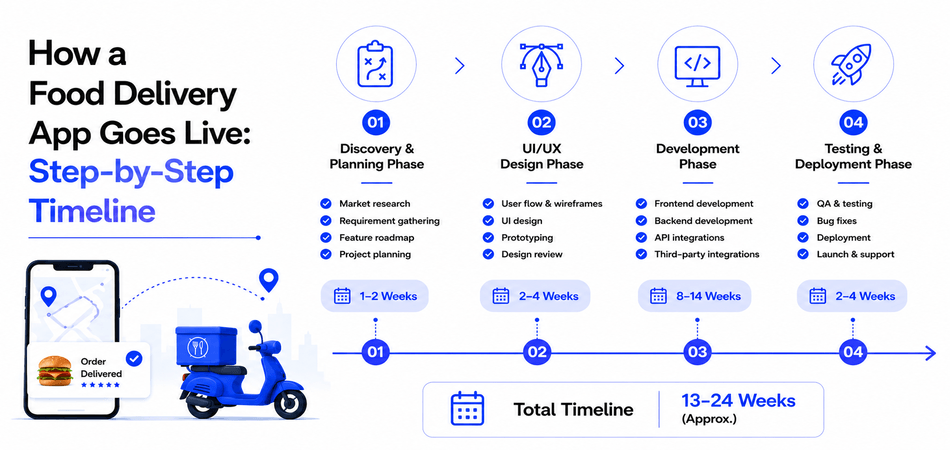
How a Food Delivery App Goes Live: Step-by-Step Timeline
Food delivery app development usually follows a structured process rather than being built in one go. Each stage has its own purpose, and everything moves step by step so that the final product actually works like a stable system, not just an app sitting on the surface.
Here are the key stages involved in the development timeline.
Development timeline breakdown
| Phase | What happens | Timeline |
| Discovery & planning | Business goals, user flow, and system structure are defined | 1–2 weeks |
| UI/UX design | App screens and user journey are designed | 2–3 weeks |
| Development | Core features and backend systems are built | 4–12 weeks |
| Testing & deployment | Bugs are fixed and performance is tested before launch | 1–3 weeks |
Discovery & planning phase
This is where everything actually starts. Before anything is designed or built, business requirements are defined, user journeys are mapped, and the overall system structure is planned. It is also the stage where decisions are made around features and scalability because modern digital food ordering systems are expected to handle real-time demand, multiple users, and smooth coordination between restaurants, customers, and delivery partners. All of this has to be thought through properly.
UI/UX design phase
Once the direction is clear, the focus shifts to how the app will feel when you actually use it. UI/UX design is created so that browsing, ordering, and tracking food feels simple not complicated. In food delivery app development, this stage is very important because even small design issues can affect how users interact with the platform, and whether they stay or leave, so everything has to feel smooth, clean, and kind of effortless.
Development phase
This is where the idea starts turning into something real. Core features are built, including on-demand food delivery app development functions like ordering systems, payment flows, tracking, and admin panels. On the backend side, systems are designed to handle real-time activity, and things like predictive delivery systems are added so that delivery times can be estimated better, and the overall flow becomes more efficient… even when traffic is high or unpredictable.
Testing & deployment phase
Before anything goes live, the entire platform is tested properly – performance checks, bug fixing, and real-world usage scenarios are all covered so that nothing breaks when real users start using it. The goal is simple: it should not just work in ideal conditions, but also under pressure, when everything is happening at once. Once everything is stable, it is deployed and made available to users.
Overall, the timeline for food delivery app development usually ranges between 8 to 20 weeks, depending on how complex the features are, how advanced the system needs to be, and how scalable the digital food ordering systems have been designed to become over time.
Common challenges in food delivery app development
Building a food delivery app sounds straightforward at first, but things get complicated pretty quickly, and it is because real users, restaurants, and delivery partners all enter the picture at the same time.
So here are some of the biggest challenges that the businesses have been facing during the food delivery app development.
- Keeping real-time tracking accurate:
Keeping the real-time tracking accurate is one of them, and it is a challenge because the users expect live updates. But maintaining accurate location tracking without delays, that has been difficult for many platforms and it still are a problem in some cases.
- Handling peak-hour traffic:
Handling the peak-hour traffic is another challenge, and it was, and still is, one of the most unpredictable ones. The order volumes can spike suddenly, because of lunch, dinner, weekends, or special events, so the pressure on the entire system increases and it can be overwhelming.
- Managing delivery operations:
Managing the delivery operations is something that the platform has been struggling with, and it is because assigning the right rider, optimising the routes, and avoiding the delays requires constant coordination, but it does not always go smoothly.
- Ensuring secure payments:
Ensuring secure payments are in place is critical, and it was always a concern because every transaction must be processed safely, so that the sensitive customer information stays protected, but the threats have been evolving.
- Scaling as the business grows:
Scaling as the business grows is something that you have to plan for early, because what works for a few hundred users, it may not work for thousands. Therefore the platform needs to be built with growth in mind, but that is easier said than done.
- Keeping restaurant data updated:
Keeping the restaurant data updated is the last challenge, and it has been a persistent one. The menus, pricing, availability, and the order status must stay synchronised across all of the restaurant partners, but because the data is constantly changing, it were, and are, difficult to manage in real time.
The good news is that most of these challenges can be addressed, and it is because the right technology stack, scalable architecture, and a well-planned development approach have been making a real difference, so the businesses that invest in these early are in a much better position.
The role of AI in food delivery apps
AI in food delivery isn’t really “future tech” anymore. In fact it is already baked into how most apps work today. You don’t really notice it, but it’s constantly making decisions in the background, what you see, how fast your order moves, and even how smoothly the kitchen and delivery side stay in sync. Honestly it’s less about flashy features and more about everything just feeling faster, more sorted than it used to be.
Machine learning in food ordering apps
Machine learning in food ordering apps is basically the reason your app starts feeling familiar over time. You don’t have to search too hard, because it already remembers your patterns, your usual cravings, even the time you tend to order. It’s subtle, but it slowly removes friction from the whole process and therefore the experience just feels easier, kind of automatic.
Predictive delivery systems
Predictive delivery systems are where things get interesting, because instead of reacting late, the system starts guessing what’s about to go wrong – busy hours, late deliveries, high demand areas – and adjusts things before it actually becomes a problem. So what you get is fewer delays, less confusion, and not that constant “where is my order now” moment that used to happen a lot.
Cloud kitchen apps
Cloud kitchen app development in uk is a different game altogether, because everything is delivery-only – no walk-ins, no dine-in buffer, just constant online orders coming in one after another. AI basically acts like that invisible manager in the background, making sure one kitchen is not overloaded while another is sitting idle, and it all kind of balances itself out (or tries to).
Smart rider allocation
Instead of randomly assigning riders, AI quietly figures out who makes the most sense based on distance, traffic, workload, timing and yes, all of that at once. You don’t see it happening, but that small decision is what often decides whether your food arrives early or late, and therefore it directly affects the whole experience without you even realizing it.
Demand forecasting in food delivery
Demand forecasting is basically the system saying “okay, this hour is going to get messy”, before it actually does. It looks at patterns, weekends, weather, habits, and past behaviour so that restaurants and kitchens can prepare in advance, and not get overwhelmed when the rush actually hits. It was never random, it has always been patterns (just hidden ones).
Real-time system optimization
At a larger level, AI is constantly watching the entire flow: orders, kitchens, riders, delivery times – and adjusting things in real time. If something slows down, it quietly shifts priorities so the system doesn’t fall apart.
You never really see it but you definitely feel the difference when it is missing, because then everything suddenly feels a bit slower, a bit messy. And in modern food delivery app development, that invisible layer is what keeps the whole system running smoothly.
UK compliance and regulations for food delivery app development
Launching a food delivery app in the UK involves more than just building features because there are legal and security requirements that businesses need to consider as well. The app may look great and work smoothly but if compliance is overlooked, it can create problems later on.
- UK GDPR Compliance: Food delivery apps collect customer information, and because that data is being stored and processed, businesses are expected to handle it securely and in line with UK GDPR requirements.
- Secure Payment Processing: Customers are making payments through the platform – therefore secure payment gateways are important so that financial information remains protected.
- Consumer Protection Laws: Pricing, refunds and delivery terms should be clear because users are more likely to trust a platform when everything is transparent.
- Food Safety Standards: The app may not prepare the food itself but it still works with restaurants that are expected to meet UK food hygiene regulations and safety standards.
- Cybersecurity Measures: Encryption, secure authentication, regular updates are important because cyber threats have been increasing and businesses need to stay prepared, always.
Addressing these requirements early can help reduce legal risks & it can also build customer trust. It may not be the most exciting part of food delivery app development, but it is one of the areas that should never be ignored.
How to choose the right food delivery app development company in UK
You can have the perfect business model, a solid monetisation strategy, and a clear feature list. But if the wrong team is the one who builds the app, none of that really matters and it was never going to.
The reality is that the food delivery platforms are complex systems, because they have been built to handle the real-time orders, the payments and the thousands of users all at once. That is why choosing the right food delivery app development company in UK is one of the most important decisions you will have been making during the entire process.
Here are a few factors, that are worth considering before you are making your choice.
Look for industry-specific experience
Not every app development company understands the complexities of the food delivery platforms, but it was never expected that they would. Because from the real-time order tracking, and the delivery management to the restaurant integrations, the experience in the on-demand delivery space are something that can make a significant difference, to the final product.
Evaluate their technical expertise
A food delivery app are relying on the multiple technologies that have been working together. Before you are making a decision, assess whether the company, have experience with the scalable backend systems, and the cloud infrastructure, but also the payment gateway integrations, the GPS tracking, and the modern development frameworks.
Review their portfolio & client success stories
A company’s previous work reveal a lot about the capabilities it have been building. Reviewing the portfolio, case studies and also the client testimonials are something that can help you understand the type of projects they have delivered and whether it were aligning with the business goals you have.
Consider post-launch support
Launching the app is only the beginning but it is something you have been preparing for. Because as the platform grows, you will need the regular updates, the performance optimization, the bug fixes and also the new features.
Choosing a company that are offering the long-term support, can therefore help ensure the food delivery app you have been building continues to scale smoothly, over time.
Why businesses choose Techugo for food delivery app development in the UK
Techugo, as a mobile app development company in UK with 10+ years of experience, helps businesses design and build end-to-end food delivery platforms that connect customers, restaurants, and delivery partners within a single, unified ecosystem.
We work across mobile and web development using Flutter app development , Node.js, Firebase, AWS, Google Cloud, and scalable backend architectures to ensure consistent performance across Android, iOS, and web platforms. This reduces development complexity while maintaining high speed, stability, and smooth user experience even under heavy usage.
A good example of this is our work with Milkbun, where we built a more scalable ordering experience.
From customer-facing apps and restaurant panels to admin dashboards, we develop fully integrated digital food ordering systems that support real-time tracking, secure payments, order management, and high-volume traffic handling. Our focus also extends to scalability and future readiness, enabling advanced capabilities like AI-driven features, predictive delivery systems, and cloud kitchen integrations as the platform evolves.
Hungry to launch? So are we. Get in touch with our team and we’ll have your platform up and running before the next order comes in.
Final perspective
Food delivery apps are no longer just digital products. They are becoming operational infrastructure for the entire food industry. What started as convenience has now evolved into a fully automated ecosystem driven by scalability, intelligence, and real-time systems.
In markets like the UK, success depends on how efficiently platforms combine technology, user experience, and operational speed into a single system – and that’s exactly where a strong food delivery app development company plays a critical role in shaping the outcome.
FAQs
Q1.What is food delivery app development?
Food delivery app development is the process of building digital platforms that allow users to browse restaurants, place orders, and get food delivered in real time through mobile or web applications.
Q2.What is the food delivery app development cost in UK?
The cost usually depends on features, complexity, and scalability. A basic MVP can start from a lower range, while advanced platforms with real-time tracking, AI features, and multi-vendor systems can go significantly higher.
Q3.How long does food delivery app development take?
On average, it takes around 8 to 20 weeks depending on the app size, design complexity, backend architecture, and integrations required.
Q4.What are the essential food delivery app features?
Essential food delivery app features include real-time order tracking, secure payments, push notifications, smart search, restaurant dashboards, and GPS-based delivery tracking.
Q5.What technologies are used in food delivery apps?
Modern apps are built using technologies like Flutter, Node.js, Firebase, AWS, Google Cloud, and third-party APIs for payments, maps, and real-time tracking.
Related Guides
14 May 2026
AI Scheduling Assistant for Healthcare | A Comprehensive Guide in 2026
Most days, clinics face more patients than they can handle. Long waits happen often when too many people need care at once. Running things smoothly be..

Ankit Singh

28 Apr 2026
How Much Does it Cost to Build an AI Wellness App? (2026 Guide)
Is launching an AI wellness app in 2026 really worthwhile? That's a question a lot of tech giants would ponder. Demand isn’t hiding, it’s loud and..

Abhinav Gupta
Join the newsletter and get all the updates.
Subscribe
Let's have a Quick
Chat with you!
Have a question or a project idea? Reach out to us. We're here to help you navigate your journey with expert guidance and innovative solutions tailored to your needs.

Email us
sales@techugo.com