

 SA
SA
 KW
KW
 IE
IE AU
AU UAE
UAE UK
UK USA
USA
 CA
CA DE
DE
 QA
QA ZA
ZA
 BH
BH NL
NL
 MU
MU FR
FR















📌 Key Takeaways
- By the end of 2030, the retail market is projected to reach USD 48.22 trillion globally.
- Retail software development costs range from $20,000 to $200,000+ depending on various factors.
- Retail software solutions improve business efficiency through real-time monitoring, process automation and faster checkouts.
- Techugo helps retailers build secure, scalable, and growth-focused software solutions.
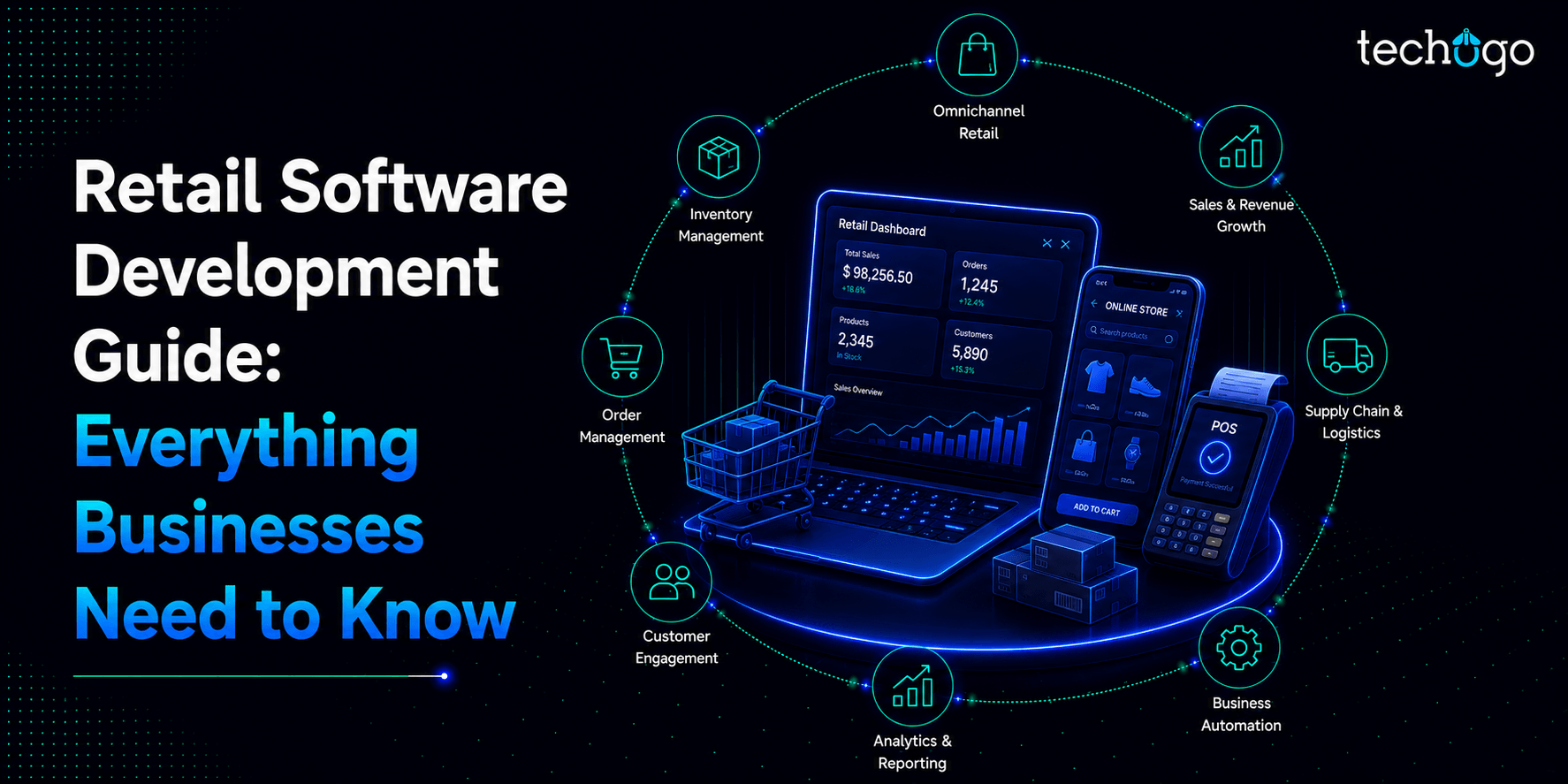
The current retail market is the opportunity king among industries. In fact, the global retail market size, being around USD 25.81 trillion in 2024, is projected to reach USD 48.22 trillion by 2030, growing at a CAGR of 10.98%. It’s the golden period for businesses looking to build retail software. Now POS or eCommerce systems are no longer limited to a global audience.
Modern retailers, as well as users expect intelligent features. Businesses need solutions that connect inventory, payments, customer engagement, analytics, AI, warehouses, and omnichannel experiences into one seamless ecosystem.
If you are wondering where to start, how to boost sales in retail, how the software development works, or what the cost is. No worries we got your back. This guide covers everything you need to know to make the right decision for your retail technology solutions.
What Is Retail Software Development?
Retail software development is a way to build a digitally powered solution from ideation to execution for an eCommerce platform, POS system, or inventory solution, it directly helps retailers to manage and streamline their operations. This system is built to increase user experience through a connected ecosystem that supports every side of business.
As per the current shopaholic generation, running an offline store without any digitally connected system can make you lose thousands of customers daily.
When a user sees something on social media, they immediately open their browser to search for a similar product online, click on the cart button and then place an order. As users, we expect an effortless shopping journey. That is why the demand for retail software development is growing in the industry. Modern retail software eliminates unnecessary issues by synchronizing inventory, orders, payments, customer information, and logistics across every sales channel.
So think of retail software as the full system that provides real-time stock visibility, smoother logistics, order management, purchase tracking, etc that fulfils users’ expectations which is above all else.
When Should Your Business Invest in Custom Retail Software Development?
What if I say not every business needs modern retail software from day one? So the ultimate question arises – how would I know when it’s the right time to invest in custom retail software development solutionsinstead of sticking with off-the-shelf tools?
It’s a completely fair question not every business needs custom software development for retail industry. If you are just starting with a small store so white label solutions or other prebuilt solutions are recommended.
No business will stay the same forever and for a growing business, a supporting system that supports its growth is the most demanded thing. As you build your customer base, expand your range of products, and begin to sell through a variety of channels, those all-in-one solutions tend to start feeling insufficient.
Here are five common scenarios that indicate your business is ready to invest in retail software solutions:
1. Your Business Has Outgrown Manual Processes
2. You’re Selling Across Multiple Channels
3. Inventory Management Is Becoming a Challenge
4. Your Customers Expect Better Shopping Experiences
5. You’re Planning to Scale Your Retail Business
Popular Retail Software Solutions That Improve Customer Experience
The retail industry software solutions in today’s fast-paced shopping world allow several operations to be run more smoothly while delivering an impeccable user experience. Here are the top solutions powering success in retail.
1. Point of Sale (POS) Software
POS is basically an environment where users purchase and pay for goods. In an easy way, it is a checkout system built for retailers or shop owners. It records every transaction of daily operations in the store or warehouse. It is a beneficial way to know the best-selling products, slow-moving inventory, employee performance, peak shopping hours, and overall store profitability.
2. Inventory Management Software
Inventory management software in retail business works as the most valuable asset that monitors, organizes, and controls their stock in real time. With each sale, return, or restock of a product the inventory is updated automatically, providing full insight to businesses on what is available, what is running low, and what needs to be reordered. The biggest advantage for retailers is improved efficiency and better decision-making.
3. Customer Relationship Management (CRM) Software
Retail business is not just about making sales and earning revenue it’s also about building customer relationships because it helps businesses in the longer term. Retailers can build loyal customer relationships through Customer Relationship Management (CRM) software by sending them personalized promotions, recommending relevant products, managing loyalty programs, and offering timely customer support.
4. Retail eCommerce Platforms
Retail eCommerce software development allows companies to sell products online and manage catalog, orders, payments, and customer service from a single solution. Retail & eCommerce software development companies offer features like digital catalog, secure payment gateway integrations, mobile responsiveness, a shopping cart, pay later options, and POS software integration. eCommerce platforms leverage wider market reach and increase sales opportunities today’s digital-first shoppers expect.
5. Order Management System (OMS)
An order management system allows a retailer to know the status of an order at every step in the process from order placement through delivery and return. As an integral part of the retail software package, an order management system aggregates orders from all the sales channels, tracks their status in real-time and enables you to process them seamlessly and uniformly. This results in faster delivery and better shopping experience, particularly for multi-store retailers and those that also partner online.
6. Warehouse Management System (WMS)
Warehouse Management System (WMS) as the name shows, manages the entire warehouse operations through a consolidated system that provides complete visibility of operations. Businesses can ship, pick, pack and store the products directly with very minimal delay and errors across the board. It offers support for barcoding, bin and shelf management, stock allocation, automated picking and packing, shipment tracking as well as real-time inventory updates.
7. Enterprise Resource Planning (ERP) Software
ERP Software is a centralized system that gives complete access to business owners, from finance and procurement to inventory, sales, and human resources. ERP systems are one of the best solutions built for enterprise-level businesses as they automate workflows through seamless collaboration opportunities, eliminating manual efforts that result in faster decisions.
8. Loyalty & Rewards Management Software
eCommerce app development includes features like loyalty and reward management to help retailers improve their relationship with customers. It offers rewards based on customer behavior. In addition to improving retention that generates repeat purchases and loyalty towards the brand.
9. Payment Processing & Digital Wallet Integration
A seamless payment experience is imperative for today’s retail. Payment Processing and Digital Wallet Integration your business can receive payments from various methods such as credit/debit cards, UPI, digital wallets, contactless payments and Buy Now Pay Later (BNPL) schemes. Retailers can lessen checkout friction and improve the shopping experience by providing payment options that are secure, quick and flexible.
10. Workforce & Employee Management Software
Workforce and Employee Management Software makes it easy to manage employees as it allows retailers to manage their schedules, attendance, shifts, payroll, and evaluations of performance. Automating day-to-day activities will enable the firm to boost workforce productivity and ensure proper staffing and operations on a day-to-day basis.
How the Retail Software Development Process Turns Ideas into Scalable Solutions
For successful retail software development solutions, a reliable development partner follows a strategic approach that includes –
1. Understand Your Business Needs
Every successful retail software project starts with an understanding of the business and not the technology. This step involves the identification of pain areas, business goals, customer needs and weaknesses of the existing system. The better the requirements definition, the easier it will be to implement.
- Analyze business workflow and pain points
- Align with business objectives and growth
- Know the expectations of your customer base
- Collect functional and technical needs
2. Define Features & Build a Development Roadmap
A roadmap acts like a blueprint of the complete software development process, whether it’s about what features are going to be integrated or what technologies will be integrated, everything is well structured.
- Prioritize business-critical functionalities
- Select a scalable technology stack
- Plan development phases and milestones
- Define project goals and investment
3. Design a Simple and User-Friendly Experience
The interface design is the face of the software, and keeping everything user-centric and easy to use is the priority of retail software development. Hire retail software development team that builds wireframes, user journeys, and interactive prototypes while focusing on speed and accessibility.
- Creating wireframes and design prototypes
- Designing responsive web and mobile interfaces
- Optimizing user journeys and navigation
- Validating designs through stakeholder feedback
4. Develop and Integrate Core Retail Features
Once the design has been finalized, retail software engineers start writing code for the core features depending on the type of services you require. Every line of code is written to ensure
- Developing core business features
- Integrating POS, CRM, ERP, and payment systems
- Connecting APIs and third-party services
- Implementing security and data protection measures
5. Test Everything Before Launch
The software is tested thoroughly before going out to users to make sure everything is working as expected. The objective is to detect bugs, enhance performance, and provide a stable, secure, and dependable solution.
- Functional and usability testing
- Performance and load testing
- Security and vulnerability testing
- Fixing bugs and optimizing performance
6. Deploy the Software and Go Live
Once the software has been successfully tested, it is released to the production environment and made accessible to the users. This step allows for a smooth release with minimal disturbance to day-to-day business activities.
- Setting up production servers and infrastructure
- Migrating existing business data
- Configuring software for live operations
- Training employees and providing launch support
7. Monitor Performance, Gather Feedback, and Keep Improving
The technology and customer needs evolve rapidly and your software should run at that speed. Constant maintenance, along with several upgrades and performance tuning, ensures that your retail solution remains secure, efficient, and able to serve you for the growth of your business in the future.
- Monitoring system performance and uptime
- Collecting customer and employee feedback
- Releasing feature enhancements and updates
- Scaling the software as the business grows
Benefits of Retail Software Solutions for Business Growth
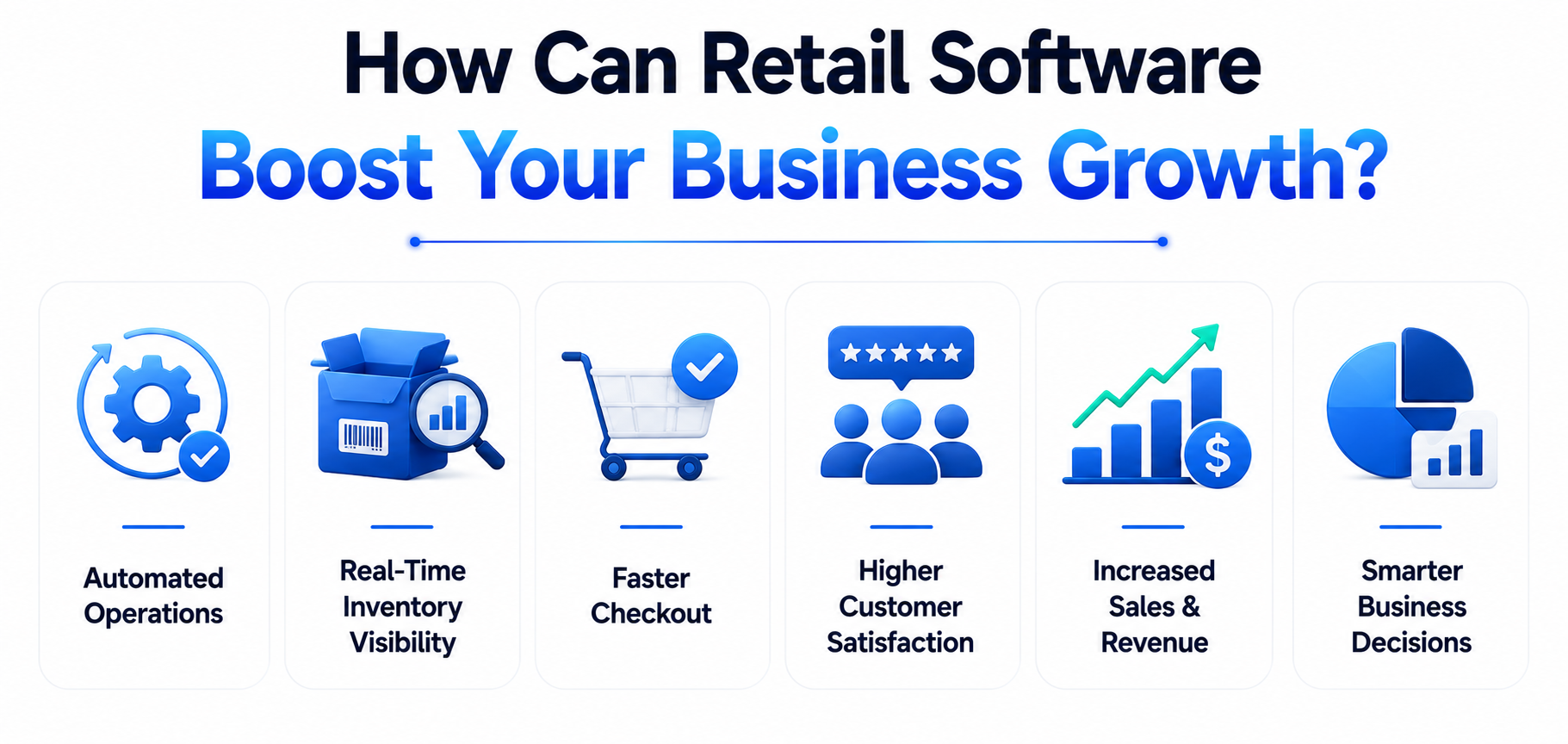
Still wondering what makes retail management software worth it? Traditional tools are no longer enough for retailers today to run their operations and provide better shopping experiences. The benefits of retail management software highlight exactly what you are getting on the table. Let’s explore the key benefits.
1. Automated Business Operations
Selecting custom retail software development services is indeed a good decision for companies that aim to automate their operations without making any manual efforts. Rather than performing such activities manually, like billing, updating inventory, order processing, managing customers, and report generation, the retail software will perform all the activities automatically.
2. Real-Time Inventory Visibility
Retail businesses solely depend on real-time product visibility, because knowing your business inside out prevents stockouts, reduces overstocking, improves purchasing decisions, and minimizes losses. Business owners will have a clear idea which products are sold, returned, transferred and need to get restocked with additional manual attention. This ensures faster customer service with fewer errors and a smoother shopping experience.
3. Faster Checkout Experience
A seamless checkout could be the deciding factor in a customer’s shopping trip. With retail software development, companies can develop streamlined billing processes that function with multiple payment options, and reduce waiting lines. That not only saves time, but also delivers a convenient shopping experience which results in repeat customers.
4. Improved Customer Satisfaction
Working with a professional retail software development company enables businesses to offer customized and seamless experiences that modern customers demand. Whether it’s real-time order tracking or loyalty schemes, responsive mobile applications or simple returns, the appropriate technology can make shopping easier, instill trust, and create long-term customer loyalty.
5. Higher Sales & Revenue
Today’s retail software solutions enable businesses to open the door to new growth from simplifying operations to engaging customers and providing omnichannel selling. With improved inventory management, more personalized offers and data-backed insights, retailers can boost conversions and encourage repeat purchases to drive even more sales and revenue.
6. Smarter Business Decisions
Retail POS systems provide real-time data, reports and analysis that allow a retailer to understand their business from every angle. There’s no guesswork anymore, retailers can now reliably spot trends, adjust pricing and plan for growth.
7. Reduced Operational Costs
Retail software automates processes and workflows, streamlines operations, and reduces expenses from manual labour. Businesses can save time and money due to fewer errors, more streamlined workflows, and more efficient processes.
Future Trends in Retail Software Development
1. Microservices & MACH Architecture
In retail software development, microservices and MACH adoption are the new trend. MACH stands for Microservices, API-first, Cloud-native, and Headless. So businesses now prefer smaller, independent retail software architecture that can be easily built, updated, and scaled according to business growth. These services provide complete flexibility and agility in 2026 that help businesses stay ahead in competition. This is becoming a top choice because of its ability to support omnichannel retail.
2. AI-Powered Hyper-Personalization
In today’s world, consumers want to feel that the brands know their requirements. AI-driven hyper-personalization helps the retailers to offer personalized shopping experience by making product recommendations, sending offers to them according to their likes and dislikes, and giving content according to their needs.
3. Phygital Retail Experiences
In the digital shopping trend, phygital retail is one of the preferred choices among users. Now users don’t rely on online or offline, they want a smooth experience at every touchpoint. Combining both is one of the smartest ways to bridge the gap between offline and online services. With this solution, businesses are able to give services such as online ordering, in-store pickup, individualized promotions, and live inventory visibility across every shopping channel.
4. Creator Commerce & Social Shopping
Now business owners promote or launch the first product on social media before websites or apps. The reason is the growing trend of Creator Commerce & Social Shopping, business owners partner with influencers and creators who promote products online and some platforms enable product purchase directly from social platforms. This shortens the buying journey and significantly improves conversion rates.
5. Generative AI for Retail Innovation
Retailers are increasingly turning to AI solutions for retail to improve operational efficiency and engage better with customers. Whether it is creating product content, predicting demand, or providing personalized shopping experiences, AI allows businesses to work smarter, driving higher productivity and sales.
6. Green Software Engineering & Cloud Optimization
It is good to be innovative, but responsibility is equally important. This is why Green Software Engineering & Cloud Optimization are considered to be a significant trend in retail. By creating lean, energy-efficient software and utilizing cloud technologies more efficiently, retailers will be able to cut down on expenses, improve performance, and decrease their carbon footprint.
How to Choose the Right Retail Software Development Company
When choosing a software consulting company, your priority should be the value and expertise, not just the services they are providing. So how to evaluate?
Before making your decision, here are the key points to keep in mind.
1. Retail Industry Experience
Hire retail software developers from a successful and well-established company. Your preferred company should have years of successful experience in delivering quality software. The more relevant experience a company has, the more reliable it is likely to be. Experience with real-time projects over the years and certifications increases the chances of building a scalable solution.
2. Portfolio & Proven Success
Look for a number of projects, relevant case studies, and client testimonials when choosing a retail software development company. Check live apps, read the reviews and feedback of customers, and evaluate app’s quality manually to understand their industry knowledge and ability to solve real world problems.
3. AI & Emerging Technology Expertise
In the current AI-driven world, your retail software developing partner should be able to help your business stay ahead in the market. Look for those who have hands-on experience on the technologies like generative AI, agentic AI, machine learning, IoT, and cloud computing technologies that enhance customer experience and automate business operations.
4. Project Timeline & Delivery Approach
A great business idea loses its value when it takes too long to execute. Choose a retail software development services provider that aligns with your expectations and project timeline. In the market tons of retail software development companies claiming to deliver faster, but before relying on one, you must transparently communicate with the development partner and ask for a project workflow blueprint to ensure timely delivery.
5. Data Security & Compliance
The customer data you hold is one of your greatest business assets, and it needs protecting. A custom retail software development company can enhance security with encrypted transactions, role-based access, routine security updates and compliance, allowing sensitive data to be kept secure while enabling secure business growth.
6. Transparent Pricing & Communication
The retail software development process is built on trust. Before choosing a retail software company make sure they offer transparent pricing and clear communication from day one. Conduct a clear discussion with the development team about cost breakdown, hidden charges and what the cost would be of adding additional features in the system.
How Much Does Retail Software Development Cost?
The cost of retail software development usually varies between $20,000 and $200,000+, based on what kind of solution you are going to develop. The retail application development cost in today’s market is mainly determined by complexity, custom features, use of AI, integration with third party solutions, cloud infrastructure, security requirements, etc., as well as the size of the project. A simple retail application needs significantly less capital compared to that, but when it comes to enterprise-ready solutions with omnichannel support and automation, the higher end of the price spectrum is natural.
| Retail Software Solution | Average Market Cost (USD) | Development Timeline |
| Point of Sale (POS) Software | $20,000 – $40,000 | 2–4 Months |
| Inventory Management Software | $25,000 – $60,000 | 3–5 Months |
| Customer Relationship Management (CRM) | $30,000 – $70,000 | 3–6 Months |
| Retail and e-commerce software development services | $40,000 – $100,000 | 4–7 Months |
| Order Management System (OMS) | $40,000 – $90,000 | 4–6 Months |
| Warehouse Management System (WMS) | $50,000 – $100,000 | 5–8 Months |
| Loyalty & Rewards Software | $25,000 – $60,000 | 2–4 Months |
| Enterprise Resource Planning (ERP) | $80,000 – $100,000+ | 6–12 Months |
| AI-Powered Retail Software | $100,000 – $150,000+ | 8–12+ Months |
| Enterprise Omnichannel Retail Platform | $150,000 – $200,000+ | 9–15+ Months |
Partner with Techugo for Smarter Retail Software Solutions
The retail and ecommerce industry is one of the most profitable businesses in the world with tons of opportunities in the market. Now selling or listing any product online is not retail, it’s about giving personalized services to users based on their interests. Investing in a retail business will provide immense growth opportunities in the next five years for sure.
Choosing the right technology partner for your business whether you are launching a new retail platform, modernizing legacy systems, or building a custom solution, will improve customer experience and increase ROI. Techugo, is the leading company when it comes to scalable, secure and future-ready retail software development customized as per your business needs.
Frequently Asked Questions
1. How much does retail software development cost?
To develop the AI-powered retail software solutions, the cost ranges between $20,000 and $100,000+ depending on the business size and features required for your business.
2. How long does it take to develop retail software?
Generally, building retail software can take somewhere around 2 to 6 months for startups to mid-size businesses. While enterprise-level software can take up to 6 months to 1+ year due to higher complexity and feature integration.
3. Can I sign an NDA before discussing my retail software idea?
Yes, as a leading retail software development company, we always encourage asset and idea protection that is why we sign an NDA before discussing any idea in depth.
4. Can AI be integrated into retail software?
Yes, we are an AI-native software development company in the USA, UAE, India, and other countries that empower personalized product recommendations and intelligent chatbots to create smarter retail experiences.
6. What technologies are commonly used for retail software development?
To develop an AI-powered modern retail solution combines multiple technologies like React, Flutter, Node.js, Python, and .NET, along with cloud platforms like AWS or Google Cloud.
7. Do retail software development companies provide post-launch support?
Yes, companies like Techugo provide post-launch support for retail businesses including bug fixes, performance monitoring, security updates, feature enhancements, cloud management, and regular maintenance that ensure efficiency and security.
8. Why should I choose custom retail software over off-the-shelf solutions?
Off-the-shelf software meets the needs of generic business processes, but it usually does not provide enough flexibility for expanding retailers. Customized retail application development services are designed specifically around your unique workflows, your branding and your operational needs, enabling you to automate processes, increase efficiencies and support future business growth.

Get in touch
We'd love to hear from you.