 SA
 KW
 IE
 AU
 UAE
 UK
 USA
 CA
 DE
 QA
 ZA
 BH
 NL
 MU
 FR


















📌 Key Takeaways
- IoT makes it easier for agricultural businesses to monitor operations and respond to issues as they arise.
- Smart farming systems let businesses track their crops, soil and equipment, all in one place.
- Custom IoT solutions allow agricultural businesses to build systems around their operational needs and scale them as they grow.
- AI and data analytics will open new possibilities for precision agriculture.
To help agricultural enterprises overcome inefficiencies in operations, IoT in agriculture can lead to better resource utilisation, remote monitoring and prompt decision-making.
For instance, sensors can trigger irrigation when soil moisture drops below a predefined level.
The use of connected devices allows businesses to keep an eye on field conditions, track equipment and make changes when something needs attention.
As per the data from Grand View Research, the global market for agriculture-based IoT was worth $28.65 billion in 2024 and it is estimated to be at $54.38 billion by 2030, in accordance with a compound annual growth rate of 10.5%. Notably, this growth indicates that the sector is open to using better and smarter farming methods.
But how exactly does IoT transform traditional agriculture? Let us explore its key use cases, challenges, benefits, best practices and more.
What Is IoT in Agriculture?
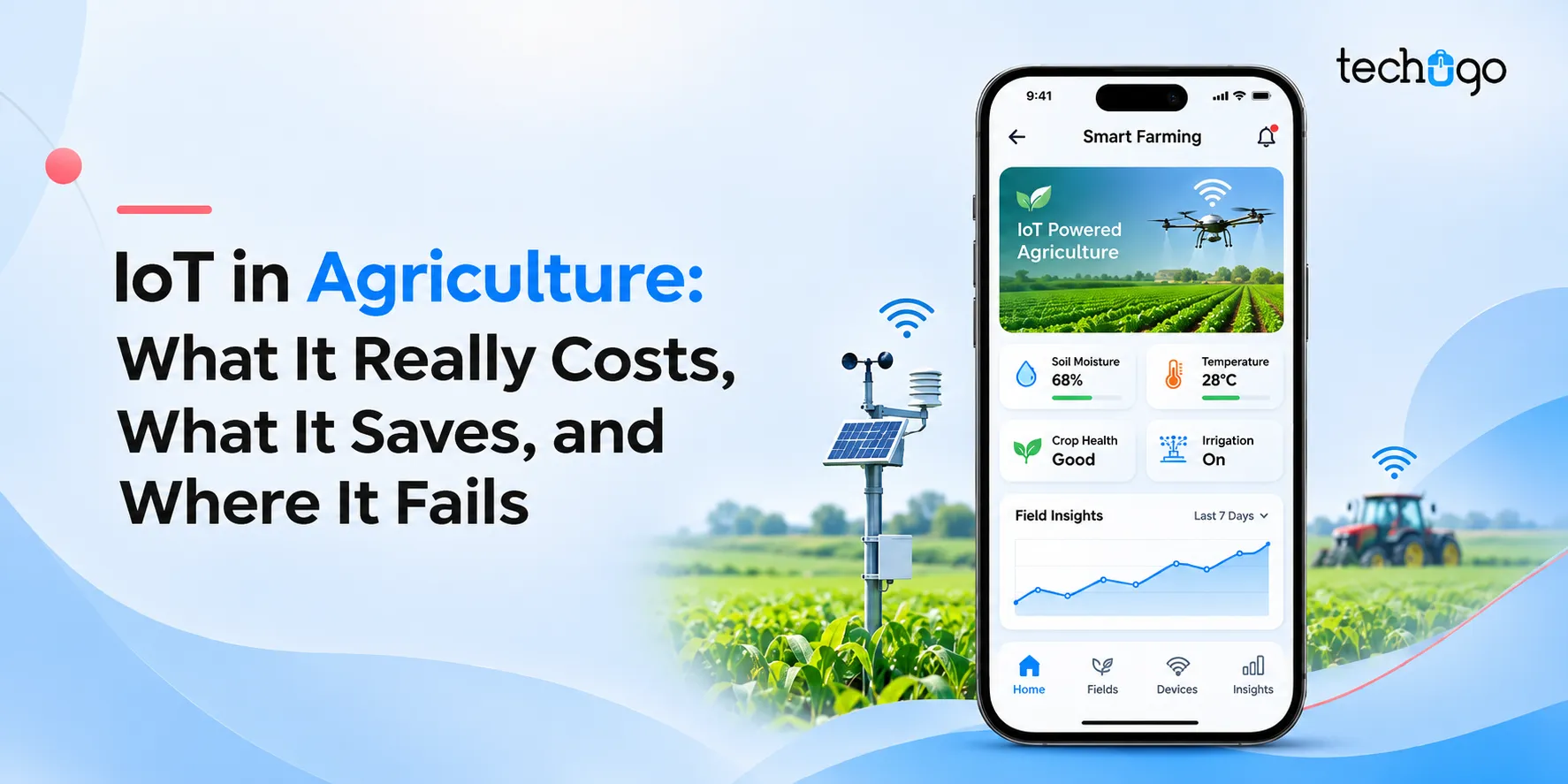
IoT in agriculture means employing internet-linked devices, tools, and gadgets for collecting and sending live data across farming fields. These devices track conditions such as soil moisture, temperature, humidity, crop condition, and climate, thus allowing companies to gain a better understanding of their crops’ conditions.
By means of IoT application development, organizations integrate all these devices into a single platform from which it is possible to monitor all farming processes, automate day-to-day operations, and benefit from remote access to essential data. Thus, agricultural companies are able to make the right decisions, use their resources smartly, and conduct large operations without spending too much time on it.
Understanding How IoT Works in Agriculture
The working of IoT in agriculture involves connecting sensors, equipment and other smart devices through the internet. These devices are installed across agricultural fields, greenhouses and storage facilities to monitor conditions like soil moisture, temperature, humidity, weather patterns & crop health.
The process follows a series of steps, starting with data collection and ending with informed decisions or automated actions. Here’s how it works –
Sensors & Smart Devices (collect real-time data) → Internet Connectivity (transfers the data) → Central Platform (processes and analyses data) → Insights & Alerts (provides useful information) → Automated Actions (triggers relevant operational changes).
The information is then transferred to a central platform where agricultural businesses can access it via dashboards and monitoring systems. If, for instance, the moisture in the soil reaches a certain level, the system can warn the responsible party to take action. Likewise, weather forecasts may be used to help a business adjust irrigation schedules due to the forecasted weather.
IoT applications in agriculture also enable enterprises to link different devices & appliances to a centralised platform, while agriculture software development makes it easier to manage these connections (and automate responses based on specific conditions).
Overall, such a connected system provides agricultural enterprises with enhanced control over their day-to-day operations and aids in coordinating their operations across various locations.
Planning to Invest in IoT for Agriculture?
Partner with Techugo to develop custom IoT solutions that help you monitor farm operations, manage resources and make data-driven decisions.
Real-World Applications of IoT in Agriculture
There are a number of practical uses of IoT in agriculture that enable ag businesses to manage various activities, keep track of field conditions, and enhance the efficiency of operations. It has a number of major applications such as:
1. Smart Irrigation Systems
Soil moisture sensors measure soil moisture, supplying business intelligence to help decide when watering is necessary. Also, connected irrigation systems can alter the water supply, taking into consideration the conditions in the field, and thus can make water supply management more efficient.
2. Crop Monitoring
The sensors are connected and gather data on the temperature, humidity, and other factors. This assists the agricultural teams in detecting changes that can impact crop growth and acting in a timely fashion.
3. Livestock Monitoring
Collars and tracking devices enable businesses to keep track of the animals’ movement and locations, as well as health-related indicators. This enables teams to monitor livestock over large areas.
4. Equipment Monitoring
Smart farming equipment that uses IoT can help businesses track the usage of their farm equipment and monitor its performance and provide them with information about maintenance needs. This helps to minimise unexpected equipment downtime.
5. Greenhouse Automation
Inside greenhouses, connected sensors are monitoring the temperature, humidity and light conditions. This can be fed into automated systems to control ventilation, lights, and temperature.
6. AI-Powered Farming
By integrating IoT data with AI in Agriculture, businesses can gain insights, detect patterns, and foresee potential challenges. These are all applications that can be used to help inform planning and operational decisions.
How IoT Benefits the Agriculture Industry
Every aspect of the agricultural business is benefiting from IoT as it provides resource management and operation monitoring. The enterprises can get real-time information from different devices and equipment and find out the problems they need to solve. Some key benefits of using IoT for agriculture include:
1. Better Resource Management
Connected sensors help companies track how much water is used, what conditions the soil is in – and other resources. This allows teams to reduce unnecessary waste of resources.
2. Greater Efficiency
Automatic systems reduce the need for manual monitoring. Companies can remotely control the use of water for irrigation and the operation of equipment, therefore saving time.
3. Data-Driven Decision-Making
IoT devices provide real-time information that helps agricultural teams understand field conditions and respond to changes. This supports more informed decisions across different operations.
4. Reduced Operational Costs
Early identification of equipment issues and better resource management can help businesses avoid unnecessary expenses and reduce unexpected downtime.
5. Better Monitoring Across Locations
Businesses can keep track of multiple fields, greenhouses and facilities from a single point of control with connected platforms.
The field of tech in Agriculture is growing and IoT in agriculture is playing an essential role in modern agriculture. It enables businesses to connect various processes and oversee them more effectively and efficiently.
Challenges Agricultural Businesses Face When Adopting IoT Solutions
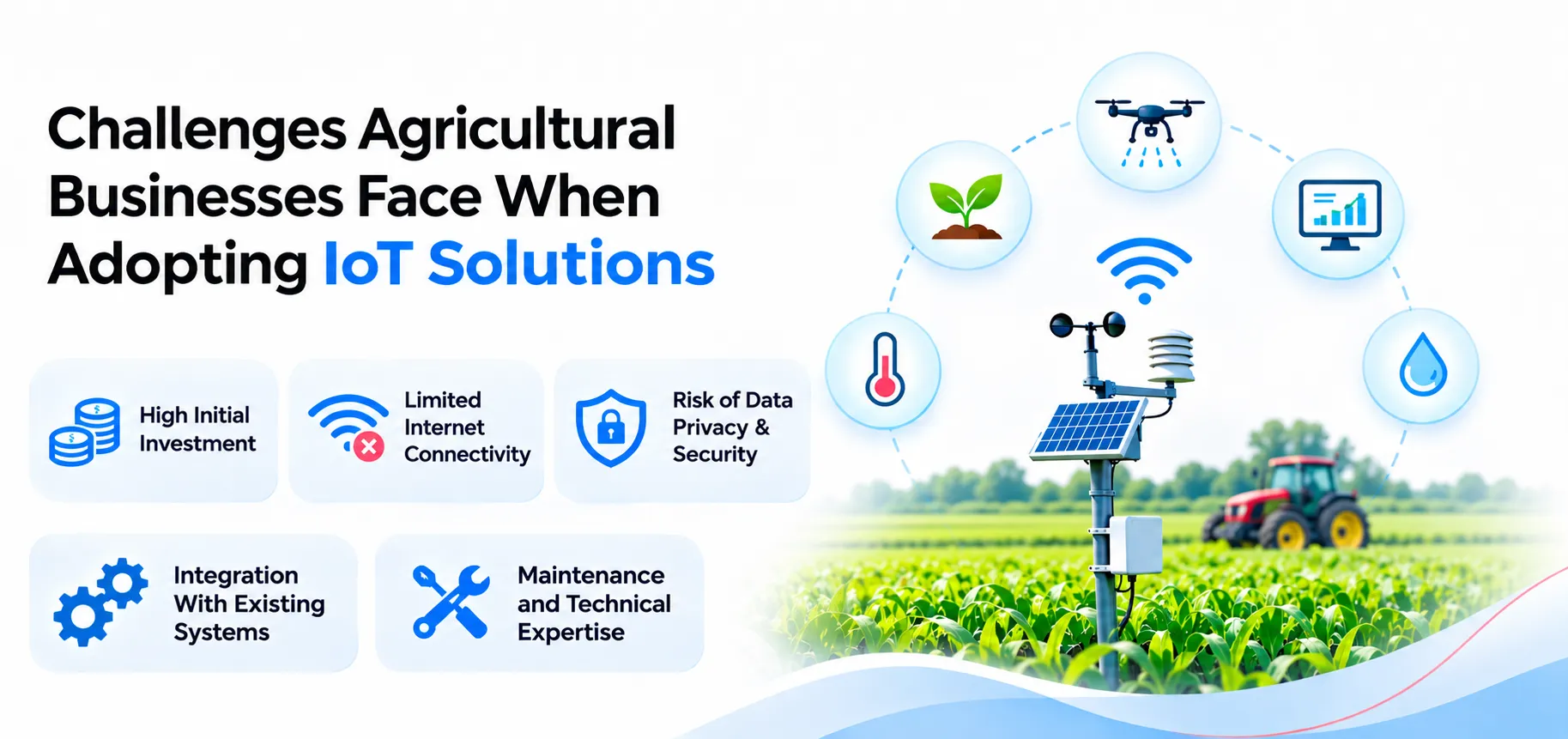
While IoT offers several benefits to the agriculture industry, implementing these solutions can also come with certain challenges. Before businesses start using connected technologies… they should take into account factors like infrastructure, price, information security and technical expertise. The difficulties are:
1. High Initial Investment
Investment in sensors, connected equipment, software platforms and network infrastructure is needed to set up IoT systems. The cost of implementing these technologies may be higher if they are applied at several sites in an agricultural business (or if the business has large landscaped areas).
Solution – Have a reasonable budget. Make an initial investment in the most important features only, and develop the system over time.
2. Limited Internet Connectivity
In order to gather and share real-time information, the IoT devices need a reliable Internet connection.
But sometimes agricultural fields are in remote areas where the network coverage may be limited. This can impact data transmission, remote monitoring and the performance of connected systems.
Solution – Choose suitable connectivity options. Explore different network technologies to ensure reliable communication between connected devices.
3. Risk of Data privacy & security
Large amounts of operational data are collected and shared across connected devices – security is of major concern. If not adequately protected, agricultural firms can be vulnerable to a variety of threats, including unauthorised access, data leaks and abuse of sensitive information.
Solution – Protect data! Keep data safe by applying different encryption as well as controlling access and updating software on a regular basis.
4. Integration With Existing Systems
Farm enterprises employ various tools and equipment to run their businesses. This can be tough when new IoT solutions need to be integrated into these existing systems, with devices communicating in different ways or employing different technologies. This also has implications for the Internet of Things in precision agriculture, where devices that are connected with each other must collaborate to provide accurate monitoring and decisions at the field level.
Solution – Check device compatibility. Choose IoT devices for agriculture that can integrate with existing farm equipment and software.
5. Maintenance and Technical Expertise
Regular maintenance, software updates and occasional troubleshooting of IoT devices are necessary to ensure they operate properly. Companies might also require experienced professionals who can control linked systems, analyze data and troubleshoot technical problems.
Solution – Train personnel. Provide practical training so that teams can use IoT in agriculture effectively and manage connected systems.
Types of Smart Farming Technologies Used Today
In smart farming, technologies assist farmers in making their businesses more efficient and easier to run by allowing them to keep an eye on their crops, manage resources and automate daily operations. As more and more agricultural businesses use IoT in agriculture, it allows businesses to link various devices, gather real-time data and make decisions faster about what’s occurring in their fields.
Now let us look at the various technologies that facilitate this process.
| Smart Farming Technology | Primary Application |
| IoT Sensors | Monitoring soil moisture, temperature, humidity and crop conditions |
| GPS and GIS Technology | Field mapping, navigation and precision farming |
| Drones and UAVs | Aerial crop monitoring, field surveys and spraying |
| AI and Machine Learning | Predicting crop conditions, analysing data and supporting decisions |
| Automated Irrigation Systems | Managing water supply based on soil and weather conditions |
| Robotics and Automation | Automating planting, harvesting and other agricultural tasks |
| Weather Monitoring Systems | Tracking weather patterns and forecasting environmental changes |
| Livestock Monitoring Devices | Tracking animal health, movement and location |
Such smart agriculture technologies can support diverse functions. Drones can be used to inspect large fields, but IoT can be used to monitor soil conditions and automation can be used to manage the supply of water. Thus, each technology performs its share of work and helps improve various aspects of agricultural processes and their management.
Role of AI, Machine Learning & IoT in Precision Agriculture
AI, machine learning & IoT are gradually reshaping how farming businesses monitor fields and manage everyday operations. While each technology has a different role, they work together to help businesses make better use of real-time information.
1. IoT for Real-Time Data Collection
The role of IoT devices is to collect information from sensors installed across agricultural fields. These sensors monitor soil moisture, temperature, humidity and other environmental conditions. With the growing use of IoT in agriculture, businesses can access real-time field data and keep track of multiple locations remotely.
2. AI for Smarter Agricultural Decisions
Artificial Intelligence utilizes information received from the devices to identify changes and important insights.
For example, AI-enabled systems are able to process photos of plants taken by drones and detect the possibility of plant diseases, pest attacks and lack of nutrients.
3. Machine Learning for Predictive Analysis
Machine learning studies past and current data to find patterns and predict what might happen next. That helps businesses figure out how much water the crops will need, anticipate crop-related issues and plan their resources better. As part of a smart farming system, some of those tasks can even run on their own based on what the system learns.
Ready to Bring AI and IoT to Your Farming Operations?
Build scalable farming solutions that use AI and IoT to simplify everyday operations and support smarter agricultural practices.
IoT in Agriculture: Traditional Farming vs. Smart Farming
IoT has introduced new ways to handle some of the most common agricultural activities. The applications of IoT cover different aspects of farm management and their impact becomes clearer when compared with the methods used in traditional farming.
A side-by-side comparison can help explain how IoT changes the way these activities are carried out.
| Basis | Traditional Farming | Smart Farming (IoT-Based) |
| Field monitoring | Relies heavily on manual field inspections | Uses connected sensors to monitor field conditions |
| Soil moisture | Farmers check soil moisture manually | Sensors track soil moisture in real time |
| Irrigation | Irrigation follows fixed schedules | Irrigation adjusts based on soil conditions |
| Weather tracking | Weather updates come from external forecasts | Connected devices collect local weather data |
| Equipment monitoring | Equipment is checked manually | Sensors track equipment performance and usage |
| Data collection | Field data is collected through manual observation | Data is collected and accessed remotely through connected devices |
How to Implement Smart Farming IoT Solutions in Agriculture
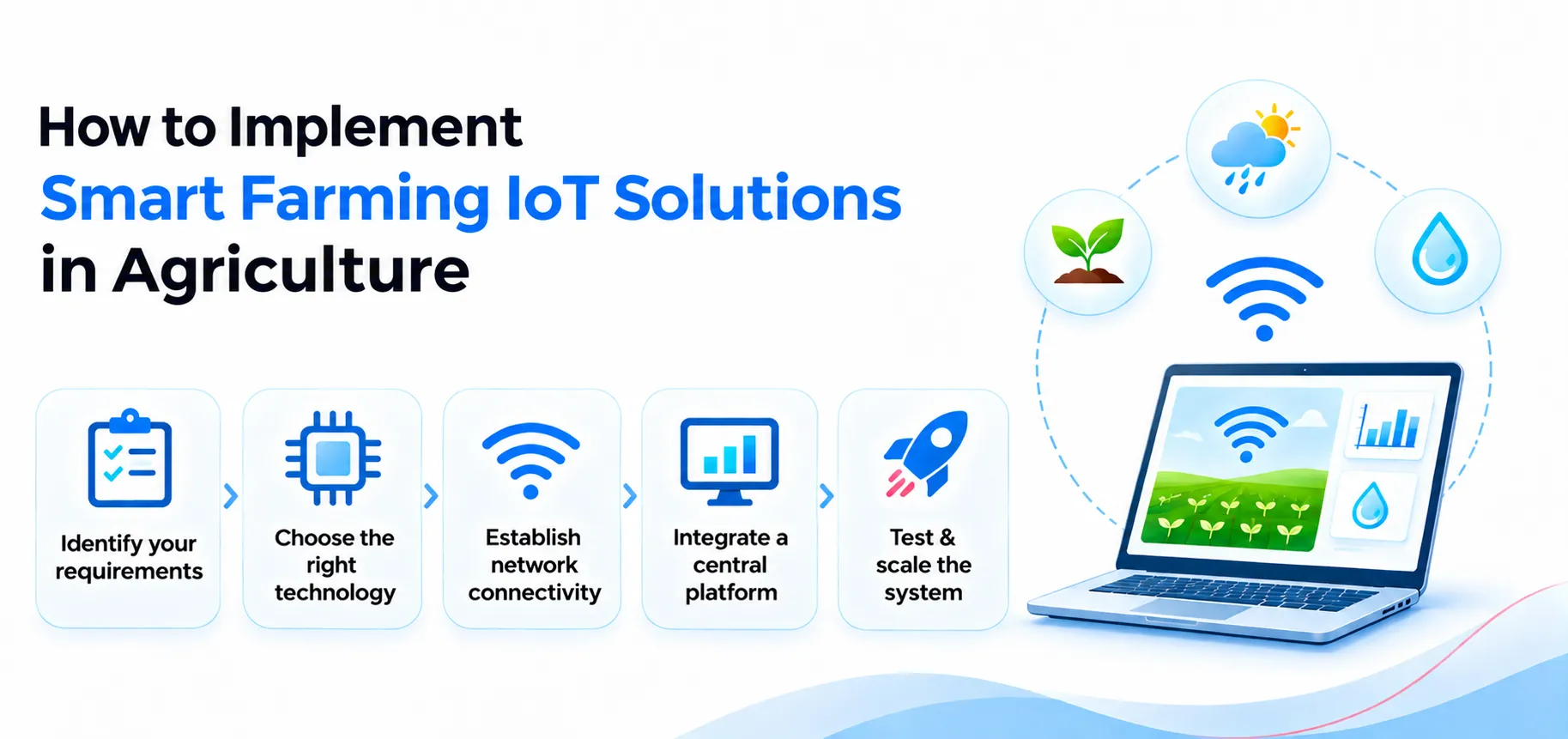
If you’re considering smart farming IoT solutions for your farm, you require a proper understanding of farm requirements and the right technology to support daily operations. Below are a few steps you can follow:
Identify your requirements – Determine which farming operations need improvement and where connected technology can add value.
Choose the right technology – Select suitable IoT devices, sensors and software based on your farm’s size and operational needs.
Establish network connectivity – Set up a reliable network to ensure connected devices can communicate and share information.
Integrate a central platform – Connect devices to a central platform where teams can access and manage farm-related data.
Test & scale the system – Start with a small implementation, evaluate its performance and then expand it as your requirements grow.
The Next Big Future Trends in IoT-Based Agriculture
What farming looks like today may change to a great extent over the next few years. The future of agriculture will be shaped by technologies that make farming more connected, data-driven and efficient. The growing use of IoT in agriculture is expected to introduce new ways of managing agricultural operations, with greater automation and access to real-time insights.
Here are some emerging trends to watch:
1. AI and IoT Integration
The integration of AI and IoT in smart farming will enable agricultural enterprises to process vast amounts of farm data, determine trends, and make better decisions.
2. Advanced Predictive Analytics
Going forward, future IoT systems will be leveraging historical and real-time data to better predict crop yields, identify potential threats and inform future crop planning decisions.
3. Autonomous Farming Equipment
Automated activities like planting, spraying and harvesting will be supported by the use of IoT-enabled tractors, drones and robotic equipment, which will reduce the need for manual labour.
4. Connected Supply Chains
The technology of IoT will enhance visibility outside the farm, as it will make it easier for businesses to monitor agricultural products when they’re in storage, in transit and in distribution.
5. Sustainable Farming Practices
Water, energy & other resource usage will be optimized through the use of connected technologies and this will facilitate sustainable agriculture.
How Much Does It Cost to Implement IoT in Agriculture?
The expense of using IoT in farming relies on various aspects such as size of the farm, necessities of hardware, connectivity and IoT application development. The intricacy of software and the level of customization desired can also determine the total investment cost here. Below is the estimated cost breakdown:
| Cost Component | Estimated Cost (USD) |
| IoT sensors and devices | $500–$5,000 |
| Connectivity and network setup | $500–$3,000 |
| IoT software and platform development | $5,000–$30,000 |
| Data storage and cloud infrastructure | $500–$5,000 |
| System integration | $2,000–$10,000 |
| Testing and deployment | $1,000–$5,000 |
| Estimated Total | $9,500–$58,000 |
The figures mentioned in the table can serve as a guideline for potential budget needs for a simple or mid-sized agricultural IoT project. However, the real cost will depend on the amount of devices in the network, its scale, data needs, complexity of the solution and what is needed for integrating the solution. For example, the expenses may be maximized in more complex projects with multiple locations requiring sophisticated analytics and sensor systems.
Factors that can increase the cost are:
- Number and type of sensors required
- Farm size and geographical coverage
- Custom dashboard and application requirements
- Integration with existing agricultural equipment
- Ongoing maintenance and connectivity charges
Techugo’s Experience in Building Smart Agriculture Solutions
Techugo has worked on projects that use technology to make things easier for farmers and others in the agricultural sector. Two such examples are our projects with ICRAF and the TOFI mobile application.
1. ICRAF
Techugo collaborated with ICRAF on its Trees Outside Forests in India (TOFI) initiative, which promotes agroforestry and expands tree coverage across seven Indian states. The main requirement of the project was to help farmers and other stakeholders find relevant agricultural information without difficulty. So Techugo built a platform that brings the useful resources together and lets people find what they’re after without having to search through multiple sources. We helped address the accessibility challenge and helped push the bigger goal behind the initiative, which was getting more people on board with agroforestry.
2. TOFI Mobile Application
The TOFI mobile application developed by Techugo aims to make agricultural resources and information more accessible. The project highlights how technology can address practical farming needs and support the adoption of digital solutions. Such initiatives also create opportunities to adopt technologies like IoT in agriculture and IoT energy management solutions to improve resource management.
FAQs
1. What technologies are used in agricultural IoT solutions?
Agricultural IoT solutions commonly use sensors, GPS, cloud computing, AI, machine learning, wireless communication protocols and data analytics platforms.
2. Can IoT solutions integrate with existing agricultural systems?
Yes. IoT solutions can integrate with existing farm management software, agricultural equipment, ERP platforms and monitoring systems, provided the technologies are compatible.
3. Why should agricultural businesses invest in custom IoT solutions?
Custom IoT solutions allow businesses to start with what they need today and introduce additional features as their operations become more demanding.
4. How can IoT improve agricultural supply chain management?
IoT enables businesses to track agricultural products during storage and transportation, monitor environmental conditions and improve inventory visibility across supply chain operations.

Get in touch
We'd love to hear from you.