

 SA
SA
 KW
KW
 IE
IE AU
AU UAE
UAE UK
UK USA
USA
 CA
CA DE
DE
 QA
QA ZA
ZA
 BH
BH NL
NL
 MU
MU FR
FR
















📌 Key Takeaways
- Agriculture apps are making farming more data-driven with AI and IoT.
- The biggest gap in agriculture apps today is integration between farming, logistics, and decision-making systems.
- 50–70% of large U.S. farms already use GPS and automation tools.
- Successful agriculture apps focus less on complexity and more on usability, real-time insights and actionable recommendations.
Farming used to start with soil, seeds, and weather guesses.
Now it starts with data.
And maybe a mobile app.
Because today, a farmer doesn’t just ask “Will it rain?” – the system already knows. It tracks soil health, and it predicts yield, also flags crop diseases, and sometimes it even tells you when something is about to go wrong before it actually happens.
That’s exactly the shift agriculture mobile app development is driving: turning farming into something more connected, more precise, but also far less dependent on guesswork, because now data is doing what humans used to estimate.
Also Read – How Tech in Agriculture Is Transforming Farming
Best apps for agriculture
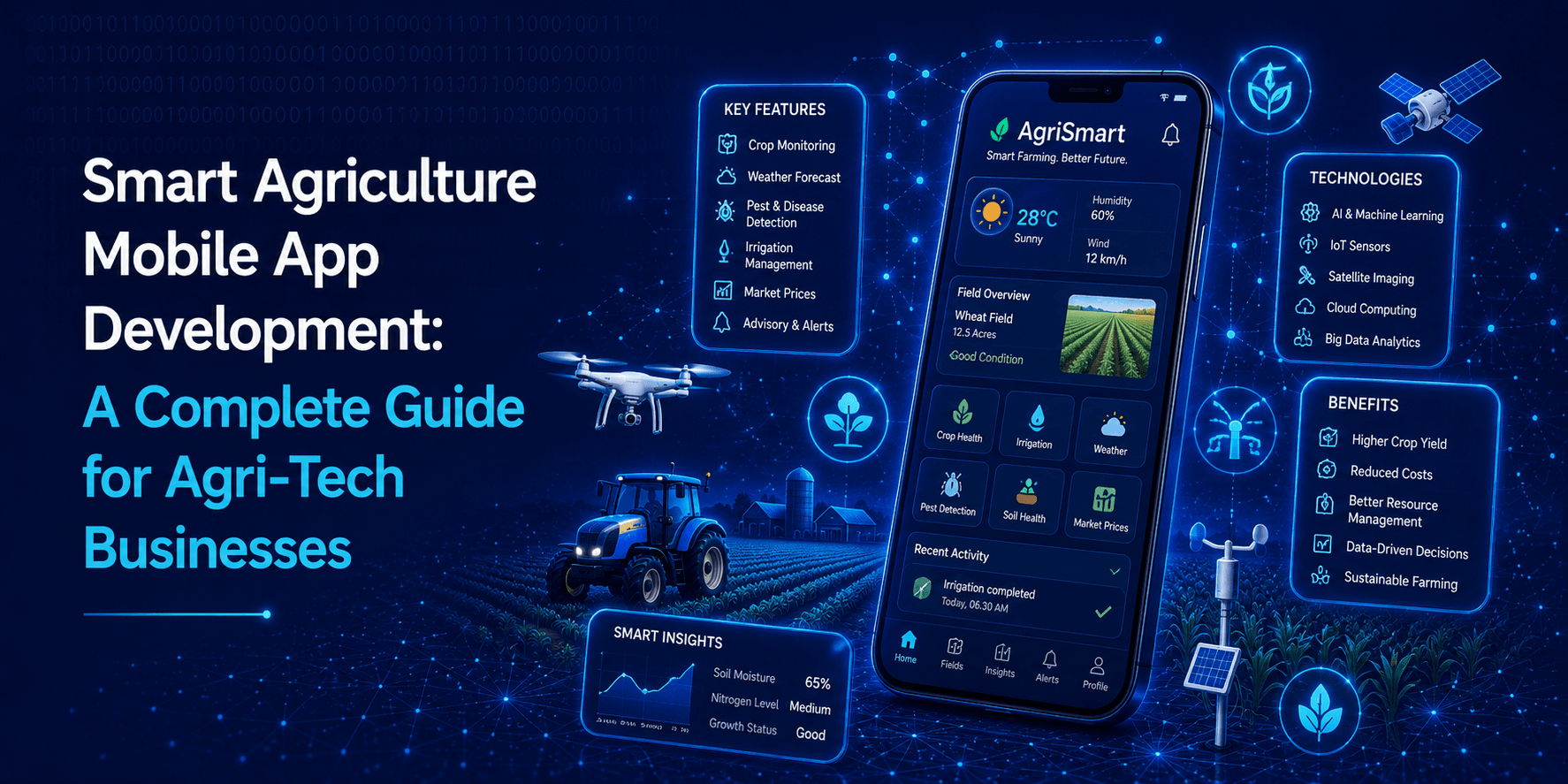
The agriculture app space has evolved into a full ecosystem powered by agriculture mobile app development, where simple tools have now turned into intelligent systems solving real farming challenges. Today these apps are no longer standalone utilities – they’re part of broader digital farming solutions that connect data, farmers, and decisions in real time.
Let’s break it down clearly.
Types of existing aggri apps
Most agricultural platforms for farmers today fall into a few major categories:
- Crop monitoring apps
Track crop health using satellite data, images, and sensors to detect issues early. - Farm management apps
Help manage farm operations like scheduling, labor, inventory, and planning. - Weather & forecasting apps
Provide real-time weather updates so farmers can make timely irrigation and harvesting decisions. - Marketplace apps
Act as a layer that connects farmers directly with buyers, removing middlemen. - IoT-based smart farming apps
Use connected sensors to monitor soil, moisture, and environmental conditions in real time.
What makes these apps successful
The most successful agriculture mobile apps don’t just offer features — they solve real problems in a simple way:
- Clean and easy-to-use interface for farmers
- Real-time updates that support quick decisions
- Offline or low-network functionality for rural areas
- Actionable insights instead of raw data
- Strong focus on usability across different farming conditions
In short, the best agricultural platform for farmers doesn’t overwhelm users — it simplifies their daily decisions.
Gap opportunities in the market
Even though digital farming solutions is growing rapidly, there are still major gaps in the market:
- Lack of fully integrated platforms combining multiple farming functions
- Limited AI-driven decision-making inside most apps
- Poor connectivity between IoT devices and agriculture mobile apps
- Weak personalization based on crop type, region, and soil conditions
- Very few end-to-end applications that connect farming, logistics, and sales together
The biggest gap in the market right now?
👉 Simplicity + real-time intelligence.
This gap is exactly where the next generation of agriculture app development is heading – building smarter, unified, and more predictive ecosystems instead of isolated tools.
In the United States, precision agriculture adoption is already well advanced among large-scale farming operations. According to the USDA Economic Research Service, more than 50–70% of large-scale U.S. crop farms use automation and guidance systems such as GPS-based autosteering and yield mapping technologies.
With this context in mind, let’s look at the cost side.
Agriculture mobile app development cost in USA
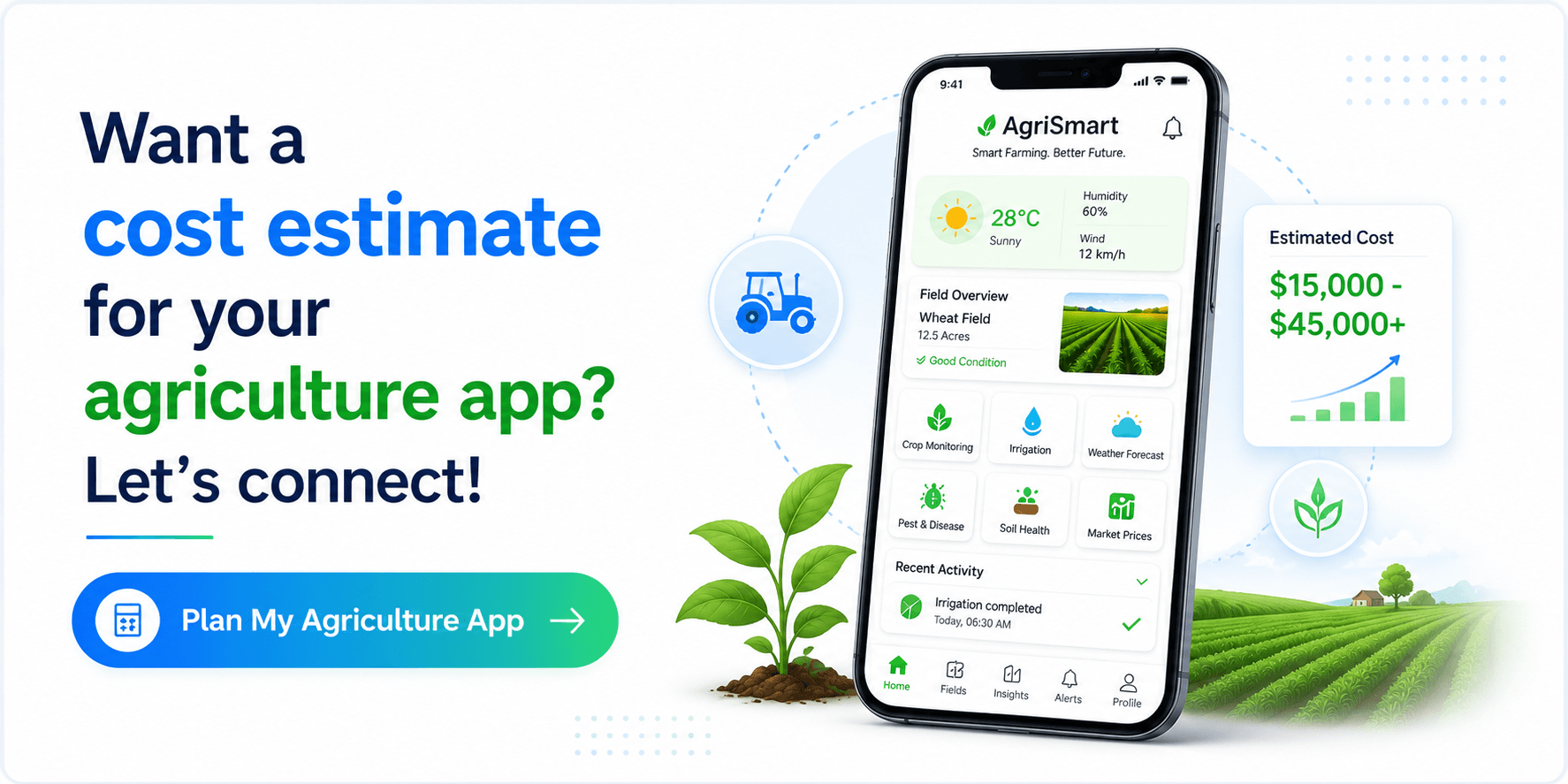
The cost of building an agricultural platform for farmers depends heavily on the level of features, technology stack, and integrations like AI, IoT, and real-time data systems.
Here is how the cost is divided
| App Type | Estimated Cost (USD) | Timeline |
| Basic Farming App | $25,000 – $50,000 | 2–3 months |
| Mid-Level Smart Farming App | $50,000 – $120,000 | 3–6 months |
| Advanced AgTech Platform | $120,000 – $200,000+ | 6–12+ months |
But what actually affects the cost?
The cost to develop a smart farming app varies based on several important factors:
- App complexity and number of features
- Integration of AI, machine learning, and predictive analytics
- IoT connectivity with sensors, drones, and GPS systems
- UI/UX design quality and user experience depth
- Backend architecture and cloud scalability
- Expertise of the AgTech software development company you choose
👉 The more “real-time intelligence” you add, the higher the cost goes.
Because now it’s not just an app – it’s a connected system.
So things like AI models, IoT sensors, cloud systems, and data processing all play a big role in pricing.
Use cases of agriculture mobile apps for farmers and agribusinesses
Smart farming is no longer just about monitoring crops – it’s about making agriculture more data-driven, efficient, and predictive. This is exactly where agriculture mobile app development and modern digital tools are transforming traditional farming practices.
Also Read – Get Multiple Agriculture Benefits with Security Drones for Farms
Below are some of the most practical real-world use cases:
1. Farm management & monitoring
Farmers can track crop health, soil conditions, irrigation schedules, and overall field performance in real time, and everything gets centralized into one dashboard so that you don’t have to rely on manual records anymore. With smart farming app development it becomes easier, because the data was earlier scattered but now it are all in one place, therefore decisions are faster.
2. Weather forecasting & climate alerts
Apps now integrate live weather data and it helps farmers plan sowing, irrigation, and harvesting activities more accurately and yes, this reduces crop loss and improves productivity, but also sometimes forecasts were not perfect so farmers still adjust based on ground reality.
3. Precision agriculture with IoT
Using sensors, GPS, and drones farmers can monitor soil moisture, nutrient levels, and field conditions with high accuracy and this is where custom software development for agriculture industry plays a big role, because it connects devices and systems that earlier were working separately and now they are connected, so that resources are used more efficiently.
4. Supply chain & market connectivity
Smart farming apps are also connecting farmers directly to buyers, distributors, and marketplaces, reducing middlemen and improving profit margins, and it was something that earlier was very fragmented but now it is becoming more structured.
5. AI-based farming recommendations
Modern platforms provide personalized insights such as when to irrigate and how to improve soil health – all driven by agriculture mobile app development technologies, so that farmers are not just guessing but actually acting on data.
Features of agriculture mobile apps
If you really break it down, a good agriculture app is just trying to make farming less guesswork and more clarity.
1. Weather forecasting integration
Farming depends so much on weather that even a small change can mess things up. So having live weather updates inside the app just helps farmers plan better without second-guessing.
2. IoT sensor connectivity
This is basically what brings “real field data” into the app, especially in IoT-based smart farming apps. Sensors in the soil track moisture, temperature, nutrients and all that, and send it directly to the phone. So instead of assuming what the field needs, farmers actually know.
3. AI-based yield prediction
This one helps farmers get a rough idea of how much they might harvest. It’s not perfect, but it gives a direction like when to sell, how to plan storage, or what to expect.
4. Farm management dashboards
Think of this as the main screen where everything shows up – crops, updates, alerts, data. No jumping around different systems, everything is just… there.
5. Real-time alerts and push notifications
If something changes in the field (weather, pests, soil issues) the app just notifies you instantly so you can act fast instead of finding out too late.
6. AI chatbots
And then there’s the chatbot part. Basically, if a farmer has a question, instead of waiting for an expert, they can just ask the AI chatbot integrated inside the app and get a quick answer or guidance.
Step-by-step process of agriculture mobile app development
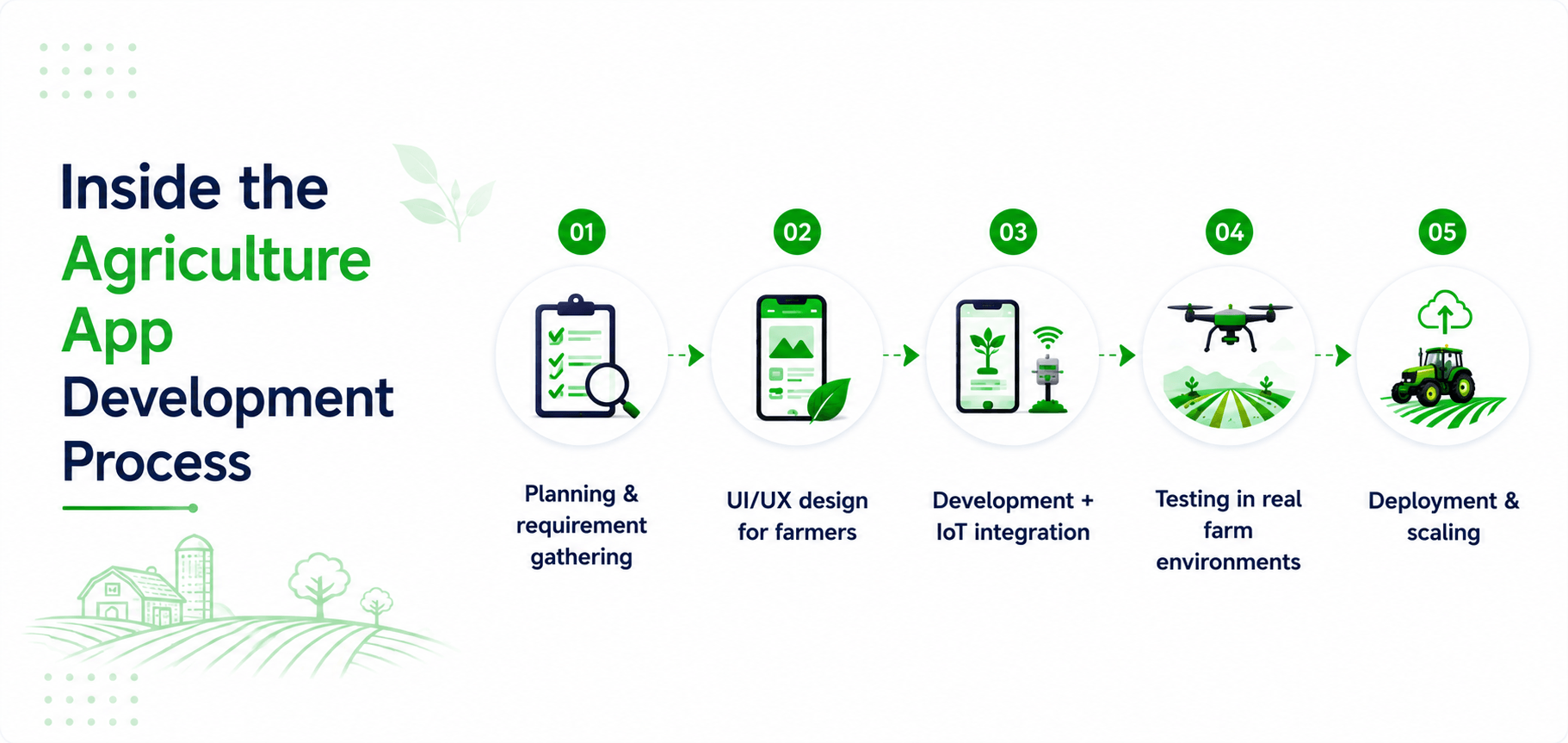
Building a farming app isn’t overly complicated in theory, but in practice it needs a very clear process because you’re dealing with real-world conditions, not just screens and code.
Here’s how it usually works step by step in agriculture mobile app development:
Also Read – How Tech in Agriculture Is Transforming Farming
1. Planning & requirement gathering
Everything starts here. Before any design or development, the goal is to clearly understand what problem you’re solving. Are you building for small farmers, large agribusinesses, or both? This stage sets the direction for the entire development process, because every feature depends on real user needs.
2. UI/UX design for farmers
This step is more important than people think. The app has to be extremely simple and practical. Farmers shouldn’t have to figure things out — it should just feel natural. So clean screens, easy navigation, and minimal complexity become the focus here.
3. Development + IoT integration
This is where the actual build happens. Developers start connecting APIs, weather systems, backend logic, and IoT devices like sensors. In modern agriculture app development, this is the core phase where everything comes together into a working digital farming system.
4. Testing in real farm environments
This is not just about testing in a lab. The app is actually tested in real farms to see how it performs under real conditions like network issues, weather changes, and field data variations. This step helps refine the product before launch.
5. Deployment & scaling
Once everything works smoothly, the app is launched. After that, it’s scaled based on user demand and feedback, which is an important part of long-term agriculture mobile app development success.
Challenges in agriculture app development and their solutions
Building agriculture mobile apps is not as simple as it looks. These apps work in real farming environments where conditions are unpredictable, the network is unstable, users also have different levels of tech skills and data comes from multiple sources like sensors & weather systems, so because of this the development becomes more complex than expected.
Because of this, development comes with several real challenges such as:
1. Poor connectivity in rural areas
Many farming regions still have weak or unstable internet and agriculture apps often depend on real-time data, but when the network drops it becomes difficult to function properly, so that is where issues start.
Solution:
Apps are built with offline-first functionality, data are stored locally and then synced when internet is available, and also lightweight app design is used so that dependency on constant connectivity is reduced, therefore it still works in low network areas.
2. Lack of digital literacy among farmers
Not all users are comfortable using mobile apps. Some prefer very simple, direct interactions. Sometimes even basic navigation becomes confusing if the app is too complex.
Solution:
The UI is kept simple with minimal steps. Local language support, voice assistance, and clear icons are added so that users can easily understand it easily without confusion, because the goal is that you should not struggle while using it.
3. Integration with IoT devices and sensors
Agriculture apps often need to connect with devices like soil sensors, drones, GPS systems and these devices use different technologies – and that makes integration difficult, so it is not always smooth.
Solution:
APIs and middleware are used to connect hardware and software. This helps standardize data, ensures smooth communication between devices and the app so everything works together even if systems are different.
4. Data accuracy and reliability
Agriculture decisions depend heavily on data like weather, soil, and crop conditions. If the data is incorrect it can lead to wrong decisions, and therefore reliability becomes very important.
Solution:
Multiple data sources are used instead of relying on one and AI models are also used to validate and improve accuracy over time, so that the system becomes more reliable as it learns.
5. High development and maintenance costs
Advanced features like AI, IoT integration, real-time dashboards increase development cost and maintenance effort – it becomes more expensive as complexity grows.
Solution:
Most projects start with an MVP and only core features are built first, and after validation the app is scaled step by step, and cloud infrastructure also helps reduce upfront costs so that the system can grow gradually.
Monetization models for agriculture mobile apps
Making money from agriculture apps is a bit different compared to normal consumer apps. You’re not just dealing with casual users – you’re dealing with farmers, agribusinesses, suppliers, sometimes even governments. So the monetization has to actually make sense in that ecosystem, not just look good on paper.
Most successful agriculture apps don’t rely on one revenue stream. They usually mix a few models depending on the users and features.
1. Subscription model
This one is pretty common. Basically, users pay monthly or yearly to access advanced features. Things like AI-based recommendations, crop insights, yield predictions, or detailed analytics usually sit in the paid tier.
The basic version is often free, just to get people in and let them try it first.
It works better for bigger farms or agribusinesses because they actually see ongoing value in the data.
2. Freemium model
This is more of a “try first, pay later” approach.
The app is free to use at a basic level.
But once users need deeper insights or smarter features, that’s when payment comes in.
For example, basic weather updates might be free, but detailed soil analysis or AI predictions are paid.
It lowers the entry barrier, which is important in agriculture because adoption is still growing.
3. Marketplace commissions
A lot of agriculture apps also turn into marketplaces. Farmers sell produce. Buyers purchase directly. No middlemen in between. The app takes a small commission from each transaction.
This works really well because it’s tied directly to real usage, not just app engagement.
4. Data-based revenue model
Agriculture apps collect a lot of useful data – crop patterns, soil info, yield trends, weather impact, and more.
This data (when anonymized and aggregated) can be useful for agribusiness companies, research organizations, or even government planning.
So in some cases, platforms monetize insights from data.
But this has to be handled carefully because privacy matters a lot here.
5. SaaS for businesses
Some apps don’t even focus on individual farmers.
Instead, they target agribusinesses, cooperatives, or large farming operations.
They offer tools like farm management systems, logistics tracking, inventory, and analytics as a subscription service.
Companies pay based on usage or number of users.
6. Hardware + software model
This is common in IoT-based smart farming apps.
Companies sell devices like sensors or monitoring equipment along with the app.
So revenue comes from both hardware sales and software usage.
It becomes more of a complete solution rather than just an app.
AI in agriculture: the future of smart farming apps
Now this is where things are really heading.
AI in agriculture is slowly becoming the backbone of modern farming apps, and it’s changing how decisions are actually made on the farm. Earlier, farmers would react only after a problem showed up. But now AI helps them spot what might go wrong in advance and deal with it early, which honestly changes the whole approach.
With data from weather patterns, soil conditions, and crop history, AI can forecast crop yield, detect plant diseases early, suggest the right irrigation timing – and even track long-term soil health trends. It also helps in supply chain decisions by giving a clearer idea of demand and pricing, instead of everything being based on assumptions.
One of the most useful outcomes of this is AI-based farming recommendations. Here, the app doesn’t just display data, it actually guides farmers on what to do next – when to water, what to plant, or how to respond if something looks off in the field.
So farming slowly moves away from guesswork and becomes more about clarity and informed decisions.
And that’s the shift happening right now: from traditional farming to smarter, more AI-driven systems.
How to choose the right agtech software development company
Choosing an AgTech software development company is not really about picking “a development team.” It’s more about finding someone who actually gets what farming looks like in the real world.
Because building an agriculture app in a meeting room is easy. Building it for real farms, real weather, real users… that’s where things change.
So yes this decision matters more than it looks.
Industry experience in AgTech or related domains
First thing – don’t ignore experience.
And not just “we build apps” experience.
You want to know if they’ve worked around real-world systems like logistics, IoT, or data-heavy platforms.
Why? Because agriculture is not a simple use case.
There are seasons. There are delays. There are field conditions that don’t behave the way software expects. If a company already understands that kind of complexity, half your problems are already solved.
Look for AI and IoT capabilities
Modern agriculture apps are not just apps anymore. They’re connected systems: sensors in soil, drones in air and AI models predicting crop health.
So if a development company is not comfortable with AI and IoT, it’s going to show later.
And usually not in a good way.
You want a team that can actually handle real-time data, machine learning models, and device integration without making it feel forced or patchy.
Ability to build scalable architecture
Here’s something people underestimate. If your agriculture app works, it won’t stay small. It grows fast.
More users = more data = more devices.
So if the backend is not built properly, things start breaking when you scale. That’s why scalability is not “later work.” It’s day-one thinking. Cloud systems, modular architecture – all of that matters more than it sounds at the beginning.
Focus on simple and practical UX
This one is big because your users are not developers. They don’t care about fancy dashboards or complex navigation.
They care about – “Can I understand this in 10 seconds?” If the answer is no, they drop it. Simple UI wins herelways. Less clicking. Less thinking. More clarity.
That’s what actually makes adoption happen in agriculture apps.
End-to-end development capability
This part is often ignored until it becomes a problem.
You don’t want one team designing, another coding, another testing, and everyone blaming each other later.
A good AgTech company handles everything together.
Idea → design → development → testing → launch → scaling.
When that flow is smooth, the product feels consistent in real life too.
Agriculture app development trends to watch in 2026
1. AI is becoming more decision-driven
AI is no longer just an add-on feature. It is becoming the core of agriculture apps, where systems suggest actions like irrigation timing, crop selection, and yield improvement based on real-time and historical data.
2. Expansion of IoT-based smart farming
IoT adoption is increasing across agriculture. Sensors, drones, and GPS systems are being used to monitor soil, weather, and crop conditions in real time, moving farms toward fully connected systems.
3. Shift toward predictive farming
Agriculture apps are moving beyond forecasting. They now use climate patterns, soil data, and crop history to predict risks and guide farmers before problems actually happen.
4. Rise of unified agriculture platforms
Instead of separate apps for weather, farming, and marketplaces, the trend is moving toward single platforms that combine farming, logistics, and sales in one system.
5. More focus on simple user experience
Apps are being designed for ease of use with voice support, regional languages, and simple navigation so that farmers can use them without technical difficulty.
How Techugo helps you launch scalable agri-tech solutions
If you’re planning to turn this idea into a real product, working with the right development partner makes all the difference.
Techugo is a leading mobile app development company in the USA, focused on building scalable, high-performance digital solutions powered by modern technologies like AI integration, Flutter app development, cloud computing, and IoT-enabled systems. From integrating smart sensors to building AI-driven analytics and real-time dashboards, the emphasis is on creating practical, future-ready applications that perform reliably in real-world environments.
Whether you’re looking to build a simple mobile application or a full-scale digital platform, Techugo helps you design, develop, and scale your product using the right technology stack, including Flutter for cross-platform development, AI/ML models for intelligent features, and cloud-based architectures for scalability and performance.
You’ve already seen what’s possible with smart farming.
So now’s the time to take action – contact our team and we’ll help you build it.
FAQs
1. How much does agriculture mobile app development cost?
The cost of agriculture app development depends on features and complexity. A basic app may start around $25,000, while advanced AI and IoT-based smart farming platforms can go beyond $200,000.
2. How does IoT help in agriculture apps?
IoT connects sensors placed in fields to the app, allowing farmers to monitor soil moisture, temperature, and nutrient levels in real time so they can respond quickly instead of relying on assumptions.
3. What is the role of AI in agriculture apps?
AI in agriculture helps analyze data from weather, soil, and crops to predict yield, detect diseases early, and provide AI-based farming recommendations that improve productivity and reduce risk.

Get in touch
We'd love to hear from you.