

 SA
SA
 KW
KW
 IE
IE AU
AU UAE
UAE UK
UK USA
USA
 CA
CA DE
DE
 QA
QA ZA
ZA
 BH
BH NL
NL
 MU
MU FR
FR















📌 Key Takeaways
- 10.41 million electronic medical records show how quickly Dubai’s digital healthcare ecosystem is growing.
- Compliance comes first. Your app should meet Dubai’s healthcare regulations, data privacy standards, and security requirements.
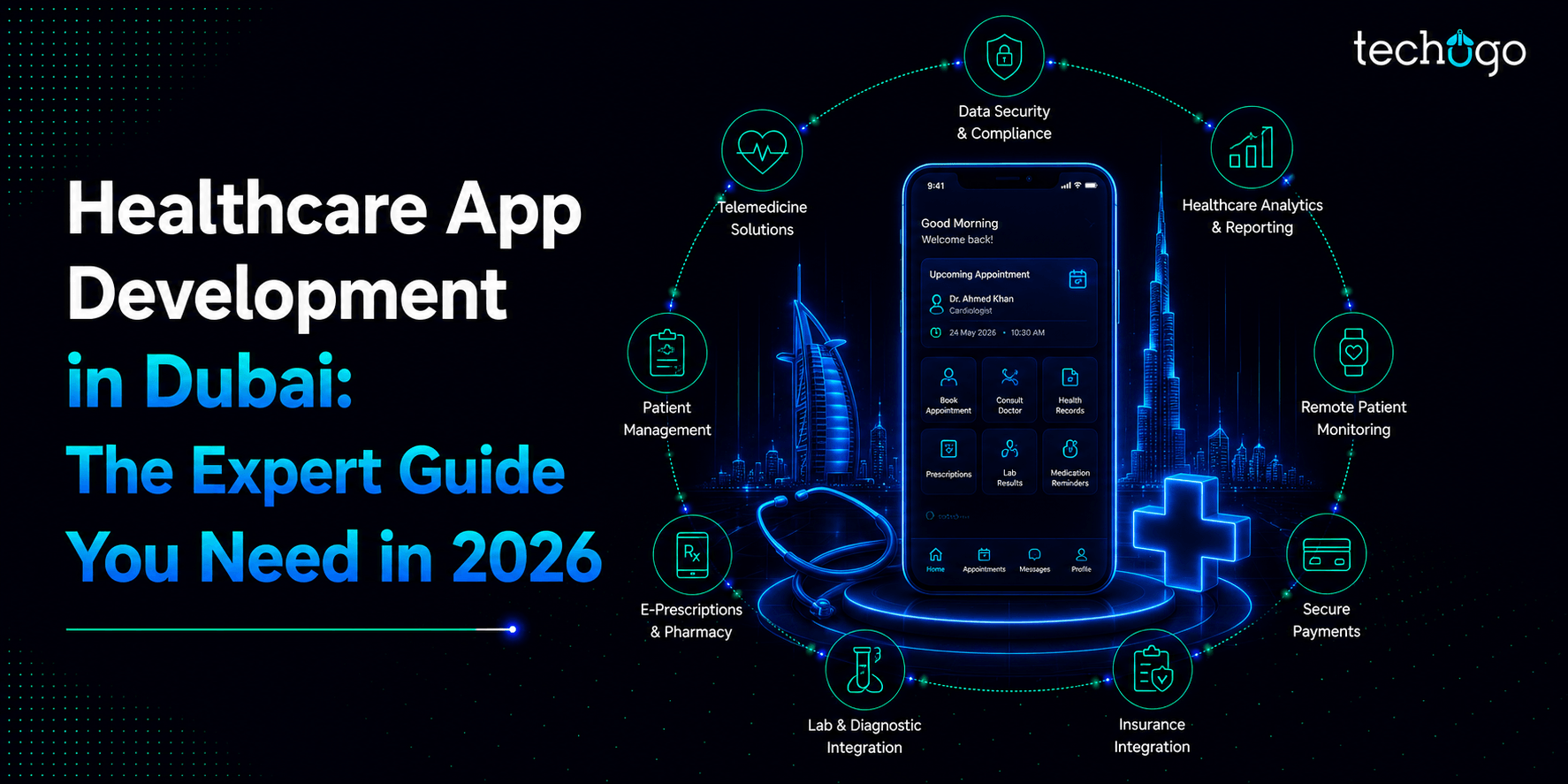
- Some of the most important features are appointment booking, telemedicine, electronic health records, e-prescriptions & secure payments.
- The total cost to build such a healthcare app is based on factors like complexity and the integrations you need.
- Choosing the right mobile app development company in Dubai will help you a lot in building a secure and compliant healthcare app.
Convenience has officially become part of healthcare.
Banking went mobile. Shopping went mobile. Food delivery went mobile. Healthcare was always going to follow.
Healthcare in Dubai’s gone completely digital lately. You can book a doctor, have a video call with one, or check your medical records (all without leaving your couch).
If you’re a provider, it’s an opening for you.
Like, it makes the everyday work easier. It helps you keep up with patients and even minimises a lot of manual work.
This is what healthcare app development is all about. It could be a telemedicine platform, a pharmacy app or remote patient monitoring, but whatever it is, the strategy has to be right. So in this guide, we’re breaking down everything including features, types, costs, compliance and so much more.
So let’s get started!
Why invest in healthcare app development in Dubai?
By the first half of 2025, Dubai’s NABIDH platform had grown to 10.41 million electronic medical records – connecting 1,888 licensed healthcare facilities, 53,659 healthcare professionals, and 91 EMR systems.
This is what the report says.
There are so many other reasons why healthcare app development is booming in Dubai and why you should invest. Take a look –
1. Dubai is going all-in on digital health
The city’s whole innovation agenda is nudging hospitals and clinics to stop dragging their feet and actually invest in proper app development. And this is why demand for experienced healthcare app developers keeps going up and up.
2. Increasing adoption of telemedicine
Virtual consultations and remote monitoring have gone from a pandemic workaround to something patients genuinely expect. That alone is bringing a lot of new app development work.
3. Need for secure patient data management
With so much sensitive patient information moving online, providers can’t just build an app and be done. No. There’s still a need for ‘secure patient data management’.
4. More clinics going digital means more demand
Every hospital or clinic that makes the switch adds to the pressure on the rest to follow. It’s creating a wave of demand for custom-built healthcare solutions.
Hard truth – the clinics and hospitals that are already working with a healthcare app development company right now are the ones who’ll be way ahead when everyone else is still figuring it out.
Common types of healthcare apps and their uses
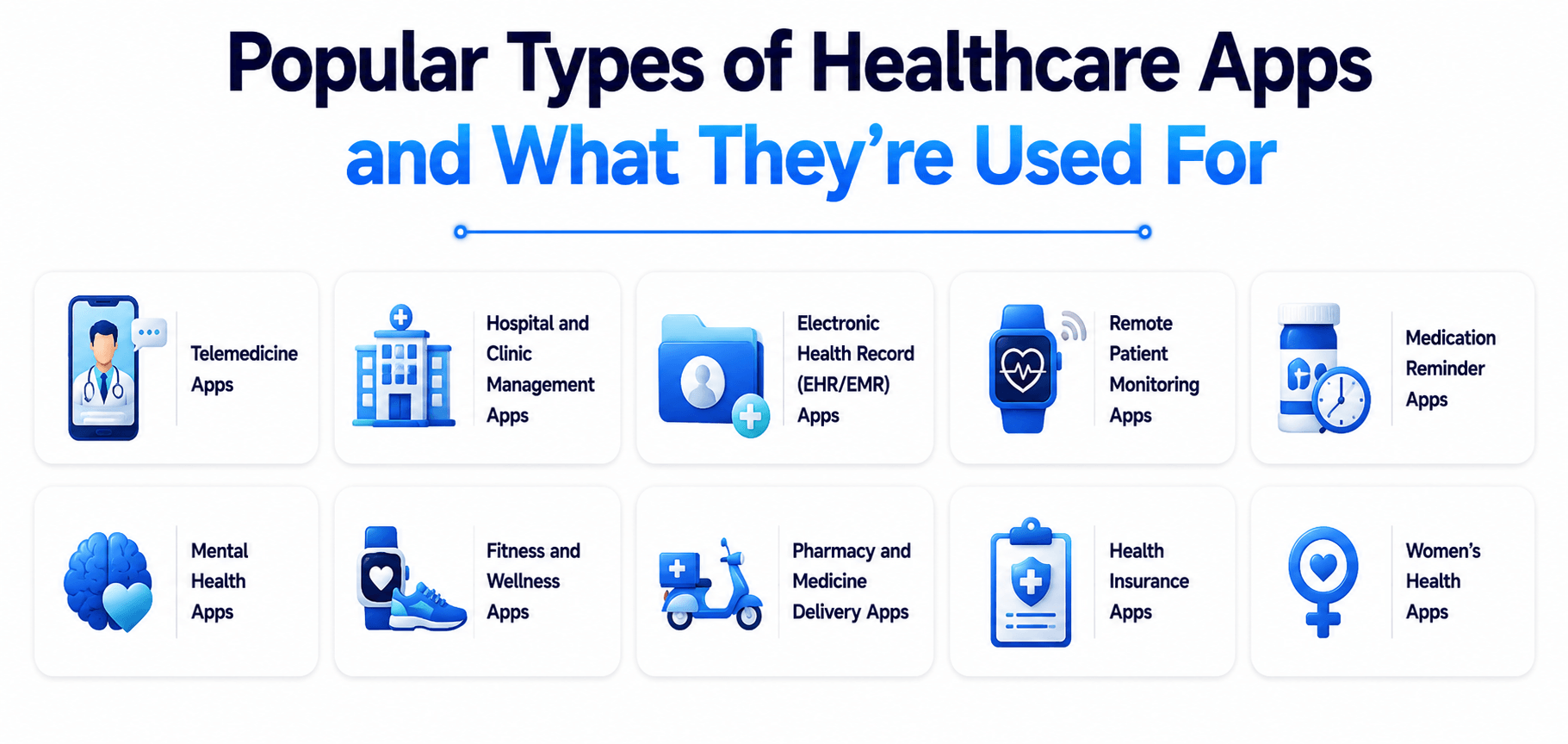
1. Telemedicine apps
Used for virtual consultations, video calls, e-prescriptions, and remote follow-ups.
2. Hospital and clinic management apps
Hospital & clinic management apps are for appointment scheduling, patient records, billing & staff coordination.
3. Electronic health record (EHR/EMR) apps
To secure access to patient medical histories, test results, and treatment plans.
4. Remote patient monitoring apps
Used to track patient vitals in real time using connected wearables and IoT devices.
5. Medication reminder apps
Basically helps users manage prescriptions, dosage schedules, and refill alerts.
6. Mental health apps
Offer therapy sessions, mood tracking, meditation, and self-care resources.
7. Fitness and wellness apps
It’s to monitor workouts, nutrition, sleep, and overall health goals.
8. Pharmacy and medicine delivery apps
Used to – enable online prescription uploads, medicine ordering, and doorstep delivery.
9. Health insurance apps
Health insurance apps are used to manage claims, policy details, provider networks, and digital payments.
10. Women’s health apps
Used to support menstrual tracking, pregnancy care, fertility, and postpartum health.
This whole space basically falls under custom healthcare app development – and it’s a big reason mobile app development companies in Dubai are seeing so much demand from healthcare clients these days, since each of these categories needs pretty different features and compliance handling.
Essential healthcare app features for better user experience
1. Secure login and user authentication
Since healthcare apps deal with super sensitive data, security has to be there. Biometric login, multi-factor auth, role-based access – these keep patient info safe.
2. Appointment booking and scheduling
Booking, rescheduling, cancelling.
These three are the basics, and they should all take a few seconds. Real-time availability and reminders help reduce the chances of missed appointments.
3. Telemedicine and video consultations
This is probably the biggest reason people get into telemedicine app development these days. Being able to consult a doctor over video means patients don’t have to sit around waiting rooms, and follow-ups become a lot more convenient.
4. Electronic health records (EHR) integration
When EHR is integrated properly, doctors can just pull up history, prescriptions & lab reports on the spot. Speeds up decisions a lot.
5. E-Prescriptions
Prescriptions go digital, straight to the pharmacy the patient picks. Pro – almost no probability of errors.
6. Medication reminders and push notifications
Quick reminders for meds and checkups, but they actually keep people on track more than you’d expect.
7. Secure payments and insurance support
Payments and insurance claims handled inside the app which makes the whole billing process effortless.
8. Analytics and admin dashboard
Gives providers a better view of appointments, engagement, and performance. You can usually tell how experienced healthcare mobile app developers are by how well they handle this part of a healthcare app development project.
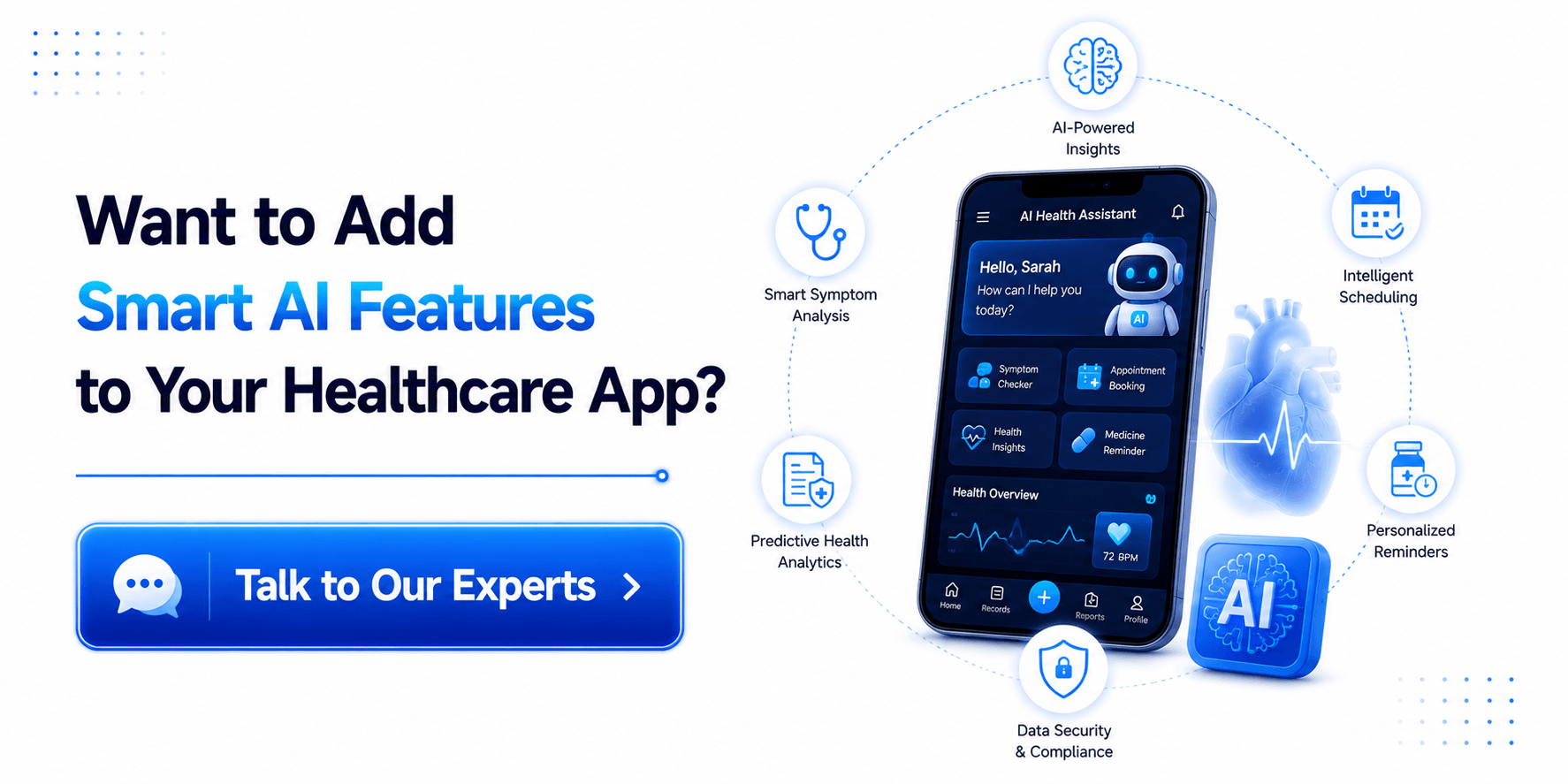
Top AI features in healthcare apps
The basics get your app running. But it’s AI that makes it premium.
With that in mind, let’s explore the AI capabilities changing healthcare apps from the inside out.
1. AI chatbots and symptom assessment
Instead of googling symptoms and spiraling into panic… patients can just chat with an AI bot that asks the right questions and points them in the right direction like book a doctor, head to the ER, or just rest it out.
2. Predictive analytics for early diagnosis
An AI can spot patterns in patient data way before a human might catch them.
3. Voice-to-text clinical documentation
Doctors talk and AI transcribes and organizes it into proper medical notes (saves hours of typing).
4. AI-powered medication management
- Tracks what a patient’s taking
- Flags dangerous drug interactions
- Predicts if someone’s likely to skip doses (based on their behavior patterns)
5. AI-assisted medical imaging analysis
For scans, X-rays, and MRIs, AI can help spot anomalies faster and sometimes catches things that are easy to miss at first look.
6. Smart appointment scheduling and no-show prediction
AI looks at patterns and predicts who is likely to miss an appointment – so that clinics can send extra reminders or double-book smartly.
7. AI-powered insurance fraud detection
AI flags suspicious claims patterns way faster than manual review, saving insurers (and patients) a lot of trouble.
So these are the features that come up again and again when people talk about AI in healthcare app development these days. By the way, it’s a big part of why healthcare application development looks so different than it did a couple of years back.
Custom healthcare app development process: step by step
Step 1: Define your goals
So the first thing you have to do is figure out the problem your app is going to solve (and who it’s actually for). Because if you figure things out early, the whole project kind of loses its footing.
Step 2: Conduct market research
You’ve got to study what your competitors are doing, and what users are expecting, and also the healthcare regulations that apply to you.
It’s a lot but this is the only way you can spot what competitors are missing
Step 3: Plan features and create wireframes
List out the features you need. Map the journeys users are going to take through the app. And then build wireframes, because you want to see it before you build it, not after.
Step 4: Design the UI/UX
The interface has to be intuitive. It has to be accessible. Patients, doctors, admins – they’re all going to be using this, so it needs to work for everyone, not just one type of user.
Step 5: Develop the app
This is where you build the frontend and the backend and the APIs and all the integrations, and you’re doing this while also implementing security measures and healthcare compliance standards.
Step 6: Test the application
You have to test for function, for security, for usability, for performance – across devices because obviously it’s not going to work the same way on every phone.
Step 7: Launch the app
Deploy it on the App Store and Google Play, and then you have to watch it closely, especially in those first few weeks because that’s when the real issues tend to show up.
Step 8: Maintain and improve
Now that it’s launched… you’re releasing updates, fixing bugs, adding features, and keeping the app compliant, because regulations keep changing and so do user expectations, so you have to keep up.
This entire process – planning, building, testing, maintaining – is basically what custom healthcare software development means in practice
If your team hasn’t built healthcare apps before, it’s a good idea to hire mobile app developers in Dubai who have. There’s a lot to get right in this space, and experience helps avoid the common mistakes.
Healthcare app development cost in Dubai: what to expect in 2026
Before you start doing the math…
Know this: You won’t find a standard price that works for every healthcare app.
Your budget depends on the features, security, integrations, and compliance your product needs. That’s why the healthcare app development cost in Dubai usually ranges between AED 100,000 and AED 1,500,000+.
This is how it breaks down –
|
App Type |
Estimated Cost (AED) |
|
Basic App |
100,000–250,000 |
|
Mid-Level App |
250,000–700,000 |
|
Advanced Platform |
700,000–1,500,000+ |
So, where do you fit?
If this is your first healthcare product, you don’t need to build every feature right out of the gate. A good healthcare mobile app development company will help you figure out what actually matters now versus what can wait until later. That way your money goes toward what your users really need first, and your healthcare software development budget doesn’t spiral out of control.
Top technologies powering healthcare apps in Dubai
1. Frontend: Flutter, React Native, Swift, and Kotlin for fast, responsive healthcare apps.
2. Backend: Node.js, Python, .NET, and Java to power secure, scalable applications.
3. AI & Machine Learning: Symptom checkers, virtual assistants, predictive analytics, and medical insights.
4. Cloud Computing: AWS, Microsoft Azure, and Google Cloud for secure data storage and scalability.
5. NABIDH & EHR/EMR Integrations: Connects patient records across different healthcare providers.
6. IoT & Wearables: Apple Health, Google Fit, and connected medical devices for remote patient monitoring.
7. Telemedicine Technology: Secure video consultations, real-time messaging, and virtual care.
8. Security & Compliance: End-to-end encryption, multi-factor authentication, OAuth 2.0, and secure APIs to protect sensitive patient data.
Healthcare app compliance requirements you need to know
Safe to say, healthcare app development takes a lot more than a great idea. So, where do you begin? Start with the essentials.
Here’s what should be on your checklist:
HIPAA – Protects patient health information through strict privacy and security standards. (Remember – You can compromise on launch dates. You can’t compromise on a HIPAA-compliant healthcare app).
GDPR – Gives users control over their personal data and requires clear consent.
NABIDH (Dubai) – If you’re building for Dubai, your app needs to support NABIDH standards for secure health information exchange and interoperability.
End-to-end encryption – Every patient record, message, and medical report should stay protected.
Role-based access control – Access should be limited based on who’s using the app – doctors, nurses, patients, administrators, all get different levels.
Audit logs – Keep a full record of who accessed or changed patient data. This matters just as much for security as it does for compliance.
Secure cloud infrastructure – Store healthcare data on cloud platforms that are actually compliant, with regular backups and a real disaster recovery plan in place.
Patient consent management – Make it simple for users to understand what data you’re collecting, why, and how they can manage or withdraw their consent.
Even something like a pharmacy app development company handling prescription data and medical history has to take all of this seriously, since the risks aren’t any smaller just because it’s “just” a pharmacy app.
What is NABIDH and why does it matter for healthcare apps?
Okay, so if you’re building a healthcare app that is going to operate in Dubai, you really can’t ignore NABIDH.
It’s basically the backbone that ties together hospitals, clinics, pharmacies, labs… pretty much every healthcare provider in the city – onto one connected network.
But why does it matter? Why should you care?
Because it means patient data isn’t confined to a single hospital’s system. When your app is properly integrated with NABIDH, doctors can view a patient’s full history (like previous visits, test results, prescriptions) – regardless of where that patient was treated before.
If you’re building for Dubai’s healthcare space, this isn’t an option because DHA (Dubai Health Authority) expects providers to be interoperable. And NABIDH integration is how you prove your app plays nice within that ecosystem and meets their compliance standards.
How Dubai’s medical tourism industry is driving healthcare app development
Want to attract more international patients to Dubai? It starts with the app experience you’re offering them.
To meet the needs of international patients, healthcare organizations are investing in features like:
1. Booking appointments before they land – patients can lock in their treatment slots while they’re still back home.
2. Virtual consultations – so doctors can assess patients before they travel and check in on recovery after they’ve flown back too.
3. Access to medical records from anywhere – patients aren’t stuck carrying physical files or requesting PDFs from clinic to clinic.
4. Multilingual support – because a lot of these patients aren’t native English or Arabic speakers and language shouldn’t come in the way of good care.
5. Payments and insurance sorted out digitally – nobody wants to deal with confusing billing while they’re already stressed about medical trip.
6. Staying connected after they leave – through chat, notifications, recovevry tracking – so the relationship doesn’t end after they fly back home.
Challenges of building healthcare apps in Dubai
1. Regulatory compliance challenges
Challenge: Look, healthcare apps in Dubai need to comply with the regulations from the Dubai Health Authority (DHA). So if your app doesn’t comply, you’re not just risking fines, you’re risking people never trusting it again.
Solution: Build around DHA requirements. Get your compliance person involved before you start building, and check in on it as you go. (This is step one in any healthcare app development project).
2. Data security and patient privacy
Challenge: Patient records are exactly what hackers want so these apps get targeted a lot.
Solution: Encrypt everything, add MFA, limit who can see what & run security tests every so often.
3. Integration with EHR and legacy systems
Challenge: So many hospitals in Dubai already run EHR, lab – and billing systems that don’t link up with newer apps easily.
Solution: FHIR and HL7 make this easier. Build the APIs properly and test the connections before the product goes live.
4. Multilingual user adoption
Challenge: Dubai’s healthcare system serves people from all over the world. So an English-only app may not be enough for your audience.
Solution: Design for multiple languages (especially Arabic and English)
(This is something experienced healthcare software development services team plans for right from the start).
5. Integration with NABIDH
Challenge: In Dubai, if you don’t plan for NABIDH, it will cost you later.
Solution: It’s better to work with developers who understand Dubai’s healthcare ecosystem – and can build software that supports NABIDH.
Scalability & performance
Challenge: Works fine with a couple hundred users, then slows to a crawl once more people join.
Solution: Build it on the cloud, use microservices, and keep tabs on performance as usage grows.
Note: If you’re partnering with a mobile app development company in UAE, make sure this kind of long-term thinking is part of the plan.
Healthcare app development trends in the UAE
1. Smarter AI Experiences
The UAE is already investing a lot in AI for healthcare app development. You’ve got virtual assistants (to answer basic questions), symptom checkers & tools that help doctors catch things earlier than they would’ve on their own.
2. Wearables & remote care
- Smartwatches
- Fitness trackers
- Medical devices
These are pretty much everywhere in Dubai now. Moreover, it’s all becoming a normal part of healthcare mobile app development. Doctors can check in on patients without them needing to come in.
3. Remote patient monitoring
With connected devices, doctors can keep track of patients from far away, so people aren’t stuck going in for every little check-up.
4. Interoperability
- Hospitals
- Clinics
- Pharmacies
- Insurers
The goal now, across the UAE’s healthcare sector, is getting all of them to share data properly. A big part of that starts with legacy app modernization, since a lot of these older systems were never built to connect with anything new.
5. Better healthcare connectivity
All the Hospitals, clinics, labs, pharmacies and insurers in the UAE are trying to get on the same page when it comes to data (NABIDH in Dubai is a big part of that).
How to choose the right healthcare app development company in Dubai
1. Look for healthcare expertise
Always go with a team that’s actually worked on healthcare projects before. If they know their way around HIPAA, GDPR, EHR/EMR integrations, and telemedicine platforms, that experience will save you a ton of time.
2. Evaluate their technical capabilities
The sign of a good healthcare app development partner is that they are comfortable building things that scale and know how to work with newer tech like AI and cloud setups.
So just take a look at their tech stack, how they work, and of course – what they’ve built before.
3. Prioritize security & compliance
Patient data isn’t something to take lightly. It needs real good protection. So make sure whoever you’re working with follows secure development practices.
4. Check support beyond launch
Once you launch your application, your work is officially done – something I’d never say.
Because the actual work in mhealth app development starts after the launch. So you should ask the healthcare software development company you’re partnering with if they provide post-launch support and maintenance.
Build the next big healthcare app in Dubai with Techugo
Great healthcare apps are not built overnight. In a market like Dubai, the team behind your app matters just as much as the idea itself.
At Techugo, we are an award-winning mobile app development company that people trust, and we bring healthcare know-how together with modern tech to build apps that are secure, scale well, and are actually easy for people to use. So far, we’ve built all sorts of telemedicine platforms, patient portals, and
AI-powered healthcare apps. We handle the whole process ourselves, start to finish. Doesn’t matter if you’re just starting out or you’re already an established healthcare provider, our team’s going to work with you to turn what you have in mind into an app that actually performs and brings real value, whether that’s for patients, providers or your business.
So, if you’ve got a healthcare app idea, maybe it’s time to give it the attention it deserves. Talk to our team.
FAQs
1. How much does healthcare app development cost in Dubai?
The cost to build a healthcare mobile app in Dubai usually ranges from AED 100,000 to AED 1,500,000+.
2. How long does it take to develop a healthcare app?
Most healthcare apps take 3 to 12 months. A simple MVP can launch much faster, while feature-rich apps naturally take longer.
3. What features should a healthcare app have?
It depends on your goals, but popular features include appointment booking, telemedicine, secure messaging, e-prescriptions, payments & patient records.
4. Do healthcare apps in Dubai need to comply with local regulations?
Yes. Healthcare apps in Dubai need to follow UAE healthcare regulations and data privacy rules.

Get in touch
We'd love to hear from you.