

 SA
SA
 KW
KW
 IE
IE AU
AU UAE
UAE UK
UK USA
USA
 CA
CA DE
DE
 QA
QA ZA
ZA
 BH
BH NL
NL
 MU
MU FR
FR


















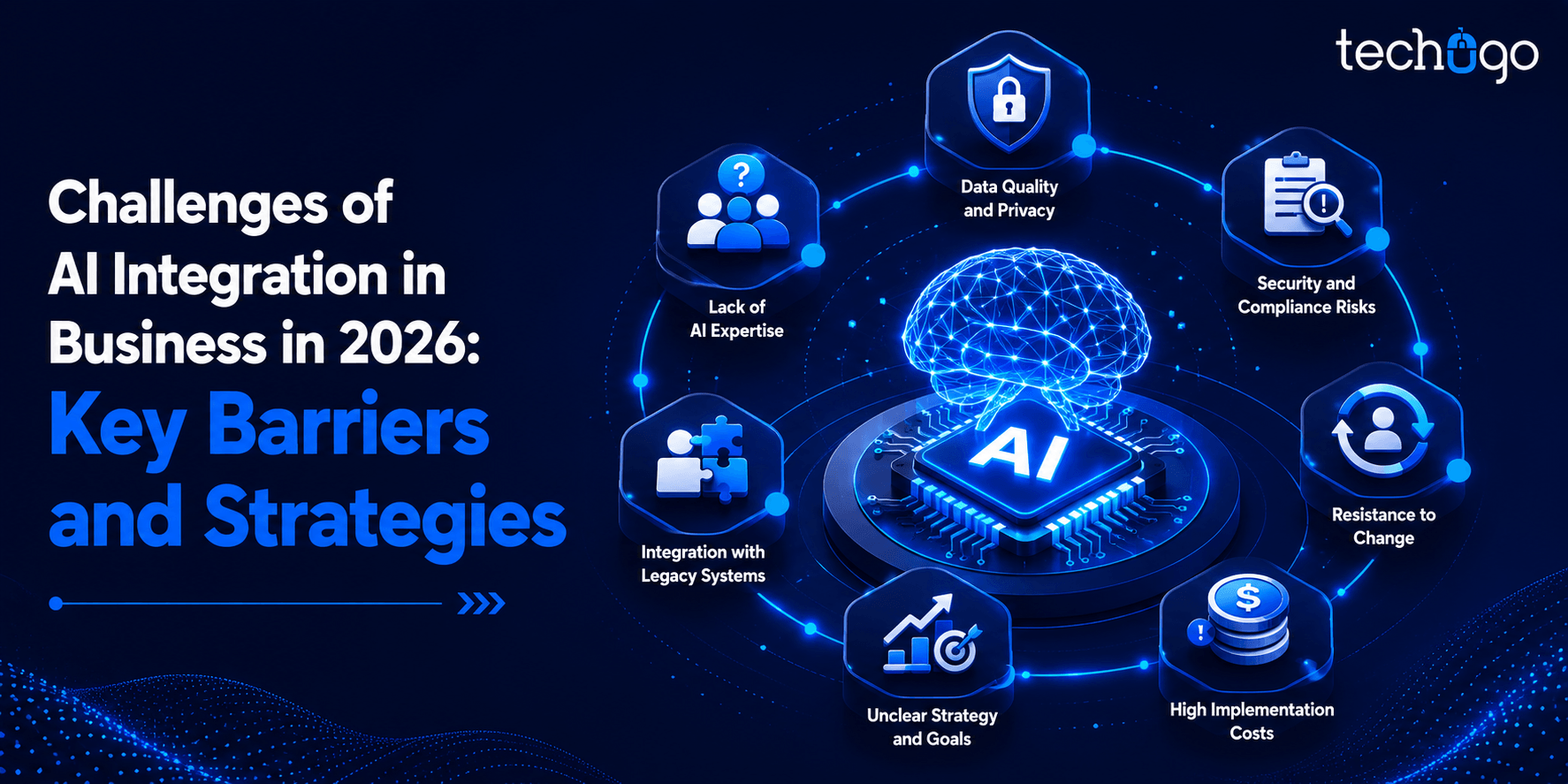


📌 Key Takeaways
- AI integration brings challenges like data privacy, security, and compliance issues.
- Poor data quality can reduce AI model accuracy and performance.
- Integrating AI with existing systems can be complex and time-consuming.
- High development and implementation costs remain a major challenge.
- Businesses need skilled AI experts for successful AI adoption and management.
We all get intrigued by the creative innovation of technology; chatbots, virtual assistants, and automated vehicles, which are a part of artificial intelligence. To describe the main functionality of AI, it can be stated that it focuses on the creation of machines that can replicate human behavior and decision-making.
Indeed, with AI, the science fiction of yesterday has become the reality of today. Businesses today are rapidly adopting intelligent systems. Among the biggest concerns they face are AI integration challenges that impact scalability and execution.
Looking closely around you, it can be measured that this very technology has transformed how businesses operate and interact with their customers. And no prize for guessing, but across almost every industry, AI in business is delivering measurable growth and efficiency.
According to Statista, the global AI market is projected to surpass $305 billion by 2026, reflecting the rapid pace of AI adoption across industries.
At the same time, a report by PwC suggests that AI could contribute up to $15.7 trillion to the global economy by 2030, making it one of the most impactful technologies shaping business transformation.
Well, this is just a synopsis of the global impact of AI and reflects how rapidly AI adoption in businesses is growing. However, when it comes to discussing the pool of advantages offered by AI, then this post would not complement the needs. AI has been around for a while, and it has come on leaps and bounds in that time. Whether it’s AI integration in startups or in enterprises, this technology has much more to offer.
Its worthy mechanism has made it a hot favorite of big guns like Google, Netflix, and Amazon, among many others. This creates pressure for businesses (still left) to embrace AI technology, streamline operations, and expand their revenue funnel.
But there is another side of the story as well, and that is the AI integration challenges waiting at the door. Before integrating any new technology, you need to pay attention to every side of it, and playing blind to AI implementation challenges is not an ideal choice.
The below post will give you a better understanding of AI technology in business and the challenges standing along with it.
Key AI integration challenges that businesses face today in 2026
While AI adoption is growing rapidly, businesses in 2026 are facing newer and more complex integration issues. Let’s look at them…
AI data quality and governance issues
AI systems heavily rely on large volumes of data, making AI data challenges one of the most critical barriers in successful AI integration. Managing the quantity, collection, cleaning, labeling, and governance of data cannot be ignored in modern AI-driven systems.
Artificial intelligence learns from available information in a way similar to humans, but at scale it requires significantly larger and more structured datasets to identify meaningful patterns. This is where most AI integration challenges in business begin.
However, AI cannot function beyond the quality and scope of the data it is trained on, which creates a clear gap between expectations and real-world performance. Poor data quality, fragmented data sources, and lack of governance often lead to inaccurate outputs and unreliable predictions.
To bridge this gap, companies must establish strong data governance frameworks, invest in data engineering practices, and ensure continuous data flow that aligns with AI model requirements. This helps organizations improve model accuracy and ensures smoother AI implementation in business environments.
AI bias and ethical risks
AI technology works with the “black box” models, where we end up getting a conclusion or a prediction but no explanation to it. Although, if the conclusion offered by the system matches your understanding, then there is no doubt to arise, but if you disagree with the solution, then you certainly want to know how the decision was made, and how that solution is considered to be the right option. This lack of transparency is one of the key AI explainability challenges in modern AI integration in business. This gap creates trust issues, especially in critical sectors like healthcare, finance, and enterprise decision-making.
This is where the demand for explainable AI (XAI) becomes important. AI systems must not only deliver accurate results but also provide clear reasoning, data traceability, and decision logic behind their predictions. Without this, organizations face increasing AI bias and ethical risks, which can directly impact trust, compliance, and adoption.
AI talent shortage and skill gap
Artificial Intelligence continues to face a significant challenge in the form of a lack of skilled expertise, making the AI talent shortage one of the major barriers in successful AI integration in business.
As organizations integrate AI into their operations, the demand for skilled professionals in machine learning, data science, and AI system management continues to rise. However, many businesses struggle to keep pace with skill requirements.
Hiring professionals who are well-versed in AI technologies is often a difficult and time-consuming process. This includes roles such as AI engineers, data scientists, and MLOps specialists, which are still in limited supply compared to market demand.
This growing AI skills gap forces companies to rethink their internal capability building, invest in upskilling existing teams, and adopt a long-term strategy for AI adoption in enterprises rather than relying solely on external hiring.
Learning transfer challenges in AI
The AI model is expected to use the experience from one field to another, through the process called the transfer of learning, the way humans do. But when it comes to Artificial Intelligence, there are difficulties to carry its experiences from one set of circumstances to another. While transfer learning improves efficiency in training models, it does not always guarantee accurate performance when the model is applied to a significantly different environment or dataset.
In many cases, AI systems struggle with generalization across domains, especially when data patterns, user behavior, or business contexts change. This becomes a key concern in AI implementation challenges, where models trained in one setting fail to deliver consistent results in another.
As a result, organizations must carefully evaluate how and where transfer learning is applied, ensuring proper fine-tuning and domain-specific training to improve reliability and performance.
Rising cost of AI implementation
Well, it is a little expensive to integrate AI in the business model, as AI requires expertise, advanced infrastructure, and continuous model training, and this all comes with a price. This leads to startup ventures to consider their budget issues much before thinking about investing into it.
In addition, ongoing costs such as cloud infrastructure, data storage, and AI model optimization further increase the long-term financial commitment, making AI adoption in enterprises a strategic rather than impulsive decision.
Indeed, it is a great tool to trigger user-experience and enhance revenue goals as well, but the money investment along with it must be considered.
AI explainability and trust gap
AI systems often operate as “black box” models, where they produce outcomes or predictions without clearly revealing how those decisions are made. This lack of transparency creates one of the most significant AI explainability challenges in modern AI integration in business.
While the results may be accurate, businesses and users increasingly want to understand the logic, data inputs, and decision pathways behind AI-generated outputs. Without this clarity, it becomes difficult to fully trust or validate AI-driven decisions, especially in critical sectors such as healthcare, finance, and enterprise operations.
This growing AI trust gap highlights the need for explainable AI (XAI) solutions that provide visibility into model behavior. By improving transparency, businesses can enhance accountability, reduce bias concerns, and build stronger confidence in AI implementation across organizations.
Just Read : The Future Of Customer Service with AI Chatbot Integration in UAE Apps
What are the smarter AI integration strategies?
While AI integration challenges are real, businesses can overcome them with a more structured and strategic approach rather than rushing adoption.
1. Start with a clear AI use-case strategy
Instead of applying AI everywhere, businesses should begin with specific, high-impact use cases such as customer support automation, predictive analytics, or process optimization. A focused approach ensures better ROI and reduces implementation risks.
2. Invest in data readiness before AI deployment
High-quality data is the foundation of successful AI systems. Companies must prioritize data cleaning, structuring, and governance before model training to avoid performance issues later.
3. Adopt explainable AI (XAI) solutions
To reduce the AI trust gap, businesses should prefer models that offer transparency in decision-making. Explainable AI improves accountability and helps stakeholders understand how predictions are generated.
4. Upskill internal teams for AI adoption
One of the biggest barriers in AI integration is the skill gap. Organizations should invest in training programs, workshops, and certifications to build in-house AI capability instead of relying entirely on external resources.
5. Use phased AI implementation instead of full-scale rollout
A step-by-step implementation approach helps businesses test, validate, and optimize AI systems before scaling. This reduces risk and improves system reliability over time.
6. Prioritize ethical AI and bias monitoring
To ensure responsible AI adoption, companies should continuously monitor models for bias and ethical risks. This is especially important in industries like finance, healthcare, and hiring systems.
7. Choose scalable AI architecture
Businesses should build AI systems that can scale with growth. Cloud-based infrastructure and modular AI design help ensure long-term flexibility and cost efficiency.
To sum up
Artificial intelligence is not error-free. Human biases can sometimes seep into algorithms, leading to biased or inconsistent results. However, this does not reduce its potential. AI continues to evolve rapidly, and with better models, governance, and explainability, many of these barriers are gradually being addressed.
That’s why integrating AI into core business operations can help organizations better track performance, measure ROI, and unlock more structured decision-making in 2026. As a result, businesses gain a clearer understanding of AI-driven contributions across processes and customer experiences.
With a strategic, step-by-step approach, AI implementation in business becomes more structured, scalable, and effective. This is where the Techugo team plays a key role in helping businesses navigate AI integration challenges with the right technical and product-focused approach.
Connect with Techugo
Being an experienced AI app development company, we focus on building high-quality digital solutions powered by AI, designed to simplify complexity and help businesses focus on growth instead of technical hurdles.
To explore how AI can transform your business operations and unlock new opportunities with intelligent solutions, get in touch with Techugo today.
FAQ
Q 1: What are the biggest challenges of AI integration?
Major AI integration challenges include data privacy concerns, system compatibility issues, implementation costs, and lack of skilled professionals.
Q 2: Why is data quality important for AI integration?
AI systems rely on quality data to deliver accurate insights, predictions, and efficient performance. Poor data can affect AI outcomes.
Q 3: Is AI integration expensive for businesses?
AI integration costs depend on project complexity, infrastructure, tools, and customization requirements, making advanced implementations more expensive.
FAQ 4: How does AI integration affect existing business systems?
AI integration may require system upgrades, API connections, workflow changes, and compatibility adjustments with existing infrastructure.
Q 5: Why do businesses need AI experts for integration?
Answer: AI experts help with implementation, model training, optimization, data management, and ensuring successful AI adoption.

Get in touch
We'd love to hear from you.