

 SA
SA
 KW
KW
 IE
IE AU
AU UAE
UAE UK
UK USA
USA
 CA
CA DE
DE
 QA
QA ZA
ZA
 BH
BH NL
NL
 MU
MU FR
FR













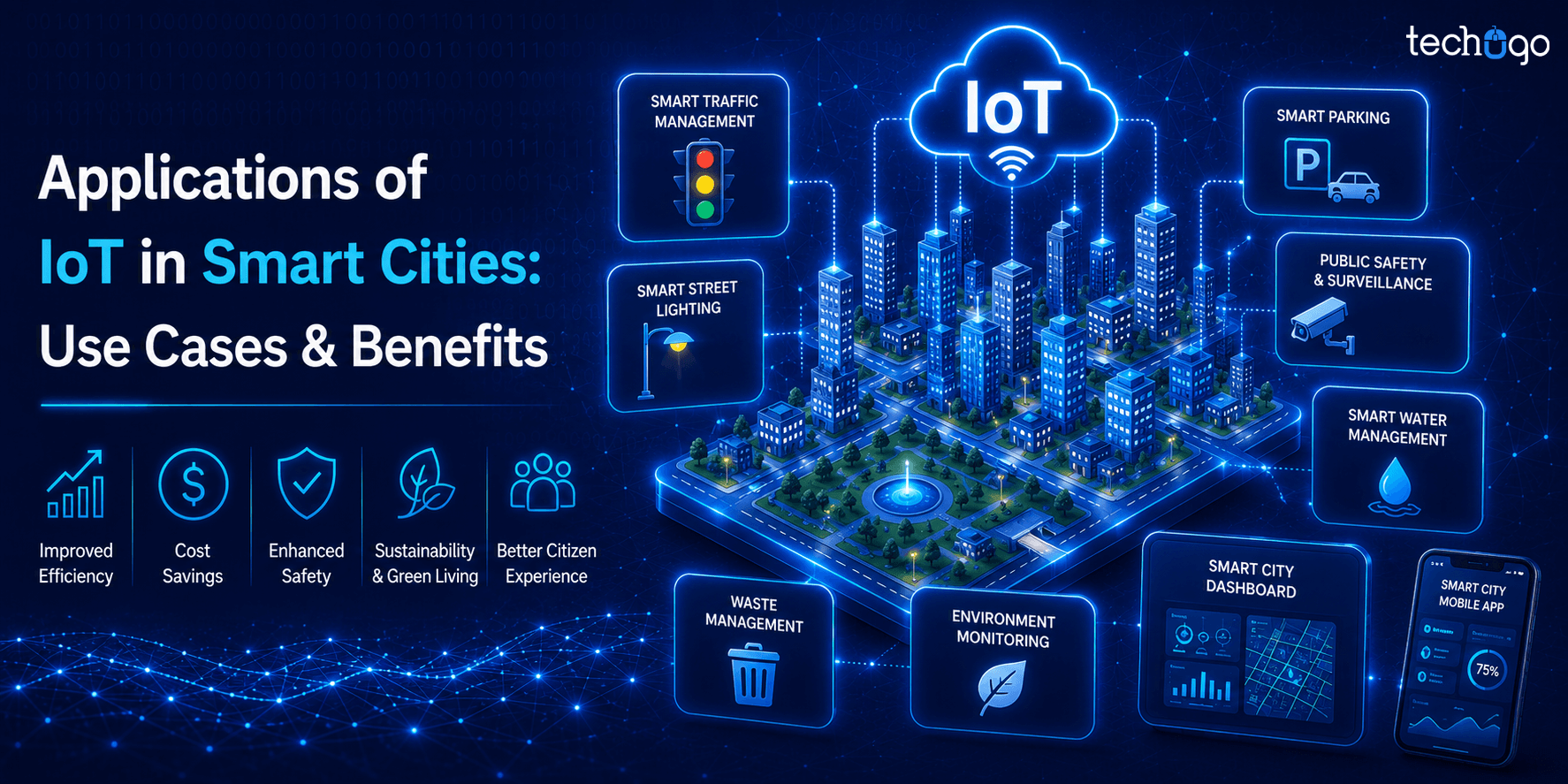


What if your city ran on smart apps?
No, it’s not sci-fi. IoT and AI are turning cities into living, breathing systems.
Millions of people, vehicles, buildings, and utilities interact every day (sometimes chaotically). Managing this complexity is no easy task. But this is exactly what the applications of IoT in smart cities do. They basically help cities think ahead, respond faster, and make life smoother for everyone. From traffic management to energy optimization, IoT is changing urban infrastructure in ways that were unimaginable a decade ago.
Back in 2025, it was already valued at around USD 952 billion, and it is just getting started. By 2026, the market is expected to hit about USD 1,187 billion. And if the growth keeps up, it could soar to over USD 6,300 billion by 2034 as cities double down on IoT, AI, and connected technologies.
That’s a massive 23% annual growth rate.
Now, pause and think about your business. Are you building mobile or IoT solutions that tap into this? Because here’s the thing: these are not just apps that gather data. They can predict trends, uncover hidden insights, and actually help cities run more smoothly.
And if you’re wondering about timing, the demand is not slowing down. It’s only growing.
Want to know how IoT is actually transforming city life? Keep reading and find out.
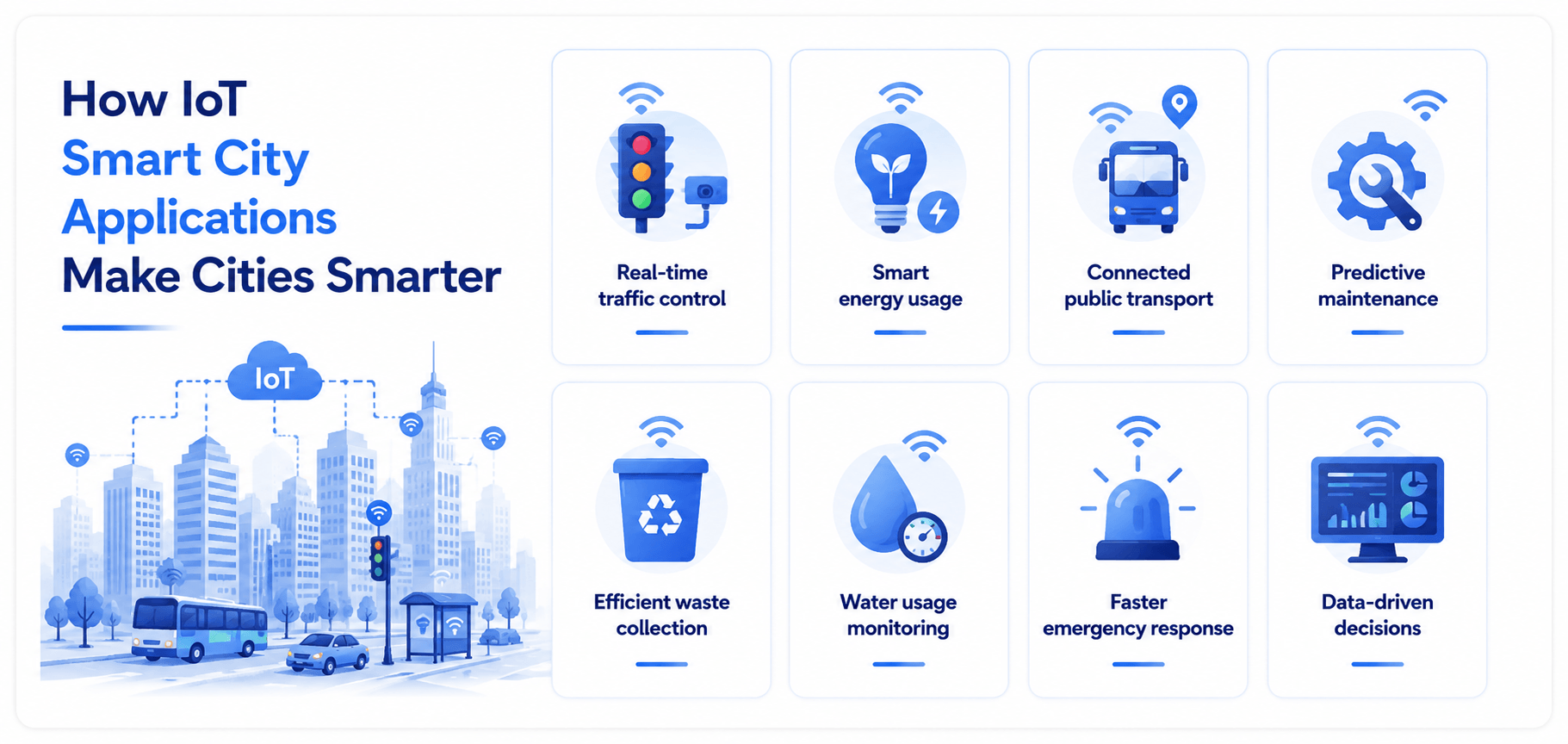
Have you ever wondered how cities are now capable of thinking? Since we can adjust our traffic lights to ensure our water is not in danger, it is all possible with the help of the IoT applications for smart cities. IoT enables cities to collect real-time data and make decisions in real-time due to the connection of sensors, devices, and infrastructure.
Imagine streetlights that change depending on the traffic, or sensors that monitor the quality of water. Cities are well-equipped to react to changing conditions, respond fast, and meet the needs of their citizens with the help of IoT.
The effect extends past infrastructure as well. IoT can be used in governance to deliver data-driven insights that can assist city administrators in making smarter decisions, allocate resources more efficiently, and remain transparent.
Honestly speaking, it is not just a technical upgrade. IoT gives cities a “sixth sense.” It assists them to respond, adjust and take care of citizens in ways we have only imagined.
Key Applications of IoT in Smart Cities
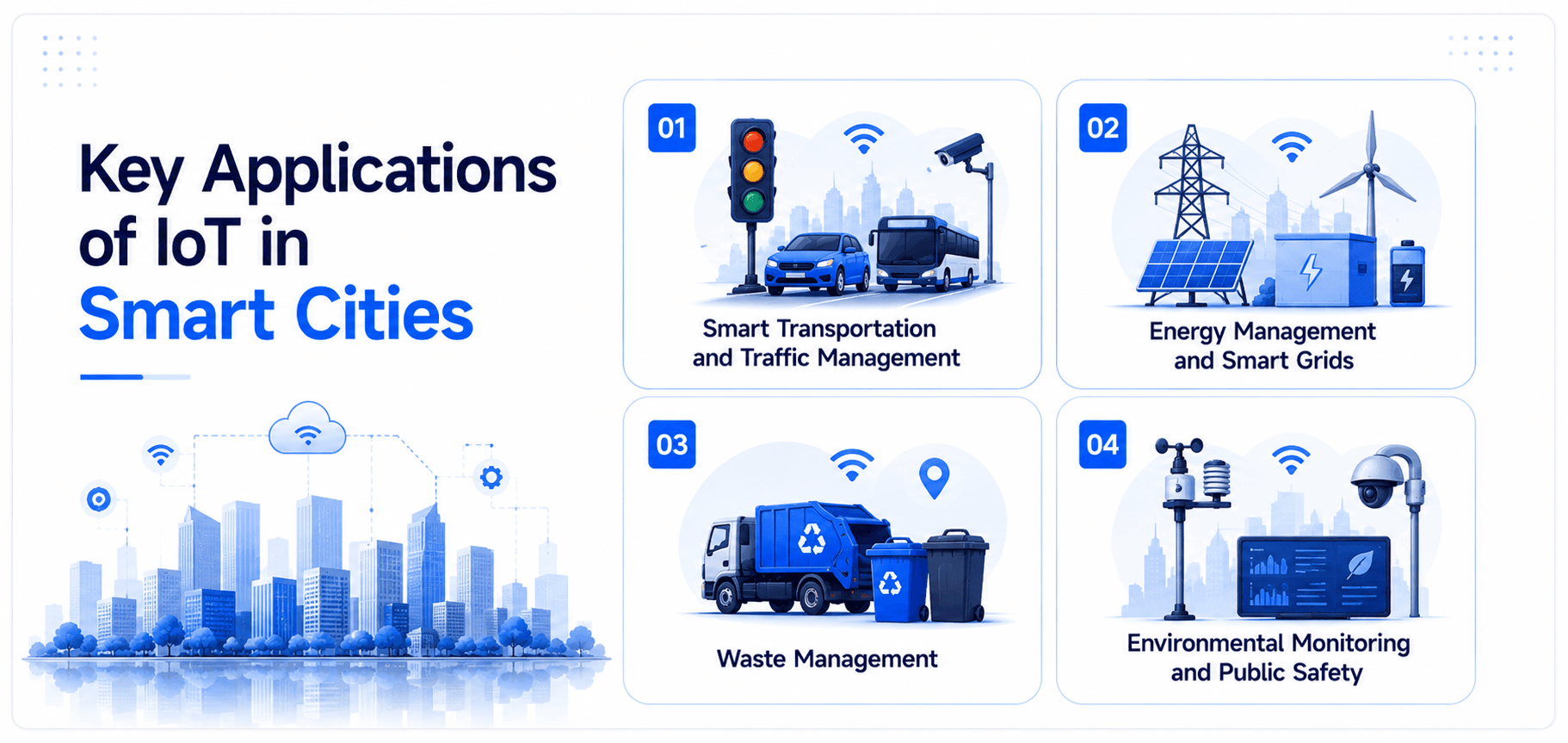
IoT’s impact goes far beyond trendy jargon. Here are some of the most transformative IoT applications for smart cities:
1. Smart Transportation and Traffic Management
Delays at traffic lights, traffic congestion, and unexpected delays are the order of the day in most cities. However, by adopting the IoT-based traffic lights, smart sensors, and real-time vehicle monitoring systems, cities can begin to think in advance. Such systems can dynamically adjust traffic lights, remind people of traffic jams, and even give priority to emergency vehicles, which makes the journey much quicker and safer. Imagine that your city is reading traffic patterns and acting almost like a living organism; that is basically what IoT does.
2. Energy Management and Smart Grids
Energy wastage is old news. The IoT devices are currently tracking the real-time electricity consumption in buildings and neighborhoods. The Smart grids automatically balance supply and demand, and the connected meters assist the offices and residential buildings to self-regulate. What do we find as a consequence? Reduced bills, reduced wastage, and a city that almost breathes life because it knows where the power is needed most.
3. Waste Management
No one enjoys trash dumpsters or unscheduled garbage collection. The IoT sensors on bins and collection trucks can now check the amount of waste and build an optimal route for garbage trucks. It implies that bins are not emptied every single time, and this saves on the unnecessary trips, fuel consumption, and costs of operation. Less waste on the road, clean streets, and smarter waste. Very little, yet a big difference in the city life.
4. Environmental Monitoring and Public Safety
Contemporary cities have a massive task in ensuring the safety of the environment and the safety of the residents. The IoT is used to monitor air and water quality, noise levels, and even radiation, which provides authorities with time to put a problem under control before it gets out of control. The interconnected surveillance systems and emergency network provide the people with peace of mind due to the faster response to accidents or incidents.
All these demonstrations indicate how IoT applications in urban infrastructure are transforming the lives of cities.
The possibilities with IoT applications are endless. And when executed thoughtfully, they create smarter, more responsive systems. Working with the right IoT app development company just makes that process feel effortless.
Benefits of IoT in Smart Cities: Smarter, Safer, More Efficient Urban Life
Have you ever wondered how a city manages to have a million things going on at the same time? IoT is an implementation that works like a conductive medium, whether it is lights or water. It works out of the spotlight to ensure nothing stops the flow of life.
But what does become different when IoT intervenes? Here are the benefits of IoT in smart cities:
1. Operational Efficiency
The repetitive tasks in the city can be handled by IoT, which implies that there will be less manual work and more time to handle significant projects by the city staff. Automated streetlights to intelligent water systems are just some of the connected solutions that enable faster and more reliable everyday operations.
2. Enhanced Citizen Services
Think about real-time information regarding the transport of people, a direct route to the closest parking place, or even the date when utilities will be repaired. IoT-powered connected systems bring all these possibilities to reality and provide citizens with not only functional but also convenient services.
3. Data-Driven Decision Making
Information surrounds us all, but it is not important unless it is interpreted. IoT organizes it. It reveals the things that are important. Through IoT, this information can be gathered, analyzed, and then taken into action by the city authorities, allowing them to make smarter decisions regarding infrastructure, public policy, and emergency planning. That is where the role of IoT in smart governance can actually shine; it provides leaders with the information that was unavailable before.
4. Cost Savings
Smart systems do not merely ease things; in fact, they save money. IoT will allow reducing the waste of resources, decreasing the cost of maintenance, and maximizing the use of energy throughout the city. That represents great savings to both administrators and residents.
5. Increased Transparency
It also conserves resources. The energy consumption is streamlined, waste is minimized, and most importantly, the operations become smarter. Once systems are interlinked, everybody is working on the same data. This creates confidence between the citizens and the city authorities since the decisions are transparent, evidence-based, and can be easily monitored.
IoT also looks out for people. The benefits of IoT in smart cities go beyond just convenience. They transform urban environments into places that are safer, more sustainable, and more responsive to the people who live there.
Check out Smart City Use Cases with IoT
Here is a closer examination of real-world smart city use cases with IoT and how they are transforming the manner in which cities operate:
1. Smart Streetlights
Streetlights may appear normal, but suppose they could think a bit. They change automatically depending on the movement of traffic and people with the help of IoT. When no one is around, lights are turned off and turned on when required, bringing about energy savings and making streets safer. A streetlight that can tell when you are coming.
2. Connected Parking
Locating a parking place can be an adventure of its own- or a nightmare. Parking lots have sensors that direct drivers to the empty parking slots and reduce the time wasted circling the blocks. Fewer cars will result in lower pollution and drivers who are happier. Suddenly, there is no feeling of chore of parking.
3. Healthcare Monitoring
There is more to IoT than roads and streetlights; people are also taken care of. Sensors in the public health sector will be able to monitor all aspects, such as air quality and foot traffic in hospitals, providing live information to authorities. In that manner, issues will be identified and tackled before they get out of control. It is as though one had a city that watches over the well being of every person.
4. Water Management
Water is valuable, and every drop matters. IoT sensors track the consumption and identify leaks before they drain funds or resources. They assist in the proper allocation of water within neighborhoods so that all people receive what they require and unnecessary wastages are minimized. Imagine a clever system that will keep the city hydrated without a drop of water wasted.
5. Public Transport
Waiting until the bus or train arrives can be annoying. However, with IoT, it is possible to remove the guesswork in the commuting process. Updates in real-time maintain schedules precisely and prevent congestion as well as optimization of routes. The riders are aware of when to move out, and the transport systems operate more efficiently. It is a sort of pulse that makes the city move.
6. Waste Management
Garbage bins full? Not anymore. Sensors are used to track bins and trucks in order to optimize the routes of collection. Bins are not emptied on a regular basis and this saves fuel and unnecessary movements. It is a little change with a huge effect, as the city will be clean and efficient.
7. Energy Management
IoT monitors real-time energy usage in both office buildings and residential buildings. Smart grids run automatically according to the demand thus avoiding wastage, and reducing bills. Connected meters make buildings self-regulating and this results in a system where energy is not working harder but smarter.
The examples above demonstrate that IoT applications can address some practical problems in the city but also enhance the quality of life.
Want to Know How IoT is Transforming Everyday City Life?
Cities run on a million moving parts. And IoT helps businesses and city managers keep up without breaking a sweat.
Here is a quick look at how IoT is transforming everyday city life:
| City Function | Before IoT | After IoT |
| Street lighting | Manual schedules, high energy waste | Automated, adjusts based on traffic/presence |
| Parking | Drivers circle blocks, wasting time | IoT sensors guide to available spots |
| Water leak detection | Reactive repairs after complaints | Proactive alerts, minimal water loss |
| Public transport tracking | Guesswork schedules, delays | Real-time tracking, reduced waiting |
| Emergency services | Delayed responses due to info gaps | Instant alerts, coordinated response |
As you can see, IoT doesn’t just make cities “smarter” in theory; it changes the day-to-day experience.
For companies offering services, logistics, or infrastructure solutions, these applications of iot in smart cities open doors to new opportunities. They allow businesses to integrate technology, optimize operations, and deliver better experiences (without guesswork).
In short, IoT turns cities into smarter, more efficient ecosystems where businesses, authorities, and citizens all win.
These Are The Challenges Cities Face in Going Smart
Despite its transformative potential, IoT adoption in urban infrastructure faces challenges:
1. Data Privacy and Security
IoT networks collect vast amounts of personal and operational data. Protecting this data against cyber threats is critical.
2. High Implementation Costs
Building and maintaining IoT infrastructure requires investment in devices, sensors, networks, and analytics platforms.
3. Interoperability
Devices from different manufacturers must communicate seamlessly. Without standardization, IoT systems can become fragmented.
4. Maintenance and Scalability
IoT devices require continuous updates, monitoring, and scaling as cities grow.
Addressing these challenges of IoT in smart cities is essential to fully realizing the technology’s potential.
The Future of IoT in Smart Cities
The future of IoT applications for smart cities is exciting. As IoT integrates with AI, 5G, and edge computing, cities will evolve into fully adaptive systems. Imagine:
- Autonomous public transportation networks
- Predictive healthcare monitoring and emergency responses
- Real-time environmental management
- Integrated services with minimal human intervention
IoT smart city applications will continue to bridge the gap between urban challenges and technological solutions, making cities more connected, sustainable, and livable.
How Techugo Helps as an IoT App Development Partner
Need smarter IoT applications? Techugo turns connected devices and real-time data into tools that actually work for you.
Here’s how:
Global reach with real experience: Techugo is a highly established mobile and digital solutions provider with offices in India, the USA, UAE, Canada, and the UK. Founded in 2015, we have delivered hundreds of apps across industries, powering solutions from startups to global enterprises, including Fortune 500 brands.
IoT is part of a broader tech toolkit: While we are known primarily for mobile and web apps, our services also include Internet of Things (IoT) development, meaning we can integrate connected devices, sensors, dashboards, and real‑time data into practical applications alongside mobile and web interfaces.
Real‑world problem‑solvers: Our model is a combination of technical and business savvy. And this implies that we are not merely building apps but are trying to connect IoT, analytics, and interfaces in such a way that data can be turned into actionable insights you can use to automate the processes and enhance the operations.
Security and long‑term support: We also offer IoT security consulting and long‑term support, helping businesses not only launch connected solutions but keep them secure, scalable, and future-ready.
Cross-industry presence: Our IoT expertise is part of an expanded family of technology-related skills (including AI, cloud, mobile apps, and enterprise systems), and therefore, we are well-versed with creating connected solutions in industries such as healthcare, automotive, smart homes, logistics, and others.
Smarter operations start here. Let Techugo, a leading mobile app development company, create IoT solutions your team can rely on. Connect now!
FAQs
Q1: What are smart cities’ IoT applications?
A: IoT applications are interconnected networks (through sensors, smart devices, and dashboards) that assist cities with real-time monitoring, control, and enhancement of traffic, energy, water, waste, and public services.
Q2: Does the implementation of the IoT need new hardware?
A: Not always. Lots of IoT applications work with other devices and infrastructure. Our team is able to evaluate what you already possess and develop around it.
Q3: How secure are IoT applications?
A: Security is key. Our best practices, data encryption, and long-term support keep your IoT systems secure and scalable.
Q4: How long does it take to develop an IoT application?
A: It is based on the complexity, devices, and integrations. Small pilots can be prepared within a matter of weeks, while large-scale smart city or enterprise solutions require several months.

Get in touch
We'd love to hear from you.