


 SA
SA
 KW
KW
 IE
IE AU
AU UAE
UAE UK
UK USA
USA
 CA
CA DE
DE
 QA
QA ZA
ZA
 BH
BH NL
NL
 MU
MU FR
FR













28 Apr 2026
How Much Does it Cost to Build an AI Wellness App? (2026 Guide)

Abhinav Gupta



Is launching an AI wellness app in 2026 really worthwhile?
That’s a question a lot of tech giants would ponder. Demand isn’t hiding, it’s loud and present. People log their bedtime hours, workouts, mood patterns, and even meals – all through their mobile.
Thanks to artificial intelligence. AI is providing functions, which are exceeding those of merely logging data. It provides predictive capabilities to identify when stress arises, coaching functions are changing and adapting continuously (rather than periodically), and progress towards one’s goals feels less like guesswork.
Fast changes in digital health are spreading worldwide. The benefits that artificial intelligence has demonstrated so far in medicine have generated significant interest. Every dollar put in brings about three times the revenue back. Seeing this, startups have jumped on the bandwagon, and fitness labels and major medical companies are following suit. The main reason for their expansion in the AI wellness application space is due to the volume of validated results.
What catches many founders off guard is the AI health app development cost, as AI-driven wellness apps are quite different from standard mobile applications. The primary difference includes the requirement of additional data and machine learning applications, along with various country laws related to AI healthcare and linking with fitness trackers and/or medical devices.
In line with other industries, the cost to build an AI wellness app ranges from approximately $40,000 to $400,000 or more, depending on how intricate it is, what kind of smart functions are included, and whether it’s built to grow. Today, through this guide, we’ll get to know everything about the AI wellness app development cost in 2026 and the factors that impact the overall development budget.
So let’s get started.
Why investing in an AI wellness app development is a smart move in 2026?
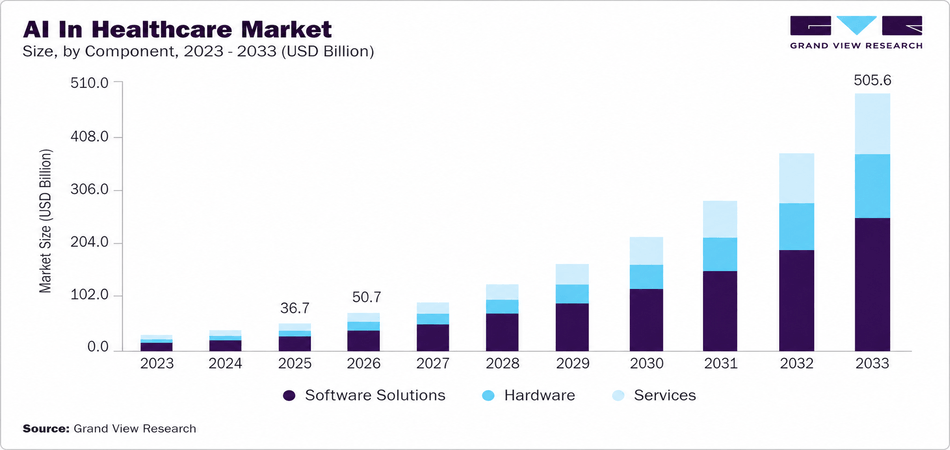
Image Source: Grand View Research
Around the world, artificial intelligence in medicine is expected to swell from roughly $36.6 billion in 2025 to more than $505 billion within eight years, a staggering 39% increase a year as per Grand View Research.
What stands out here isn’t just momentum; it’s staying power written into the numbers themselves. Numbers point to more than 30% already leaning on artificial intelligence for staying fit and healthy. This stage feels new, yet growth keeps coming.
Right now, AI health and wellness apps are growing fast – almost 49 % each year until 2030. Looking at things through a business lens, chances pop up for serving individual customers alongside companies. Direct wellness services aimed at people become possible, while teaming up with companies focused on employee health works too.
In short the reason for increase in demands of AI wellness apps in 2026 are:
- Rising demand: Digital wellness adoption is growing fast as more users prefer app-based health tracking and guidance.
- Strong market growth: The global AI healthcare market is expanding rapidly, creating long-term business potential.
- Recurring revenue models: Subscriptions and personalized plans generate consistent income.
- Personalization advantage: AI-driven insights improve user engagement and retention significantly.
- Untapped niches: Mental health, fitness, and preventive care still offer room for new, focused solutions.
Types of AI wellness apps you can build in 2026
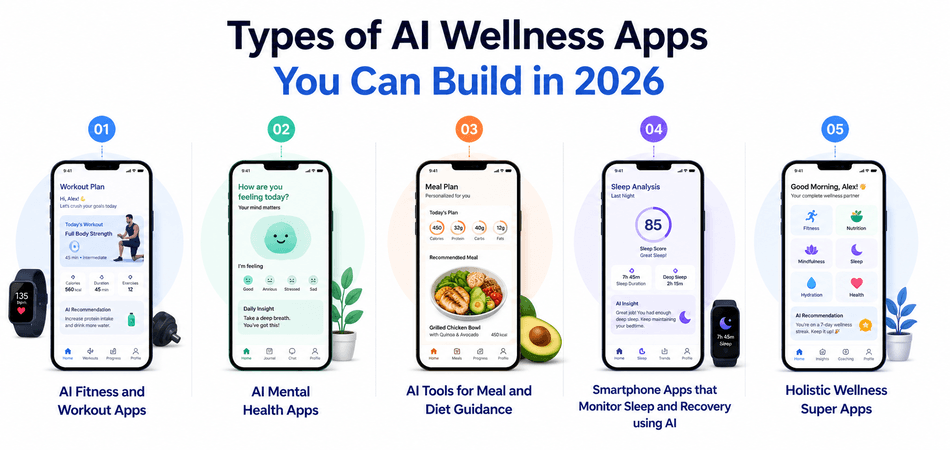
Building an AI wellness app in 2026 means facing choices early on. Different types bring distinct tools, layers of difficulty, along with varied needs for artificial intelligence. These factors shift how much it will take to make such a product by 2026.
-
AI fitness and workout apps
Acting much like a coach, AI-powered fitness apps build unique exercise schedules, watch how you improve, then tweak workouts as you go. Freeletics and Fitbit type apps study how you move using smart tech. When needed, they nudge you toward better habits instead of just tracking. Behind these AI fitness apps sit powerful engines that handle live updates while adjusting to user choices through smart algorithms, making their creation more involved. Each piece must work without delay. Building them means solving tougher design puzzles.
-
AI mental health apps
Mental health tools are spreading fast. Not robots – just smart chats that notice how you feel, spot patterns in what you do, then step in with quiet help. Emotional check-ins turn into routine. Growth shows up quietly – in small prompts, nudges, replies at odd hours. Support isn’t loud anymore. It hums inside pockets. Take Woebot, for instance – it leans on chat-based artificial intelligence shaped by principles of cognitive behavioral therapy to support people dealing with stress and anxious thoughts.
-
AI tools for meal and diet guidance
With these types of AI powered wellness apps, meal suggestions come tailored to what you eat each day. When it comes to goals like losing weight or gaining energy, patterns in your meals get reviewed automatically.
Tracking what you eat becomes simpler when apps such as MyFitnessPal step in with smart pattern recognition. Fitia jumps into the mix, shaping meal ideas based on how your body responds over time. Building these systems means pulling together AI tools, massive food libraries, one chunk of personal health information. Each piece pushes up the cost to build your AI wellness app.
-
Smartphone apps that monitor sleep and recovery using AI
Some AI based wellness apps made for better sleep study your rest habits, how you recover, one way they do it is by checking stress clues. These tools often connect to wearable devices that send live updates.
Tracking tools such as Oura give users a look at how deeply they sleep. Meanwhile, Garmin Connect shows patterns in how well the body bounces back after effort. Because they link so closely to IoT devices, the systems needed become pricier. Each added sensor or gadget slows progress while raising the AI wellness app development cost behind the scenes.
-
Holistic wellness super apps
One app handles your workouts, food choices, rest, and mind – all stitched together neatly. It flows without gaps, linking movement to meals, downtime to thoughts, everything in step.From smart tools such as Centr to platforms like Vantage Fit, digital support shapes daily health habits. These AI based wellness apps learn your routine, adjusting tips without needing constant input. The app development timeline of these AI wellness apps takes the longest. This happens because AI suggestions link up with wearables, while content tools feed data into live tracking panels.
Top 5 AI wellness apps in 2026
Here are the top five AI wellness apps you can take ideas from:
1. HealthifyMe
Founded in 2012 by Tushar Vashisht and Sachin Shenoy
HealthifyMe has grown to 35+ million users, making it one of the largest AI wellness platforms in Asia. It works through an AI coach called “Ria” that analyzes food, activity, and lifestyle data to give personalized diet and fitness advice.
2. Oura (Oura Ring + App)
Founded in 2013 by Petteri Lahtela, Kari Kivelä, Markku Koskela
Oura has sold 5.5+ million devices and scaled into a billion-dollar wellness brand. It tracks sleep, recovery, and health signals using a wearable ring, then uses AI to deliver insights and predictive health alerts.
3. MyFitnessPal
Founded in 2005 by Mike Lee, Albert Lee
With 80+ million active users, it remains a dominant nutrition and wellness platform. MyFitnessPal uses AI to analyze food habits, suggest improvements, and sync with fitness data for holistic health tracking.
4. Woebot Health
Founded in 2017 by Alison Darcy
Woebot gained recognition with FDA Breakthrough Device designation in 2026 for mental health support. It works as an AI chatbot that provides CBT-based emotional support through conversations.
5. Simple (AI Coach App)
Founded in 2019
The app has 20M+ downloads and processes 100K+ AI conversations daily. It uses AI coaching to guide users on nutrition, fasting, and lifestyle through chat, voice, and visual inputs.
How much does it cost to build an AI wellness app in 2026?
If you’re planning to build an AI wellness app, the biggest question is always the cost of the mobile app development. And the honest answer is, it depends on how far you want to go with AI, personalization, and scalability.
On average, the cost to build an AI wellness app in 2026 ranges from $20,000 to $400,000+, depending on features, AI depth, and integrations. This range reflects everything from a simple MVP to a fully scalable AI-driven health platform.
Cost overview by app complexity
| App Type | Cost Range | Timeline |
| MVP AI Wellness App | $20K–$50K | 2–4 months |
| Mid-Level AI Wellness App | $50K–$150K | 4–8 months |
| Advanced AI Wellness App | $150K–$400K+ | 8–14 months |
Cost by app complexity
-
MVP AI wellness app (20K to 50K)
Start here when trying out a new concept – it keeps things tight. Built around essentials, it gives users what matters fast: profile setup, fundamental health checks, then smart tips shaped by behavior.
The result? Less clutter, clearer purpose.
Right now, the AI part stays slim by design. Many apps lean on ready-made models or preset rules rather than crafting heavy frameworks. This way, making progress moves quickly while holding expenses steady when creating a wellness app with AI.
Start before it feels ready. What matters most? Learning whether anyone cares. Put something out fast – watch how folks react instead of guessing their needs. See which parts stick, which vanish. Money stays where it should: away from extras nobody asked for.
Some new companies thrive here by launching a basic version first. They test interest early instead of guessing what people want. Growth comes after they see how customers actually use it. Real behavior shapes their next steps, not assumptions.
-
Mid level AI wellness app (50K to 150K)
Here’s when the AI wellness and mental health app begins acting more mature. Not just functioning – now it connects deeper with users. Features roll in slowly, shaping how people interact. Instead of simple tasks, there’s room to adjust, to choose.
Little changes make it feel less generic. Personal touches appear without warning. Engagement grows because things respond differently now. It adapts slightly, each time someone uses it. Most times, it’s here that AI suggestions start appearing. Chatbots step in to help users without delay. Wearables begin linking up smoothly. Experience tweaks make everything feel sharper. Behind the scenes, systems grow tougher. Handling bigger loads matters now. Quick back-and-forth flows better when built right.
Optimization kicks in now – that’s why building an AI health app climbs higher in price by 2026. Instead of only checking features, the work shifts toward refinement. Custom touches grow stronger while paths users follow feel more natural. Sticking around matters more than ever here.
Startups on the rise often land here – keeps expenses in check while handling growth without breaking a sweat. Performance stays steady, scaling feels natural, money doesn’t vanish overnight.
-
AI mental health app development cost (150K to 400K+)
Out here, scaling up means getting every detail right from day one. Growth isn’t an afterthought – it’s built into how things move forward. Precision shapes the path just as much as ambition does. The system runs deep, designed not for quick wins but steady momentum.
Long-term thinking guides each choice, quietly, without fanfare. Big demands call for tight coordination, nothing left to chance. This kind of setup doesn’t shout – it simply holds its ground.
Out of today’s tools, some go further – offering forecasts based on patterns, live updates about well-being, choices shaped closely around individuals, while linking across devices without hiccups. These smart systems? Built from scratch, then refined nonstop through exposure to massive amounts of information.
Start with solid infrastructure – tight security matters just as much when dealing with private health details. Compliance tools become essential too, particularly under strict data rules.
Spending more here means backing a system built to handle speed, precision, at the same time growing smoothly. Big companies often fit this space, or new businesses gaining real momentum and aiming to push forward fast.
Full breakdown of AI health app development cost in 2026
Here’s a clear breakdown of where your money actually goes when working with a healthcare app development company:
| Development Stage | Estimated Cost Range |
| Planning & Research | $5K–$15K |
| UI/UX Design | $10K–$40K |
| Frontend Development | $15K–$50K |
| Backend Development | $20K–$80K+ |
| AI Model Development & Training | $20K–$60K+ |
| Admin Panel Development | $5K–$20K |
| API & Integrations | $5K–$25K |
| Testing & Deployment | $5K–$15K |
The biggest cost drivers here are backend infrastructure and AI model development. These are not one-time efforts they evolve as your app scales.
What factors influence the price of AI mental wellness apps
- Feature Complexity
Building extra functions takes longer, costs more. Cheaper by far?
A basic tracker instead of one juggling AI advice, data views, multiple gadgets at once.
- AI algorithm and personalization level
When an app watches how you act, then shifts on its own, costs climb fast due to extra data needs, longer training phases, and heavier system demands.
- Live data handling and insights
When apps track real-time health information – such as heartbeat, rest patterns, or movement – they rely on powerful servers behind the scenes.
Because of this demand, the cost and timelines of app development, effort, and ongoing support go higher.
- Connecting with fitness trackers and medical gadgets
Smartwatches or fitness bands linking up? That brings more moving parts. Each step – from matching systems to keeping info correct – takes added effort.
- Data privacy and compliance HIPAA GDPR
When apps manage private health details, following rules isn’t optional. Creating one that meets HIPAA demands strong system design, data scrambling during storage and transfer, plus ongoing checks, which stretches timelines along with expenses.
- Development region
The country of your mobile app development company matters a lot. Take building phone apps in the US – hourly rates climb fast when set beside India or UAE. Still, steeper prices may bring sharper skills, quicker results.
Truth sits where value meets need – cost ties less to what your AI wellness app does, more to how sharp, flexible, and locked down it runs.
Core features of AI wellness apps and their cost impact
Building an AI wellness app? The cost of AI health app development grows fast when fancy features get added.
Think live responses, sharp personal touches – stuff that thinks on its feet. More complexity in how data moves pushes the cost of app development up too.
A. User panel features
-
User profiles and health data tracking
Most AI based wellness apps begin the same way. People enter simple facts – age, daily routines, targets, and medical background. It might seem straightforward at first glance. Yet keeping medical information safe makes the system behind it much harder to handle. When past records need reviewing, expenses climb even higher.
-
Smart suggestions from Artificial Intelligence
At its heart, every AI-driven wellness app works like this. It watches how people act, then offers ideas – maybe exercise, food choices, or ways to clear the mind. Some simpler suggestion tools start near $20,000. More complex AI based wellness apps, built to predict user choices deeply, often go beyond $100,000.
-
Tracking daily activities like fitness sleep and food
Most people log their steps, meals, rest times, and routines every day. Still, stacking several trackers into a single platform makes the system behind it much harder to manage. AI based wellness apps managing such inputs must be built tougher, handling flows without slowing down. Pulling pieces together means the machinery behind them can’t afford weak links.
-
Guided programs for workouts meditation and diet
Each day, people stick to these organized routines. As they move forward, artificial intelligence adjusts the plans just for them. App development costs differ based on how much material is needed along with custom rules. Fixed setups run at lower rates. When systems adjust themselves using artificial intelligence, app development costs rise.
-
Live alerts and reminders
Staying on track feels easier when alerts pop up at the right moment. Workouts get a nudge from timely prompts appearing on screen. AI app development cost goes up when alerts use AI to spot habits such as silence or signs of strain.
-
Connects with wearable tech and devices
Higher costs of AI mobile app development often come from here. Real-time health monitoring becomes possible when linking to gadgets such as the Apple Watch, Fitbit, or Google Fit. When apps link to many devices, expenses for building AI health tools in 2026 tend to climb sharply.
B. Admin panel features
-
User management and data monitoring
When it comes to building AI wellness apps, watching how users interact matters just as much as tracking their activity levels. Complexity creeps in step by step the moment more measurements are added. This causes mobile app development costs to climb alongside.
-
AI model management interface
Updates never stop if the model has to keep working right, because training needs refreshing now then while someone watches how it behaves. A dashboard that tracks how well an AI works – its precision and results – takes much more time to build than most expect.
-
Managing content programs and plans
Running things like workouts and meal schedules falls on admins. Meditation routines show up in their tasks too. Handling these pieces means keeping track without missing details. When AI based health and fitness apps pull live content shaped by artificial intelligence, handling them takes more effort than working with fixed, unchanging material.
-
Analytics and performance dashboard
Behind every AI wellness app, insights dig into how users act, how precise the system stays, one step at a time. These smart tracking screens push up app development costs behind the scenes, especially where data moves and transforms.
-
Security and compliance controls
Built into every step, protection matters because personal details travel through these tools. Encryption, along with strict login controls, often pushes the cost of mobile app development higher.
How team structure and region impact AI wellness app development cost
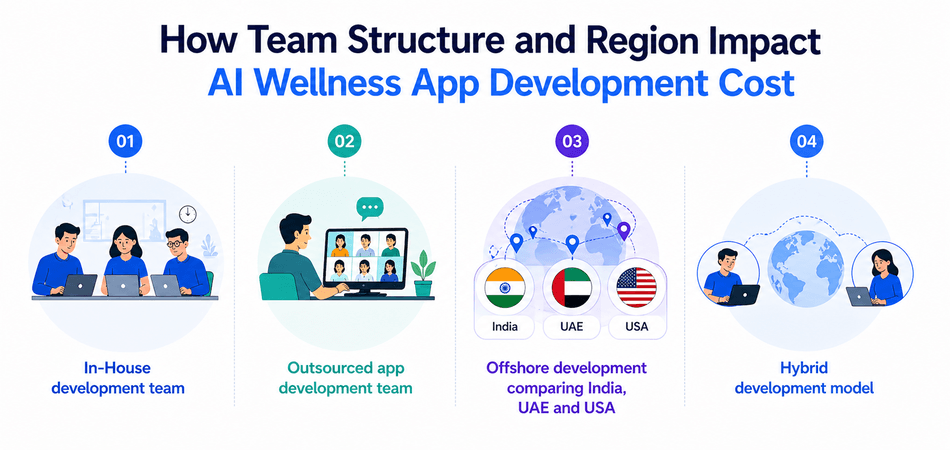
One of the largest expenses in building an AI wellness app is the type of mobile app development team you choose.
-
In-House development team
Starting fresh with your own mobile app development team means calling the shots on every part of the AI wellness app. That includes how it’s built, who handles user information, even where things go years down the line. Yet there’s a heavy price tied to that freedom. A complete team can cost up to a million in twelve months once recruitment, software, gear, and setup enter the picture.
-
Outsourced app development team
Most new companies go this way when they start out. Rather than hiring each person themselves, they work alongside a mobile app development company that builds health apps. That kind of app development company usually includes designers, coders, and experts in artificial intelligence all ready to help. Most companies see expenses drop between 30%-60% when they outsource instead of building teams internally.
-
Offshore development comparing India, UAE and USA
Price swings a lot depending on where you look. Take a mobile app development company in the USA, hourly rates there often land between $100 and $200. Meanwhile, healthcare app development companies in places like India or the UAE might ask only $25-$75 for the same tasks. Just this single change might cut app development costs on building an AI wellness app by 50%.
-
Hybrid development model
With the hybrid approach, you stay in charge while skipping the expense of developing all pieces yourself. At the same time, adjusting team size becomes effortless – shrink or expand depending on what’s required.
Hidden costs in AI wellness app development
Apart from the listed costs that take the total app development costs up, there are certain hidden costs that can’t be ignored.
-
Training AI models and their data expenses
Most people overlook how much effort goes into feeding machines. Gathering information comes first, then fixing errors hides inside that step. Labeling bits properly matters just as much as sorting them right. Running training cycles adds up fast. Some AI wellness apps need $5000 just to start, others climb past $50000 when things get complicated.
-
Cloud infrastructure and storage costs
Month by month, expenses keep coming – they’re not just a single payment. Think of it like water dripping steadily, rather than a quick splash
- GPU usage can range from $1 to $40+ per hour
- Storage can cost $20–$200+ per TB/month
Few people start using it. Over time, more show up each week. Numbers climb without warning. App development costs rise when demand spikes suddenly. Thousands pay monthly at peak times
-
Third-party API costs
Third party tools power most AI mental health apps – things like chatbot systems, fitness trackers, checkout processors, also alert platforms. Most of these depend on how many people use them. Higher numbers mean higher costs of mobile app development. Most times, using APIs piles up costs over months – biggest hit hits apps leaning hard on AI features.
-
Maintenance and ongoing AI updates
Most software wraps up once it goes live. Not so with artificial intelligence tools – they keep evolving long after release. Yearly upkeep typically runs between 15%-25% of what it first cost to build them. This includes:
- Bug fixes
- Feature updates
- AI model retraining
- Performance optimization
-
Security compliance and data protection expenses
When it comes to AI wellness apps, personal health details are always involved. Because of that, strong protection isn’t a choice – it has to happen. Costs include:
- Data encryption
- Secure authentication
- Compliance with regulations (HIPAA, GDPR)
- Regular audits and monitoring
Yearly expenses for security plus adherence to rules might hit anywhere from $15,000 to $200,000 based on size. Each setup changes what you pay.
-
User acquisition and marketing expenses
Here’s an app development cost few notice – yet it usually adds up fastest. Starting the app comes first. After that, people need to show up. You’ll need to invest in:
- Paid ads (Google, Meta)
- Influencer partnerships
- Content marketing
- App store optimization
Over time, spending on promotion often equals – or sometimes surpasses – what it takes to build the product itself.
How to build an AI fitness app: Step-by-step development process
Developing an AI wellness app is much more than just writing code, it involves a series of steps that are absolutely crucial for the success of your AI wellness app. This includes the following
Understanding customers and their needs
Clarity kicks things off. Not until you grasp your users – their needs, struggles, even the tools they rely on now – should any code appear. Start by checking what others offer in fitness, mental health, and eating habits. Spot where they fall short. That shapes how much your AI mental wellness tool will cost to build, since adding unused parts raises expenses.
Plan features & define MVP
After looking into things, it’s time to figure out what your first version will include. The goal here isn’t perfection – just enough to start testing ideas with real users. Start small when you begin. Core pieces matter most – think user profiles, simple tracking, maybe a touch of AI suggestions. That approach reduces the cost to build an AI wellness app in 2026. Begin with something tiny. Test it quickly. After that, grow step by step. This is the pattern behind many leading AI wellness tools.
UI/UX design and prototyping
Start with clear, minimal layouts. Before coding begins, sketch out basic structures and turn them into interactive previews. That way problems in how people use the product show up sooner, which means fewer fixes down the line and lower app development costs.
Core development phase
Here’s when coding starts for real. On one side, there’s the part people interact with; on the other, systems handling information behind the scenes. Behind every AI wellness app, there’s a hidden engine doing heavy lifting. When users interact, their information flows into systems built to store and manage it carefully. Connections to outside tools happen quietly, often without notice. Speed, reliability – these depend on structures most never see.
Building and connecting AI Models
Starting with data, AI models learn patterns before slipping into apps quietly. They show up later as tailored suggestions, clear answers, or smart guesses. One step follows another without flash or noise. You can either:
- Use pre-trained AI models (faster and cheaper)
- Build custom models (more accurate but expensive)
Costs of development rises when artificial intelligence gets more advanced inside an AI wellness app.
Testing & QA
Testing each feature happens before anything goes live. This includes:
- Functional testing (does everything work?)
- Performance testing (does it handle traffic?)
- Security testing (is user data safe?)
Because they suggest choices, AI tools must be checked so errors don’t slip through. Users often vanish soon after release when testing gets ignored. A solid check before going live keeps them around longer.
Deployment & launch
After tests finish, it heads to both iOS and Android stores along with live cloud hosting. Yet beginning isn’t where things end – this moment kicks off what comes next. You’ll also need to prepare:
- App store optimization (ASO)
- Marketing campaigns
- Initial user onboarding strategies
Getting off to a solid start shapes how fast things grow at first.
Scaling and improving after launch
Tracking user behavior helps shape updates, while comments guide tweaks. A few tweaks might include smarter user fits, connections to other platforms, and even added well-being pieces. Deeper settings can appear through tailored touches, linked systems, or small wellness upgrades.
Putting together an AI wellness app isn’t something that happens overnight. Each stage flows into the next: create, try it out, see what works, then make it better.
How to reduce AI wellness app development cost
To reduce the mobile app development cost to build your AI wellness app, here are some best practices.
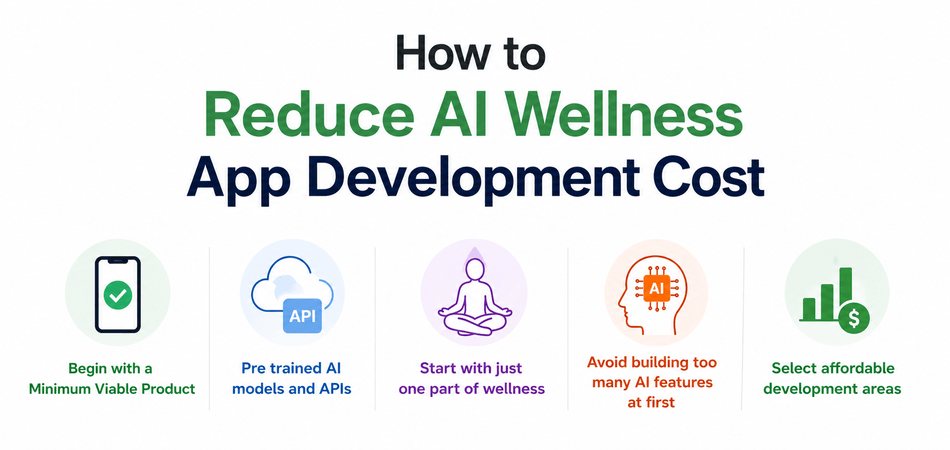
Begin with a minimum viable product
Start small. Pick one piece – say, AI-driven workouts – rather than bundling everything at once. Most of the upfront expense drops away when you stick to essential features. Building just what works slashes AI health app development costs by 40–60% in 2026.
Pre trained AI models and APIs
Start with ready-made AI systems instead – plug them into your workflow through available interfaces. Tools like recommendation engines, automated helpers, or data trackers come built on services that allow fast setup. Because it cuts down on coding hours, spending less on teaching the system becomes possible, while getting your product out the door speeds up too.
Start with just one part of wellness
One feature working well beats ten half-finished ones. Focus comes before function every single time. One feature at a time – working out, mood care, eating well – they each bring hidden layers. Tied together, the effort stretches longer, prices climb without warning. Start small, then grow by focusing on just one area. Take a single market, master it completely
Avoid building too many AI features at first
Most startup leaders think stuffing AI into every corner improves their product. Actually, it only drives up expenses while delivering little benefit. Most of the time, basic features work just fine. When things get trickier, that is when smart software can step in. A single change like this could lower your mobile app development costs that much while developing.
Select affordable development areas
Most companies spend less on creating an AI wellness app when they pick a strong mobile app development company in India. A smart choice here makes a big difference in total price cutting costs by 40%-70%.
Choosing the lowest price isn’t always smarter. Teams familiar with AI plus medical software tend to deliver better results. Mistakes made early often lead to higher expenses later.
How you can monetize your AI wellness app
Some of the common ways businesses monetize their AI wellness apps are as follows:
Subscription-based plans
Month after month, users keep coming back to this one – it’s the go-to version out there. Instead of a one-time fee, they hand over payment each year or every month just to unlock extras such as smart feedback tools, step-by-step plans, or help shaped by artificial intelligence.
Monthly fees show up a lot in top wellness apps powered by AI. That setup brings steady income over time. People typically hand over $10 to $40 each month. What you get decides how much it costs.
In-app purchases
Some people skip subscriptions altogether. In those cases, buying things inside the app makes sense. You can sell:
- Personalized diet plans
- Premium workout programs
- Meditation packs
- Advanced analytics features
Most people like this setup because it gives clear results fast. When something lasts only a short time, they feel less pressure. Free tools draw them in at first. Later, extra functions make paying seem worth it.
AI coaching and custom plans
For many people, this kind of tailored experience justifies a higher price. Certain high-end AI coaching setups might cost over $100 monthly, especially when they offer deeper support and stronger results. Because the experience feels personal, revenue grows while users stick around longer too.
Corporate wellness programs
Companies buy your AI wellness app for staff wellbeing, skipping personal customers entirely. Through corporate health initiatives, it finds its market – no need to chase single users. Some companies charge by the worker count, others offer site-wide access. Either way, deals grow bigger and last longer than ones tied to single people alone.
Focusing on worker well-being, firms now see steady gains through this business approach – its expansion tied closely to performance outcomes. Revenue trends rise when health becomes a daily priority within teams.
Working with top brands
Just because something earns money doesn’t mean it must be the main goal. Sometimes value shows up in quieter ways. Partner with:
- Fitness brands
- Nutrition companies
- Healthcare providers
- Wearable device companies
Pick up earnings via affiliate deals instead of skipping them entirely. Team-up profits show up through shared branding efforts sometimes. Another path opens when services link together behind the scenes.
Challenges in AI wellness app development
Most people think building an AI wellness app looks smooth when sketched out early. Yet once work begins, hurdles pop up – things like shifting regulations or unclear data paths.
These hiccups often stretch app development timelines, drain budgets, tear at team focus. Without careful steps, users start doubting what the tool offers. Even planning ahead doesn’t always shield you from surprise delays.
Data privacy and compliance challenges
The main issue with AI wellness apps? They gather personal health details. Sleep records show up here. Mental well-being notes get stored too.
Movement tracking slips in alongside them. Medical timelines appear without much notice. Data piles grow quietly behind screens. One out of every four people feels okay sharing health details, yet most hesitate. Worrying over who sees their info slows how fast new tools get used.
Besides rules such as GDPR and HIPAA, that demand tight control over data, strong encryption, and also clear permission from users. Falling short on any part isn’t merely a glitch under the hood – suddenly, lawyers start asking questions.
One more issue keeps getting worse – spills of private information. During 2024, leaked healthcare files topped 276 million, showing just how shaky safety really is here.
How well AI suggestions match reality
Garbage in, garbage out – that’s how it works. What goes into the system shapes what comes running back. Feed it junk, expect nonsense. Quality matters more than anything else behind the scenes. Mistakes start long before the machine speaks up. Bad information leads straight to bad answers. The source holds the real power here.
Wrong tips in wellness apps often make users lose faith fast. Take bad workout guidance – off-the-mark meal calories might follow, then sketchy stress coping ideas show up. These missteps pile up, and results suffer.
So ongoing training, plus checking how it performs, piles up work. This also drives the mobile app development costs higher while making things harder to manage.
User engagement and retention
User retention beats first impressions every time. Hooking someone takes effort – holding their attention? That’s the real test.
Weeks pass. App opens grow fewer each day. Boredom kicks in when nothing changes inside the screen. Value fades fast without clear results showing up. Repetition kills curiosity before habits can take hold. Features such as adaptive plans, smart alerts, or live updates matter a lot. But, these elements demand more time, work, effort, and costs to build.
Connecting wearables and health systems
These days, a wellness app built with AI usually links up to gadgets such as smartwatches or fitness bands. Health platforms often sync in too, making data flow smoother across tools people already use. Connection isn’t rare – it’s kind of standard now when setting up personal tracking systems.
Yet getting things to work together usually hits snags. Information in health care tends to sit split between different setups, while numerous systems struggle to share details effectively. You’ll deal with:
- Different data formats
- API limitations
- Syncing issues
- Real-time data processing challenges
This pushes how long it takes to build things, along with making them harder to manage. Truth sits clear. Building an AI wellness app goes beyond functions – instead, it balances credibility, precision, together with reach, all without pause.
Future trends in AI wellness app development (2026 & beyond)
One step ahead, AI wellness apps now learn your habits instead of just recording them. Smarter predictions show up before you ask – because waiting feels outdated. Personalization goes beyond names; it knows your rhythm, your delays, your small changes. This isn’t tomorrow’s idea – it’s what today’s updates quietly deliver.
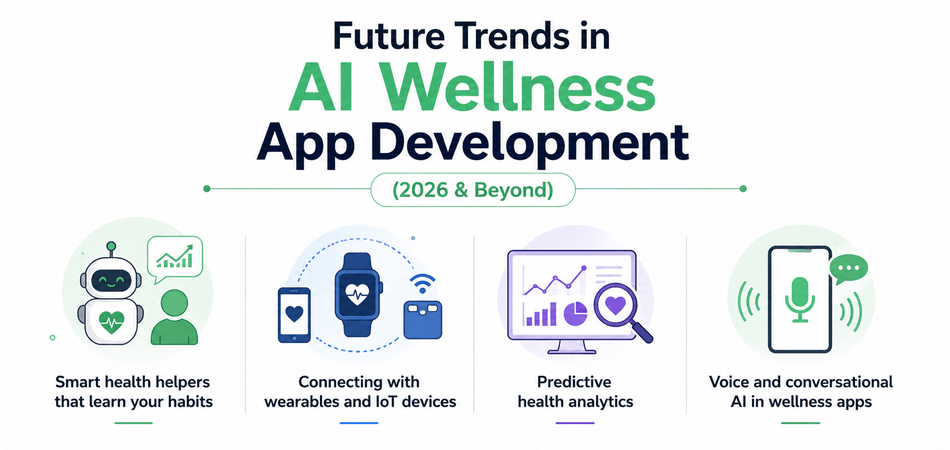
Smart health helpers that learn your habits
Out of nowhere, generic wellness apps are losing ground. What’s coming up instead? Hyper-personalized tools – ones tuned into how you live, move, and feel over time. These aren’t one-size-fits-all. They learn by watching, adjusting quietly behind the scenes. While old models shout routines at everyone, they listen first. A shift is happening without fanfare. Your patterns shape what comes next, not preset rules. Quietly, depth replaces breadth.
Out of nowhere, artificial intelligence now steps into daily life as a steady partner in personal well-being. Not only does it gather numbers, it also makes sense of them – then moves. Because it boosts interaction, this shift has real strength. Longer stays happen when the experience seems to get who they are – beyond mere monitoring. Instead of feeling watched, people feel seen.
Connecting with wearables and IoT devices
Fitness trackers used to feel optional. Now they quietly drive how modern wellness platforms work. Today, every serious wearable app feeds continuous data into AI systems such as heart rate, sleep cycles, stress levels, and even hydration patterns.
This shift is tightly connected to IoT app development, where devices like smartwatches, bands, and connected health tools stay linked in the background, sending real-time updates without user effort. The result is simple: wellness apps no longer depend on manual input. They learn from you all day.
Because data flows constantly, AI models become more accurate over time. Instead of reacting to isolated inputs, apps start recognizing patterns like poor sleep trends or rising stress levels and adjust recommendations automatically.
What’s interesting is how invisible this feels. Users don’t actively “track” anymore. The system does it for them, only stepping in when something meaningful changes.
This always-on connection between wearable apps and IoT systems is what turns basic tracking into real-time, intelligent wellness support.
Predictive health analytics
Tomorrow sneaks into today’s apps. Gone are just past reports – soon they whisper warnings before moments arrive. Days before any signs show up, modern AI spots trends that hint at future health issues. Health threats start forming quietly, yet these smart systems notice what humans miss.
Hidden signals get picked up early by algorithms trained to watch for shifts. Before a person feels unwell, predictions emerge from quiet data changes. Machines see the small clues piling up where doctors might overlook them. For example:
- Predicting fatigue or burnout
- Detecting early illness signals
- Suggesting preventive actions
Wellness apps now act more like early warning systems – changing the way folks handle their well-being. Shifts like these quietly reshape daily habits without announcing themselves.
Voice and conversational AI in wellness apps
Voice is quietly changing how people interact with wellness apps. What once needed tapping through screens now often starts with just speaking. Users can log workouts, describe how they feel, or ask for guidance without navigating menus.
This shift is powered by advances in chatbot app development, where AI systems are trained to understand conversations and respond in a natural, helpful way. These chat-based assistants act like always-available wellness guides and answer questions, suggest routines, or offer mental health support in real time.
For many users, this removes friction. Instead of figuring out where to click, they simply say what they need. That makes apps more accessible, especially for people who find complex interfaces frustrating.
What’s changing is not just the interface, but the experience. Wellness apps are starting to feel less like tools and more like conversations. And as businesses continue embedding AI assistants into apps and devices, this voice-first interaction will only become more common.
Build a high-performing AI wellness app with Techugo
Big thoughts grab attention, yet when it comes to AI in wellness apps, how things are built makes the difference. What sets Techugo apart is hands-on know-how, shaped by actual work creating digital health tools that grow smoothly over time.
Starting strong outside medicine, Techugo shaped big digital spaces such as TrueFan alongside Lifology, engineered for smooth function even with massive audiences. Their skill in growing systems quickly becomes clear here.
Out front because they start with strategy. Development waits while they map out the product, shape the user experience, and work through system structure. Artificial intelligence ties in smoothly, servers live in the cloud, security runs deep – this mix supports today’s health-focused digital tools well.
Starting with solid coding skills, Techugo backs firms aiming to launch smart health apps on phones. Built to last, their work includes ongoing fixes and updates that keep things running smoothly over time. Instead of quick fixes, they focus on steady growth behind the scenes. Helpful during setup, they stay involved well after release. Strong under pressure, their team handles complex tasks without slowing down.
Conclusion
Building an AI wellness app in 2026 is a strong opportunity, but it’s not something you approach casually. The cost to build an AI wellness app can range widely depending on features, AI depth, and scalability goals. What matters more than budget is clarity, knowing your target users, solving one real problem, and building step by step.
Start with an MVP, validate demand, and then invest in advanced AI features as you grow. This approach keeps the AI health app development cost in 2026 under control while reducing risk.
In the end, success in this space comes down to execution, user trust, and continuous improvement, not just technology.
Related Guides
8 Jun 2026
Food Delivery App Development in UK: Cost, Features & Timeline (2026)
📌 Key Takeaways Food delivery app development is now a full digital ecosystem, not just a simple ordering app. Features like real-ti..

Akshay Gupta
14 May 2026
AI Scheduling Assistant for Healthcare | A Comprehensive Guide in 2026
Most days, clinics face more patients than they can handle. Long waits happen often when too many people need care at once. Running things smoothly be..

Ankit Singh
Join the newsletter and get all the updates.
Subscribe
Let's have a Quick
Chat with you!
Have a question or a project idea? Reach out to us. We're here to help you navigate your journey with expert guidance and innovative solutions tailored to your needs.

Email us
sales@techugo.com