

 SA
SA  KW
KW  IE
IE AU
AU UAE
UAE UK
UK USA
USA  CA
CA DE
DE  QA
QA ZA
ZA  BH
BH NL
NL  MU
MU FR
FR 















📌 Key Takeaways
- Mobile banking apps are now a must-have for banks that want to stay competitive.
- A good banking app needs to do three things well: stay secure, stay simple to use, and be built to handle future growth.
- Some of the important features of an average banking app are AI, biometric login, instant payments, and real-time alerts.
- The cost to develop a mobile banking app in 2026 ranges between $20,000 and $200,000+.
My grandmother still thinks “online banking” means the website. Meanwhile, her grandkids haven’t opened a bank’s website in years. Why would they, when the app does everything faster. That’s the gap banks are scrambling to close.
According to McKinsey, 73% of customers at U.S. megabanks now use digital channels as their primary way to access banking services. It isn’t really news to anyone who’s watched a line at a bank branch these days. It’s basically retirees and people fixing a problem the app could not solve. Everyone else just taps and goes.
Now in this guide, we’ll get into everything mobile banking app development involves – the types, costs, features, use of AI, process, compliance, and the list might not end. So, let’s get straight into it.
Why businesses need mobile banking app development services in 2026
You’ve probably already figured that a banking app matters, but here’s what it actually does for banks and fintechs once it’s live:
1. No more branch visits – the entire point of banking mobile app development: checking balances, sending money, paying bills, all from your phone (whenever).
2. Keeps customers loyal – A good banking app development strategy just makes people stick around instead of switching to whichever bank has a better app.
3. Lower operational costs – When everyday transactions move to the app, banks spend less on staffing.
4. Stronger security – Here, we’re talking about biometric login, multi-factor authentication, encryption and fraud detection.
5. Smarter, personalized banking – Spending insights, personalized recommendations, real-time alerts – it’s the difference between an app that just shows numbers and one that actually helps.
6. Stay ahead of the curve – Banks, fintechs, credit unions – whoever’s serious about mobile banking app development services is the one keeping up with where customers already are.
Be it a legacy bank or a fintech app development project starting fresh – one thing will stay the same: show up where your customers already are (on their phones).
Types of mobile banking apps you should know
1. Digital-only banking apps (Neobanks)
These are the type of bank where all you have to do is open an account. Just open an account, get through KYC, apply for a loan (all from your phone). You don’t have to worry about different branches; you don’t have to worry about long lines. This is what people want these days.
2. Corporate banking apps
Different beast entirely. This isn’t your everyday banking app. It’s for corporate/businesses. And businesses need payroll, bulk payments, invoice approvals, multiple people accessing one account… a good mobile banking app development company knows how to build for that complexity.
3. Investment and wealth management apps
Why juggle five apps when one is enough to handle all your savings, stock trades, mutual funds, and portfolio tracking? Smart mobile banking app developers are building this into one clean experience now.
4. Payment & digital wallet apps
Send money, scan a QR code, tap and pay – it just needs to work instantly. Most banking apps bake wallet features right in these days, because honestly, customers expect it.
Real-world use cases of mobile banking apps
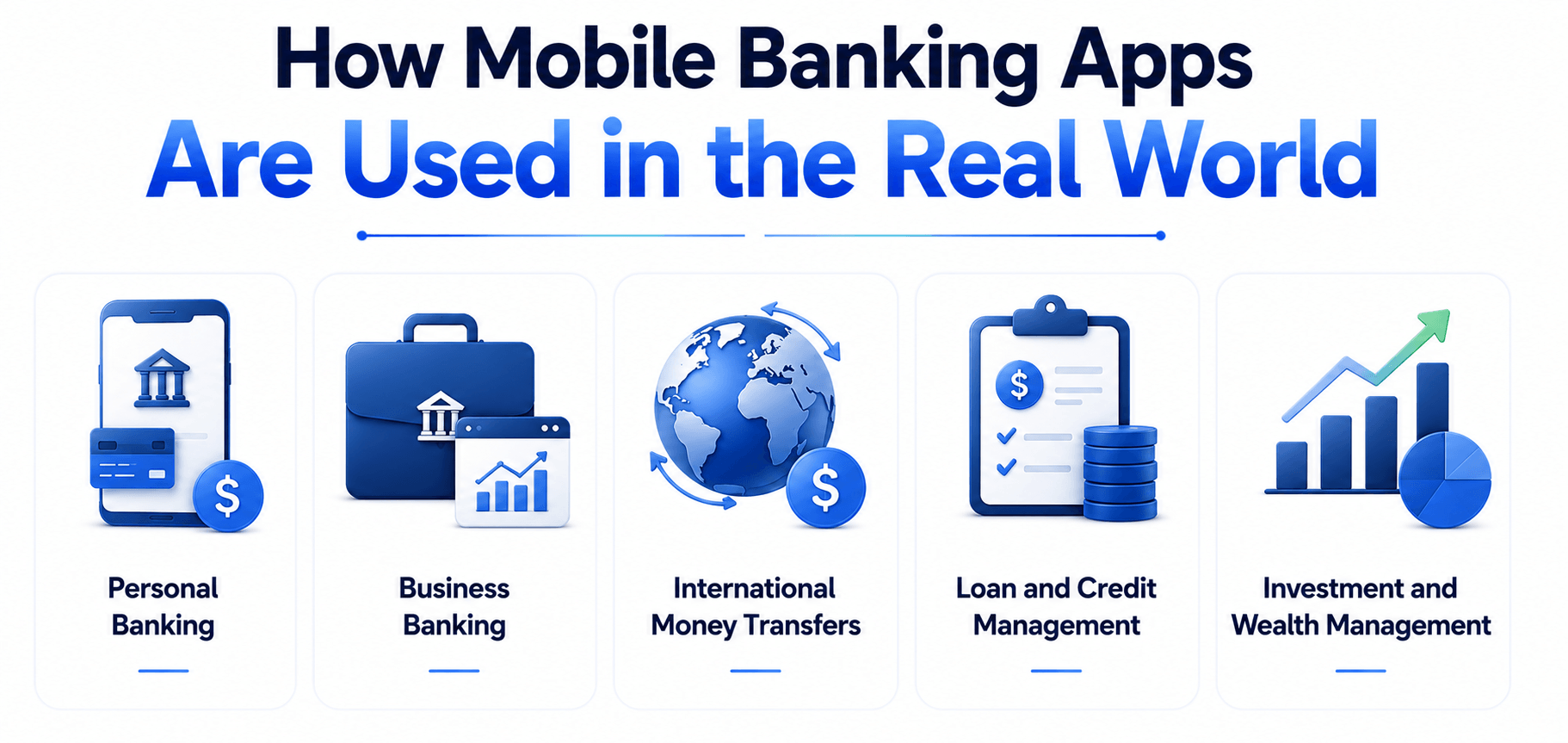
1. Personal banking
This is what everyone already knows. An app (like Chase Mobile or Chime) that lets you check your balance, send money, pay a bill, get an alert when something happens on your card. You’re not going to a branch for this anymore, and honestly why would you.
2. Business banking
This one’s complicated though. In business, you’ve got payroll, bulk payments that need approvals from three different people, expense tracking, employees who should see some certain things (records) but not everything.
In this case, all you need is a smart banking mobile app development team that plans for that complexity instead of pretending that it’s simple.
3. International money transfers
Used to take days and you’d lose money on fees. Now you can literally watch the transfer happen and see the actual exchange rate.
(For users who regularly send or receive money across borders).
4. Loan and credit management
Apply for a loan, check your EMIs, pay off your credit card – literally all from one dashboard instead of going through all the paperwork.
5. Investment and wealth management
And now a lot of these apps let you invest too (without needing a whole folder only for ‘finance apps’). That’s obviously why cross-platform app development matters so much now. Build once, and it works the same whether someone’s on an iPhone or Android.
Features of mobile banking apps every user expects
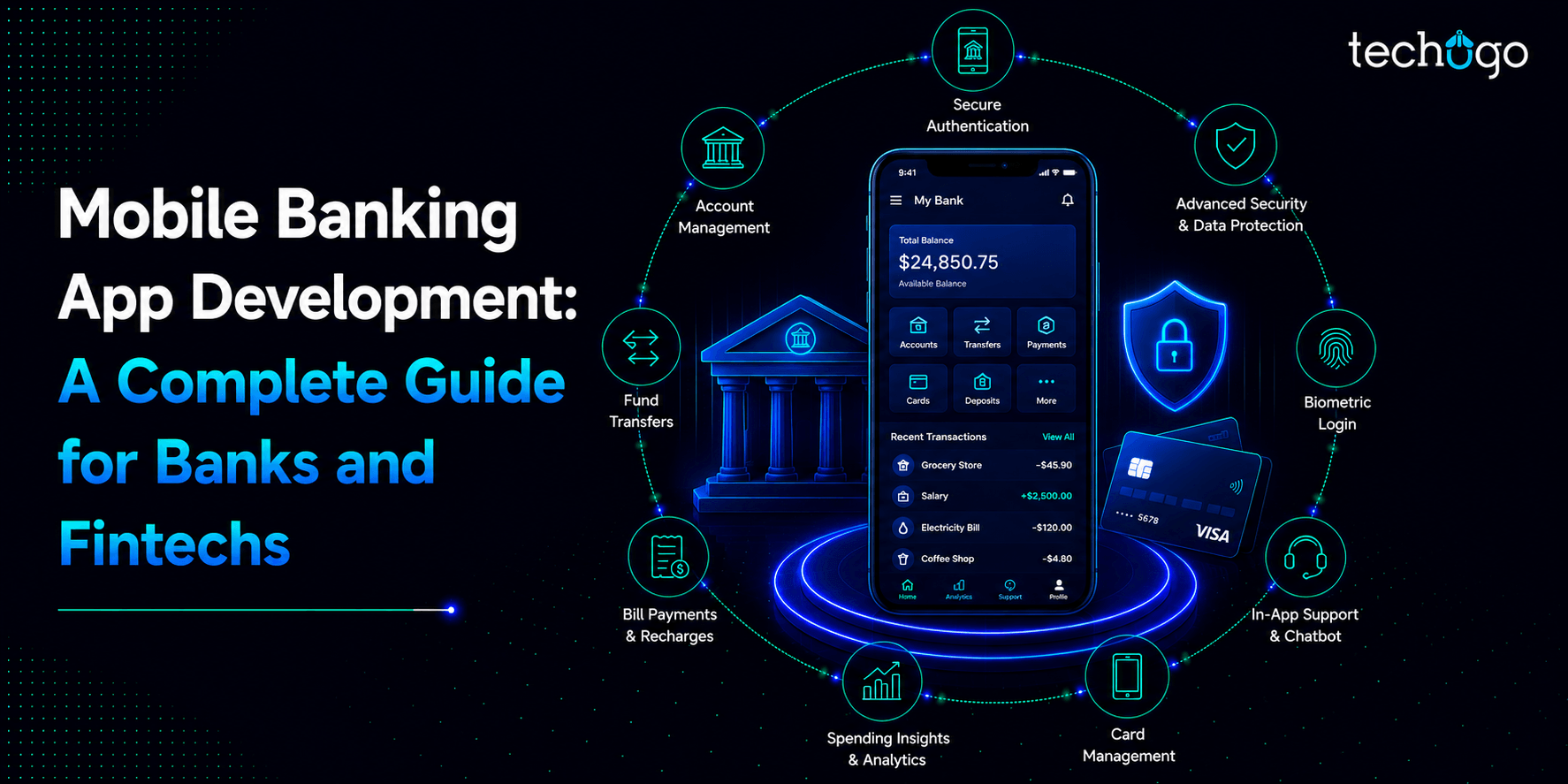
1. Biometric login
Face ID, fingerprint, whatever your phone’s got… you’re not typing a 12-character password every time you have to check your balance. It’s fast and it’s more secure than most passwords people come up with. (Not a secret but most mobile banking app developers build this in as a default now).
2. Real-time notifications
A very basic but very crucial one. The second money moves, you know about it. How? Push notifications. Someone swipes your card, a bill gets paid, your paycheck lands – you get a ping instantly.
3. QR code & contactless payments
Scan a code, tap your phone, done. There’s no cash or card involved, no chance of you fumbling around at checkout as an entire line forms behind you.
(This is actually the part teams obsess over the most because if the payment flow feels even a little clunky, people notice immediately).
4. Budgeting & spending insights
The app basically tells you where your money’s going – like, “you spent $200 on food delivery this month” kind of honest. Some apps even nudge you before you overspend.
5. 24/7 chat support
Card gets blocked out of nowhere on a Sunday? You’re not waiting till Monday! An AI chatbot (or a real person, depending on the app) sorts it out right then and there.
6. Bill pay & auto-pay
Set it once, forget it. Rent, utilities, subscriptions – all of it happens on time, every time.
{Worth knowing: There are so many off-the-shelf apps that are NOT built for your business. They don’t run on your approvals, workflows or your users. If none of the templates fit, that’s basically the whole reason custom mobile banking app development exists – someone builds it around you (your business) instead of the other way around.}
AI features in mobile banking app development
1. AI chatbots & virtual assistants – Type your question, get an answer right away.
2. Fraud detection – It’s watching your spending in the background. And the second something looks off, it flags it instantly or blocks it.
3. Personalized financial insights – Not just numbers, it actually tells you something, like where you’re overspending or where you could save. Feels less like a bank, more like a free financial advisor.
4. Smart budgeting suggestions – Based on how you actually spend, not some generic template. This kind of personalization is usually a big focus in AI app development now.
5. Predictive cash flow alerts – It can tell you’re about to run low before payday, so you’re not blindsided by an overdraft.
6. Voice banking – Just talk to it – “what’s my balance,” “pay my electricity bill” – done (for more clarity, you don’t have to tap).
At this point AI’s just expected when you’re developing a mobile banking application.
You don’t get points for having it, you lose points for not having it.
7 steps to successfully build a mobile banking app
Step 1. Define your purpose
Do you know exactly what type of banking you’re trying to build?
Because if you don’t, it’s a bad start. So just pick one (could be personal banking, business, or investing).
Step 2. Research compliance
Banking is regulated to death and so your KYC, your data security and your licensing needs to be dealt with now, not after you have already built half the app.
Step 3. Plan the UX
Checking your balance shouldn’t feel like a scavenger hunt through menus. So try to keep it as simple as you can. (Remember that simple doesn’t mean “basic”, an interface can be simple and attractive at the same time).
Step 4. Choose the right tech stack
Mobile app development for banking either goes smoothly, or it turns into a whole mess because the tech stack you choose now is the one you’re stuck with. So choose tech you won’t regret.
Step 5. Build & integrate
Now you have to build & integrate –
- APIs
- payment gateways
- and your biometric login
Why? Because it is not enough for each piece to work on its own, they all have to work together.
Step 6. Test everything
A security bug in a banking app isn’t just a bug. It’s a headline. So test everything as if your life depends on it.
Step 7. Launch & iterate
Because you’re never really done (yes, even after the launch), people will find things you missed and that’s fine, that’s how it’s always been, and therefore mobile banking app development is a process, not an ultimate.
Benefits of mobile banking apps beyond everyday transactions
Everyone has used a banking app at this point, but most people don’t really think about why it’s actually good. There’s more to the mobile banking app benefits than people realize.
Let’s get into it.
1. 24/7 banking convenience – You get access all the time, and you don’t need a branch, because it’s all right there – transfer funds, pay bills, etc. You can check your account, whenever.
2. Enhanced customer engagement – And it’s not just convenience, it’s the personalized alerts too, so that you’re back on the app every time you get that notification.
3. Lower operational costs – Banks aren’t spending as much running branches all day, so stuff moves faster on your end too.
4. Stronger security & fraud prevention – It’s only good if it’s safe. So they’ve got fingerprint login, encryption, and machine learning in banking industry.
Mobile banking app development cost: what should you expect in 2026?
So, how much does it actually cost to develop a mobile banking app in 2026? Short answer: it depends but let’s break it down.
Your mobile banking app development cost can either be $20,000 or $200,000+. It all depends on –
- how complex you want your app to be
- what features you’re adding
- and the platforms you are targeting.
A rough breakdown
| App Type | Estimated Cost (USD) | Timeline |
| Basic MVP | $20,000 – $60,000 | 3–4 months |
| Mid-range app | $60,000 – $120,000 | 5–8 months |
| Enterprise-grade app | $120,000 – $200,000+ | 8–12+ months |
(These are general industry ranges. Actual quotes depend on your specific requirements.)
Why costs are shifting in 2026?
1. AI integration – the major factor. Spending insights, fraud alerts, chat support – all these features takes time to build, so it costs more.
2. There’s been some bad breaches lately, so security testing and compliance checks take longer than they used to. That eats into the budget too.
3. Open banking’s pushing a lot of digital payment app development toward heavier API work. (Might cost more, but at least you won’t have to rebuild everything later).
How to keep costs manageable?
1. Build the MVP first, add stuff later. Don’t try to cram every feature in on day one.
2. Go cross-platform if you can (saves you from building two separate apps).
3. Ask for a real cost breakdown before you say yes. If the quote’s vague, that’s usually scope creep waiting to happen.
Compliance requirements for banking mobile app development
Monetary apps don’t get second chances, unfortunately. But fortunately, there’s a checklist for that.
Here’s what needs to be airtight before yours goes live.
1. PCI DSS Compliance – basically keeps card data safe when payments are happening
2. KYC (Know Your Customer) – checks people actually are who they say they are, so randoms can’t just open accounts
3. AML (Anti-Money Laundering) – flags all the shady transactions
4. GDPR & CCPA – makes sure customer data isn’t just floating around unprotected, handled the way it’s legally supposed to be
5. Multi-Factor Authentication (MFA) – one password isn’t enough anymore, this adds another layer so accounts don’t get hijacked easy
6. End-to-End Encryption – your data’s locked up whether it’s sitting there or moving between systems
7. Secure APIs – lets your app connect and exchange data with other banking services without leaving a door open for hackers
8. Regular Security Audits – catches weak spots before someone else finds them first, keeps you compliant as rules change
Best practices for building a secure mobile banking app
1. Prioritize security from day one
Security’s got to be the first thing that comes to your mind here. Encryption, biometric login, multi-factor authentication – this is what actually protects user data and gets people to trust your app in the first place.
2. Keep the user experience simple
Banking apps deal with important tasks. So it needs to be clean, fast and easy, not like a chore.
3. Build for scalability
Your app should be ready to handle more users, transaction and even the future updates (because you don’t want to be rebuilding it every time it grows). So the best thing you can do is build for scalability.
4. Test regularly & stay compliant
Don’t skip this part (even by mistake). Regular security testing and compliance checks catch problems early and keep you on the right side of industry regulations. So it’s a must.
Common mobile banking app development challenges businesses face
1. Meeting Security and Compliance Requirements
Probably the biggest challenge in mobile banking application development. There’s a ton of mobile banking software development that goes on internally – PCI DSS, GDPR, regional finance rules… and on top of that you still need real encryption, MFA, fraud detection.
You can’t mess around with security. So the solution is to prioritise:
- PCI DSS
- GDPR
- Regional finance rules
- Encryption
- MFA
- Fraud detection
2. Integrating with legacy banking systems
Then you’ve got banks still running on ancient core systems that were never built for mobile. Connecting that with a new app might sound simple but it is actually not. The fix? Careful API integration and modernising step by step (not all at once).
3. Balancing security with user experience
And the classic one – people want security but also fast and easy to use, and those two things kind of fight each other.
But you don’t have to deal with this problem on your own. You can always just team up with a mobile banking app development company to deal with this.
4. Ensuring scalability and performance
Salary-day traffic can bring any app to its knees.
A professional mobile banking application development company plans for these spikes from day one. So again the solution is – choose the right company, build right from the start.
Future mobile banking app development trends to watch
1. AI-powered financial assistants
Is there anything that AI assistants can’t do? Exactly.
AI is about to act like a money coach. You’ll get spending tips and budgeting nudges without you asking.
2. Advanced biometric authentication
Passwords are probably on their way out. Face scans, your voice, even how you type – that will be enough to get you in.
3. Open banking & API integration
And your app doesn’t have to do everything on its own now. Say you’ve got a loan somewhere else or a separate savings app – it can all show up in one place now.
4. Predictive fraud detection
Fraud detection’s gotten smarter, catching sketchy activity before it even happens, not after.
5. Cloud-native banking platforms
And with everything running on the cloud now, that’s really where mobile banking app development is headed – apps handling way more users without slowing down during rush hour.
What to look for in a mobile banking app development company
1. Experience in fintech development
This isn’t the place to hire the cheapest team you find. Banking apps come with real security stakes and compliance – think about what it actually takes to run a mobile banking app like ADCB. So you obviously want a company that has done this before.
2. Focus on security and compliance
Your dev partner needs to genuinely understand encryption, authentication, data protection, the whole regulatory maze – because if they don’t… your users’ money and your data is at risk.
3. Strong technical expertise
A team that can actually build the hard/advance technical features like real-time transactions, API integrations, biometric login, AI features – that’s what you should look for if you want something premium.
4. Long-term support
You’re going to need updates, maintenance, and ongoing support long after – because a banking app that gets abandoned post-launch is a problem.
Why leading businesses choose Techugo for mobile banking app development
By now, you probably know that building a banking app does not only include adding features. It has to be secure. Fast. Scalable. And it has to earn your users’ trust from the very first tap.
This is what Techugo is here for.
So we’ve been running as a mobile app development company for over 10 years now. And it’s been startups, enterprises, and global brands, because we’ve kind of worked with everyone at this point. Our team works alongside you from day one, it doesn’t matter if you’re still figuring the idea out, or you’re already scaling something that exists – we’re there either way. Regardless of the size of your business, we give our 100%.
And this is why businesses choose us, because we –
1. Build with security-first architecture (encryption, MFA, fraud detection)
2. Handle legacy core banking integrations without disrupting what’s already running
3. Design for scale, so the app doesn’t buckle on payday when everyone logs in at once
4. Use AI and machine learning for smarter fraud detection
5. Stay compliant with PCI DSS, GDPR, and regional financial regulations
6. Use cloud-native infrastructure for faster releases and better uptime
7. Stick around post-launch instead of just shipping and disappearing
If you’ve been waiting for the right time to build your banking app, this is it. Team up with Techugo & let’s create something incredible together.
FAQs
1. What is a mobile banking app?
A mobile banking app is basically your bank, but on your phone. You can check your balance, send money, pay bills, whatever – no need to go to a branch.
2. How much does mobile banking app development cost?
Depends what you’re building, honestly. Basic app costs a lot less than a full-blown banking platform. Usually starts around $30,000, can go past $250,000 if you’re building something enterprise-level.
3. How long does it take to build a mobile banking app?
Usually 4 to 12 months. If you start with an MVP though, you can launch way sooner and just keep adding features later.
4. What features should a mobile banking app have?
Start simple with features like secure login, transfers, bill pay, transaction history, alerts. You can also add advanced AI features if you want to upgrade your app later.

Get in touch
We'd love to hear from you.