 SA
 KW
 IE
 AU
 UAE
 UK
 USA
 CA
 DE
 QA
 ZA
 BH
 NL
 MU
 FR















📌 Key Takeaways
- QIB Mobile is a strong model for secure, user-friendly digital banking solutions in Qatar.
- Essential features include account management, fund transfers, bill payments, card controls and biometric security.
- The cost to digital banking app development in Qatar is QAR 109,000–546,000+, based on project scope.
- QCB compliance and strong security are essential for building a reliable banking app.
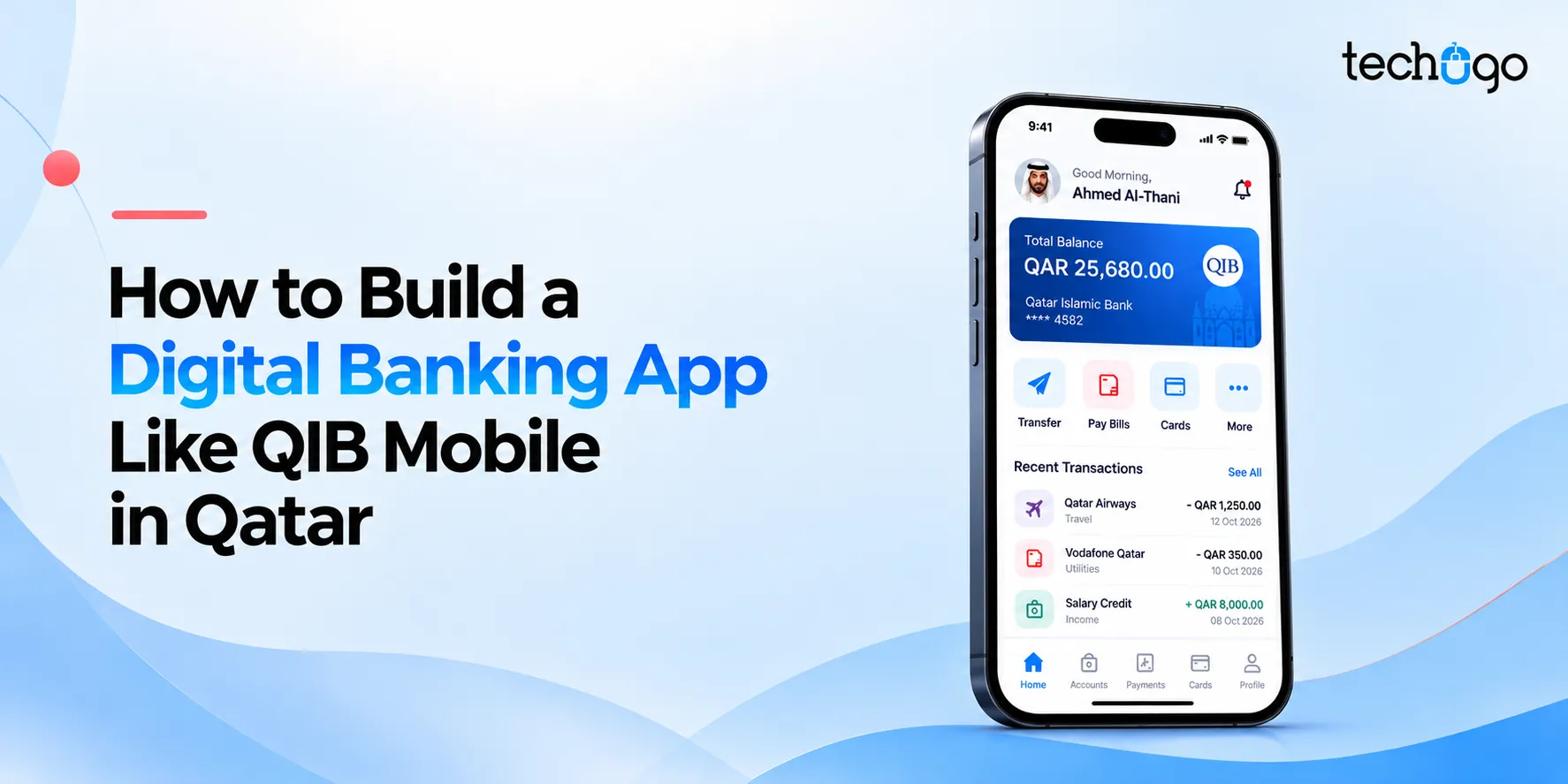
QIB Mobile is now at the heart of the financial evolution in Qatar. It’s an official mobile banking app of Qatar Islamic Bank that lets customers handle all their banking needs from their smartphones. The app has recorded over 5 million user logins every single month. Plus, 71% of all new bank accounts are opened digitally via the app. 83% of total retail customers are actively engaged on the platform.
Seeing such growth and success, some are planning for digital banking app development that mimics QIB Mobile’s model. Reasons are its seamless UX, strong security and hyper-localized features.
QIB Mobile perfectly exemplifies a secure, convenient digital banking solution that shows what a full-fledged banking app can do. But how do you replicate the success of a platform that processes millions of secure transactions while maintaining a flawless interface?
In this comprehensive guide, we will break down everything – from features to development steps needed to build a world-class mobile banking app tailored for Qatar’s thriving market.
What is QIB mobile and how does it work?
QIB Mobile is the official banking app for Qatar Islamic Bank (QIB) that works like a digital branch in your pocket. Once you’re a QIB customer with an ATM card,
1. you simply download QIB Mobile
2. register an account and log in with a username/password or even Face ID/Touch ID
3. After login, you see all your accounts and cards on one dashboard
4. You can tap to view balances, check statements and deposit checks
5. You can transfer money to anyone (local or international)
6. You can pay utility bills or mobile top-ups with just a few taps. For example, the app lets you pay bills for Ooredoo, Vodafone, Kahramaa, and more. It even integrates QIB’s own digital wallet (mPay) for fast, digital payments.
Behind the scenes, QIB Mobile connects securely to the bank’s systems: whenever you log in, it sends a one-time passcode (OTP) to your phone or requires your fingerprint to confirm it’s you. All data in the app is encrypted, and nothing sensitive is stored on your device without protection.
In practice, this means QIB Mobile works just like the bank’s internal software, giving you real-time access to your accounts whenever you want. It also includes extra tools (like finding the nearest ATM or branch, and a live currency converter).
In short, QIB Mobile app development has delivered a full-service mobile banking solution – and it’s a great model if you want to build something similar for Qatar users.
Build a Digital banking app like QIB Mobile today
Get a complete roadmap for a secure, high-performing mobile banking app tailored to your Qatari market.
Why is digital banking app development growing in Qatar?
“Qatar Digital Banking Platforms Market stands at USD 450 million, fueled by digital adoption, smartphone penetration and government initiatives for a paperless economy.” – Research and Markets
You might wonder why Qatar has seen such a boom in mobile banking app development. Several reasons explain the rapid growth.
First, Qatar’s regulators are actively supporting fintech and inclusion. The Qatar Central Bank (QCB) recently issued a new digital banking framework, explicitly encouraging banks and fintech firms to launch digital banks for underserved customers. This means Qatar’s policies favor innovation in banking technology, aligning with the country’s vision to expand financial inclusion and digital transformation of finance.
Second, consumer demand is rising. Qatar has very high smartphone penetration and a young, tech-savvy population. People expect to do everything on mobile – banking included. And when they see how easy it is to bank online, they start demanding better digital banking solutions.
Third, global and regional trends are at play. Fintech companies all across the world have shown that well-designed banking apps attract customers (think of Revolut, Chime, etc.). Major players like STC in Saudi launched a digital bank, setting new standards. Banks in Qatar notice this and want their own version to keep up – essentially, “how to build a digital banking app like STC Bank” is on many boards. Qatar also participates in the broader Middle East movement towards cashless payments and smart cities. All these factors – supportive policy, tech-savvy users, and competitive pressure – make digital banking app development in Qatar a fast-growing field.
What are the essential features of a digital banking app like QIB mobile?
There are a number of features that a good digital banking app like QIB Mobile offers which make it user-friendly yet secure. Here are some of the main features, inspired by QIB Mobile and these best practices:
1. Account Management: The app should let users see all their accounts (checking, savings, deposits) and their transactions at one platform. Users should be able to see balance, statements and loans/investments.
2. Fund Transfers: Customers expect to have trouble-free transfers of funds both locally and globally. It is reasonable to provide an option to transfer money not only among Qatari banks but abroad.
3. Bill Payments & Top-ups: Users should be able to settle monthly payments (water, electricity, internet) as well as recharge the mobile phone. For instance, the QIB Mobile’s “Pay” screen contains the most frequently used billers (Ooredoo and Kahramaa).
4. Card Control: This feature allows users to manage their debit/credit cards. Users can see their card info, switch on international transactions, block/unblock their cards on demand. In some apps, users can even set limits for withdrawing and spending.
5. Account Opening & Services: QIB Mobile enables the user to open new accounts as well as apply for other services (loans, credit cards, insurance) using the application. A key point of the application is the feature of the “apply for services.”
6. Integration of Digital Wallet: If the bank has its own digital wallet (such as QIB’s mPay) or cooperates with others (such as Qatar’s Urpay), you need to integrate them so users can make tap-to-pay transactions or perform peer-to-peer transactions through the app.
7. Security Features: Implement biometric access (especially fingerprint/Face ID). Two-step authentication (OTP) for each transaction. Also implement session timeouts and fraud alerts in real-time.
In summary, building a mobile banking solution like QIB Mobile means packing in features for account overview, secure transfers, card and bill management, plus extra conveniences – all while keeping the interface simple and fast.
How to build a digital banking app in Qatar like QIB Mobile: Step-by-step process
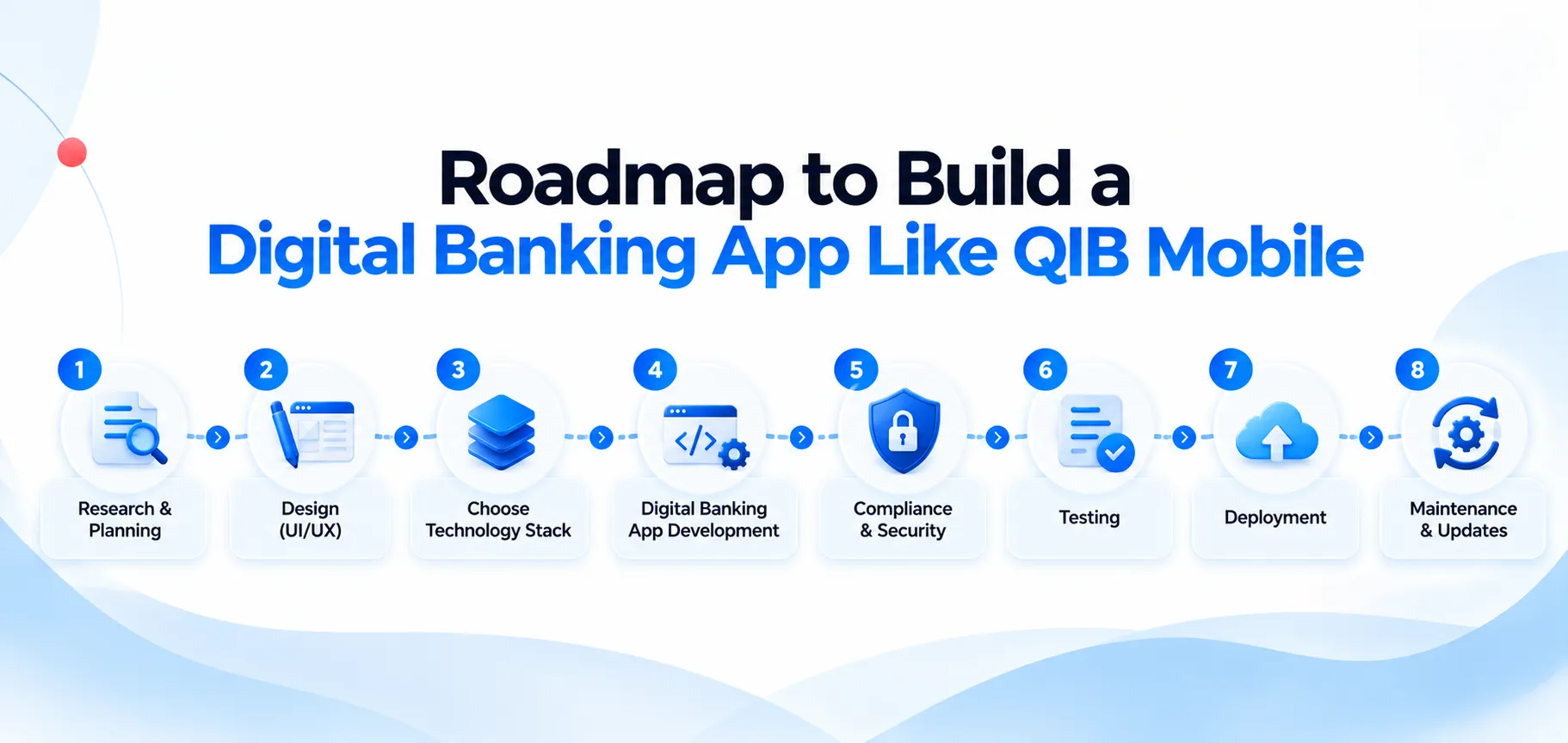
Follow an organized step-by-step process for digital banking app development in Qatar, and those steps are:
1) Research & Planning
Start with a clear concept. Define your target users, services (transfers, loans, etc.), and goals. Study Qatar’s market: what local banks offer, what compliance rules you must follow (we’ll cover this later). Outline features and how they solve user needs. You should also check QCB guidelines because any digital banking app must align with Qatar’s regulations.
2) Design (UI/UX)
Create sketches to reflect consumers’ pathways, where wireframes and user flows are important elements. A user-friendly interface with understandable menus is to be created, while the app must incorporate features for the Arabic and English language users and several other features (large text, voice-over if possible). As for the screens of the app, give mockups for dashboard viewing, login, transfers, etc.
3) Choose Technology Stack
Select whether to go with native or cross-platform technology. Pick the backend which best suits the application – also, pick the database and servers. Make sure that the selected tech stack allows for integrations with banking APIs as well as supports payment gateway integration.
4) Digital Banking App Development
Now, create a Front-end and Back-end for account management, conducting transactions, and user profiles. You’ll have to integrate core banking, OTP, payment gateways, and identity verification APIs for KYC. Also, it is better to add AI-based fraud detection tools because modern banks prefer to add fraud engines that can analyze transactions in real-time. It is necessary to apply secure encryption libraries.
5) Compliance & Security
Throughout development, implement regulatory requirements. For example, perform identity verification (KYC) digitally – this could be scanning IDs and a quick video (liveness test). Enforce transaction limits or alerts to prevent fraud. Follow Qatar’s data rules (encrypt data, avoid storing sensitive data unnecessarily). Build in extensive logging for audits.
6) Testing
You need to perform functional test, usability tests and, of course, security tests (penetration tests and vulnerability scans). You also need to check how the application performs on as many devices as possible and in various networks.
7) Deployment
Finally, publish the app. Submit your iOS version to the Apple App Store and the Android version to Google Play, following their guidelines (you’ll need appropriate bank-related metadata and may need to meet their financial app requirements).
8) Maintenance & Updates
Once your product is launched, it must be maintained continuously. Pay attention to possible bugs and user feedback and update the app in order to add features or fix security issues. It is worth noting that digital banking app development like QIB Mobile are not “complete” – you will have to improve the app further when changing requirements or the needs of the users come into the picture.
Throughout this process, having a structured approach helps. By the end, you’ll have a fully tested, secure banking app customized for Qatar’s market.
What technology stack is required to develop a digital banking app?
A digital bank app is expected to rely on secure and trustworthy technologies. In order to carry out a successful digital banking app development, technologies need to be chosen that can ensure security, speed as well as scalability. So if you want to build a digital banking app like QIB Mobile, pick technologies on the basis of necessary banking features, integration and security needs.
| Component | Recommended Technologies |
| iOS Development | Swift |
| Android Development | Kotlin, Java |
| Cross-Platform Development | Flutter, React Native |
| Backend Development | Java/Spring Boot, C#/.NET, Node.js |
| Architecture | Microservices |
| Database | PostgreSQL, MySQL, Oracle |
| Cloud Infrastructure | AWS, Microsoft Azure, Google Cloud |
| APIs & Integrations | Payment gateways, KYC APIs, banking APIs |
| Security | TLS, AES encryption, AI-based fraud detection |
| DevOps & CI/CD | Jenkins, GitHub Actions, GitLab CI |
How much does it cost to develop a digital banking app in Qatar?
Building a full-featured banking app is a significant investment. Estimates vary, but industry figures give a ballpark range. Experts at Techugo notes that:
- simple banking apps can cost around QAR 109,000–182,000 to build
- while more advanced apps with AI can reach about QAR 546,000
- fully-featured banking app typically has a minimum cost around QAR 546,000+
Of course, “simple” vs “complex” depends on your feature list.
An MVP with just login and account view is on the low end (QAR 109K). If you add bill pay, card management, foreign transfers, loyalty programs, etc., the development hours grow quickly.
Keep in mind, these are development costs. Additional costs come from design, project management, compliance audits and post-launch maintenance.
If you hire a local mobile app development company in Qatar, rates might be different than offshore teams. However, for budgeting, it’s safe to assume you need well over QAR 364,000 to get a robust, secure app built. As one guide summarizes: developing a banking app is a “complex project that requires significant investments of time and money”.
Calculate your digital banking app development cost
Don't rely on guesswork. Get a clear, feature-by-feature cost breakdown based on your project needs.
What factors affect digital banking app development costs?
Several factors play a key role in determining the final price tag of your banking app project. So the final cost to develop a banking app depends on:
1. Feature complexity
Basic features like balance checks cost less than advanced features like international transfers, loan applications, and AI chatbots. In short, “the more features required, the higher the overall cost”.
2. Platform choice
Developing for both iOS and Android natively costs more than using cross-platform frameworks.
3. Design and UX
Custom interfaces, animations, and personalized dashboards increase mobile banking app development costs.
4. Security and compliance
Encryption, multi-factor authentication, fraud detection and Qatar’s regulatory requirements add to development and testing costs.
5. Backend complexity
Integrating existing banking systems or building scalable infrastructure affects digital banking app development costs.
6. Third-party integrations
Payment gateways, KYC services, OTP providers, and fraud detection tools require additional integration and testing.
7. Developer location and team
Hourly rates vary by region. In the USA or Western Europe, developers may charge $60–$200 per hour; in South Asia rates can be lower. So who you hire affects cost. Thus, a firm in Qatar having local expertise may charge extra but will definitely bring regulatory knowledge.
8. Post-launch maintenance
Hosting, security updates, bug fixes, and new features add ongoing costs, typically around 15–20% of the initial development cost annually.
In the end, if you see low estimates, check what’s excluded (you may have missed important security or features) because a realistic cost quote will account for all these factors.
Discuss scope and surprises up front with the Techugo team to avoid runaway costs.
What regulatory and compliance requirements apply to banking apps in Qatar?
The market for financial apps in Qatar is highly regulated. Thus, when developing your banking app in Qatar, the rules set forth by the Qatar Central Bank (QCB) and data laws need to be taken into account. Some of the main requirements include:
| Regulatory Requirement | Key Compliance Details |
| QCB Digital Banking Framework | Follow applicable QCB rules for digital banking, including governance, customer protection and financial stability |
| Data Handling and Protection | Protect customer data through encryption, access controls and secure data management practices |
| KYC and AML Compliance | Verify customer identities, screen against applicable sanctions lists and monitor suspicious transactions |
| Payment Card Security (PCI DSS) | Protect cardholder data and follow PCI DSS requirements when applicable |
| Personal Data Protection Law | Comply with Qatar’s PDPL No. 13 of 2016, including applicable consent and data-handling requirements |
| Consumer Protection | Clearly disclose fees, terms and conditions and provide accessible complaint and dispute-resolution channels |
| Cybersecurity | Apply secure coding practices, strong authentication, vulnerability testing and regular security audits |
In short, treat the app like an extension of a regulated financial institution. The Qatar Central Bank explicitly requires banks and fintechs to adopt cutting-edge security for customer data. So incorporate strong authentication (biometrics, 2FA), secure coding, and frequent compliance reviews.
Working with a digital banking app development partner like Techugo that is familiar with Qatari regulations is a wise decision to navigate these requirements successfully.
What challenges should you consider when developing a digital banking app in Qatar?
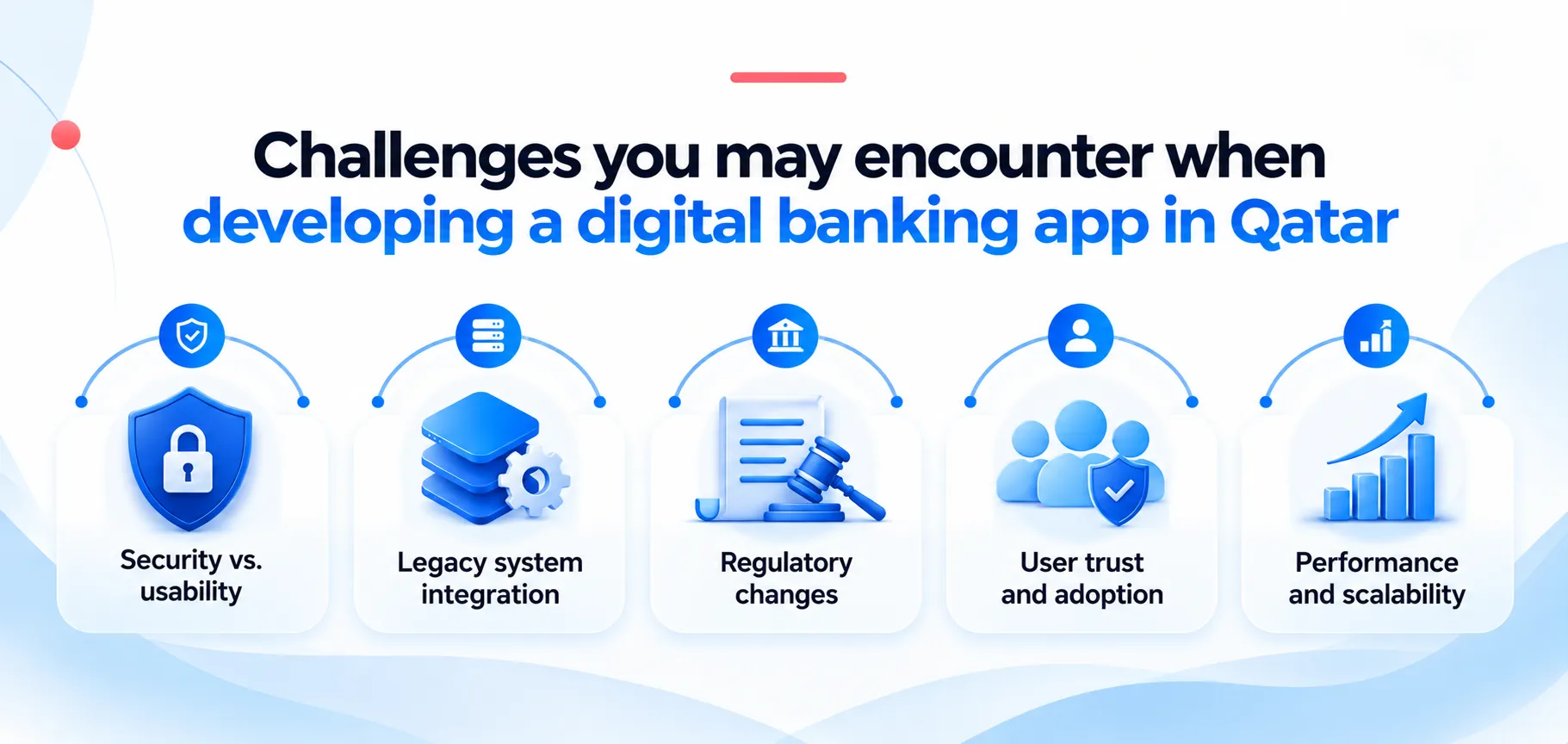
Developing a banking app comes with unique challenges that you must plan for:
1. Security vs. Usability
Balancing security and usability is challenging. You need encryption, KYC, and fraud controls without making logins or transfers frustrating. For example, requiring too many steps to log in or transfer money can frustrate users, but too few checks can risk breaches.The solution is often risk-based authentication: use stronger checks (like extra OTP) for large transactions, and simpler logins for basic tasks.
2. Legacy System Integration
Many banks in Qatar still run core banking software from years ago. Integrating your app with these legacy systems can be complicated. Old systems may not support modern APIs or high transaction volumes. You might need to build custom middleware or incremental upgrades (“progressive decoupling”, and this can increase development time and cost.
3. Regulatory Changes
Laws and guidelines can evolve. For example, Qatar’s new data regulation is recent; future changes could come in crypto or open banking domains. This means your digital banking solution must be flexible to adapt to new rules (modular design and easy update processes help here).
4. User Trust and Adoption
If you’re not a household name, customers may hesitate to trust a new banking app. Building strong branding, intuitive design, and offering guarantees (like deposit insurance) helps. Also ensure the app is bug-free at launch – any glitch in balance calculation or transfer can destroy trust.
5. Performance and Scalability
If your user base grows quickly, the app and servers must handle it. Peak loads (e.g. salary days, shopping events) shouldn’t crash the system. Load testing is essential. Designing a scalable cloud-based backend (auto-scaling servers, content delivery networks) can mitigate this challenge.
Being aware of these issues ensures your digital banking app development project stays on track and meets industry standards.
How long does it take to develop a digital banking app?
Timeline can vary widely with app complexity, but we can cite some industry experience. One of the reports says that a simple banking app takes at least 10 weeks (with a full team). Meanwhile, a highly complex app – with multiple platforms and advanced features – might take 5–6 months or more just for the development phase. In practice, end-to-end development (including design, compliance checks, and testing) can often stretch to 6–12 months before launch.
A realistic plan that allows 6+ months for a robust banking app is wise, and partnering with an experienced mobile app development company in Qatar can help streamline the process.
How can you monetize a digital banking application?
Monetizing a banking app works differently than other apps, since the main business of a bank is financial services. In general, income comes from the financial products the app offers, rather than charging for the app itself. The common strategies are:
1. Interest on Loans and Deposits
When users save money in the bank or take a loan, the bank earns interest spread. While not unique to the app, increasing user base through the app indirectly boosts this revenue.
2. Subscription/Premium Services
Some banks offer premium account tiers or subscriptions within the app. For example, you might have a free account and a paid VIP account that offers perks like higher ATM withdrawal limits and more. Subscriptions can provide steady revenue if users find extra features valuable.
3. Transaction Fees
The app can charge fees for certain transactions. For instance, some banks charge a fee for international transfers or expedited payments. Small convenience fees on bill payments or check deposits are another possibility. Over many transactions, these fees add up.
4. Card Fees and Usage
Even if banks do not charge monthly fees, they still earn money thanks to interchange fees as soon as card payment (either debit or credit) is made by a user. The increase in spending via app will also help the bank get a small share of interchange fees paid to merchants for every purchase made.
5. Cross-Selling & Affiliate Commissions
This is big. Your app can suggest related financial products (credit cards, personal loans, etc) to the user. When customers sign up for these via the app, the bank earns commissions or interest revenue. Some neo-banks also partner with other financial services and take a referral fee.
6. In-App Offers and Ads
Traditional advertising is rare in banking apps, but targeted offers for partner services (e.g. an insurance company’s banner ad) can be a small revenue source. Be careful: banking customers prefer minimal advertising.
The app should focus on driving engagement with the bank’s products, from which revenue naturally flows (via interest, fees, or commissions).
How to choose the right digital banking app development company in Qatar?
Picking the right development partner is crucial. Here are some tips:
1. Look for a company with proven fintech app development services experience and a portfolio of banking or payment apps.
2. Choose an app development partner in Qatar that understands local regulations, customer needs, and QCB requirements. This local knowledge ensures your app is designed for your audience.
3. Ensure the company offers full-cycle services, including UI/UX design, testing, and maintenance. If they provide related services like banking software development and payment integration, that’s a plus.
4. Check its expertise in banking software development, payment integration, encryption, authentication, and fraud detection.
5. Review client references and feedback to assess communication, delivery timelines, and problem-solving skills.
6. Compare costs based on expertise, quality, compliance, and post-launch support rather than choosing the cheapest option.
7. Check whether the company offers cross-platform app development using frameworks like Flutter or React Native.
In summary, you want a trusted team that knows both banking and the Qatar market. For instance, Techugo is an example of such a firm: we offer digital banking app development in Qatar, payment gateway integration, and even AI fraud-detection features. We’ve certified and experienced professionals and expertise that align with your project’s scope and vision.
Launch your digital bank with confidence!
Techugo’s fintech specialists have delivered secure, compliant mobile banking apps for international clients. From payment gateway integration to AI-based fraud detection, we cover the full spectrum of banking app development. Ready to innovate? Let’s discuss your project.
FAQs
1. What local payment systems does the app need to support?
To compete in the local market, your app should integrate with national payment rails like mPay (Qatar’s mobile payment system) and support regional transfer options such as instant wallet payments or cash pickups.
2. Can my app connect directly to local billers like Kahramaa or Ooredoo?
Yes. You can link your app directly to local utility providers via secure Application Programming Interfaces (APIs). This lets your users view and pay bills for services like Kahramaa, Ooredoo, and Vodafone directly on their screens.
3. Do I need a special license to launch a digital bank in Qatar?
Yes. You must get an official digital banking license from the Qatar Central Bank (QCB). Under the QCB Regulatory Framework, your business must be headquartered in Qatar, and most of your board members have to live there.

Get in touch
We'd love to hear from you.