

 SA
SA
 KW
KW
 IE
IE AU
AU UAE
UAE UK
UK USA
USA
 CA
CA DE
DE
 QA
QA ZA
ZA
 BH
BH NL
NL
 MU
MU FR
FR















📌 Key Takeaways
- The global mental health app market is projected to reach $45.12 billion by 2035, creating immense opportunities.
- Choosing the right app type, whether mindfulness, online therapy, CBT/DBT, or AI-powered support, is the foundation of successful development.
- A mental health app’s success starts with understanding user needs, researching competitors, and prioritizing essential features.
- Features like mood tracking, journaling, secure messaging, and personalized analytics can make your app engaging.
- Continuous testing, user feedback, security updates, and ongoing maintenance help keep mental health apps reliable after launch.
Mental healthcare is slowly becoming a top priority in the United States of America. Patients increasingly expect convenient, personalized, and accessible care without visiting a hospital or clinic for every health concern. But at the same time, healthcare providers are looking for smarter ways to monitor chronic conditions, reduce avoidable hospital visits, and improve patient outcomes.
Moreover, the global market size for mental health apps has crossed $9.61 billion in 2025. By 2035, the market is expected to reach $45.12 billion, growing at a CAGR of 16.73% from 2026 to 2035. So, when the opportunity is this massive, why not explore it?
Thus, in this guide, we’ll explore complete mental health app development, its key features, estimated costs and timeline, steps of development, and various other factors that are key to securing the best mental health application.
What Is Mental Health App Development?
The process of designing, building, and deploying mobile or web applications that aid emotional, psychological, and behavioral well-being is what mental health app development is all about.
Depending on the target audience and business objectives, these applications can serve different purposes. If you look at them thoroughly, some are helping users to:
- practice mindfulness and track their moods
- others connect patients with licensed therapists
- this leads to appointment scheduling, going for video consultations, and tracking their progress.
Looking For A Mental Health App That Meets Your Business Needs?
From teletherapy to any condition-specific platform, Techugo can help you build a solution that aligns with your business goals.
Types of Mental Health Applications Businesses Can Develop
Before you go into development or ask any mental health app development company to build one for you, it is important to know the direction. It means what type of app are you looking for is the first question that needs to be answered.
So, if you don’t know the answer to that, then here are some possible solutions:
1. Meditation & Mindfulness: Creating mindfulness practices into daily routines is what these applications help incorporate. Thus, leading to stress reduction, better sleep, and daily mindfulness through audio guides and breathing exercises.
2. Online Therapy & Counselling Applications: Connecting users with mental health professionals through digital mediums is what these applications target. They may offer therapist discovery, appointment scheduling, secure messaging, video consultations, and session management.
3. Self-Help & CBT/DBT Apps: Delivers acceptance and commitment therapy (ACT), structured cognitive behavioral therapy (CBT), or dialectical behavior therapy (DBT) models for anxiety, depression, or emotional regulation.
4. AI-First Companion Chatbots: AI in mental health makes use of natural language processing (NLP) that offers conversational support, symptom detection, and real-time coping methods.
5. Mental Health Applications For Children & Teenagers: Care around age-appropriate design, parental involvement where applicable, consent, data collection, and safeguarding for developing younger audiences matters. Hence, the focus is on emotional literacy, stress management, and access to qualified support.
What Are The Benefits of Investing In Mental Health App Development?
When you have understood the basics of mental health app development, now it is time to question what you are going to get from this. So, let’s take a look and go through its benefits one by one.
1. Growing Demand For Mental Health Solutions: Issues and understanding of the mental health epidemic are growing significantly in different parts of the world. Now, people are treating this as a serious problem. So, there is a need for solutions to tackle such a problem, and there aren’t many.
2. Expanding Digital Health Market: The global mental health market is expanding quicker than ever. So, even if you are going for HIPAA compliance for telemedicine apps, your business will also grow exponentially.
3. Anonymity & Reduced Stigma: Privacy in the current age is as important as anything. People don’t want to feel embarrassed about visiting a therapist in person or even during video consultations. This is especially crucial for users who are in the bracket of 14 – 24 years old.
4. Cost Effectiveness: With the digital push, mental health applications can lower costs and even control expenses. Factors contributing to this include the reduced need for in-person consultation, cutting transportation expenses, and a slightly lower need for hospital admissions. For businesses, their services expand to various locations without the need to actually be there.
5. Scalable Revenue Streams: Developers and healthcare providers can monetize through multi-tier subscription models, in-app purchases, B2B enterprise, and wellness brand partnerships.
Essential Features of A Mental Health Application
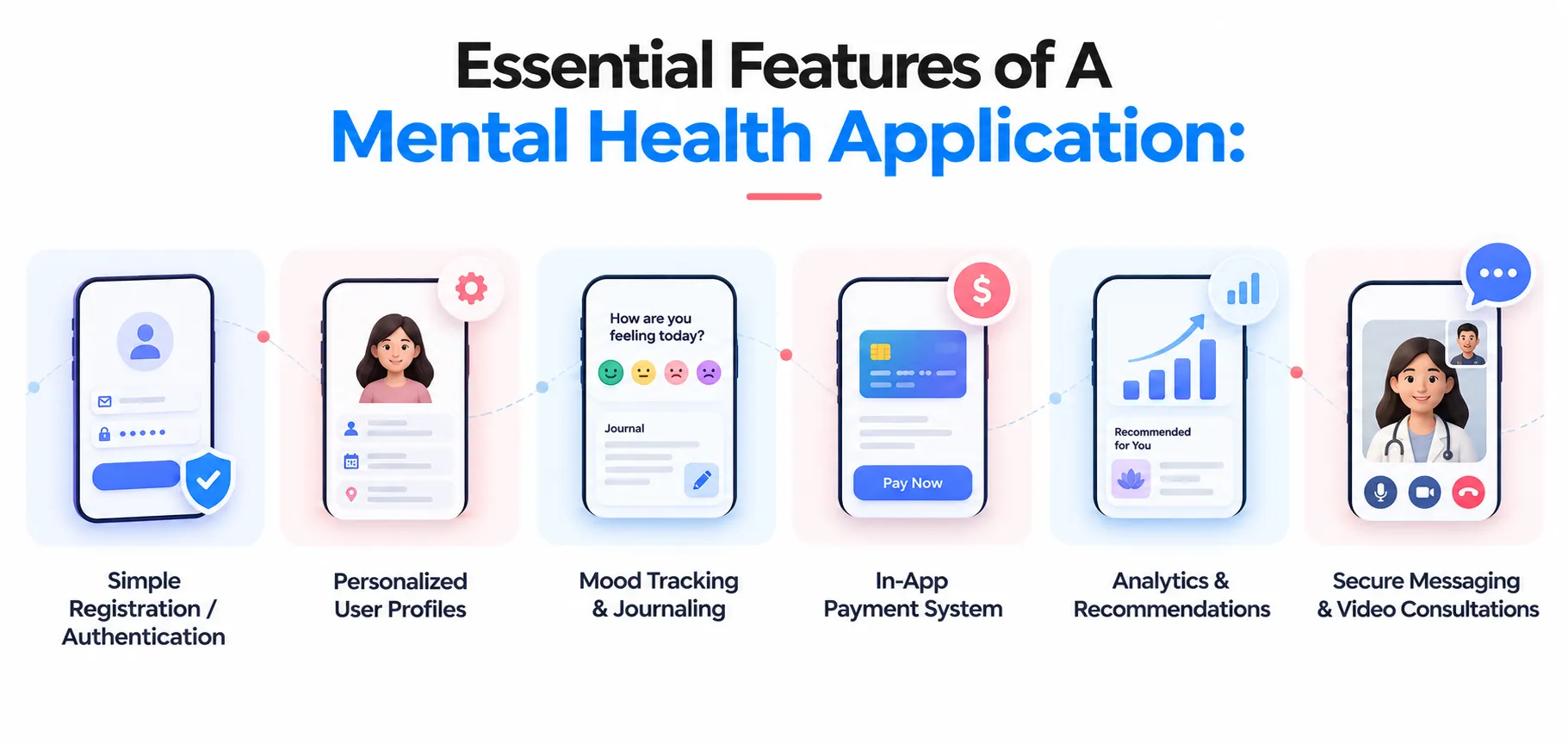
Features are what make or break a mental health application in the USA. This means that you should ask for every possible feature during mental health app development. Instead, focus on elements that make your software stand out from the crowd. So, here are some of the key features to watch out for:
1. Simple Registration or Authentication
The first step, i.e., the registration process, should be simple and inviting, which promotes more profile creation. Depending on the application, registration likely includes email or phone verification, secure authentication, consent collection, and an optional profile setup.
2. Personalized User Profiles
As part of mental health solutions, the platform may include therapist details, appointment information, or care-related records, subject to appropriate access control. But when you are going for mental health app development services, the personalizations must remain transparent and give users the ability to manage preferences. This is where EHR/EMR integration can come in and help maintain complete records.
3. Mood Tracking & Journaling
This feature is exactly what it sounds like. It enables users to record what their emotions were at any time during the day. Also reflecting on daily experiences and observing changes over time is a part of it. Tracking moods can be effective with a chatbot, where healthcare chatbot development can be useful
If you take a step with professional mental health app development services, you will likely see mood check-ins, customizable journal entries, emotion labels, and visual progress summaries.
4. In-App Payment System
Want to monetize your application? Just ask the mental health app developers to integrate subscription payments or in-app purchases. This will be connected to the App Store and Google Play to process payments. After everything is done and dusted, now give access control based on paid features.
5. Analytics & Recommendations
Users would want to know what their progress is while using this application. So, it is better to track user progress or let them know the outcome of a particular follow-up with that psychologist’s recommendations based on analytics.
6. Secure Messaging & Video Consultations
When you allow users to connect with therapists or other concerned persons and give them privacy, then people will continuously use your app. This can be in the form of secure messaging and video consultations. So, if you ask, “How to develop a mental health app? One of the foundations is making the platform safe and secure.
Advanced Features To Include In A Mental Health App
In today’s world, users want personalized experiences that will assist them in managing stress, as well as those helping them to understand their emotions, learn healthier habits, and reach the needed professional help. However, the approach of incorporating all existing features is not the best one. The key point is to take the features that suit the purpose of the app as well as the audience you want to reach.
1. Personalized Meditation & Wellness Plans: A single wellness plan is not adequate for everyone. Individualized meditation, breathing exercises, mindfulness events, and relaxation sessions can improve how meaningful it feels for users.
2. Personalized Notifications & Habit Reminders: Soft nudges help individuals to stick to their wellness plans and go to their therapy appointments or do their daily check-ins. Yet, notifications should be adjustable in nature, as continuous notifications may become annoying and stressful.
3. Crisis Support & Emergency Resources: In any situation where users might be going through a period of extreme emotional pain or crisis, mental health applications should take appropriate measures to provide the required help.
4. Strong Privacy & Security Controls: Privacy is not simply a technical necessity – it is an essential aspect of the mental health application. Users must be assured that their communication, diary entries, diagnostic tests, and any other private information are being managed responsibly.
Mental Health App Development Process: From Planning To Launch
Asking “how to create a mental health app?” is always a good step, especially when you don’t know anything about it. So, here’s the detailed mental health application development process, from start to finish:
1. Defining App’s Purpose
To begin with, clarifying the purpose of health app development is essential. The purpose might be tracking emotions, facilitating mindfulness, aiding therapy, or even all of these goals combined. Once you acknowledge the purpose, you will know what function needs to be included in your app.
2. Research The Users & Market
Always take a look at your target audience, their needs, and any competing platforms that can get in the way. This stage is somewhat important in identifying any gaps in apps that are in the market and how you can fill them. Doing this much research can make mHealth app development a success.
3. Plan The Features
After identifying your product, the next step is to come up with a list of features and rank their importance. For example, in designing HIPAA-compliant healthcare apps, features like therapists’ profiles, scheduling, secure messaging, and video conferencing are important.
4. Design The UX
When it comes to mental health apps, the navigation must be simple, especially since users can get confused or stressed out. Give instructions to the mental health app development company to make simple layouts, ensure important actions are visible, and eliminate any steps that are not necessary.
5. Choose The Tech Stack
The type of technologies you use to make the mHealth application will certainly determine the success or failure of the platform. The technology stack also depends on the features, platforms, integrations, and scalability needs of the platform.
6. Build & Integrate The App
At present, it has become much easier for developers to start the development of the core functionality and provide connectivity to all necessary services. But if you decide to use mental health mobile app development services, it can be expected that the process will include frontend and backend development as well.
7. Test Everything
Voilà, now you have reached the final stages of custom medical software development. Now is the time to test every aspect of the application, from security and authentication to video calls and anything coming close to sensitive user data. This step is important to find any inconsistencies and fix them before the app is live.
8. Launch & Continuous Improvement
Once the testing is done, the final step is to launch the app and monitor how it performs. Take feedback from customers, and analytics data can help you solve problems, upgrade current features, and choose what to create further. The loop never stops working when you are making an app for mental health app because you will always change according to the desires of real people.
How Much Does It Cost To Develop A Mental Health App? (With Duration)
Sometimes the mental health app development cost varies greatly depending on the functionalities that one wants the app to have. A very basic application for mood tracking costs less than an app that has video therapy, AI, wearable integrations, and advanced security.
But here are some of the application types with duration for each type:
| Application Type | Estimated Development Cost (USD) | Estimated Duration of Development |
| Basic MVP Mental Health App | $20,000 – $60,000 | 1 – 2 Months |
| Moderate Mental Health App | $60,000 – $120,000 | 5 – 10 Months |
| Advanced / Enterprise Mental Health App | $120,000 – $240,000+ | 8 – 15+ Months |
Wondering About How Much The Mental Health App Will Cost You?
Don’t make a guess. Get a quote that is specific to your goals and the features that you need in your application.
How Is AI Transforming Mental Health App Development?
AI is creating new opportunities for mental health applications by making digital experiences more adaptive, responsive, and personalized. Instead of offering the same content to every user, AI-powered systems can help tailor recommendations, identify patterns, and support certain routine interactions. After reading all this, let’s take a look at some of the ways AI is working its magic:
1. Personalized Mental Wellness Recommendations
AI can analyze relevant user preferences, mood logs, activity history, and feedback to suggest suitable wellness activities.
For instance, if a user regularly reports feeling stressed in the evening, the app might recommend a short relaxation exercise at that time. Recommendations should remain optional, transparent, and easy to adjust.
2. AI Chatbots For Initial Support
With the help of AI, chatbots can provide assistance in using applications, going through guided self-reflections, receiving educational resources, or finding answers to common queries.
For example, a chatbot can lead a person through a breathing exercise or provide information on how to manage everyday stress. This allows someone to access basic wellness services even outside of normal business hours.
3. Early Identification of Potential Concerns
AI models can find patterns in mood assessments, check-ins, or other allowed data to recognize changes that require attention. Signals should be seen as indicators rather than diagnoses. AI models need a lot of validation, checking for biases, and human monitoring, especially where their outputs affect medical practice or lead to actions triggered by a crisis.
4. NLP For Journaling
Natural Language Processing allows software to analyze written language and identify patterns such as emotional themes or changes in sentiment. A journaling feature might help users reflect on frequently mentioned stressors or summarize their own entries over a selected period. Such tools can be useful when designed with consent and clear limitations.
Common Challenges In Mental Health App Development & How To Overcome Them
Building a mental health app comes with challenges that go beyond ordinary mobile app development. The platform will handle deeply personal information, support users during emotionally difficult moments, and operate in a regulatory environment where the intended use of the software matters. Thus, addressing common challenges and ways to overcome them is crucial:
1. Protecting Sensitive User Data
One of the biggest challenges is securing information such as therapy conversations, mood histories, health assessments, and personal journal entries. A data breach or inappropriate disclosure can seriously damage user trust.
2. How To Overcome It?
Start with a privacy-by-design approach. Collect only the data the platform genuinely needs, encrypt sensitive information, restrict employee access, and establish clear retention and deletion rules.
3. Meeting Privacy & Regulatory Requirements
Mental health apps may be subject to different legal requirements depending on their users, features, location, and business model. A general wellness application may face different obligations from a platform that provides clinical services or makes medical claims.
4. How To Overcome It?
Identify the markets where the app will operate before finalizing the product architecture. Map the data the app collects, the reasons for processing it, who can access it, and where it is stored.
Avoid assuming that one certification or privacy policy automatically makes an app compliant everywhere. Legal and regulatory requirements should be assessed against the app’s factual functionality.
5. Building Trust In AI-Powered Features
AI chatbots and personalized recommendations can improve usability, but inaccurate responses or inappropriate suggestions may put users at risk. This is particularly concerning when users interpret AI-generated content as professional mental health advice.
6. How To Overcome It?
Define clear boundaries for every AI feature. Use carefully reviewed content for routine wellness guidance, test the system against challenging and high-risk scenarios, and create clear escalation pathways when the system encounters situations outside its capabilities.
Mental Health App Compliance Checklist: Laws and Regulations To Follow
A mental health application is home to sensitive information. This involves sensitive personal information for which developers must prioritize data privacy, security, patient safety, and regulatory compliance from the very beginning.
So, here is a practical checklist of the major laws that exist in the US when it comes to healthcare app development:
1. HIPAA (Health Insurance Portability & Accountability Act)
Establishing the requirements to protect sensitive health information, control its use and disclosure, and maintain appropriate safeguards is what HIPAA is all about. But it doesn’t necessarily mean that it applies to every mental health application. So, a compliance checklist should look like this:
- Determine whether your business is a HIPAA-covered entity or business.
- Encrypt sensitive health data in transit and at rest.
- Implement role-based access controls and user authentication.
- Apply additional protections to psychotherapy notes when applicable.
2. FTC Health Breach Notification Rule (HBNR)
Like, have you wondered if your mental health application is not covered by HIPAA? But hold on, this doesn’t mean that you have the right to gather and distribute data as part of healthcare app development solutions, be it New York, Boston, Baltimore, Cleveland, or any other part of the states. Thus, a checklist for FTC HBNR looks like this:
- First, determine whether your platform falls within the rule’s scope.
- Maintain a documented incident response and breach notification plan.
- Identify what health information was affected and who may have accessed it.
- Prepare procedures for notifying the media when required.
3. Federal Trade Commission Act (FTC Act)
Banning any deceptive or unfair business practice is what the FTC Act was created for. Therefore, promises about privacy, security claims, advertising, and statements about clinical effectiveness must be reflected in the product also. To keep this in check, here are some of the major points:
- Publish an accurate and accessible privacy policy.
- Explain what data the app collects, why it collects it, how it shares it, and who it shares to.
- Get appropriate consent for sensitive or unexpected data collection.
- Ensure actual data practices match all privacy and security promises.
4. FDA Regulations For Digital Mental Health Products
A mental health app that provides meditation exercises, general awareness content, or simple mood tracking may be treated differently from software that diagnoses a psychiatric condition or recommends specific clinical treatments. Thus, a simple checklist for mental health solutions:
- Define the app’s intended use and clinical claims.
- Determine whether any feature qualifies as regulated medical device software telemedicine app development.
- Review the FDA guidance and device classification requirements.
- Assess clinical performance, software reliability, and patient safety risks.
5. State Consumer Privacy Laws
Mental health app developers must also assess applicable state privacy laws, which may provide additional protections for sensitive personal information. Depending on the business and its activities, the law may provide rights to access, deletion, correction, and sharing or sale of personal information. Thus, the checklist could look like this:
- Assess which state privacy laws apply to your business.
- Provide required privacy notices and disclosures.
- Establish processes for responding to applicable access, correction, and deletion requests.
- Check whether specific state consumer health data laws impose additional requirements.
Why Does Your Business Need Techugo’s Mental Health App Developers?
Building a mental health application requires a thoughtful balance of technology, user experience, privacy, and business strategy. You need a mental health app development company that understands your product vision, translates it into practical features, and plans for the technical and operational challenges that come with digital healthcare.
This is where Techugo can be considered a potential technology partner for your project.
The Final Word
Mental health app development presents an opportunity to make wellness resources and professional support more accessible through digital technology. However, building a successful application requires more than an attractive interface or a collection of useful features. The best approach is to begin with a clearly defined problem, build an MVP around the essential needs of the user, and improve the application through testing and feedback. At the same time, plan for ongoing maintenance, regulatory changes, and the responsibilities that come with handling sensitive mental health information.
Thus, with the right strategy and the right mental health software development company, your business can build mental health applications that serve users responsibly while creating a foundation for sustainable growth.
FAQs
Q) How can I monetize the mental health application?
The business model for a mental health application may include subscriptions like monthly or yearly plans, freemium services, in-app payments for purchases, pay-per-session therapeutic assistance, and partnerships with other businesses.
Q) How do I choose the right mental health app development company?
Ans) Look for a software firm that specializes in healthcare software, whose experience includes secure application architecture, user-centric design, and knowledge of the regulations that apply. Check out the portfolio of past projects, evaluate the technical skills of the company, and learn about its development methodologies and post-launch support services.
Q) Can a mental health app integrate with wearable devices?
Yes, a mental health app can integrate with wearable devices and health platforms to collect relevant information. This includes sleep patterns, heart rate, and physical activity. These insights may help users identify patterns associated with their mood and stress levels.
Q) Should I build a native or cross-platform mental health app?
The choice depends on your budget, performance requirements, target audience, and planned features. Native development can provide deeper access to platform-specific capabilities, while cross-platform development can help share code across iOS and Android and potentially reduce development effort.
Q) What should be included in a mental health app’s MVP?
For a mood tracking app, this could mean secure account creation, mood updates, journaling, and simple progress summaries. For a therapeutic app, it includes therapist profiles, setting up appointments, and secure messaging functions.

Get in touch
We'd love to hear from you.