

 SA
SA
 KW
KW
 IE
IE AU
AU UAE
UAE UK
UK USA
USA
 CA
CA DE
DE
 QA
QA ZA
ZA
 BH
BH NL
NL
 MU
MU FR
FR















📌 Key Takeaways
- Remote patient monitoring applications let medical personnel track patients outside the facility using medical devices connected to the internet.
- By 2033, the worth of the remote patient monitoring industry is expected to be $110.7 billion, attracting many investments.
- The key functionality of any remote patient monitoring software consists of health monitoring, integration with devices, automatic alerts, and providers’ dashboards.
- The use of FHIR APIs and HL7 interfaces makes it possible to implement EHR integration, leading to enhanced healthcare information transfer.
- In turn, a dashboard for remote patient monitoring is a helpful tool for healthcare specialists.
Remote patient monitoring software allows healthcare providers to track patients’ health data outside traditional clinical settings using connected medical devices, mobile apps, and digital health platforms. From monitoring blood pressure and blood glucose levels to tracking heart rate and oxygen saturation, these solutions help providers make informed decisions using real-time or regularly collected data.
So, in this guide, we will explore the remote patient monitoring software development process, its benefits, key features, estimated costs, and the steps businesses can take to build a secure, scalable solution for the US healthcare market.
What Is Patient Monitoring Software Development?
Designing and building software that enables health providers to do every step remotely (collect, transmit, monitor, and manage patient health information) is what patient monitoring app development is all about. However, its validity and utility can only be proven if clinicians can interpret the data during the time they have with the patients.
Therefore, a typical ecosystem includes:
- Patient Mobile Application
- Connected Medical Devices
- Provider Dashboard
- Backend Infrastructure
- Notification & Alert System
- Integration Layer
Need Expert Help With Remote Patient Monitoring Software Development?
Connect with Techugo’s development team to plan your project with confidence.
Global Remote Patient Monitoring Market Size (Why Look For This App)
If you are looking to build some kind of business in the remote patient monitoring space, first it is important to know about the opportunity at hand. According to a report, the global remote patient monitoring market was valued at $26 billion in 2025. But in the current year, 2026, it has reached an astounding $30.9 billion.
However, for the year 2033, this market will reach $110.7 billion, which shows a compound annual growth rate (CAGR) of 20% from 2026 to 2033. And if you look at the revenue share contribution by location, North America dominates this by a staggering 40%
So, it is quite evident that there are ample opportunities when it comes to remote patient monitoring software development.
What Are The Key Features of A Remote Patient Monitoring Software?
How well patients, medical devices, and health providers are integrated into the remote patient monitoring system determines its success. Thus, here are some of the essential features to consider when opting for remote patient monitoring software development services:
1. Patient Registration & Onboarding
The onboarding process should be smooth and make it easy for patients to get themselves registered, create an account, complete profiles, go through consent information, and connect monitoring devices. As part of the remote patient monitoring software solutions, consider including:
- Secure sign-up and authentication
- Patient demographics and relevant medical history
- Consent and privacy notes
- Personalized care-plan setup
2. Real Time or Scheduled Health Data Monitoring
Health data monitoring is the foundation of an RPM application. The platform must gather data that is relevant for use in the desired medical scenario and present it accordingly. Depending on the purpose, it can include the following:
- Blood pressure
- Heat rate
- Glucose
- Body weight
- Blood oxygen saturation
3. Connected Medical Device Integration
Bluetooth Low Energy (BLE), device manufacturers’ APIs, Wi-Fi-enabled equipment, or approved cellular-connected devices are just some of the integrations that need to be integrated. Device compatibility, data accuracy, transmission reliability, and how the cross-platform app development will handle disconnected devices or missing readings must be evaluated during the development phase.
4. Automated Alerts & Notifications
Here, some of the useful capabilities include configurable thresholds, missing-reading reminders, notification prioritization, and escalation workflows. However, alerts and notifications need to be used like a pinch of salt. Too many of them will frustrate clinicians, while a poorly structured one can miss important details.
5. Healthcare Provider Dashboard
With the help of a provider dashboard, clinicians get a centralised view of patient information. Instead of getting into individual patient records and measuring them, authorized staff can take the help of the dashboard to monitor patient trends and identify patients who might need follow-up. A list of capabilities includes:
- Patient list and monitoring status
- Historical readings and visual trends
- Alert queues and review status
- Care-plan information
- Notes and follow-up documentation
6. EHR & Healthcare System Integration
Integrating RPM application with EHR platforms, practice management software, billing systems, and telehealth tools minimises the risk of duplicate data entry and improves continuity of care. A remote patient monitoring software development company can help you with integrations that are:
- FHIR-based APIs
- HL7 interfaces or
- Vendor-specific APIs
7. Patient Reminders & Care Plan Management
Potential features include measurements, reminders about medication, providing educational materials, tracking progress, and notifying about appointments. These tools can promote engagement; however, the reminders need to be configurable and do not imply that the app replaces the advice of the qualified specialist.
What Metrics Should Be Displayed On A Remote Patient Monitoring Dashboard?
When patients have the remote patient monitoring software, what should it display? There have been many debates about the metrics that a custom remote patient monitoring software development company in the USA must build. Thus, here are some of the key metrics that should be displayed on the RPM dashboard.
| Metrics | Alert Priority | Alert Threshold |
| Heart Rate | High | Below 50 BPM or above 120 BPM at rest |
| Blood Pressure | Critical | Systolic above 180 mmHg and/or diastolic above 120 mmHg |
| Blood Oxygen (SpO2) | High / Critical | Below 92%; below 90% warrants urgent assessment |
| Body Temperature | High | Above 100.4°F (38°C) or below 95°F (35°C) |
| Blood Glucose | High | Below 70 mg/dl or above 250 mg/dl |
| Respiratory Rate | High | Below 10 or above 24 breaths/minute at rest |
| ECG Data | High / Critical | Clinician-defined abnormal rhythm or device-specific critical event |
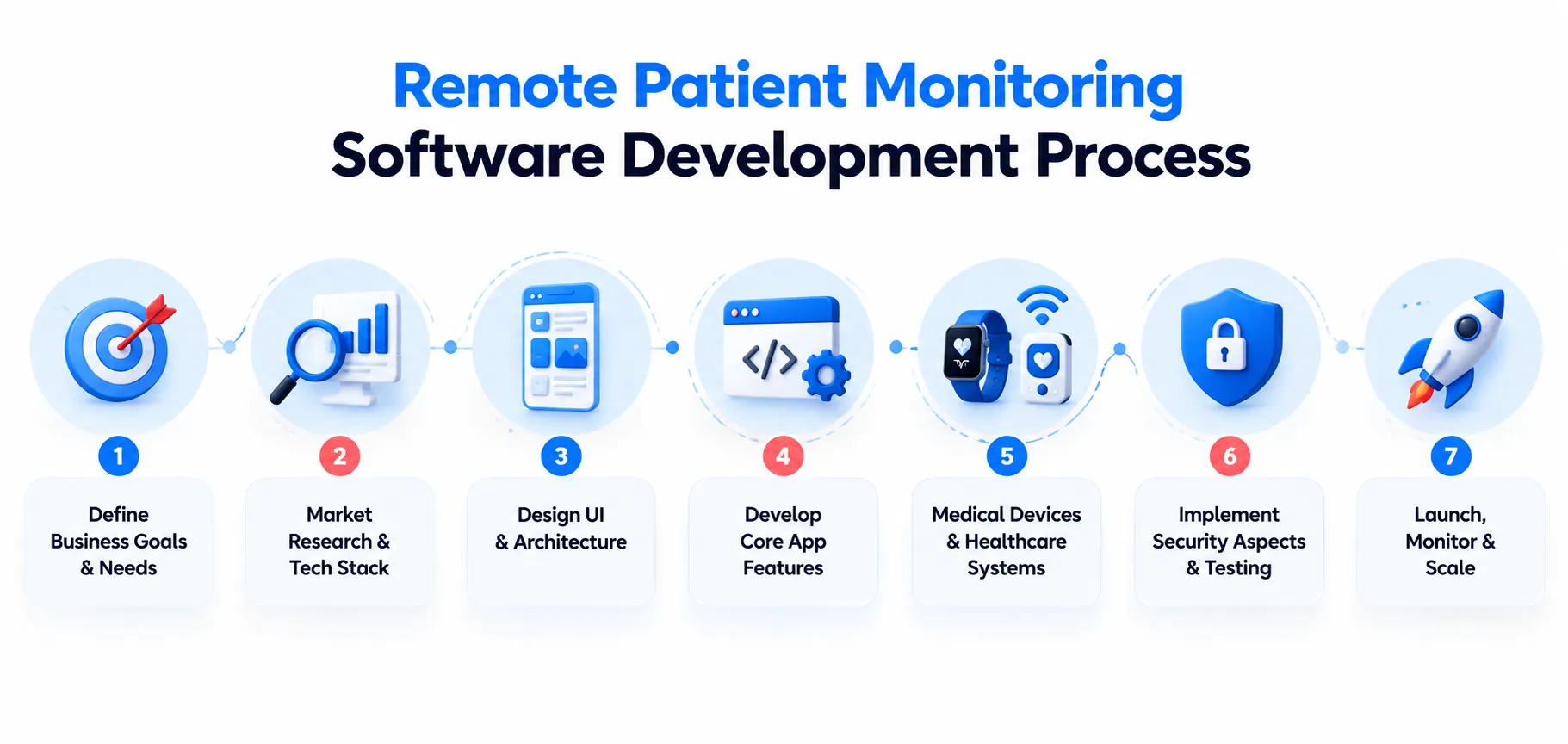
Remote Patient Monitoring Software Development Process (Detailed)
Developing a detailed and careful RPM application is not possible without the assistance of remote patient monitoring software development companies. This is due to the complexity of features, compliance, and detailed UI/UX designs for which you might need expert help. So, the steps of remote patient monitoring software development look like this:
1. Defining Business Goals & Requirements
At this point, identify your target audience and core functions, clinical monitoring needs, and business model and success metrics. You need to consider the relevant regulatory requirements and reimbursement issues. Helping you prioritize important features and avoid unnecessary development expenses is possible through clearly defined goals.
2. Conduct Market Research & Select Tech Stack
When doing market research about US digital healthcare, importance should be given to competing RPM solutions, patient expectations, and leading to sophisticated healthcare software development.
The next step is to select a technology stack that fits your specified requirements. For example, one might consider using Flutter or React Native for mobile application development, React for the vendor dashboard, Node.js or Python for backend operations, and appropriate cloud hosting services.
3. Design The UI & App Architecture
Simple onboarding, crystal-clear measurement instructions, and convenience in accessing data are what patients need. To do this, it is important to know healthcare app development costs, and healthcare providers will organize dashboards, historical readings, and alerts that help them identify patients who need attention.
At the same time, planning application architecture, including mobile and web interfaces, backend services, databases, APIs, and cloud infrastructure, will be done through expert services.
4. Develop Core Application Features
After the creation of the design and architecture, it is now time to get important features that make up the application. Top remote patient monitoring software development companies integrate patient registration, secure authentication, health data tracking, provider dashboards, automated reminders, and configurable alerts.
Features are added according to the application’s requirements, which later determine its success.
5. Integrate Medical Devices & Healthcare Systems
Integrating medical devices like blood pressure monitors, glucose meters, pulse oximeters, and weight scales will be done only according to the needs of your platform. On top of this, these integrations may use Bluetooth, Wi-Fi, cellular connectivity, or manufacturer-provided APIs.
Further additions when it comes to custom remote patient monitoring software development services consist of FHIR-based APIs, HL7 interfaces, or vendor-specific integrations.
6. Implement Security, HIPAA Compliance & Testing
Remote patient monitoring software companies in the USA utilize relevant encryption techniques, role-based access safeguards, secure API communication processes, audit logs, and backup measures.
Verify the applicability of HIPAA laws to your organization and offerings, as well as extra privacy or security regulations in your state, as well as any contractual obligations or FDA regulations. The goal is to ensure that the application performs reliably and supports the intended clinical workflow. This is also applicable for telemedicine software development, especially in the North American region.
7. Launch, Monitor & Scale
Once the application is complete and tested, it is now time to launch it. So, when the patients are in limited numbers or are a handful, its usability and operational challenges can be better put to the test. Moreover, a remote patient monitoring software development company will help you with metrics like patient enrollment, monitoring adherence, data transmission reliability, alert review times, and beyond.
Technologies Used In Remote Patient Monitoring Software Development
To collect data related to health, transmit it safely, analyze readings, and assist doctors in making the right decision, the proper combination of technologies is important. But which technologies should you use for RPM systems? Let us take a closer look at the key elements that are the basis of modern RPM software.
1. IoT & Connected Devices
IoT devices enable medical devices to collect health measurements and transmit them to connected applications or healthcare platforms. Common connected devices include blood pressure monitors, glucose meters, pulse oximeters, smart scales, and compatible cardiac monitoring equipment.
2. Bluetooth Low Energy (BLE), Wi-Fi & Cellular Connectivity
Bluetooth Low Energy (BLE): Commonly used to connect nearby medical devices to a patient’s smartphone or tablet while keeping power consumption relatively low.
Wi-Fi: Allows compatible devices to transmit readings through a home or clinical network.
Cellular Connectivity: Enables supported devices to send data over mobile networks, which can be useful for patients without dependable home wi-fi.
Near-Field or Wired Connections: May be appropriate for specific device types and specialized workflows.
3. Cloud Computing & Infrastructure
Cloud-based systems enable RPM to collect, manage, and distribute relevant health data without the necessity for healthcare entities to take care of the basic infrastructure. Cloud computing solutions enable storage of data from patients, running applications, analytics, notifications, backups, and establishing integration with outside health systems.
4. AI & ML
Potential applications of AI & ML include:
- Trend analysis and anomaly detection.
- Risk stratification to support clinical prioritization.
- Personalized monitoring insights.
- Prediction of potential health deterioration in validated cases.
- Optimization of alert prioritization.
5. HL7 & FHIR
Software for RPM often requires the transfer of data between various electronic health records, clinical software, and other healthcare platforms. Technologies for interoperability enable these applications to share information by using proven data formats and protocols.
HL7: A family of healthcare information exchange standards used to support the transfer of clinical and administrative data.
FHIR (Fast Healthcare Interoperability Resources): A healthcare data interoperability standard that defines resources and APIs for exchanging information between systems.
Benefits of Developing a Remote Patient Monitoring Software
RPM solutions work by forming networks of patients, medical devices, and specialists through a digital system that helps people keep track of their health parameters and continue their treatment.
So, let’s explore the key benefits of developing remote patient monitoring software:
1. Improved Patient Monitoring & Care
A major benefit of RPM software is that it allows healthcare providers to review patient health between in-person appointments. For example, patients managing hypertension can share blood pressure readings from home, allowing clinicians to review changes over time and determine whether follow-up is needed.
2. Early Identification of Potential Health Concerns
RPM software can flag measurements that fall outside clinician-defined thresholds, helping care teams identify patients who may need further assessment. Automated alerts and trend monitoring can help providers prioritize follow-ups instead of manually reviewing every measurement.
3. Greater Convenience For Patients
Seeing a doctor regularly may be difficult for patients who are disabled, busy, or don’t have access to transportation. RPM software allows qualifying patients to monitor their health while staying at home.
4. Better Management of Chronic Conditions
Chronic conditions like diabetes, high blood pressure, and congestive heart failure typically necessitate frequent checking of vital signs and communication with doctors. RPM software allows health providers to gather measurements over time that will provide them with data to support their management of the illness.
5. Improved Patient Engagement & Adherence
RPM supports patients in effectively following monitoring schedules and being engaged in their own treatment. The features of RPM, such as reminders for measurements, reports about patients’ progress, educational materials, and personalized care plans, motivate patients to remain engaged.
How Much Does It Cost To Develop A Remote Patient Monitoring Software? (With Timeline)
Cost and the time of development are definitely important checkpoints that you would want to know. Therefore, when you are looking for custom remote patient monitoring software development services in the USA, prepare your budget according to this table:
| Software Type | Estimated Development Cost (USD) | Estimated Timeline |
| Basic / MVP RPM Software | $20,000 – $60,000 | 1 – 3 Months |
| Mid-Level RPM Software | $60,000 – $150,000 | 5 – 12+ Months |
| Enterprise-Level RPM Software | $150,000 – $270,000+ | 7 – 16+ Months |
When considering remote patient monitoring software development cost, the medical software development cost is not too far away. So, if you want to go in this direction, then do opt for this.
Want A Clear RPM Software Development Estimate?
Get a tailored cost estimate based on your features, integrations, and business goals.
Factors Affecting Remote Patient Monitoring Software Development Cost
The cost of developing remote patient monitoring (RPM) software is determined not only by the development of a mobile application. It involves aspects such as integration of medical devices, securing health information, ensuring interoperability, managing clinical workflows, and continual support.
Now, let’s go over the most critical factors that affect RPM software development costs.
1. App Complexity & Feature Requirements
A basic application that collects health readings and displays them to patients is simpler to build than a platform with automated alerts, provider dashboards, advanced analytics, and multi-user roles. So, the more complex the features and workflows, the more time and resources you will need for development, testing, and deployment.
2. Medical Device Integration
Your application may need to connect with devices such as blood pressure monitors, glucose meters, pulse oximeters, smart scales, or compatible cardiac monitoring equipment. Moreover, integrating a single well-documented device may be relatively straightforward.
3. UI/UX Design & Accessibility
A remote patient monitoring program has to be user-friendly for both patients and medical providers. Patients must know how to connect their devices, send in their readings, follow reminders, and understand their history of monitoring. Providers will need dashboards that are easy to read so that they can understand the measurements and determine if follow-up is needed.
4. Third-Party Integrations & EHR Connectivity
Various RPM platforms require the transfer of information with electronic health record (EHR) systems, telehealth systems, billing software, or healthcare analytics tools. These integrations allow providers to use the necessary patient information without jumping between various unrelated systems. That said, the complexity of the integration can vary considerably, depending on the software providers and data workflows used.
How To Ensure Security & HIPAA Compliance In An RPM Application?
A secure development strategy should address HIPAA wherever applicable, along with relevant state privacy laws, contractual requirements, and any additional regulatory obligations.
1. Determine HIPAA Obligations: Healthcare providers, health plans, and healthcare clearinghouses may be HIPAA-covered entities. Technology companies that create, receive, maintain, or transmit protected health information on behalf of a covered entity may qualify as business associates. Don’t assume that using a cloud provider or adding a policy makes an application HIPAA-compliant.
2. Encrypt Sensitive Health Information: An RPM application must have appropriate encryption for data transmitted between mobile devices, backend services, and healthcare integrations. Data stored in databases, backups, and other storage systems should also get the necessary protection.
3. Implement Strong Authentication & Access Control: Assigning permissions according to users’ responsibilities should be done using role-based access controls.
4. Maintain Audit Logs & Monitoring: Access to patient records, changes to permissions, and administrative actions are all activities recorded in the audit log. So, an RPM platform should maintain appropriate records of security-relevant events and protect those records from unauthorized alteration.
Future Trends in Remote Patient Monitoring Software
New technologies in AI, connected medicine, wearables, and healthcare interoperability are paving the path for more personalized and data-driven health care. By understanding these trends, healthcare startups, hospitals, and other digital health companies can facilitate product development processes and recognize new avenues for growth. Thus, some of the future trends include:
1. AI-Powered Predictive Analytics
Instead of simply displaying health measurements, future RPM platforms may help clinicians identify patterns, recognize unusual changes, and prioritize patients who need further assessment. For example, an RPM application monitoring a patient’s blood pressure could analyze readings over time and flag a concerning trend for clinical review.
2. Wearable Technology & Continuous Health Monitoring
Smart wearable technology allows certain measurements related to the health status of the patient between appointments with the doctor.
With the advancements made in the device functionalities, the software designed for remote patient monitoring (RPM) will be able to gather data from different sources, leading to better tracking of the health condition of the patient over time.
3. More Personalized Remote Patient Monitoring
A one-size-fits-all monitoring approach may not meet the needs of every patient. Future RPM software is likely to place greater emphasis on personalized monitoring plans based on a patient’s condition, clinical needs, and care goals.
For instance, a patient managing hypertension may need regular blood pressure readings, while a patient with diabetes may require glucose monitoring and condition-specific follow-up.
4. Extensive Adoption of Remote Monitoring For Chronic Solutions
Chronic conditions such as diabetes, hypertension, and heart failure often require ongoing monitoring and regular communication with healthcare professionals through healthcare digital transformation. RPM software can support these care programs by helping share health measurements from home.
In the future, more healthcare organizations may explore condition-specific RPM solutions that combine connected devices, patient education, provider dashboards, and structured follow-up workflows.
How Can Techugo Help Your Business?
Developing a remote patient monitoring software requires more than a capable development team. You need a custom remote patient monitoring software development company that understands how to translate your business objectives into a practical product while accounting for healthcare integrations, security, scalability, and user experience.
Techugo can help businesses approach this challenge through a structured application development process tailored to your particular requirements.
The Final Word
Remote patient monitoring is creating new opportunities for healthcare organizations and digital health businesses to extend care beyond traditional clinical settings. A well-designed RPM application can help providers collect health measurements between appointments, identify trends that warrant review, support patient engagement, and streamline selected monitoring workflows.
However, building a successful product requires more than a collection of digital health features. Businesses need a clearly defined clinical use case, compatible medical devices, reliable data exchange, secure architecture, appropriate regulatory planning, and a sustainable business model. So, if you are planning to enter the US digital healthcare market through remote patient monitoring software development, partnering with an expert can help you move from an initial concept to a scalable RPM solution that serves both patients and healthcare providers.
FAQs
Q) Who can benefit from remote patient monitoring software?
A remote patient monitoring software can benefit hospitals, private clinics, healthcare startups, specialty care providers, and home healthcare agencies. They are particularly useful for managing patients with chronic conditions, supporting post-discharge care, and monitoring individuals who need regular health assessments outside clinical settings.
Q) Can a remote patient monitoring software integrate with wearables?
Yes, an RPM software can integrate with compatible wearables and connected health devices. This includes smartwatches, fitness trackers, blood pressure monitors, and pulse oximeters. Integration depends on device capabilities, available APIs, data accuracy, and compatibility with the application’s technology stack.
Q) How can an RPM software generate revenue?
An RPM solution can earn income by means of subscription plans, charging patients or providers, obtaining a licensing fee, and entering enterprise contracts with health care organizations.
Q) What challenges can businesses face when building an RPM application?
Some common challenges are integrating several medical devices, ensuring the precision of health information, preserving the confidentiality of patients, connecting existing medical networks, and handling high amounts of health data.
Q) Does an RPM app need FDA approval?
Not every remote patient monitoring software requires FDA clearance or approval. Requirements depend on the app’s intended use, functionality, and whether it meets the definition of a medical device.

Get in touch
We'd love to hear from you.