

 SA
SA
 KW
KW
 IE
IE AU
AU UAE
UAE UK
UK USA
USA
 CA
CA DE
DE
 QA
QA ZA
ZA
 BH
BH NL
NL
 MU
MU FR
FR
















Struggling to add AI capabilities to your SaaS product?
You’re not alone.
Many SaaS businesses face challenges when implementing AI. This may be due to a lack of expertise, rising infrastructure costs, or uncertainty about where to begin.
Simply offering cloud access and a sleek UI is no longer enough. Users now demand smarter software. Platforms that can anticipate their needs, automate tasks, and adapt in real time. Organizations in every industry are shifting from stationary software to apps that are now powered by AI and leverage machine learning to learn, optimize and grow. And this is not a fad! It’s one of the top SaaS trends in 2025, as we develop the next generation of enterprise and consumer software. For,
- Smart customer support
- Personalized recommendations
- Predictive analytics
- Dynamic pricing models
AI and ML are transforming the possibilities for SaaS platforms.
The push to the adoption of AI and ML in SaaS is now paramount. It is indicated that 70% of all organizations will add AI to their product line in the next 36 months. Additionally, over 43% of equity-backed AI-powered SaaS companies are currently profitable or at least break-even compared to 30% of non-AI firms.
Let’s explore how developers can harness its full potential!
Why Integrate AI and ML in SaaS Applications?
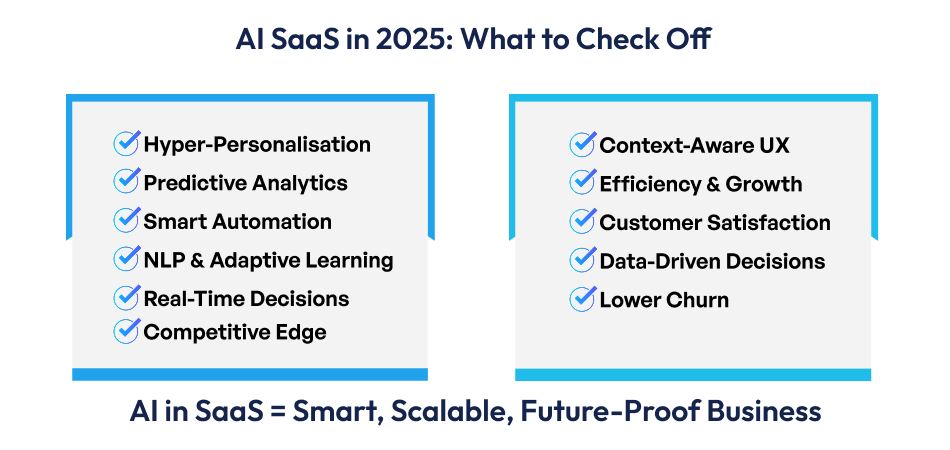
AI-powered SaaS solutions are already seen as the standard. Experts believe that by 2025, 50% of all SaaS platforms will embed functionality powered by AI. The market predictions for AI-powered, built-in SaaS are massive, with a globally compounded valuation of over $100 billion by 2025. Growing at 39% each year through 2032. Moreover, over 80% of businesses view AI-driven SaaS as a competitive advantage.
Around 70% of SaaS providers are actively investing in AI, turning it into a non-negotiable feature. Clearly, AI SaaS products dominate buyer expectations and investment priorities. 35% of SaaS businesses leverage AI software currently, with another 42% working to integrate it. Given the level of growth, it’s safe to say AI SaaS needs to be discussed further.
As the need for intelligent and adaptive software increases, the use of AI and ML enhancements in our SaaS applications will undoubtedly be essential. The use of AI will allow SaaS to move from static tools to proactive, data-driven platforms that learn, adapt, and scale. For developers who leverage AI in software-as-a-service, it means there is an opportunity to offer not just functional experiences, but smart and future-proof experiences.
| Value Propositions | Business Benefits |
Core value propositions:
|
Real-world impact:
|
Core AI/ML Use Cases in SaaS Development
SaaS platforms infused with machine learning and artificial intelligence deliver higher performance. This is possible due to:
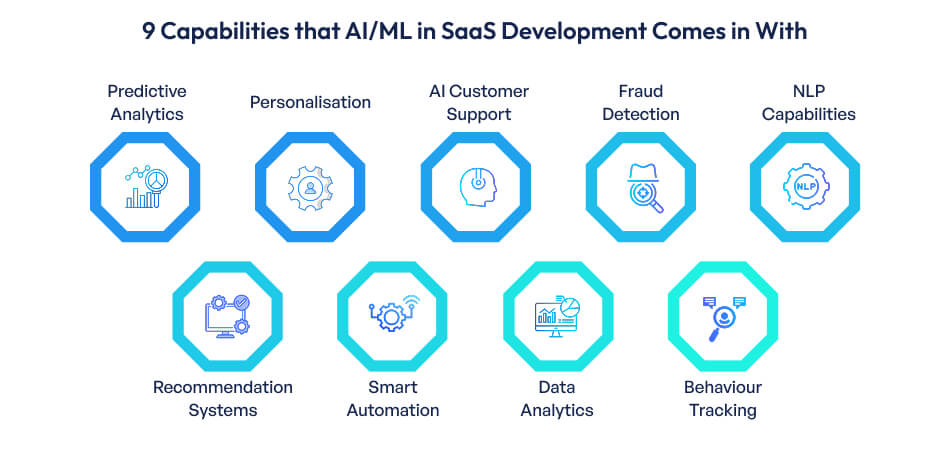
1. Predictive Analytics
- Forecast user churn and recommend retention strategies
- Anticipate product demand or seasonality patterns
- Predict customer lifetime value (CLTV)
- Estimate sales pipeline outcomes
- Identify potential bottlenecks in project management or delivery
- Generate alerts for overdue payments or contract renewals
2. Personalisation Engines
- Custom dashboards and homepages based on usage history
- Contextual product or content suggestions
- Location, device, or time-based personalisation
- Adaptive learning paths for EdTech SaaS
- Dynamic email content based on user behaviour
- Smart onboarding flows that adjust based on user role or activity
3. Automated Customer Support
- AI chatbots handling Tier-1 queries 24/7
- NLP-powered ticket classification and routing
- Voice assistants for on-the-go support
- Auto-generated knowledge base articles from FAQs
- Sentiment analysis of customer messages to prioritise urgent issues
- Feedback loops for continuously improving AI responses
4. Fraud Detection and Anomaly Detection
- Real-time fraud detection in financial or subscription-based SaaS
- Suspicious login or access attempt alerts
- Anomaly detection in usage patterns or billing spikes
- Identifying fake signups or spammy activity
- Monitoring for API abuse or abnormal request volumes
- Enforcing security protocols dynamically based on threat levels
5. Natural Language Processing (NLP)
- Smart search with auto-correct, filters, and voice input
- In-app messaging assistants or command interfaces
- AI-generated meeting notes or content summaries
- Sentiment analysis for social listening or feedback processing
- Multi-language translation and localisation
- Semantic tagging and classification of uploaded content
6. Recommendation Systems
- Suggest courses, documents, or tools based on user activity
- Recommend complementary features, upgrades, or plugins
- Tailor product bundles or pricing plans dynamically
- Predict and display what a user is likely to need next
- Optimize content visibility based on engagement patterns
- Provide collaborative filtering-based recommendations (what similar users liked)
7. Smart Process Automation
- Invoice data extraction and reconciliations
- Resume screening and talent matching in HR SaaS
- Lead scoring and sales pipeline prioritisation
- Automated compliance checks and audit trails
- Meeting scheduling assistants
- Approval workflows triggered by smart rules or usage thresholds
8. Advanced Data Analytics and Visualization
- Auto-generate insights, trends, and summaries
- Detect correlations and anomalies in complex datasets
- Recommend the next best actions based on data
- Enable predictive dashboards with scenario modelling
- Offer voice-driven or query-based analytics (e.g., “Show me monthly revenue trends”)
- Explain AI-driven forecasts with interpretable models (Explainable AI)
9. User Behaviour Tracking and Engagement Optimization
- Heatmaps and behavioural tracking to identify UX friction points
- Dynamic onboarding tailored to engagement levels
- In-app nudges or tooltips triggered by user inactivity
- Personalized feature suggestions to encourage deeper usage
- Triggered surveys or feedback forms based on event flows
- Predictive models for upsell timing or renewal reminders
How to Integrate AI in SaaS?
The journey of integrating AI into a SaaS platform involves more than just plugging in a model. It’s a layered process that blends strategic vision with technical execution. Take a walk through the essential stages of AI SaaS development:
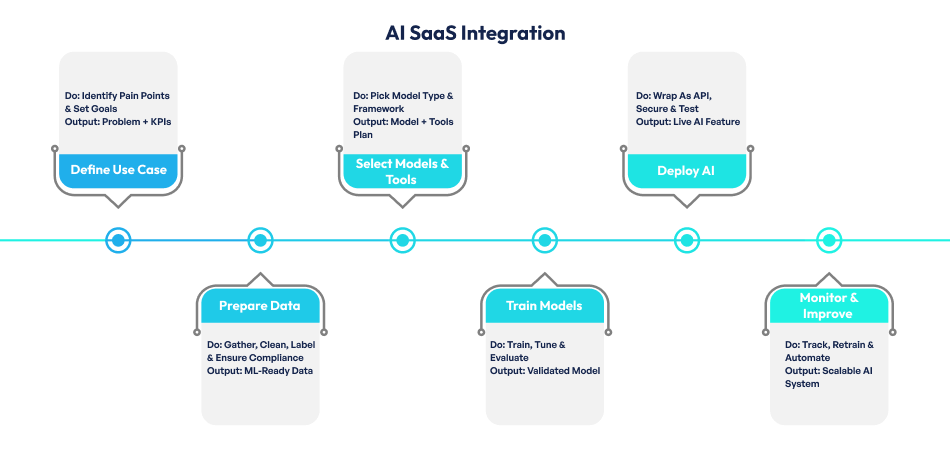
| Step | Action | Key Activities | Deliverable |
| Define Use Case & Business Goals | Identify what to build and why |
|
Problem statement + success metrics |
| Collect & Prepare Data | Build quality datasets |
|
A structured, annotated dataset ready for model training |
| Choose ML Models & Tools | Select the right tech stack |
|
Model plan + tool stack aligned with your use case |
| Build & Train Models | Develop and validate your model |
|
Trained and validated model, ready for deployment |
| Deploy in SaaS Environment | Integrate AI into the product |
|
Scalable, production-ready AI feature inside SaaS product |
| Monitor & Iterate | Maintain, improve, and scale |
|
Continuously improving, monitored AI model in production |
Challenges in AI and ML Integration in SaaS
While the benefits of AI and ML integration in SaaS applications are substantial, the journey isn’t without its challenges. Developers and business leaders must navigate technical, ethical, and operational hurdles to ensure successful adoption.
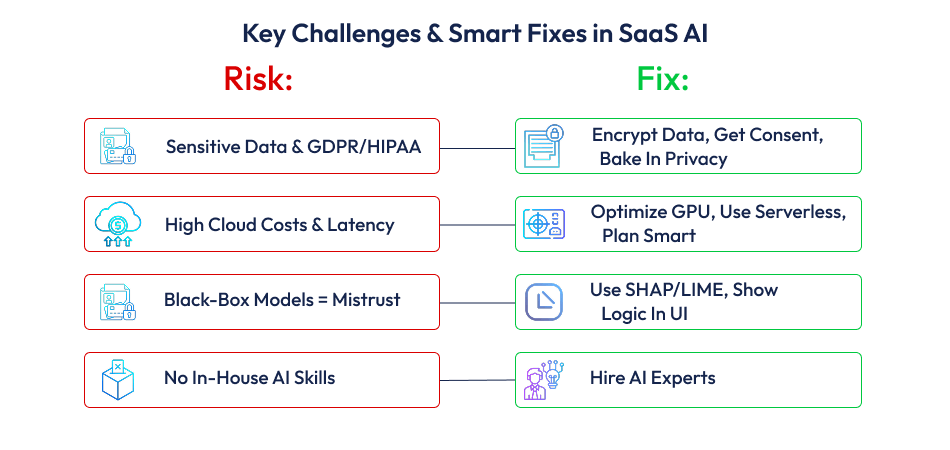
1. Data Privacy & Compliance (GDPR, HIPAA)
AI systems require data, and their responsible use forms a big concern in such scenarios. Sensitive data like user behavior, health information, or financial transactions is usually scrutinized by regulators. To curb these concerns, privacy legislation has been introduced, with the most notable being the GDPR in Europe and HIPAA in the US. These laws all set standards for strict control over data collection, utilization, and storage.
SaaS providers, therefore, must maintain encryption and explicit user consent flows to comply. For developers, a vital matter is to incorporate privacy not only into the pipelines but also into the AI models, ensuring that user information is protected.
Failing to address this can result in legal penalties and reputational damage. Particularly in enterprise SaaS.
2. Infrastructure Cost & Scalability
AI-based computation workloads are often computationally intensive and require expensive infrastructure. Training machine learning models requires huge computing power and memory when large datasets are involved, with storage also playing a role. Fast and dependable inference, which is necessary to publish predictions for thousands of users, often requires some form of geo-redundancy. It just gets harder to manage costs with AWS, GCP, and Azure as the number of users grows.
Load balancing can be useful, GPU optimization is another option, and then you have serverless inference. They all require good foresight. Small to mid-sized teams may struggle to balance innovation with operational costs if they aren’t effectively managing their resources.
3. Model Explainability & User Trust
Users and clients are increasingly interested in understanding how AI makes its decisions. Particularly in high-stakes fields such as finance, healthcare, and legal technology. Black-box models may be unacceptable without a very clear rationale. The absence of interpretability can lead to distrust, particularly where AI output directly influences user experience or business decisions. To enhance transparency, it’s essential to utilize tools like SHAP, LIME, and other Explainable AI (XAI) techniques.
Moreover, designing UX/UI elements that visualize the AI logic or provide confidence scores where appropriate is crucial. Ultimately, earning trust necessitates offering users greater visibility into the functioning of AI systems while ensuring that this information is presented in a way that is not overwhelming.
4. Talent Acquisition & Team Capability
Developing AI requires unique skills that most SaaS teams may not have in-house. Designing, training, and deploying solid AI models requires an expert approach by data scientists, ML engineers, and DevOps professionals familiar with MLOps. Such expertise is quite hard to acquire internally, especially at present in the early-stage SaaS startup. So hiring AI developers becomes a must. Whether you hire AI engineers from an AI app development company, hiring the right talent will truly push innovation while avoiding risks. With smart hiring, you move away from ill-supported AI projects toward cutting-edge, working AI systems.
Tools & Tech Stack for AI SaaS App Development
| Category | Tools/Platforms | Purpose |
| Data Collection & Storage |
|
Store structured, semi-structured, and unstructured data |
| Data Preprocessing & Cleaning |
|
Clean, manipulate, and transform data for ML model input |
| Data Labeling & Annotation |
|
Annotate data for supervised learning models |
| Model Development (ML/AI) |
|
Build and train machine learning/deep learning models |
| Natural Language Processing |
|
Implement NLP tasks like sentiment analysis, summarization, Q&A |
| AutoML Platforms |
|
Rapid model building without deep ML expertise |
| Model Serving & APIs |
|
Deploy ML models as APIs or services |
| MLOps & Model Monitoring |
|
Track, monitor, version, and automate model training and deployment |
| Infrastructure & Cloud |
|
Cloud infrastructure for scalable training and deployment |
| CI/CD for ML (MLOps) |
|
Automate testing, model tracking, and deployment |
| Frontend Integration |
|
Build dynamic UIs that connect to AI-powered APIs |
| Backend Integration |
|
Interface between frontend and AI logic or databases |
| Visualization & Dashboards |
|
Visualize predictions, analytics, and system performance |
| Security & Privacy |
|
Secure APIs, manage credentials, and ensure regulatory compliance |
When to Partner with an AI App Development Company
Integrating AI into a SaaS product can be both transformative and technically demanding. While some companies may have in-house teams ready to tackle this, others might benefit from partnering with a specialised AI app development company. Knowing when to collaborate externally is crucial for accelerating delivery, mitigating risk, and ensuring high-quality outcomes.
1. In-House Capabilities
- Do you have experienced data scientists or machine learning engineers in your team?
- Are you confident in your team’s ability to design, build, and deploy AI models from scratch?
- Is your current team struggling with AI accuracy?
- Do you require expert assistance for scalability or deployment issues?
2. Time-to-Market Pressure
- Do you need to launch your AI-driven product or feature quickly?
- Is your internal development timeline too slow for your business goals?
- Would leveraging pre-built frameworks and workflows help you accelerate development?
3. Budget & Hiring Strategy
- Is hiring a full-time AI team outside your current budget?
- Are you working on a short-term or experimental AI initiative?
- Would a project-based engagement with AI experts be more cost-effective for your needs?
4. Project Complexity
- Does your AI project require a complete infrastructure, like data pipelines, model deployment, and MLOps?
- Are you unsure how to architect the AI lifecycle for your software?
5. Industry Regulations
- Are you operating in a regulated industry where GDPR, HIPAA, or other compliance standards apply?
- Do you require explainable AI and ethical implementation strategies?
6. Scaling & Performance
- Do you need help scaling your AI application across cloud platforms?
- Are performance, reliability, and load balancing critical to your product’s success?
If you answered “Yes” to 3 or more questions, your business is likely ready to benefit from partnering with an AI app development company.
Examples of AI in SaaS
| SaaS Product / Company | Vertical | AI Capabilities | Impact |
| Salesforce Einstein | CRM / Sales | Predictive lead scoring, NLP for email insights, sales forecasting | Increased sales efficiency, better prioritisation, improved closure rates |
| Workday | HR Tech | AI-driven talent analytics, workforce planning, resume parsing with ML | Smarter hiring, improved diversity, streamlined HR operations |
| HubSpot | Marketing SaaS | Chatbots, smart content recommendations, email send-time optimisation | Enhanced user engagement, higher email open rates |
| Drift | Conversational AI | AI-powered chatbots, lead qualification, personalised sales journeys | Shorter sales cycles, improved conversion rates |
| Clari | Revenue Operations | Forecast accuracy with ML, deal risk scoring, pipeline insights | Revenue predictability, sales team alignment |
| Copy.ai | Content Generation | GPT-powered content creation tools for marketing teams | Fast content ideation, reduced marketing workload |
| Gong.io | Sales Enablement | Conversation analytics, deal intelligence using NLP and ML | Data-backed coaching, better customer insight |
| Descript | Audio/Video Editing | AI-based transcription, filler-word removal, voice cloning | Rapid editing workflows, time savings for creators |
| Reclaim.ai | Productivity SaaS | AI-powered smart scheduling, calendar optimisation, task prioritisation | Better time management, reduced scheduling conflicts |
Final Thoughts
AI, what was once a value-add, is now a competitive necessity. As AI SaaS development continues to mature, we’re seeing a shift from feature-rich software to truly intelligent platforms that learn, adapt, and deliver on user expectations in real time.
For developers, this is the perfect moment to start leveraging AI in software-as-a-service. Whether you’re experimenting with small ML models or building full-scale intelligent workflows, every step brings you closer to creating smarter, more scalable SaaS applications. AI offers more than automation. It empowers predictive insight, operational agility, and user-centric design.
But innovation doesn’t have to happen alone.
Techugo is here to help. As a trusted partner in AI SaaS product development.
So if you’re looking to add smart automation or intelligent user experience, our expert team can help you harness the full power of AI SaaS development. From custom models to seamless deployment, we offer end-to-end custom software development. Hire artificial intelligence developers from Techugo and build your AI-powered SaaS product today. Talk to us today.

Get in touch
We'd love to hear from you.