 SA
 KW
 IE
 AU
 UAE
 UK
 USA
 CA
 DE
 QA
 ZA
 BH
 NL
 MU
 FR


















📌 Key Takeaways
- Automation helps businesses reduce manual work, improve efficiency, and lower operational costs.
- Personalized financial insights help advisors better understand client goals and deliver tailored results.
- Strong security measures, including encryption and role-based access, help protect sensitive financial information.
- Technologies like AI, cloud computing, and modern frameworks support scalable and data-driven financial solutions.
- Wealth management software development costs around $25,000 to $300,000+.
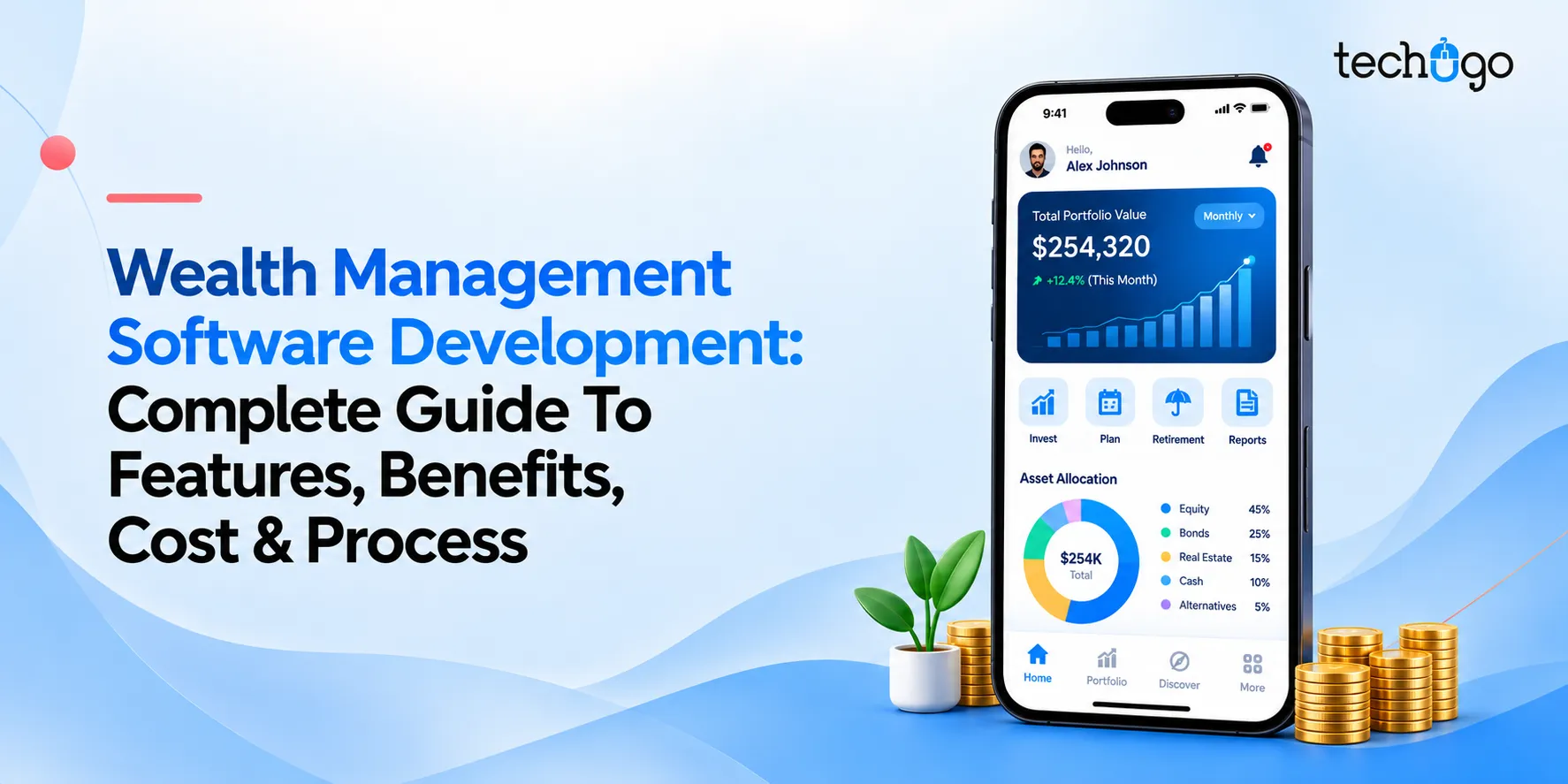
Managing wealth today involves much more than tracking investments and monitoring financial portfolios. Financial businesses must understand client goals, analyze market trends, manage risks, maintain regulatory compliance, and deliver personalized financial advice. Handling all these activities manually can become complicated, especially as a business grows and client expectations continue to evolve. This is where wealth management software development comes into play.
On top of that, the opportunity is massive, as this Grandview Research report shows. The global wealth management software market was valued at $6.3 billion in 2025. However, it is projected to reach a whopping value of $7.3 billion in 2026 and is expected to grow to $18.8 billion by 2033. And in this market, North America alone contributed to a revenue share of 37% in 2025.
So, you see, there are immense opportunities heading your way. But the first thing is to know: what is wealth management software development?
What Is Wealth Management Software Development?
The process of designing, building, testing, and maintaining digital solutions that help finance professionals manage clients’ wealth, investments, assets, and financial goals is what wealth management software development is all about.
These solutions bring multiple financial activities into one platform. Instead of switching between multiple tools to review portfolios, track transactions, generate reports, and communicate with clients, wealth managers can access the information they need through a centralized system.
So, the primary goal of custom wealth management software solutions is to make financial management more organized, transparent, secure, and data-driven.
Build Wealth Management Software Around Your Business Needs
Looking to simplify portfolio management, automate financial workflows, or improve client experiences? Techugo can help you plan a custom wealth management solution aligned with your business goals
Why Is Wealth Management Software Development Important For Financial Businesses?
Traditional procedures often fail to fulfill industry standards. The use of spreadsheets, separate systems, and manual reporting can result in inefficiencies, vagueness of information, and unnecessary operational costs.
A wealth management software solution enables one to eliminate those problems and take advantage of all crucial financial functions in a single digital environment. Here are several important reasons for this significance.
1. Growing Demand For Personalized Financial Services
Every client pursues financial goals and has preferences for investing their money, risk tolerance, and any long-term priorities.
Using banking software development as a tool helps financial advisors understand the requirements and needs of market participants, enabling them to make personalized recommendations based on the unique aspects of every client’s background.
2. Increasing Complexity of Financial Data
Wealth managers interact with data coming from various sources such as investment accounts, banking systems, market data suppliers, and financial planning tools.
If data integration is not done properly, it will take a lot of time to organize the data properly. However, various wealth management tools can help gather necessary data together and assist financial specialists with forming a clear understanding of their clients’ financial standing and making better decisions.
3. Improved Operational Efficiency
A number of different wealth management processes contain similar, repetitive tasks such as report writing, data entry, transaction entry, and conducting reviews.
So, by implementing the use of automation, it is possible to minimize administrative work, which provides consultants with more time for financial planning and the client relationship.
4. Better Risk Management
Multiple types of risks affect investment portfolios, including fluctuations in the market, risk of concentration, illiquidity challenges, and shifting economic environments. Sector-based risk assessment capabilities, analytics, and forecasting tools can assist wealth managers in pinpointing potential problems as well as developing alternatives.
5. Stronger Security & Regulatory Compliance
Wealth management platforms handle sensitive client information, investment records, and transaction histories, making security and regulatory compliance important. Depending on the firm’s activities and regulatory status, US businesses may need to address SEC requirements, applicable FINRA rules, privacy obligations, and recordkeeping requirements.
Take A Look At The Key Features of Wealth Management Software
Features play a major role in determining how useful a wealth management platform will be. While the exact requirements depend on the target audience and business model, certain capabilities are especially valuable.
1. Client Relationship Management
One of the biggest challenges for the wealth management industry is maintaining client acquisition, as there are so many players in the market. A client relationship management (CRM) module helps wealth managers organize client information, communication histories, financial objectives, and service preferences. It can also support client onboarding, meeting schedules, follow-up reminders, and relationship tracking.
2. Portfolio Management & Tracking
Portfolio tracking allows advisors and clients to monitor investments across asset classes such as stocks, bonds, mutual funds, exchange-traded funds, and other eligible investments. Thus, some of the common capabilities include:
- Real-time or delayed portfolio valuation, depending on data availability
- Asset allocation and diversification analysis
- Investment performance tracking
- Portfolio rebalancing support
- Transaction history and holdings reports
- Benchmark comparisons
3. Financial Planning Tools
Financial or wealth management tools help in organizing their finances around particular milestones like retirement, education expenses, property purchases, or long-term wealth creation. Thus, depending on the platform, these tools may include goal-based planning, retirement projections, saving calculators, scenario modelling, and cash flow analysis.
4. Risk Assessment & Management
Identifying potential risks with individual investments and the overall portfolios is what risk assessment and management is all about. Under this, major features like risk profiling, questionnaires, volatility analysis, exposure monitoring, concentration alerts, and stress testing can be effectively included.
5. Reporting & Analytics
In a financial business, clients are looking for data that is easily understandable. So, converting financial data into a more understandable manner is what reporting and analytics help with. Some typical reports include portfolio summaries, asset allocation breakdowns, transaction statements, and investment gains and losses, which leads to custom wealth management software development.
6. Client Portal & Mobile Access
By giving secure access to users regarding their financial elements through a client portal and mobile access, they will be able to:
- View investments and account balances
- Track progress toward financial goals
- Access statements and reports
- Upload required documents
- Receive notifications and reminders
- Communicate with financial advisors
Types of Wealth Management Software Solutions
After reading a lot, you might want to know about various wealth management software solutions. Ranging from the simplest tools to the most advanced ones, here are the different types of solutions:
1. Portfolio Management Software: Tracking investments and automating performance analytics helps investors (your clients) optimize asset allocation. Therefore, investors can leverage technology to reallocate money to a better-performing asset and withdraw from non-performing ones.
2. Financial Planning Software: Analyzing the current results of investments, calculating expected returns, and understanding their future practicality is what financial planning software does. Creating an ideal strategy and minimizing tax liabilities is the outcome of this fintech app development.
3. Investment Platforms: Convenient and secure access to diverse investment options and the ability to manage transactions is what investment platforms are all about. Going through this wealth management software platform enables individual investors to build personalized investment plans.
4. Client Lifecycle Management (CLM) Systems: Automating client management for the wealth management industry, from prospecting and onboarding to servicing and relationship management, is what a CLM system is all about. Moreover, using Client Lifecycle Management systems for due diligence and KYC reduces regulatory risks.
5. Trading Software: Enabling the buying and selling of stocks, commodities, exchange-traded funds (ETFs), and other securities is what trading software does. When equipped with trading algorithms, risk management features, and market data integrations, stock trading app development is what really makes the difference.
6. Blockchain Solutions: Blockchain technology simplifies the operations of investment advisors and traders in times of crypto-equity operations. Blockchain provides outstanding digital asset accounting systems with a high level of compliance with regulations.
7. Custom Wealth Management Software: Built according to your company’s specific needs, business model, and workflows is what custom wealth management software encapsulates. As a fintech app architecture, it is useful when off-the-shelf platforms don’t provide the required flexibility or the business is looking to introduce differentiated digital financial products.
Benefits of Wealth Management Software Development
Wealth management software can provide value in a variety of ways for financial businesses. The degree to which value is generated from using such software depends on just how appropriate the solution is for the company and how successfully it is implemented.
1. Better Operational Efficiency: Automating routine activities can reduce manual work across onboarding, reporting, and record management. Employees can access relevant information through a centralized platform instead of repeatedly collecting data from separate systems.
2. Improvement In Decision Making: Wealth management apps consolidate financial data and present it through dashboards, analytics, and performance reports. Advisors can use these insights to evaluate portfolio allocation, review progress toward financial goals, and identify potential risks.
3. Enhanced Client Satisfaction: A convenient digital experience can make financial services easier to access and understand. Clients can have a look at their portfolios, access reports, and track their financial goals without relying entirely on manual communication.
4. Reduced Operational Costs: A wealth management software development company helps you with automation and system integration, which reduces many inefficiencies. This helps businesses use their resources more effectively.
5. Better Scalability: As your wealth management business grows, so do your clients, transactions, and accounts. So, a scalable wealth management software solution can help your business accommodate this growth without requiring a complete system replacement.
Essential Technologies Used In Wealth Management Software Development
The software stack affects the effectiveness, scalability, security, and sustainability of the asset management system. The right mix depends on the complexity of the project, already available framework, integration needs, budget, and the skill level of the development group. So, here are some of the technologies and technical capabilities to consider:
1. Frontend Technologies
How users interact with the software is what frontend technologies determine.
1. React: Suitable for interactive web dashboards, portfolio visualizations, and client portals that need reusable interface components.
2. Angular: Worth considering for large enterprise applications that benefit from a structured framework and consistent development patterns.
3. Vue.js: Can be a practical option for lightweight interfaces or projects that need a flexible approach to building web applications.
2. Backend Technologies
The backend manages business logic, data processing, authentication, integrations, and communication between different parts of the application. Some of the common choices include:
1. Java w/ Spring Boot: A strong candidate for enterprise wealth management platforms with multiple services, complex business rules, and integrations.
2. Python w/ Django or FastAPI: Useful for platforms involving financial data processing, analytics, automation, or integration with machine learning models.
3. Node.js: Suitable for API-driven applications and systems that handle frequent client requests and interactions with external services.
3. Databases & Data Storage
Relational databases are an important part when working with structured data used for transactions and record-keeping in finance, such as PostgreSQL and MySQL.
1. PostgreSQL & MySQL: Effective for structured financial records, client information, and transactional data.
2. MongoDB: Can be useful for selected flexible or document-oriented data such as varying document metadata or adaptable records.
3. Data Warehouses: Useful when the platform needs to analyze large volumes of historical information, generate management reports, or compare portfolio performance.
4. Cloud Computing
Providing infrastructure for application hosting, data storage, monitoring, and scalable computing is what defines cloud computing.
Although cloud infrastructure helps businesses adjust their capabilities to the evolving market demand, it does not guarantee security and compliance with regulations by itself. Configuration, access management, encryption, as well as data residency requirements still need attention.
5. Artificial Intelligence & Machine Learning
AI and machine learning technologies can support document classification, data extraction, anomaly detection, forecasting, and advisor productivity tools. In cases of finance, accuracy bias, explainability and performance of the model under volatile market conditions should be considered.
1. Document Classification & Data Extraction: Useful for processing onboarding documents and extracting relevant information for review.
2. Anomaly Detection: Can help flag unusual transaction patterns or inconsistencies for further investigation.
3. Advisor Productivity Tools: Can help in summarizing documents, organizing client information, or preparing draft reports for human review.
Challenges In Wealth Management Software Development & How To Overcome Them
Developing wealth management software is about much more than building a platform to track investments or manage client portfolios. Financial businesses in the USA need solutions that protect sensitive financial data, support investment decisions, meet regulatory requirements, and deliver a seamless client experience.
The sad news is that there are some challenges to it, but the good news is you can overcome them. So, I have listed them here for you:
1. Data Security & Privacy Concerns
Wealth management platforms deal with sensitive information such as the identity of clients, financial transactions, account details, and investment portfolios. A security breach could expose sensitive information, impair trust in clients, and also lead to financial and legal consequences.
How To Overcome Them?
- Protect sensitive financial information both at rest and in transit.
- Add an extra layer of security to prevent unauthorized account access.
- Ensure users can access only the information and features relevant to their responsibilities.
- Perform vulnerability assessments and penetration testing to identify potential weaknesses.
2. Regulatory Compliance & Reporting
The wealth management software must help with regulatory requirements that relate to the corporation. The requirements in the United States may include regulations related to investors’ privacy, advisory practices, proper recordkeeping, disclosures, and other regulations.
So, keeping up with changing regulations is one of the biggest challenges for the wealth management industry. But how to solve it?
How To Overcome It?
- Partner with legal and compliance professionals to identify the requirements that apply to your business.
- Use configurable reporting features to reduce repetitive manual work and minimize avoidable errors.
- Record important activities, transactions, access events, and changes to financial information.
- Design workflows that can be updated when regulations or internal policies change.
3. Integration w/ Legacy Financial Systems
Various wealth management software providers use customer relationship management solutions, asset management systems, banks, custodians, among other tools. Integrating existing systems with new software may not be easy, as either one might be inclined to use incompatible work practices, old technologies, or different data formats.
How To Overcome It?
- Verify data synchronization, error handling, and reconciliation before launching the platform.
- Establish consistent data structures to reduce compatibility issues.
- Use integration layers to connect systems that cannot communicate directly.
- Identify the applications, databases, and third-party services that need to connect with the new platform.
4. Poor Data Quality & Inconsistent Financial Information
For wealth management, proper financial details are the most important thing to ensure success. If a client’s assets, account activity, and investment data are not recorded correctly, it would be hard to give a trusted opinion on any actions taken in managing wealth.
This problem often occurs when financial information comes from multiple custodians, banks, and investment platforms.
How To Overcome It?
- Define who manages financial data and how it should be maintained.
- Check incoming information for missing fields, incorrect values, and inconsistencies.
- Compare records across connected systems to identify differences.
- Implement processes to identify and resolve repeated client or transaction entries.
5. Scalability & System Performance
A financial management software system might begin with a low number of advisers and clients at its disposal. Nonetheless, with the company growing, the system can require management of more substantial portfolios, larger transactions, more integrations, and even more advanced reporting.
So, without proper planning, the platform may experience slow response times, delayed calculations, and unexpected downtimes.
How To Overcome It?
- Build the platform to accommodate increasing users, transactions, and data volumes.
- Use suitable cloud services to adjust computing resources as demand changes.
- Improve queries, indexing, and data storage strategies to support faster processing.
- Evaluate how the platform performs under expected and peak workloads.
Wealth Management Software Development Process: Step By Step
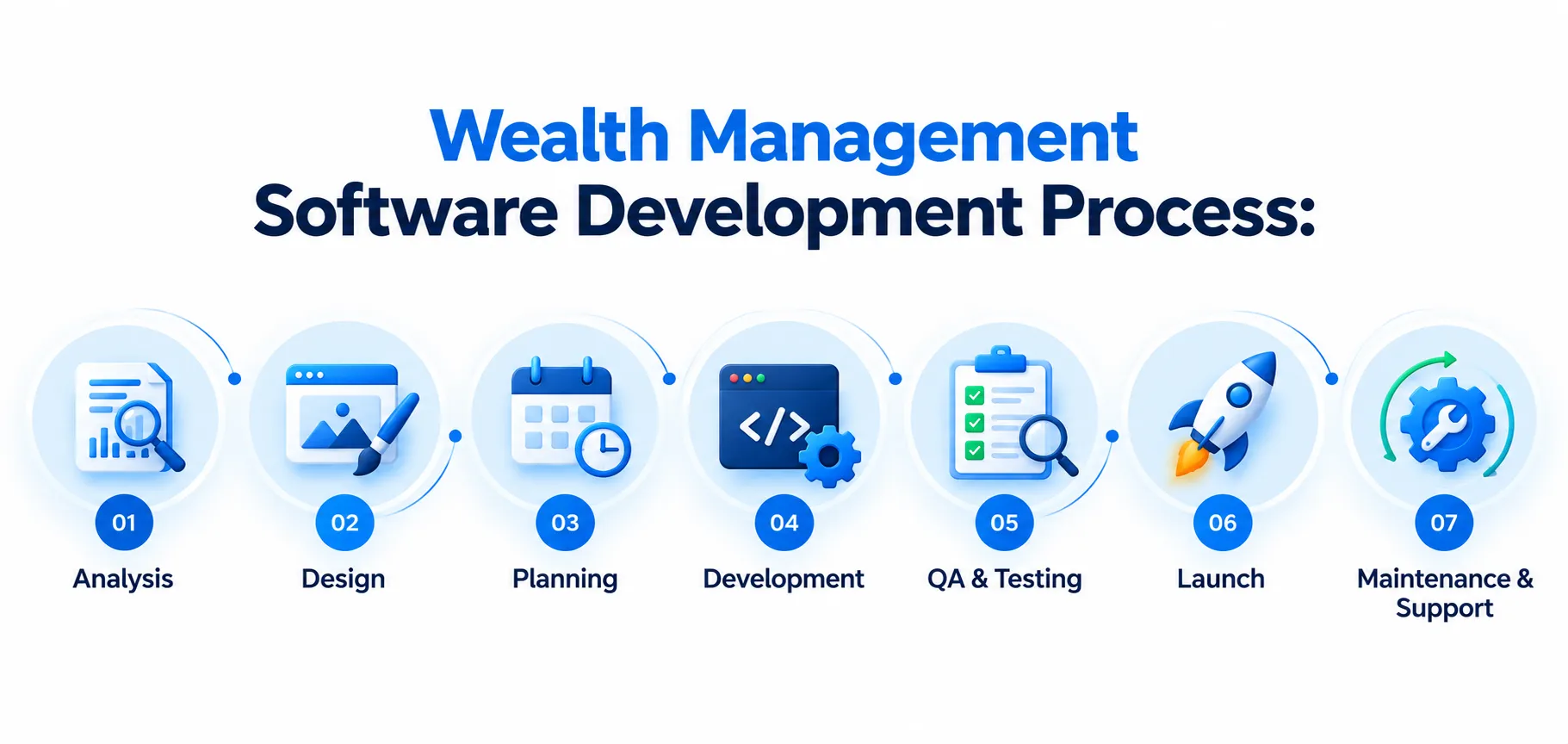
A well-structured development process helps businesses turn their ideas into reliable software that simplifies wealth management operations and delivers a better user experience. Therefore, let’s explore the key steps involved in wealth management software development:
1. Analysis
The analysis phase typically includes:
- Identify primary goals such as improving operational efficiency, improving client engagement, or simplifying investment management.
- Understanding whether the platform will serve wealth managers, financial advisors, individual investors, or enterprise financial institutions.
- List the essential functionalities, including portfolio management, financial planning, reporting, client onboarding, and risk management.
- Researching existing solutions to identify market expectations and any gaps.
- Identify relevant data protection, access control, recordkeeping, and regulatory requirements.
2. Design
During this stage, wealth management software companies typically work on:
- Create basic layouts to define the structure of screens and the placement of important elements.
- Map how users will complete tasks such as reviewing portfolio performance, generating reports, or updating financial goals.
- Develop clickable models to display how the platform will work before full development begins.
- Establish typography, colors, charts, dashboards, and other interface elements that make financial information easier to understand.
- Make sure the interface is easy to navigate across devices and accommodates different user needs.
3. Planning
The planning phase usually covers the following areas:
- Choose suitable frontend frameworks, backend technologies, databases, cloud infrastructure, and integration tools as part of investment portfolio management.
- Define how various modules will communicate, how financial data will be stored, and how the platform will accommodate future growth.
- Separate important features for the minimum viable product (MVP) from enhancements that can be introduced later.
- Estimate trading app development costs or other cost types with resource requirements, project milestones, and expected delivery timelines.
- Establish authentication methods, encryption requirements, access permissions, audit logging, and data backup strategies.
- Recognize potential technical challenges, third-party dependencies, data migration issues, and compliance-related risks that can be solved with fintech development outsourcing.
4. Development
Under development, key activities may include:
- Build dashboards, client portals, portfolio views, financial charts, and other user-facing components.
- Implement business logic, authentication, financial calculations, reporting functions, and data processing.
- Organize client records, portfolio information, transaction histories, and other financial data securely.
- Develop functionalities such as portfolio tracking, financial planning, risk assessment, and automated reporting.
- Connect the platform with relevant banking systems, custodians, brokerage platforms, market data providers, or third-party services.
5. QA & Testing
When wealth management platform providers carry out tests that look somewhat like this:
- Verifies features like login, portfolio tracking, reporting, and client management.
- Checks portfolio valuations, return calculations, fee computations, and asset allocation figures against expected results.
- Ensures data flows correctly between the platform and connected financial systems.
- Identifies vulnerabilities, weak access controls, and potential data exposure risks.
- Evaluates how the platform performs under expected workloads and increasing user activity.
6. Launch
Important activities under the launch process include:
- Launch the application into the hosting or cloud environment that is chosen.
- Move the respective client, portfolio, or operations data and check its accuracy if necessary.
- Check access permissions in production and ensure that encryption settings, monitoring systems, and other controls work properly.
- Offer instructions, documentation, and training for employees, advisors, and clients.
- Watch application performance, find any bugs during the launch.
- Collect feedback on possible user experience issues for improvement.
7. Maintenance & Support
- When it comes to post-launch maintenance and support, it includes:
- Identify and resolve errors reported by users or detected through monitoring.
- Apply patches, review vulnerabilities, and strengthen security controls as needed.
- Track application responsiveness, system availability, and infrastructure usage.
- Update APIs and resolve issues caused by changes in external systems or data providers.
- Introduce new capabilities based on user feedback and changing business requirements.
- Maintain appropriate backups and periodically verify recovery procedures.
How Much Does Wealth Management Software Development Cost?
A simple portfolio monitoring app usually needs less funding than a corporate-level wealth management solution that has many financial connections, automated investment processes, and sophisticated analytical capabilities.
| Software Type | Estimated Development Cost (USD) | Estimated Development Timeline | What Does It Cover? |
| Basic / MVP App | $25,000 – $50,000 | 1 – 2 Months | Monitor investment holdings, portfolio values & basic performance metrics |
| Mid-Level Wealth Management Platform | $50,000 – $120,000 | 5 – 11 Months | Support asset allocation, performance analysis & portfolio comparisons |
| Advanced Wealth Management Solution | $120,000 – $200,000 | 6 – 12 Months | Provide detailed performance analysis, asset allocation insights & risk-related reporting |
| Enterprise-Grade Wealth Management Platform | $200,000 – $300,000+ | 6 – 12+ Months | Incorporate backup strategies, disaster recovery planning & availability requirements |
Get A Cost Estimate For Your Wealth Management Software
From MVP to enterprise-grade platforms, costs depend on features, integrations, security, and complexity. Share your requirements with Techugo to discuss your project scope and budget.
How To Choose The Right Wealth Management Software Development Company?
Building a secure, scalable, and user-friendly platform is what the right wealth management software development company can do for you. The wrong choice can really slump your sales, profit, and even the whole business. So, how do you choose the right partner as a wealth management software developer?
1. Look For Financial Services Domain Expertise: Search for a company with relevant experience in fintech, specifically wealth management or investment platforms. Talk to them about their previous projects, the challenges their team faced, and how they overcame them.
2. Evaluate Security & Compliance Capabilities: For the US market, the team should also be prepared to work with your compliance advisers to address applicable requirements. These include SEC regulations, FINRA rules where relevant, and state-level privacy laws.
3. Assess Technical Expertise & Integration Experience: Evaluate whether the company has experience building secure APIs, integrating legacy systems, managing financial data, and designing scalable architectures. Ask how it handles integration failures, data reconciliation, system upgrades, and third-party dependencies.
4. Understand The Development Process: Ask how the company prioritizes features, manages project risks, communicates progress, and incorporates feedback. A repetitive development approach can help you validate key functionality early and avoid investing heavily in features that do not meet user needs.
5. Review Portfolio, Case Studies & Client Feedback: Here, don’t limit your questions to visual design. Ask about scalability, whether security issues were considered, how complex integration was, how the product performs after launch, and how the team addressed unexpected problems.
How Can Techugo’s Wealth Management Software Solutions Help Your Business?
Techugo’s wealth management software solutions help businesses streamline financial operations, automate routine tasks, and deliver personalized client experiences. Take a look at why many enterprises prefer Techugo:
1. Custom Software Development: Develop wealth management solutions tailored to your business model, operational workflows, and client requirements.
2. Portfolio Management Solutions: Build features to monitor investment portfolios, track performance, and provide clear portfolio insights.
3. Financial Planning Tools: Develop tools that help advisers organize client financial goals, evaluate scenarios, and support financial planning workflows.
4. Client Portals & Dashboards: Create intuitive interfaces that allow clients and advisers to access relevant financial information and reports.
The Final Word
Wealth management software development is a key investment for finance organizations that aim to boost productivity, provide their clients with an individualized experience, and maximize the benefits of financial data. Wealth management software can streamline all key processes, including portfolio management, financial planning, automation of workflows, analytics, and the security of client portals, which is also becoming a trend in wealth management.
However, the best wealth management software solution does not have to be the one loaded with functions but rather the one that provides solutions to problems, safeguarding information, enabling sound financial decisions, and creating high value for the company and its customers.
FAQs
Q) Can wealth management software integrate with existing financial systems?
Yes, it can integrate with banking platforms, brokerage systems, custodians, market data providers, and other financial tools, depending on API availability.
Q) What is the difference between custom and off-the-shelf wealth management software?
Custom software is built around your specific business needs, while off-the-shelf solutions offer predefined features that may require workflow adjustments.
Q) Is wealth management software suitable for small financial advisory firms?
Yes, small firms and even startups can use wealth management software to automate routine tasks, organize client information, and manage portfolios more efficiently.
Q) How do I choose the right wealth management software for my business?
Select software based on your business goals, client requirements, essential features, security needs, integration capabilities, and budget.

Get in touch
We'd love to hear from you.