 SA
 KW
 IE
 AU
 UAE
 UK
 USA
 CA
 DE
 QA
 ZA
 BH
 NL
 MU
 FR


















📌 Key Takeaways
- Medical billing software development involves several stages – from understanding requirements and selecting features to development and maintenance.
- Encryption, access controls and multi-factor authentication help protect sensitive data.
- The main features cover claims, payments, patient records, and healthcare system integration.
- Medical billing software makes it easier to manage claims, bills and payments.
Although medical billing is an important part of the healthcare process, the procedure of handling insurance claims, payments, and patient invoicing can be challenging and take a long time. Grand View Research states that the US revenue cycle management market is expected to generate $308.2 billion by 2030, which shows that the demand for effective billing solutions is on the rise.
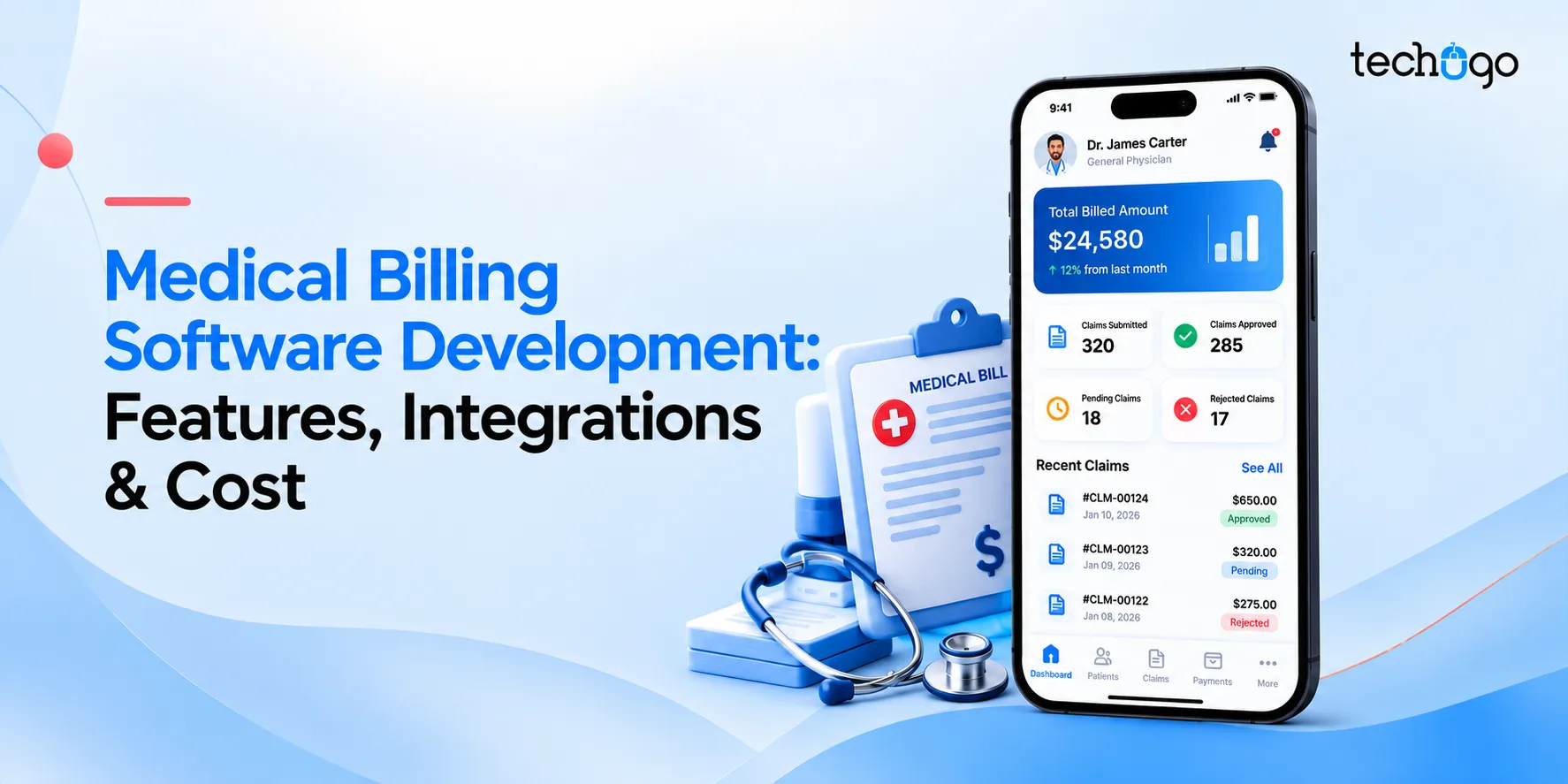
Technology has made it possible for healthcare providers to handle billing tasks with less manual effort. Medical billing software, in particular, helps healthcare providers automate claims processing, track payments – and reduce time spent on paperwork. This guide explores the key features, integrations, costs involved in medical billing software development and other important aspects of development.
What is medical billing software development?
Medical billing software development refers to the development of the software that is able to help the healthcare providers to carry out billing tasks includes processing the claims, payment tracking, as well as generation of invoices for the patients.
As part of medical software development, these solutions can include features such as automated claim submission, payment tracking, insurance verification, billing reports and integration with Electronic Health Record (EHR) systems.
Looking to Build Medical Billing Software?
Build medical billing software that works for your business and makes handling claims, payments and everyday billing tasks easier.
Why invest in medical billing software development services?
1. Reduce manual work
Medical billing software helps automate tasks like processing claims, generating invoices and tracking payments, so the staff don’t have to do everything by hand. It saves time & makes the billing process easier to manage; but the bigger win is that the chances of errors are reduced too.
2. Improve billing accuracy
Billing errors can lead to rejected insurance claims (and delayed payments) – therefore accuracy matters. With the right software, you can keep your records organized, and mistakes are identified more easily so that the billing process becomes more manageable.
3. Manage revenue more effectively
Tracking payments and pending bills is important; the reason is that healthcare providers need to keep their finances in order. Medical billing software provides reports and payment updates, so hospitals and clinics can understand their income and manage payments better.
4. Connect with existing healthcare systems
Medical billing software can connect with Electronic Health Records (EHRs) and other hospital systems as well. This means the staff can get to the relevant information more easily but, because of the connection, they don’t have to enter the same details again and again.
5. Customize software to your needs
The needs of each healthcare provider can vary. So, selecting medical billing software development services can help you build software that is made for your workflow. Plus, teams offering healthcare app development services are able to develop secure, scalable solutions, which can be updated as your needs change.
Types of medical billing software
1. Standalone medical billing software
This sort of software handles billing tasks like claim processing, invoice generation, and payment tracking.
2. Cloud-based medical billing software
It enables authorized personnel to access the billing information online from various locations.
3. Practice management software
It integrates billing with other processes such as appointment booking and patient registration.
4. Hospital billing software
It can deal with complex billing requirements in multiple hospital departments and patient services.
5. Integrated medical billing software
It links the billing with other healthcare systems. For instance – EMR/EHR software development can facilitate the integration of billing tools with electronic patient records.
Must-have medical billing software features to consider
When choosing medical billing software, it’s important to look at the features that make daily billing tasks easier. Here are some key features to consider –
1. Automated claim processing
The software should help prepare and submit insurance claims while reducing manual data entry. This can save time and help staff spot errors before submitting claims.
2. Payment tracking
Payment tracking helps healthcare providers check paid and pending bills in one place. It also makes it easier to follow up on delayed payments.
3. AI-powered billing
AI medical billing software can help identify billing errors, review claims, and automate repetitive tasks. This allows staff to spend less time on manual work.
4. Secure patient data management
The software should keep patient and billing information organized and protected. Access controls and appropriate security measures help prevent unauthorized access.
5. Payment gateway integration
Through payment gateway integration services, healthcare providers can let patients pay bills online using supported payment methods. This makes payments more convenient and easier to track.
A good medical billing software development company can assist you choose and build the right medical billing software features based on your organization’s needs, budget, and existing systems.
Key integrations for medical billing software
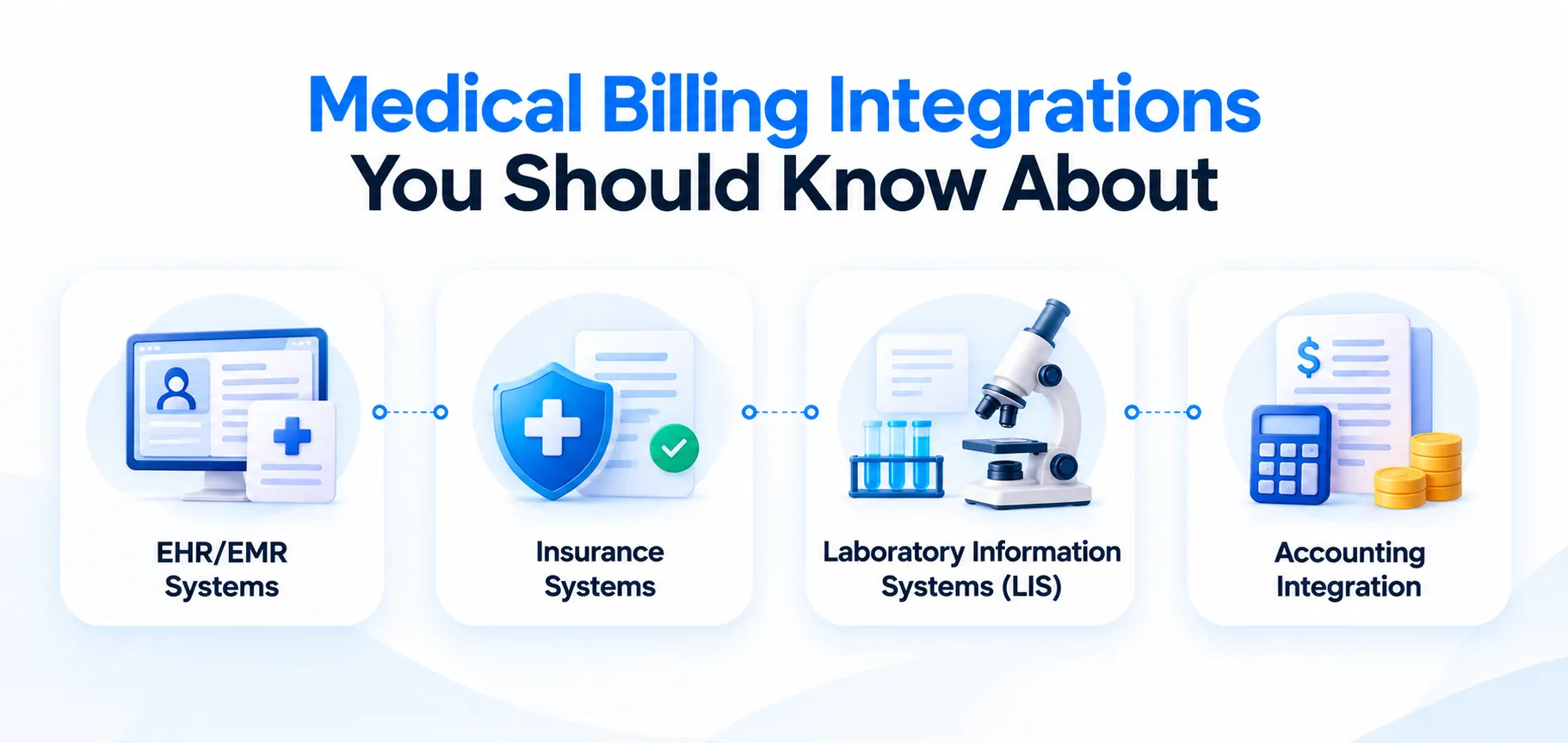
It’s true that medical billing software works better when it connects with other healthcare systems. Below are some important integrations to consider –
1. EHR/EMR Systems – This integration allows patient information to be accessed and updated in conjunction with billing information, decreasing the amount of data that needs to be entered twice.
2. Insurance Systems – Connecting with insurance platforms makes it easier to submit claims and track the status of these claims.
3. Laboratory Information Systems (LIS) – It links the billing system with lab software to transfer relevant test and billing details.
4. Accounting Integration – Connecting accounting tools helps align billing records with financial data.
How is medical billing software developed: step-by-step process
If medical billing software is being developed from scratch, there are several things to consider before the actual development begins. The process usually involves the following steps –
1. Understand the requirements
The first step is to grasp how the healthcare provider’s billing works, what they do on a day-to-day basis and what systems they have in place. This will help to understand which features the software should have, and what issues it should solve.
2. Choose the right features
So based on these requirements, developers decide which features to include (such as claim management, payment processing & patient billing). The objective is to create medical billing software programs which work in accordance with an organization’s workflow.
3. Design the software
This is the phase where the software is developed and integrated with the appropriate systems, like EHR systems and insurance providers.
4. Develop and integrate the software
During this stage… developers build the software and connect it with relevant systems, such as EHR platforms and insurance services.Also, note that setting up data exchange and payment processing are also part of medical billing software development.
5. Ensure security and compliance
Patient and billing information needs to be safeguarded all the way through the development process. When creating HIPAA-compliant healthcare apps, developers should take into account the norms and standards set forth by HIPAA, such as proper protection of personal information and other essential security measures.
6. Test the software
The software is tested for bugs, billing errors, security issues and integration problems prior to the launch. This helps to ensure the claims, payments and records operate as intended.
7. Deploy and maintain the software
After testing, the program is rolled out for use. It is continuously updated, patched, and security-proofed to maintain its smooth operation across the evolving healthcare landscape.
Technology Stack for Medical Billing Software Development
Since medical billing software deals with patient records, insurance claims and payments, developers need to choose technologies that can handle these tasks reliably. Here’s how they contribute to the system –
| Technology layer | Examples | Purpose |
| Frontend development | React, Angular, Vue.js | Builds user-friendly interfaces for managing claims, invoices and payments |
| Backend development | Node.js, Python, Java | Handles billing operations, claim processing, and business logic |
| Database management | PostgreSQL, MySQL, MongoDB | Stores patient records, billing information and payment data |
| Cloud infrastructure | AWS, Microsoft Azure, Google Cloud | Supports data storage, scalability and system availability |
| Security | Data encryption, role-based access control, multi-factor authentication | Protects sensitive patient and financial information |
| AI and machine learning | Python, TensorFlow, PyTorch | Supports automated claim reviews, billing error detection and payment predictions |
| API integration | REST APIs, FHIR APIs | Connects billing software with EHR systems, insurance platforms and payment gateways |
Medical billing software security and compliance requirements
Medical billing software needs to do two things well – handle billing tasks efficiently and keep sensitive information safe.
Developers can do this by building the right security measures into the system from the start.
The importance of security measures is also seen during the development of the software related to the integration of medical billing software with other healthcare software solutions. Examples of such possible integrations include telemedicine software development when virtual consultation applications are connected to billing solutions in order to manage payments and patient records. The use of secured methods of data exchange is to be ensured during the exchanges of data between medical billing software and other solutions in order to protect the data being exchanged.
When building medical billing software solutions, developers should consider the following security measures –
1. Data encryption: Encrypt sensitive information when it is being passed from point A to point B and it is being stored, which will decrease the risk of unauthorised access to the data.
2. Access Control: Ensure that only relevant information is accessible to relevant Staff members; only give access to relevant information via role based permissions.
3. Authentication: Enable multi-factor authentication, to provide users with an additional layer of security.
4. Compliance with regulatory standards: Adhere to relevant healthcare data protection regulations, including the U.S. HIPAA standards for covered entities and business associates.
5. Periodic security checks: Run application tests on a regular basis to find vulnerabilities & potential security threats.
Medical billing software development cost in 2026
The medical billing software cost varies based on the functionalities required, levels of complexity and whether integrations with existing systems are needed. Simpler solutions covering billing and invoicing features are less expensive than customized platforms including automated claims processing, AI features, multiple integrations and others.
Here’s a rough estimate of development costs depending on the type of software.
| Type of medical billing software | Estimated development cost |
| Basic billing software | $15,000–$40,000 |
| Mid-level billing software | $40,000–$100,000 |
| Advanced medical billing software | $100,000–$250,000+ |
| AI-powered medical billing software | $150,000–$300,000+ |
Not Sure What Your Medical Billing Software Will Cost?
Every project has different needs. Tell us what you have in mind, and let’s work out the costs together.
Factors that affect medical billing software development costs
1. Features & functionality
The more features added, the longer it may take to develop. In comparison with automated claims processing, insurance verification and AI tools for billing, billing and basic invoice generation and payment tracking are fairly simple.
2. Software complexity
The requirements for developing a basic billing platform will differ from those for developing a comprehensive platform that can be used to manage multiple billing workflows. For more complex systems, there can be a higher cost of additional workflow customization, advanced reporting capabilities, and multiple healthcare provider support.
3. Third-party integrations
Medical billing software must also integrate with electronic health records (EHRs), insurance companies and payment processing systems. Such integrations enable data to flow across systems, but they can be intricate and impact development schedules and budgets.
4. Data security & compliance
Patient and financial data are sensitive and security is critical in the world of healthcare software. Incorporating encryption, access controls, audit logs and other compliance measures increases development cost. Requirements vary based on where the software is used and which regulations apply.
5. Technology stack & development team
The technologies that are chosen for medical billing software development can impact the initial investment, as well as the ongoing upkeep expenses. The speed of development can also depend on the location, experience, and expertise of the team in the healthcare software development industry.
6. Reporting and data analytics
Reporting capabilities can get more sophisticated, which can drive up the cost of development, particularly if the software must evaluate claim denials, payment patterns and billing performance. Healthcare Data Analytics Solutions can be integrated to assist providers in recognizing trends, tracking the performance of revenue cycle and deciding what changes need to be made.
7. Maintenance & future upgrades
It’s not just the cost of medical billing software that counts. Ongoing investment is necessary to make regular updates, fix bugs, enhance security and add new integrations.
Taking these factors into consideration will help you estimate the price of the medical billing software more accurately and help you avoid paying for features that are not required by your business.
Build vs. Buy: which medical billing software approach is better?
Both options have their pros and cons. The differences can help you decide which option suits your business.
| Factor | Build Custom Medical Billing Software | Buy Ready-Made Medical Billing Software |
| Initial cost | Costs more upfront because the software is developed from scratch | Usually costs less to get started, with subscription or licensing fees |
| Development time | Takes longer since the software needs to be built and tested | Can be set up much faster because the software is already available |
| Customization | You can add features and workflows based on your specific needs | You’re limited to the features and customization options the vendor offers |
| Integration | Can be built to work with your existing EHR systems, insurance providers and payment gateways | Depends on which systems the software already supports |
| Scalability | Can be expanded as your business grows, but changes may require extra development work | You can scale based on the vendor’s plans and available features |
| Maintenance | You’ll need a development team or partner to handle updates, bug fixes and ongoing support | The vendor usually takes care of updates and routine maintenance |
| Security and compliance | Security features can be planned around your business needs and applicable regulations | You need to check whether the vendor’s security measures meet your requirements |
| Best suited for | Healthcare businesses that need specific features or have unique billing workflows | Practices that want to get started quickly with standard billing features |
In short: Developing customized medical billing software will give you more freedom & control, but at the same time… it will require you to invest more effort including time, finances and ongoing maintenance. Purchasing ready-made software will be much quicker and less complicated compared to the previous case.
Challenges to consider when developing medical billing software & their solutions
1. Data Security and Compliance
Because medical billing software handles private patient data and financial records, even a small security gap can become a serious concern.
Weak security measures can expose this information to unauthorized access.
Solution – Use data encryption, role-based access controls and multi-factor authentication. Ensure the software meets applicable healthcare regulations (such as HIPAA requirements in the United States).
2. Integration With Existing Systems
The integration of medical billing programs with electronic healthcare records (EHRs), insurance companies, and payment processors may get tricky and lead to issues like information inconsistency and delays in the processing.
Solution – Be ready for connections when developing and apply appropriate APIs for the seamless flow of data across systems.
3. Claim Processing Errors
Incorrect patient details, coding mistakes, and missing information can result in claim denials or payment delays.
Solution – Include automated claim validation, error detection, and real-time eligibility checks to identify issues before claims are submitted.
4. Scalability and System Performance
As healthcare providers undergo expansion, an increase in patient documentation and billing needs will come as well, affecting system performance.
Solution – The ideal option is to implement an architecture that is capable of scaling to match work volume. Professional companies engaged in rendering medical billing software development services can help organizations come up with recommendations with regard to the future.
Moreover, the introduction of healthcare CRM software development solutions will enable you to link such operations such as patient management with billing.
How to Choose a Medical Billing Software Development Company
 Before you settle on a development company, it’s worth checking a few things to make sure the team can meet your needs.
Let’s go through some expert tips to help you make a more confident decision –
1. Look Beyond the Portfolio
A polished portfolio is a good start but it doesn’t tell you everything. Check whether the company has worked on healthcare projects, understands billing workflows and can handle integrations with EHR systems and insurance platforms.
2. Make Security a Priority
Medical billing software handles patient records and financial information, so security can’t be an afterthought. Ask how the company protects sensitive data, manages user access and addresses applicable compliance requirements.
3. Check How They Handle Integrations
Your software may need to communicate with payment gateways, EHR platforms, and insurance systems. Choose a team that understands these connections and can explain how it plans to make data exchange reliable.
4. Discuss Future Growth Before Development Begins
Your billing needs today might look very different a few years from now. Ask whether the software can support more users, growing patient records & additional features without requiring a complete rebuild.
5. Be Clear About Your Budget and Timeline
Before starting the project, discuss your budget, timeline, and the features you need. If your plans include patient portal software development, mention it early so the company can account for both projects when estimating costs and planning the work.
One final tip – If you also plan to invest in the development of health insurance software, look for a partner that understands insurance workflows, too. This can make it easier to connect related systems as your healthcare technology needs grow.
Future trends in medical billing software development worth exploring
The practice of medical billing is changing due to the healthcare industry’s demand for quicker and more precise systems of managing claims, payments and patient information. Innovations have been helping to simplify the processes, decrease manual effort and enhance the performance of billing systems.
Well, here are some of the important trends changing the future of medical billing systems –
1. AI-powered billing automation
Artificial intelligence (AI) is making it easier to identify billing errors, check claims for missing information, and automate repetitive tasks. AI-powered tools can help billing teams reduce manual effort and catch potential issues before submitting claims.
2. Cloud-based solutions
Thanks to cloud technology, billing operations in the healthcare sector have become more flexible. Through medical billing software development, companies can create cloud-based solutions that allow healthcare providers to access billing information from different locations.
3. Advanced data analytics
The use of analytics in contemporary billing systems to provide insights into the denial of claims, late payments, and revenue trends has become common, thus helping healthcare providers to address the recurrence of problems and make informed financial decisions.
4. Improved integration with healthcare systems
Medical billing software is getting increasingly integrated with electronic health records (EHRs), insurance providers & patient portals. Data consistency and reduced data duplication due to better integration.
Team up with Techugo for medical billing software solutions
If you’re looking for a way to make your billing processes in health care simpler, Techugo creates unique technology-based solutions to suit your needs. Techugo takes care of anything from automation of billing processes to development of integrated health care systems. Choosing the right development tools allows you to reach maximum efficiency and accuracy.
Contact Techugo and learn how your business can benefit from our custom medical billing software solutions.
Wrapping up
When billing tasks start piling up, medical billing software can help healthcare providers keep things organized.
To do this effectively, it is crucial to select suitable medical billing software. In case you also want to improve healthcare insurance service processes, health insurance software development is another area that one may like to explore.
FAQs
1. How does AI improve medical billing software?
AI has the capacity to prevent billing mistakes, point out information discrepancies, simplify administrative jobs and get to the bottom of claim behavior. Such abilities may minimize the need for human labor.
2. What are the key features of medical billing software?
Commonly, you will find functions like automatic claims processing, billing patients, payment control, insurance validity checks, reporting & EHR system integration.
3. How long does it take to develop medical billing software?
It may take a couple of months for a basic solution to develop. More advanced software with multiple integrations and a wide variety of testing can take 6 months or more.
4. Is HIPAA compliance necessary for medical billing software?
If the software is used for the processing of protected health information of covered entities or business associates within the United States, then the requirements of HIPAA should be taken into consideration. Specific obligations will vary according to the nature of the software and its use and the nature of the operator.

Get in touch
We'd love to hear from you.