

 SA
SA
 KW
KW
 IE
IE AU
AU UAE
UAE UK
UK USA
USA
 CA
CA DE
DE
 QA
QA ZA
ZA
 BH
BH NL
NL
 MU
MU FR
FR















📌 Key Takeaways
- Insurance is moving from paperwork-based systems to digital software that speeds up everyday processes like claims and policy access.
- Users now expect real-time claim tracking, instant updates, and simple access to policy information.
- Insurance software are built in different types, like provider apps, aggregator platforms, enterprise tools, and claim management systems.
- Predictive analytics in insurance software helps insurers assess risk and make better pricing and approval decisions.
- Modern insurance software focuses on reducing manual work and improving end-to-end operational efficiency.
There’s a reason insurance software is replacing traditional processes faster than expected.
Also – Exploring Insurance Policy Management Software: It’s Top Platforms Our Expertise
Think about it – insurance used to mean endless paperwork, phone calls on hold, and waiting weeks just to hear back on a claim. That’s just not the world we live in anymore. Health insurance software development is completely changing how this industry works, and honestly, it was overdue.
According to recent industry insights, around 75% of U.S. adults have used a healthcare app or website in the past year to manage their health; including insurance portals and provider apps, highlighting the rapid shift toward digital-first healthcare experiences.
And here’s the thing: once people experience that convenience, there’s no going back. We want to check our policy in two taps, file a claim without mailing anything, and actually understand what’s happening at every stage of the process. That’s the bar now.
So insurers who are still leaning on old, clunky systems? They’re feeling the pressure. If you’re looking to build a health insurance mobile app, the expectations are clear – it has to be fast, intuitive, and genuinely transparent at every step. That’s not a “nice to have” anymore. That’s survival.
In this post, we will walk you through the whole picture – the key features these apps need, how development actually works, what it costs, the real challenges involved, and the tech that’s making all of this possible. Because whether you’re building one or just curious where the industry is headed, this matters.
Why businesses are investing in health insurance software development
Companies in the healthcare and insurance space are going all-in on health insurance software development, and honestly, it makes complete sense when you look at why.
The old way of doing things just doesn’t cut it anymore. Manual processes, claims that take forever to get processed, teams that aren’t communicating properly – it’s slow, it’s messy, and customers have zero patience for it today. That’s exactly why so many organizations are turning to modern health insurance software solutions that automate the heavy lifting – things like policy management, claims processing, even customer support. The result? Fewer errors, faster turnaround, and operations that actually run the way they’re supposed to.
And then there’s the rise of health insurance quoting software which honestly changes the game entirely. One of the biggest friction points in buying insurance has always been just getting a quote. It used to take days. Now users can get an accurate, personalized premium quote almost instantly, based on their actual data and risk profile. That speeds up the whole buying journey and means fewer people dropping off before they even commit to a policy.
At the end of the day, this comes down to staying competitive in a market that’s moving fast.
Businesses investing in smarter, scalable insurance technology are cutting costs, making better decisions, and delivering the kind of smooth digital experience customers actually expect now. And those that don’t? They’re going to feel it. This isn’t really optional anymore – it’s just where the industry is heading.
Types of health insurance software
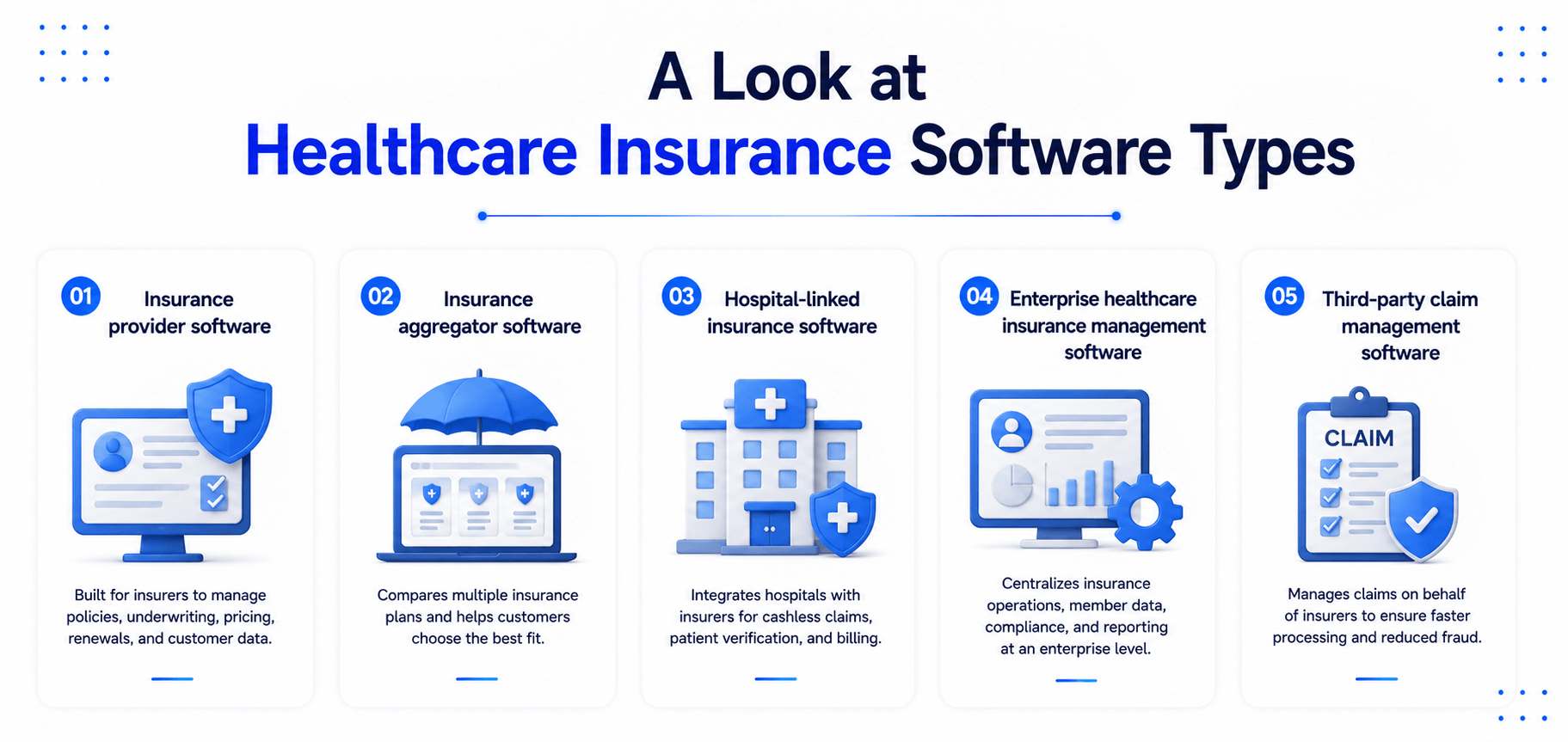
Not all healthcare insurance software is built the same – and that’s actually a good thing. As health insurance software development has matured, businesses have started building solutions that are way more focused and specialized depending on who they’re serving and what problem they’re actually trying to fix. Here’s a breakdown of the main types worth knowing about.
Insurance provider software
Insurance provider software is built directly by insurance companies to bring everything under one roof – policy management, claims processing, customer support, all of it. Users can pull up policy details, check where their claim stands, and download documents without calling anyone. These are honestly a textbook example of what modern health insurance software solutions should look like in practice.
Insurance aggregator software
Ever wished you could compare insurance plans side by side without jumping between ten different websites? That’s exactly what aggregator software does. They pull plans from multiple providers into one place and use health insurance quoting software to generate real-time, accurate premium estimates based on the user’s actual data and coverage needs. It makes the whole decision-making process a lot less overwhelming.
Hospital-linked insurance software
These ones connect the dots between hospitals, insurers, and patients directly. Cashless treatment approvals, insurance verification, billing – all handled in one place instead of bouncing between departments. Anyone who’s dealt with a medical emergency knows how chaotic that process can get, so having it streamlined makes a real difference.
Enterprise healthcare insurance management software
Enterprise insurance management software is built for large organizations managing group policies at scale. Think employee coverage tracking, compliance management, bulk claims – the kind of administrative workload that would otherwise require entire teams to handle manually. These softwares make that manageable.
Third-party claim management software
These are laser-focused on one thing – making the claims process less painful. Users can submit documents, track approvals, and stay in touch with insurers without ever having to navigate complicated backend systems. Faster, simpler, and far less frustrating for everyone involved.
Key benefits of healthcare insurance software development
The way insurance actually works behind the scenes has changed dramatically – and a lot of that comes down to how far health insurance software development has come in recent years. The benefits are showing up across the board, from how claims get handled to how patients interact with their coverage.
Faster and more accurate claims processing
Claims have historically been one of the messiest parts of the entire insurance process: error-prone, and frustrating for everyone involved. That’s changed significantly with healthcare software which automates the whole pipeline – submissions, verification, approvals – without relying on manual input at every step. Fewer delays, fewer mistakes, and a process that actually moves at a reasonable pace.
Improved eligibility verification
Here’s a problem that doesn’t get talked about enough – claim rejections that happen simply because coverage wasn’t properly verified upfront. Health insurance eligibility verification software fixes that by confirming a patient’s coverage details instantly, before treatments are given or claims are even submitted. It keeps hospitals, insurers, and patients on the same page and cuts down on the back-and-forth that wastes everyone’s time.
Better user experience and transparency
People want to know what’s happening with their policy without having to call a helpline and wait on hold. Healthcare insurance softwares now give users real-time access to policy information, digital documents, and instant support. That kind of transparency doesn’t just improve satisfaction… it actually builds trust, which is something the insurance industry has always struggled with.
Reduced operational costs and higher efficiency
By working with a healthcare app development company businesses can automate repetitive tasks and streamline workflows, helping insurers reduce administrative workload and operational costs while improving overall efficiency.
At the end of the day, the shift toward smarter, more automated insurance technology isn’t just about efficiency – it’s about building an ecosystem where everything works together more smoothly for everyone involved.
Health insurance software features
When thinking about what actually goes into a well-built insurance software, it helps to break it down by who’s using it and what they need. Health insurance software features essentially fall into three buckets – what users get, what admins need, and the advanced tech that ties it all together.
User panel features
- Policy Management: Users can view, manage, and track all their insurance policies in one place. No digging through emails or calling support — everything’s right there.
- Claim Submission & Tracking: Digital claim submission with real-time tracking means users always know where things stand without chasing anyone down.
- Premium Payment Integration: Multiple secure payment options make paying premiums straightforward and on time.
- Document Upload: IDs, prescriptions, medical reports — users can upload everything digitally, speeding up verification without the paperwork hassle.
- Notifications & Reminders: Automated alerts for claim updates, renewals, and due dates keep users on top of things without having to remember everything themselves.
Insurer/admin panel features
- Claim Approval Dashboard: A centralized system built through proper health insurance software development gives admins a clean, efficient way to review and approve claims accurately.
- Policy Management System: Insurers can create, update, and manage policies while maintaining full visibility over customer coverage.
- User Management: Admins can track activity, manage accounts, and handle support requests all in one organized place.
- Fraud Detection Tools: Data-driven monitoring flags suspicious activity and helps keep fraudulent claims in check.
Advanced features
- AI Chatbot Support: Instant responses to common queries without putting users on hold.
- NLP-Based Query Handling: Natural Language Processing makes interactions feel more accurate and genuinely conversational.
- OCR for Document Scanning: Automatically pulls data from uploaded documents, cutting out manual data entry entirely.
- Predictive Claim Analysis: AI models spot patterns and predict claim outcomes, helping teams make smarter, faster decisions.
- Real-Time Hospital Network Search: Users can find nearby network hospitals instantly for cashless treatment when it matters most.
- Generative AI: Perhaps the most exciting shift happening right now – Generative AI in healthcare is being used to personalize experiences, automate documentation, and sharpen decision-making across insurance platforms.
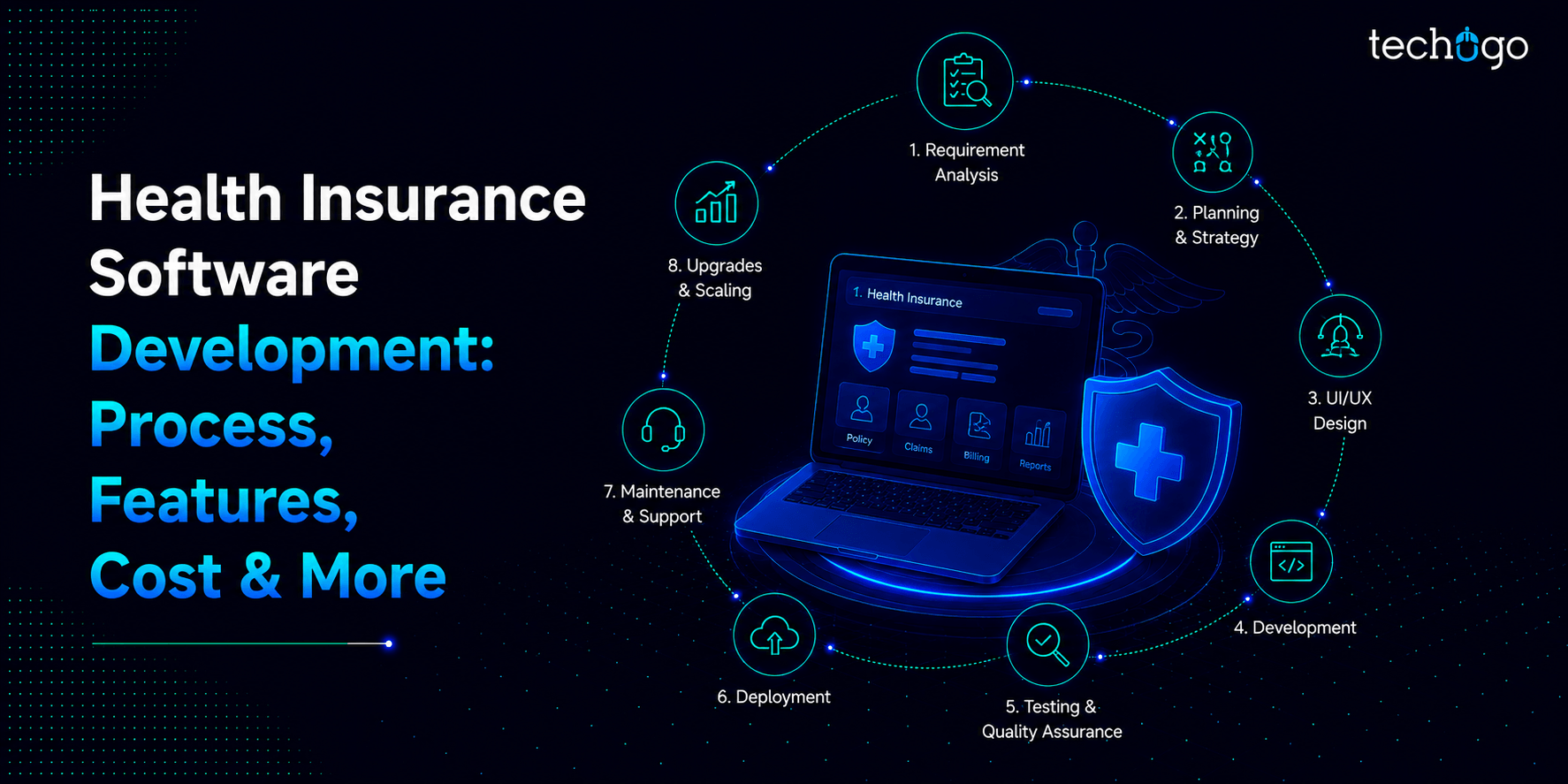
How to develop health insurance software
Building health insurance software isn’t something you can rush. It takes a clear process, and every stage actually matters.
-
Requirement analysis & planning
It starts with getting aligned on what the product needs to do, who’s using it, and what regulations apply. Skipping this step is where most projects go sideways early on.
-
System architecture design
This is where the real foundation gets laid. Health data is sensitive, transaction volumes can get high, and your architecture for health insurance software development needs to handle both without cracking.
-
UI/UX design
Whether you’re building for the web or looking to build a health insurance mobile app, the interface has to be intuitive. Policyholders shouldn’t need a manual to check their claims or make a payment.
-
Core development
This is where things come to life – claim submission flows, policy management, and the billing logic that powers health insurance billing software: premium calculations, invoicing, and payment processing.
-
Integration of advanced features
Once the core is solid, teams layer in AI-based claim validation, fraud detection, and analytics. These aren’t nice-to-haves anymore – they’re what separates modern insurance claim management software from outdated legacy systems.
-
Testing & quality assurance
This covers everything – functionality, security, performance, and compliance. No shortcuts here, especially when real user data is involved.
-
Deployment & launch
The solution goes live on cloud infrastructure that’s built to scale. Reliable performance from day one isn’t optional in health insurance software development.
-
Maintenance & continuous updates
Patches, updates, compliance tweaks – this is what keeps health insurance billing software and claim systems relevant and secure long after launch.
Each stage feeds into the next. Skip one, and you’ll feel it later.
Common use cases of health insurance software development
Modern healthcare insurance software development is changing how insurers, agents, and policyholders actually interact with insurance services. Faster claims, easier policy access, better communication – a well-built medical insurance software touches every part of the insurance lifecycle.
Policy management & digital access
One of the most straightforward use cases is giving users control over their own policies. With a medical insurance app, policyholders can check coverage details, renewal dates, and premium info whenever they need to – without calling anyone or waiting on hold.
Health insurance claims processing
This is where a lot of the friction traditionally lives. Good health insurance claims processing software built into a mobile software lets users upload documents, submit claims, and track status in real time. Approvals move faster, and users actually know what’s happening with their claim.
Agent management & support
Health insurance software for agents is about making agents more effective in the field. They can manage clients, follow up on leads, handle policy sales, and help customers file claims – all from their phone. Less admin, more actual work getting done.
Billing & premium payments
Digital softwares take the hassle out of payments. Secure gateways, automated reminders, billing history – it keeps things moving for both users and providers and cuts down on delays that nobody has time for.
Customer support & assistance
AI chatbots and in-app support systems help users resolve queries instantly. Whether it’s policy clarification or claim-related help, healthcare insurance software development ensures 24/7 assistance for better customer satisfaction.
Fraud detection & risk monitoring
AI-driven fraud detection flags suspicious claims before they become bigger problems. It makes the entire insurance software ecosystem more trustworthy and helps insurers make smarter risk decisions over time.
Technology stack for health insurance software development
When building a healthcare insurance platform, there’s a lot going on under the hood. Here’s a breakdown of how it all fits together:
- Frontend (React, Angular, Vue.js) – These handle everything the user actually sees and interacts with – policy pages, claims dashboards, account screens. All three are great for keeping things snappy and responsive.
- Mobile (Flutter & React Native) – Rather than building separate apps for Android and iOS, these frameworks let you write once and ship to both. Huge time saver.
- Backend (Node.js, Spring Boot, Django/FastAPI, .NET) – This is where the real work happens. Claims processing, policy management, fraud detection – different tools get picked depending on what the job needs.
- Databases (PostgreSQL, MySQL, MongoDB) – SQL databases for the structured, sensitive stuff; MongoDB when the data is messier or more flexible. Both have their place here.
- Cloud (AWS, Azure, GCP) – Healthcare can’t afford downtime, so cloud infrastructure is a must. Scalability, backups, disaster recovery – it’s all baked in.
- APIs & Integrations – Payment gateways, EHR systems, third-party insurance providers – there are a lot of moving parts, and APIs are what keep them talking to each other.
- AI & Analytics – Probably the most exciting layer. ML is doing real, meaningful work here – spotting fraud, predicting risk, automating claims, personalizing recommendations.
- Security (Encryption, Auth, HIPAA/GDPR) – Non-negotiable in healthcare. Everything else sits on top of this foundation.
Health insurance software development cost
Healthcare insurance software development cost varies based on features, compliance requirements, and technology complexity. In markets like the USA, a mobile app development company in USA often delivers high-quality, scalable solutions, which can influence overall pricing due to strict security standards and advanced engineering practices.
Cost breakdown table
| Software Type | Cost Range | Key Highlights |
| Basic App | $30,000 – $60,000 | MVP-level features, basic health insurance software development functionality |
| Mid-Level App | $60,000 – $150,000 | Advanced features, integrations, and claims processing capabilities |
| Advanced App | $150,000 – $300,000+ | AI-driven, enterprise-grade solution with high security and full scalability |
Factors affecting cost
- Feature complexity in health insurance software development
- Compliance and security requirements for healthcare data
- AI integration in health insurance claims processing software
- Platform choice (iOS, Android, or cross-platform)
- Third-party integrations (payment gateways, APIs, EHR systems)
Overall, the cost increases with complexity, security requirements, and the level of automation required in the system.
Challenges in health insurance software development you should know
Building health insurance software isn’t just complicated – it’s a whole different level of pressure compared to most industries.
- Regulatory compliance is relentless: HIPAA, GDPR, state-level laws… the rules keep changing and your software has to keep up. One slip and you’re looking at serious legal trouble.
- Data security is non-negotiable: You’re handling some of the most sensitive information that exists. Medical records, financial data, personal details – a breach here doesn’t just hurt the company, it hurts real people.
- Legacy system integration is a nightmare: A lot of healthcare organizations are still running on outdated systems. Getting modern software to talk to those? Painful, slow, and expensive.
- Claims processing is genuinely complex: There are so many variables, edge cases, and exceptions involved. Automating it without errors takes serious engineering effort.
- Scalability under pressure: Open enrollment periods, emergencies, sudden spikes in usage – the system has to hold up exactly when it matters most.
- User experience gets overlooked: Patients and providers aren’t always tech-savvy. If the software is confusing, people make mistakes – and in healthcare, mistakes have real consequences.
Honestly, it’s one of the hardest domains to build software for. But when it’s done right, the impact is massive.
AI trends shaping health insurance software development
Artificial Intelligence is changing how healthcare insurance softwares work by making processes faster, more accurate, and less dependent on manual effort.
From claims handling to fraud detection and customer support, AI is helping insurers improve overall efficiency and user experience. Many businesses also collaborate with an AI-powered healthcare app development company or a broader AI app development company to integrate these intelligent capabilities into scalable insurance platforms.
This shift is visible across several key AI-driven trends in the industry:
- Automating health insurance claims processing software to speed up verification and reduce approval delays
- Detecting unusual patterns and potential fraud cases to minimize financial risks and strengthen system trust
- Delivering personalized policy recommendations based on user behavior, health data, and preferences
- Powering AI chatbots that handle customer queries instantly, reducing wait times and improving support efficiency
- Using predictive analytics to enhance risk assessment, pricing accuracy, and long-term planning
This combination of AI-driven automation and intelligent insights doesn’t just improve efficiency – it reshapes how modern insurance systems respond to users, make decisions, and scale over time.
How to choose the right health insurance software development company?
Okay so if you’re trying to pick the right health insurance software company, here’s the thing: this decision matters way more than people realize. A bad hire here doesn’t just cost you money, it can cost you compliance violations, angry users, and a product that falls apart when you need it most.
So what should you actually look for?
- Real healthcare experience – General software experience isn’t enough. You want people who’ve actually worked in this space and understand how insurance and claims logic works. Not someone who’s going to learn on your dime.
- They should know compliance inside out – HIPAA, GDPR, local regulations: ask them about it directly in the conversation. If they fumble the answer, that’s your sign to walk away.
- Dig into their portfolio – Don’t just take the logos on their website at face value. Ask for real case studies, actual products they’ve shipped, maybe even talk to a past client. Real work doesn’t lie.
- Security has to be a priority for them, not an afterthought – How are they handling encryption? Access controls? Testing for vulnerabilities? If they can’t give you a solid answer, that’s a red flag.
- Communication style matters more than you’d think – You want a team that’s upfront when something’s going wrong, not one that goes quiet and delivers surprises at the end.
- Ask about what happens after launch – A lot of companies vanish once the product ships. Bugs, updates, new regulations – you need someone who’s still there six months later.
- Think long term – Are they building something that grows with you, or just patching together something that works for right now?
Look, at the end of the day you’re not just hiring developers. You’re bringing in a team that’s going to handle software that touches people’s health and money. That deserves a really careful decision.
Why Techugo is the right choice for healthcare insurance software development
Choosing the right partner plays a huge role in how successful your healthcare insurance software becomes.
That’s the mindset we bring to every project.
As a trusted mobile app development company, Techugo leverages modern tech like Flutter for smooth cross-platform apps and Node.js for solid backend systems that can actually handle real traffic without breaking. On top of that, we rely on cloud setups, secure APIs, AI-driven capabilities and scalable databases so everything runs fast, secure, and stable even when things get heavy.
A lot of the companies we work with are operating in highly competitive markets, especially in the US, where users expect everything to be instant, transparent, and reliable. Therefore the focus is always on making softwares that feel simple on the surface but are powerful underneath.
So are you thinking about building a healthcare insurance app? Let’s talk and figure out the best way forward.
FAQs
1. What is healthcare insurance software?
A healthcare insurance app is a digital platform that allows users to manage policies, file claims, track status, and access insurance services through mobile or web applications.
2. How does AI improve healthcare insurance software?
AI improves automation, speeds up claims processing, detects fraud, and provides personalized policy recommendations and chatbot support.
3. What features are important in healthcare insurance software?
Key features include policy management, claims tracking, billing, fraud detection, AI chatbots, and secure data handling.
4. How much does it cost to build healthcare insurance software?
Costs typically range from $30,000 to $300,000+, depending on features, complexity, compliance requirements, and technology stack.

Get in touch
We'd love to hear from you.