

 SA
SA
 KW
KW
 IE
IE AU
AU UAE
UAE UK
UK USA
USA
 CA
CA DE
DE
 QA
QA ZA
ZA
 BH
BH NL
NL
 MU
MU FR
FR

















📌 Key Takeaways
- HIPAA was enacted in 1996 to establish standards for protecting certain health information in the U.S.
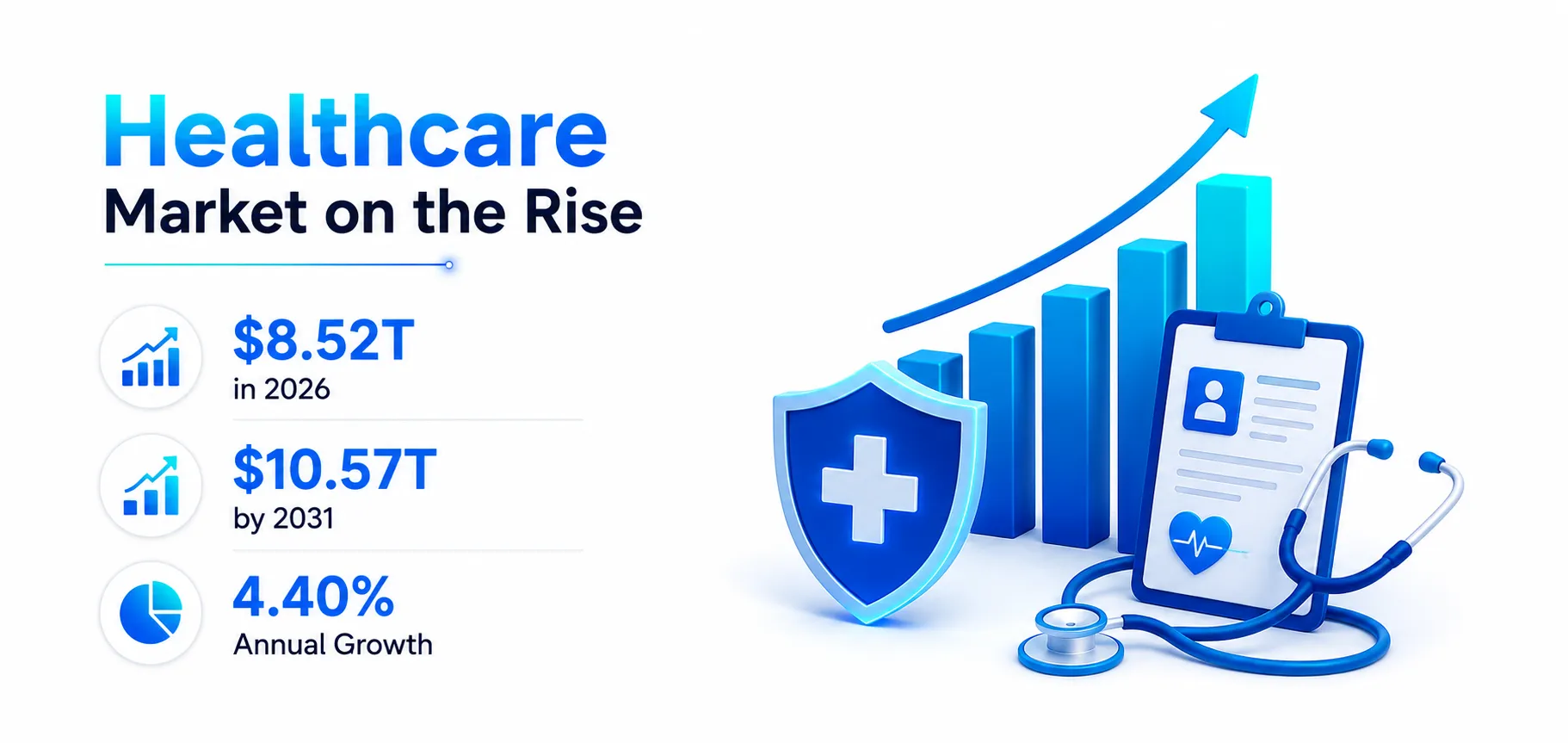
- The U.S. healthcare providers market is projected to reach US$8.52 trillion in 2026 and US$10.57 trillion by 2031.
- The cost of HIPAA-compliant telemedicine apps ranges from $20,000 to $150,000+.
- HIPAA violations can result in civil monetary penalties, corrective actions, investigations, and reputational consequences.
- HIPAA’s Privacy, Security and Breach Notification Rules are enforced by the HHS Office for Civil Rights (OCR).
The telemedicine market is crowded with thousands of competitors, so one privacy or security mistake could give users a reason to move to another platform.
Big Risk Huh?
In the telemedicine industry, a single data breach can be more than just a financial loss; it can result in lost patient trust, operational disruption and significant regulatory repercussions. Healthcare is among the most sensitive and data-heavy industries, ranging from medical records and prescriptions to diagnoses, consultations and payment details.
Days are gone when patients’ data were stored in files; now healthcare organizations and other service providers use HIPAA-compliant telemedicine apps that securely collect, store and process patients’ data.
More data means more requirements for security. Especially for U.S. covered entities.
HIPAA compliance requirements for telehealth industry are not just another regulation. They are unavoidable.
So if you are planning to launch a HIPPA compliant healthcare app or HIPAA-compliant telemedicine app development solution, looking to expand your existing telemedicine business in the USA, knowing everything about HIPAA compliance is a must.
With so many competitors competing for the same audience, you can’t afford to give patients a reason to jump ship. One privacy blunder or security error could set back years of trust. But what does HIPAA compliance actually involve and how can you get it right from day one? Let’s find out.
What Is HIPAA Compliance?
HIPAA compliance is a set of globally followed standards that comes under the Health Insurance Portability and Accountability Act (HIPAA) of 1996. It is followed by healthcare and telemedicine service providers to protect sensitive health information. The core concept of HIPAA compliance is to secure Protected Health Information (PHI) without users’ consent.
A HIPAA-compliant approach can involve multiple layers of protection.
- Privacy
- Security
- Access Control
- Data Protection
- Auditability
- Breach Response
- Patient Rights
As leading telemedicine apps continue to expand digital healthcare access, implementing strong privacy, security, authentication and data protection measures has become essential for maintaining patient trust and meeting applicable regulatory requirements.
Why Is HIPAA a Global Requirement? Market Insights
If you are a health service provider, I’m sure you must have heard of HIPAA. There’s a chance that you’ve already implemented it, but what if I tell you that HIPAA is not a global law?
So why is it still a global requirement?
Let’s understand,
Since its launch, the security features of compliance have become global standards due to patient data protection, access control, confidentiality, security and breach management.
Most importantly, it builds TRUST.
The global market for global healthcare market size is projected to reach USD 10.57 trillion by 2031 at a CAGR of 4.40%. Giving high opportunities to healthcare service providers who are currently serving or want to provide services in the USA.
Top 5 HIPAA Compliance Rules for Telemedicine Apps
Want to establish a healthcare or telemedicine business in the USA, or are you among covered entities like healthcare providers, health plans and healthcare clearinghouses, as well as business associates that handle PHI on their behalf? Some rules need to be followed throughout PHI, not just during HIPAA-compliant mobile app development. Here are some HIPAA requirements for telemedicine service providers-
1. Privacy Rule
It is used by covered entities to use or disclose patients’ sensitive Protected Health Information (PHI). This privacy rule ensures when to collect, use, or share any confidential information of the user. The information handling is done with complete security through appropriate privacy policies, user permissions and access controls.
2. Security Rule
The security rule under HIPAA ensures that any ePHI is safeguarded against unauthorized access, use, or modification. In order to ensure that there is data access control, telehealth systems must comply with HIPAA requirements, which include encryption, multi-factor authentication, role-based access control, secure APIs, logging and access monitoring.
3. Breach Notification Rule
This rule requires notifying official authorities like HHS and individuals if there is any involvement of data breaches. This helps organizations or legal entities to investigate and fully report data breaches without any delay.
4. Enforcement Rule
The HIPAA Privacy Rule describes the procedures regarding the investigation, processing and penalizing of HIPAA violations by the U.S. Department of Health and Human Services (HHS) for which the Office for Civil Rights (OCR) is the lead enforcer.
5. Omnibus Rule
This rule is used to give full security to third-party contractors or business associates, as they also handle users’ important data; it makes sure the data is securely handled by cloud providers, software vendors, hosting services, analytics tools, video platforms, or other third parties.
Essential HIPAA-Compliant Features for Telemedicine Apps
| HIPAA-Compliant Feature | What It Provides |
| Secure User Authentication | MFA, strong passwords, secure login and session management |
| Role-Based Access Control (RBAC) | Ensures users access only the PHI and features relevant to their roles |
| Secure Video Consultation | Protected doctor-patient video and audio communication |
| Secure Patient Data Storage | Safeguards medical records, patient profiles, and other PHI |
| Audit Logs & Activity Tracking | Records user access and important system activities |
| Secure Messaging | Protects sensitive communication between doctors and patients |
| Automatic Session Timeout | Reduces unauthorized access after periods of inactivity |
| Secure API Integration | Protects data exchanged with EHRs, pharmacies, labs, and other systems |
| Data Backup & Recovery | Supports data availability and recovery during system failures |
| Secure Document Sharing | Protects prescriptions, reports, test results, and medical files |
| Business Associate Management | Supports vendor security assessments and BAAs where required |
| Secure Admin Dashboard | Controls administrative access to sensitive healthcare data |
HIPAA Compliance Checklist: What Your Telemedicine App Needs
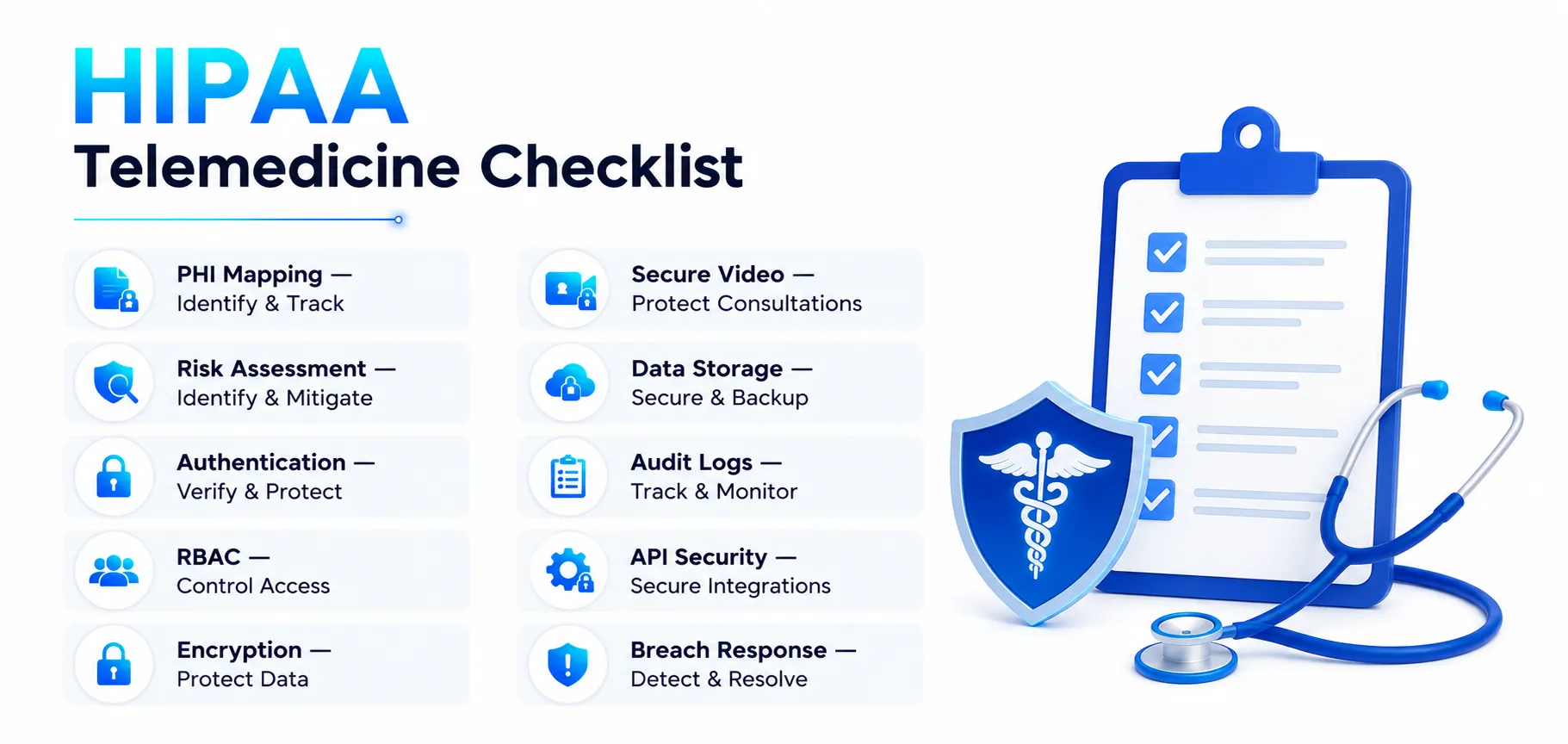
1. Identify PHI & ePHI
- Determine the patient health information that is captured.
- Know how the PHI is stored, processed and transmitted.
- Determine the authorized personnel accessing the information types.
2. Conduct a Risk Assessment
- Determine the potential security risks and threats.
- Evaluate potential impacts of each risk.
- Define the risk controls to mitigate the risks.
3. Strong User Authentication
- Find possible risks that could affect patient data.
- Analyze their potential impact on the telemedicine platform.
- Implement appropriate safeguards to minimize those risks.
4. Role-Based Access Control
- Set up role-based access for different user types.
- Ensure PHI is accessible only to authorized personnel.
- Remove or modify unnecessary permissions regularly.
5. Data Encryption
- Encrypt sensitive health information at rest.
- Use secure encryption for data in transit.
- Restrict and protect access to encryption keys.
6. Secure Video Consultation
- Use a secure video infrastructure for teleconsultations.
- Control who can access and participate in each session.
- Secure all PHI generated or exchanged during consultations.
7. Secure Data Storage
- Use appropriately secured databases and cloud infrastructure.
- Restrict access to sensitive patient records.
- Maintain appropriate backups and data protection controls.
8. Audit Logs & Monitoring
- Protect data at rest.
- Allow authorized access only.
- Keep regular backups.
9. Secure API Integrations
- Use secure API access controls.
- Protect exchanged patient data.
- Track third party activity.
10. Incident & Breach Response
- Identify security incidents quickly.
- Mitigate and remediate threats.
- Notify affected parties when required.
Steps to Build HIPAA Compliance Ready Telemedicine App Solutions
1. Define Requirements & Scope
Before starting with HIPAA-compliant telemedicine app development, the first step is to understand your audience, app’s purpose and features. Ensuring the features and solutions that your business will provide to patients will help map app’s architecture and development scope. This approach helps create a HIPPA Compliant Healthcare App that meets the required security and privacy expectations from the beginning.
Businesses looking to enter the market faster can also consider white label telemedicine apps, which can provide pre-built telemedicine functionality that can be customized and configured with appropriate HIPAA-focused security controls based on the intended use and compliance responsibilities.
2. Identify & Map PHI
The next step is to map PHI, as this will help your HIPAA-compliant software app development partner list data that is going to be collected, processed, or stored, ensuring stronger security control.
3. Design Secure Architecture
HIPAA-compliant app developers design the telemedicine app architecture around security, privacy, scalability and HIPAA requirements. This includes secure cloud infrastructure, encrypted databases, protected APIs, secure authentication, role-based access controls etc using advanced technologies.
4. Develop Core Telemedicine Features
The core development starts here where the development team turns the approved requirements and architecture into a working telemedicine product. Using frontend and backend technologies along with AI, ML, cloud, databases etc, the high-performing application’s core development is done at this stage.
5. Implement HIPAA Security Controls
At this stage the development company ensures complete transparent authentication and security features are implemented within the telemedicine software. The common security controls are MFA, role-based access control (RBAC), secure authentication, audit logs, API security, session controls, backups and monitoring.
6. Test & Validate Security
Along with the security integrations, developers also conduct thorough security testing to identify and fix vulnerabilities. They check code, vulnerability scanning, penetration testing, API security testing, authentication and access-control testing and more to maintain app’s security over time.
7. Prepare Compliance Documentation
The healthcare entity, development partner and qualified compliance/security professionals, as applicable to each party’s responsibilities, collaborate in the preparation of the compliance documentation. This documentation demonstrates how the organization treats HIPAA risk and protects.
8. Deploy & Continuously Monitor
When testing is completed, the app is deployed to a secure production environment. The developers and the security team have access to all the infrastructure and it is monitored closely, as well as being monitored constantly for access, logs, vulnerabilities and APIs. Infrastructure is patched with security updates regularly, risk is reviewed and incidents are handled to maintain ongoing HIPAA compliance.
Common Telemedicine App HIPAA Violations and How to Avoid Them
For businesses serving U.S. patients through healthcare or telemedicine platforms, HIPAA compliance is essential. Failing to meet applicable requirements can expose your business to penalties, investigations, corrective measures and damaged customer trust.
1. Civil Monetary Penalties (Financial Fines)
- Tier 1 (No Knowledge)
- Tier 2 (Reasonable Cause)
- Tier 3 (Willful Neglect – Corrected)
- Tier 4 (Willful Neglect – Uncorrected)
2. Criminal Penalties
- Tier 1 (Reasonable cause or basic intentional access)
- Tier 2 (False Pretenses)
- Tier 3 (Malicious Intent or Personal Gain)
3. Non-Financial & Collateral Penalties
- Corrective Action Plans (CAPs)
- Loss of Professional Licenses
- State Lawsuits
- Reputational Harm
Tips to Avoid These Violations
- Conduct regular risk assessments.
- Encrypt and secure PHI/ePHI.
- Apply role based access controls.
- Monitor and maintain audit logs.
- Train staff on HIPAA requirements.
- Sign required BAAs.
- Maintain an incident response plan.
- Update compliance documentation.
- Test and patch systems regularly.
HIPAA-Compliant Solutions vs. Medicine App Development: Key Differences
| Area | Regular Medicine App Development | HIPAA-Compliant Telemedicine Solution |
| Primary Focus | Features, usability and patient engagement | Healthcare functionality plus privacy and security |
| Patient Data | May collect basic health information | Protects PHI/ePHI with appropriate safeguards |
| Authentication | Standard login | Strong authentication, MFA, secure sessions |
| Access Control | Basic user permissions | Detailed role-based access control |
| Data Security | Standard application security | Appropriate encryption and security safeguards |
| Video Consultation | General video calling | Secure video communication suitable for PHI |
| Messaging | Standard in-app messaging | Protected communication for sensitive health information |
| Audit Logs | May have basic activity logs | Tracks relevant access and system activity |
| Data Storage | Standard cloud/database setup | Appropriately secured infrastructure for ePHI |
| Third-Party Services | General vendor integration | Vendor assessment and BAAs where required |
| Risk Management | Usually not HIPAA-specific | Ongoing HIPAA risk assessment and management |
| Compliance | No specific HIPAA obligations unless applicable | Designed and operated to support applicable HIPAA requirements |
While medicine delivery app development focuses primarily on pharmacy services, prescriptions, order management and medicine delivery, a HIPAA-compliant telemedicine solution places greater emphasis on protecting PHI, secure consultations, authentication and regulatory requirements.
How Much Does HIPAA-Compliant Telemedicine App Development Cost?
- Basic MVP Solution: $20,000 -$50,000
- Mid-Level Telemedicine App Solution: $50,000 – $90,000
- Advanced HIPAA-Compliant Solutions: $100,000 – $150,000+
- Enterprise-Level Solution with Advanced Integrations: $150,000+
Factors Affecting the Cost of HIPAA-Compliant App Development
App Complexity & Features – The telemedicine app complexities play a major role in HIPAA-compliant app development budget. Advanced features such as EHR/EMR integration, e-prescriptions, remote patient monitoring, AI features, wearable integration, online payments cost more in comparison to a basic application.
Third-Party Integrations – Integrating EHR/EMR, payment, pharmacy, lab, video, wearable and cloud services may add development time and cost. But these integrations bring the telemedicine app closer together in a connected, efficient and rich in features. The costs are tied to the number and complexity of integrations.
AI & Advanced Technologies – Generative AI, machine learning, predictive analytics, and AI-enabled health tracking features In Telemedicine are becoming more and more important. They can contribute to delivering smarter workflows, personalized experiences, and more efficient care of patients.
App Platforms & Development Team – The technology platform and development partner can make a big difference in your budget. Cross-platform development can help lower your costs, and a seasoned healthcare development team can provide added value with better architecture, security and HIPAA expertise.
Development Team Location – The location of the development team can greatly affect prices, as countries such as India have much lower development rates than the U.S., Canada and Western Europe. However, cost should be balanced by HIPAA expertise, healthcare experience, security and quality of development.
Maintenance & Post-Launch Support – Maintenance and post-launch support is also a non-negotiable cost factor that can’t be ignored. Growing business trends and user demand mean your app will require some changes, so having a clear understanding of this factor can help with overall budget planning.
Latest HIPAA Compliance Trends for Telemedicine Apps in 2026
As telemedicine becomes the core part of healthcare trends across the world due to its convenient, connected services. We all expect instant healthcare services, be it live virtual doctor consultation calls, monitoring health conditions with AI-powered wearable devices or getting instant medicine parcels at the doorstep.
Here are some of the common trends gaining momentum in 2026:
1. AI-Powered Telemedicine
AI-powered telemedicine services are one of the major key trends as healthcare users expect faster responses to their problems. Whether it is managing growing patient demand, telemedicine business owners use AI to support virtual triage, symptom assessment, clinical decision support, documentation etc.
2. Remote Patient Monitoring
Remote patient monitoring is in high demand as users want instant resolution of their problems at home or in their place. It helps doctors or healthcare providers to monitor vital signs and chronic conditions remotely through wearables from anywhere.
3. Wearable Integration
Wearable integration is the perfect way to remotely monitor patients with devices like smartwatches, sensors, and connected devices. These generate continuous health data that help them to understand patient conditions more accurately.
4. Advanced Cybersecurity
As healthcare or telemedicine services move online, cybersecurity has become necessary due to sensitive patient history and records. Following HIPAA compliance is one of the secure ways to win user trust, providing strong authentication, encryption, access controls and monitoring.
5. Cloud-Based Healthcare
As telemedicine industry leaders deal with a large amount of patient data, having scalability and accessibility is a non-negotiable requirement. Therefore, cloud-based healthcare services are becoming key trends that let doctors and business owners offer secure, flexible, and accessible digital services.
Will HIPAA Compliance Stay Relevant in the Future?
Yes, of course. As healthcare goes digital, the telemedicine, digital health, AI healthcare, remote patient monitoring and healthcare saas markets are tipping toward massive growth and business opportunity. For those whose business is focused on the U.S. market, HIPAA compliance will continue to be critical for protecting patient data and establishing trust. Investing in HIPAA-ready technology now will enable your business to remain competitive, scale with confidence and seize opportunities in the evolving healthcare ecosystem of the future.
Why Choose Techugo for HIPAA-Compliant Solution Development?
Techugo is a renowned technology partner for the U.S. healthcare market that enables healthtech & telemedicine companies to deliver secure, scalable and technology-led solutions. With end-to-end competence in healthcare development, integrations, AI & HIPAA-centric security, we help companies at every stage of their journey from initial planning through development and post-launch growth.
Here are the Top 5 Reasons to Choose Our Telemedicine App Development Services –
1. Healthcare Expertise
Deep expertise in healthcare, telemedicine and digital health development helps deliver solutions aligned with real-world healthcare workflows.
The focus remains on creating secure, user-friendly and market-ready healthcare experiences.
2. HIPAA-Focused Approach
HIPAA considerations are integrated from the initial planning and architecture stage, rather than added later. This approach helps build privacy and security into the solution from the ground up.
3. Secure Architecture
A security-first architecture incorporates encryption, authentication, access controls, audit trails, and secure APIs. This creates a strong foundation for protecting sensitive healthcare data across the platform.
4. Scalable Development
Solutions are engineered to scale seamlessly with increasing users, data, features and business demands. The architecture supports long-term growth without compromising performance or security.
5. Modern Technology
Advanced technologies, including AI, cloud computing, automation, APIs and modern mobile/web frameworks, power next-generation healthcare solutions. This enables businesses to deliver smarter, faster, and more connected digital healthcare experiences.
FAQs
1. What are the top 5 HIPAA violations?
Common violations include unauthorized PHI access, improper disclosure, inadequate security safeguards, missing BAAs and failure to meet applicable breach notification requirements.
2. Who needs to follow HIPAA?
HIPAA generally applies to covered entities such as healthcare providers, health plans and healthcare clearinghouses, along with applicable business associates handling PHI.
3. How much does a HIPAA compliant telemedicine app cost?
The cost depends on features, complexity, integrations, platforms, security requirements and the development company you choose.
4. Are third party integrations subject to HIPAA?
Third parties handling PHI on behalf of covered entities may qualify as business associates and require appropriate safeguards and BAAs where applicable.
5. What are the penalties for HIPAA violations?
Violations can result in civil monetary penalties, corrective actions, investigations and in certain circumstances, criminal penalties.
6. How long does a telemedicine app take to develop?
Development time depends on the app’s complexity, features, integrations, platforms, testing, and HIPAA related requirements.
7. Can an existing telemedicine app be upgraded for HIPAA requirements?
Yes, an existing app can be assessed for compliance gaps and upgraded with appropriate security controls, policies, documentation and monitoring.

Get in touch
We'd love to hear from you.