


 SA
SA
 KW
KW
 IE
IE AU
AU UAE
UAE UK
UK USA
USA
 CA
CA DE
DE
 QA
QA ZA
ZA
 BH
BH NL
NL
 MU
MU FR
FR


















📌 Key Takeaways
- Choosing the right outsourcing partner is critical for ensuring quality, scalability, security, and long-term project success
- Outsourcing enables companies to focus on core business functions while external experts handle software development.
- Hourly development costs vary significantly by region, making location a key factor in outsourcing decisions.
- Successful outsourcing depends on clear communication, well-defined contracts, regular monitoring, and strong project governance.
- Evaluating vendors based on expertise, reputation, cultural fit, scalability, security compliance, and transparent pricing leads to better outcomes.
Businesses have always been looking for ways to reduce costs and streamline functions, so they can function properly. “But how do you do this?” has been the question for many years. However, the answer came out as software development outsourcing. By partnering with external development companies, organisations can leverage global talent, improve on the issues of scalability, and accelerate product delivery. But how do you get to that level? This is where the guide will explore aspects like benefits, costs, outsourcing models, and key factors to consider when choosing the best expert in the town and even globally.
Software Development Outsourcing: What Is It?
Hiring external firms or developers to handle and work on software projects is what software development outsourcing is all about. Through this process, you can easily look out for experts who meet the exact criteria you require. To do this, you can access skills at reduced costs, and help you solve core business functions while leveraging global talent and resources.
Under this, the process is simple; you will need to contact third-party software development outsourcing services, which otherwise would be done by internal teams. This is a popular practice where cost arbitrage is in favour of the developed nation.
For Eg: A US or Europe-based software firm looking for outsourcing services in India, the Philippines, or Vietnam.
Why Choosing A Software Development Outsourcing Company Matters?
Well, you have learnt what software development consulting or outsourcing is. But questions like why do companies look for such things might be creeping into your mind. So, let’s find out why this matters in the first place.
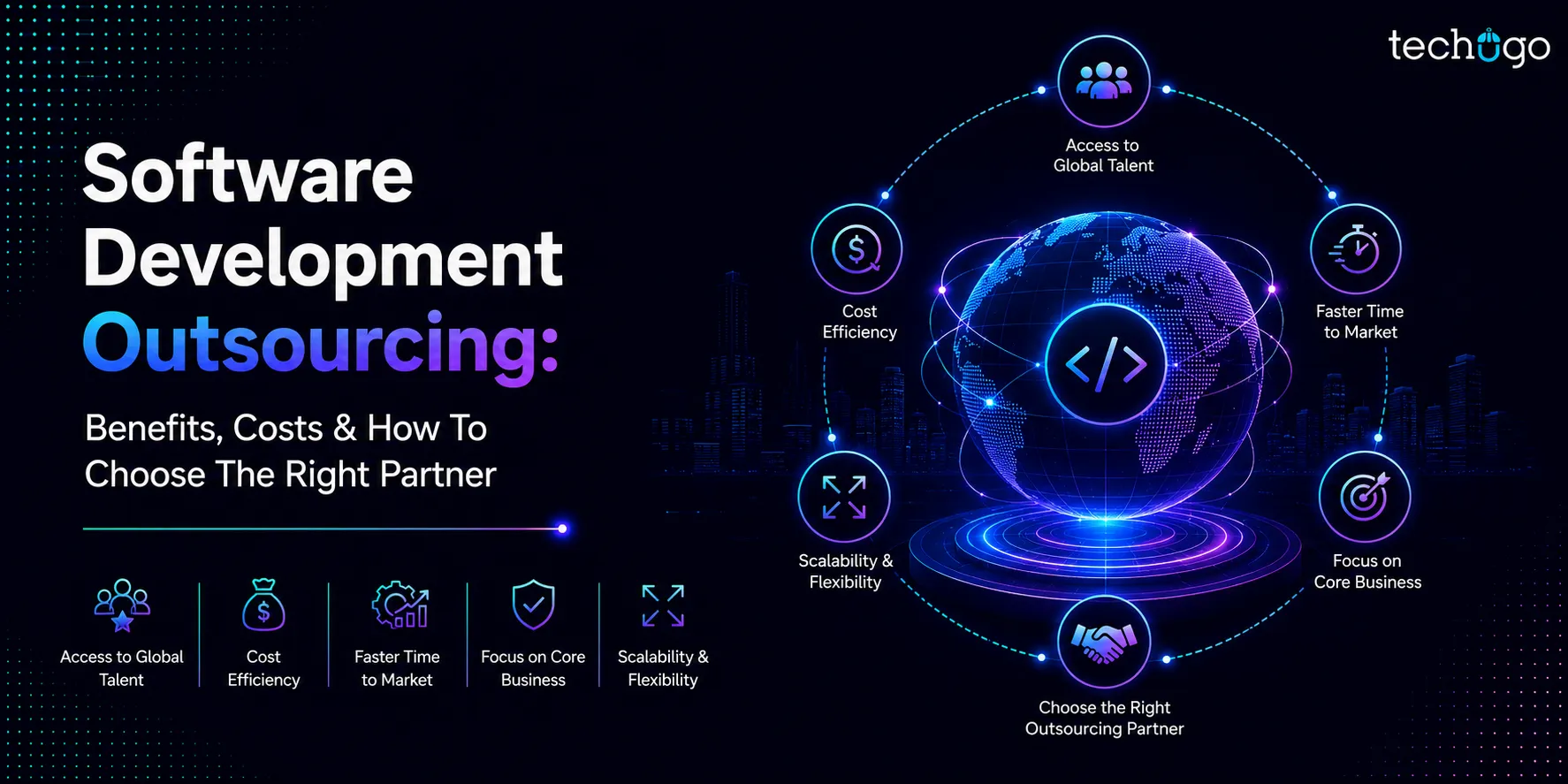
1. Economical Solutions For Established Firms
Established businesses in developed locations like North America and Europe have the benefit of cost arbitrage, and if they have enough cash flows, then it is heaven on earth for them. This allows their software businesses to seek out economical solutions and hence take the load off the bottom line.
2. Reach To Global Talent Hubs
Which is a better situation for a business: a limited pool of experts or access to global talent hubs? Obviously, the second one. So, just by searching for talent just out of your geographical location, you can find the best countries to outsource software development to. And if you are interested in doing so, then some of the countries include India, Ukraine, Vietnam, and the Philippines.
3. Exponential Scalability
According to the business requirements, outsourcing helps provide the flexibility to scale teams up or downsize them. Scalability is an important resource to have because managing resources efficiently, especially during peak workloads or when a new project starts.
4. Focus On Core Business
By looking out for software development outsourcing companies, you can delegate non-core business tasks to them. Following this strategy gives you enough time and money to focus on core business functions. Hence, business alignment is much easier when outsourcing software development.
5. Time To Market Advantages
By taking help from professional developers, your apps will be built faster, and also, proven processes will do the needful. This enables you to launch the application sooner and stay ahead of the competition.
Hourly Cost of Outsourcing Software Development (Location-Based)
At this point, you must be wondering what the actual cost of custom software development outsourcing is. But the thing is, I cannot give up the actual cost of doing one due to economic and geopolitical reasons, but at this point, some estimations would suffice. So, here is the list:
| Region | Typical Hourly Rate (USD) |
| North America | $100 – $250+ |
| Western Europe | $70 – $180 |
| Eastern Europe | $30 – $80 |
| Latin America | $30 – $80 |
| Asia | $20 – $60 |
Best Countries To Outsource Software Development
Ask 5 outsourcing companies which country is “best,” and you will get 5 different answers, usually pointing straight at wherever that company happens to be. The fact is, there is no single best country to outsource to. So, here’s how the major regions actually stack up, so you can match the destination to your project instead of chasing a headline rate.
1. India: Best For Scale
The South Asian nation remains the largest offshore software development destination, and it has earned its spot, not through hype but through sheer capacity which is best for legacy system modernization. With an IT force of more than 5 million engineers and hourly rates typically in the range of $20 – $60, India is where you go when you need to stand up a product squad, QA functions, and support engineering fast.
2. Eastern Europe (Poland, Ukraine, Romania, Czech Republic): Best For Complex, High Skills Work
If your project involves serious engineering, like in fintech, complex system design, cybersecurity, R&D heavy products, then Eastern Europe is the destination for you. Rates typically are lower than in the USA, while still delivering senior, well-educated engineers, and the time zone overlap with Europe makes real-time collaboration realistic.
3. Latin America (Mexico, Colombia, Argentina, Brazil): Best For US Time Zone Overlap
For businesses in the US that want to run daily standups, live architecture reviews, and real-time incident response without a scheduling headache, Latin America is hard to beat. Rates generally range $30 – $80 and countries like Mexico and Colombia offer close to full overlap with US working hours. Argentina, in particular, has built a strong reputation for full-stack engineers with genuine product thinking, not just people for executing tickets.
4. Vietnam: Best For Cost Efficient Volume Work
Vietnam has become one of Asia’s fastest-growing IT outsourcing hubs with strong government backing, heavy investment in tech education, and a growing market. Rates run roughly, depending on scope, and English proficiency among outsourcing developers is notably strong for the region, with a large share of programmers hitting B2-level fluency or higher.
5. Philippines: Best For Communication Heavy Roles
The Philippines punches above its weight on English proficiency and Western cultural alignment, making it a strong fit for client-facing platform work, QA, and frontend development where communication quality matters as much as raw technical depth.
Understanding Software Development Outsourcing Models
Now, it is essential to understand how you can subcontract software development to experts. Well, there are ways to do so, and according to your convenience and operational requirements, you can choose the following:
Relationship-Based Outsourcing Models
The integration of the external and internal development teams is judged by the relationship-based outsourcing models. Relationship-based models are controllable yet flexible in nature and are applicable to diverse operational situations. Within this, outsourced software development models look like this:
1. Project-Based Model: A project that is defined thoroughly with a definite scope and a set of tasks.
2. Dedicated Team Model: Teams or individual developers are completely allocated to the same project and the same management.
3. IT Staff Augmentation: External experts who come to the team to bridge the current knowledge and skills gap while maintaining complete control.
Pricing-Based Outsourcing Models
Determining how cost will be calculated and how risks will be shared between the client and the vendor is what price-based outsourcing models are all about. Finding the appropriate pricing structure is one of the best methods to keep the budget within the limits and also ensure quality. To get the best outsourcing software development services, take a look at these models:
1. Fixed Price Model: A well-defined scope for a fixed budget based project.
2. Time & Materials Model: Under this, developers get compensated according to the hours put in and resources used.
3. Incentive-Based Model: Remuneration is directly linked to the performance measures or results.
4. Shared Risk Reward Model: Both parties (vendor and client) share the same financial risks and rewards.
Location-Based Outsourcing Models
Here, the models are based on the geographical location of the service provider in relation to the client. Therefore, the impact on costs, communication speed, overlapping time zones, and cultural alignment will be direct. Outsourcing SaaS development is also a greater beneficiary of this. Under this, the models are as follows:
1. Onshore Outsourcing: Vendor is located in the same country.
2. Nearshore Outsourcing: A model where developers or team members are located in close or adjacent nations.
3. Offshore Outsourcing: Collaborating with businesses in remote locations.
In-House vs Outsourcing Software Development Explained In Detail
Comparison is the killer of happiness. This might be true in general life, but not in business terms. A bit of comparison between the most relevant outsourcing models is necessary. Isn’t it? Hence, the in-house vs. outsourcing comparison is listed below:
| Factors | In-House Development | Outsourcing Development |
| Total Cost | $200,000 – $300,000 yearly = incentives | $20 – $250 based on region and project-based cost |
| Time To Start | 40 – 60+ days to hire and notice period | 1 – 4 weeks for the vendor, and begin with the sprint |
| Control & Oversight | Full control with cultural alignment | Requires vendor governance, SLAs, and checkpoints |
| Talent Pool | Limited to the local market | Selection from the global talent pool |
| Scalability | Takes months to expand or contract + layoffs are a thing | Adjusting team size within weeks |
| IP & Security | Easier to apply internally, but the risk of attrition is real | Need expertise in SOC 2, GDPR, ISO/IEC 27001, and more |
| Best For | Long-term regulated core systems | MVPs, scaling spikes, niche expertise |
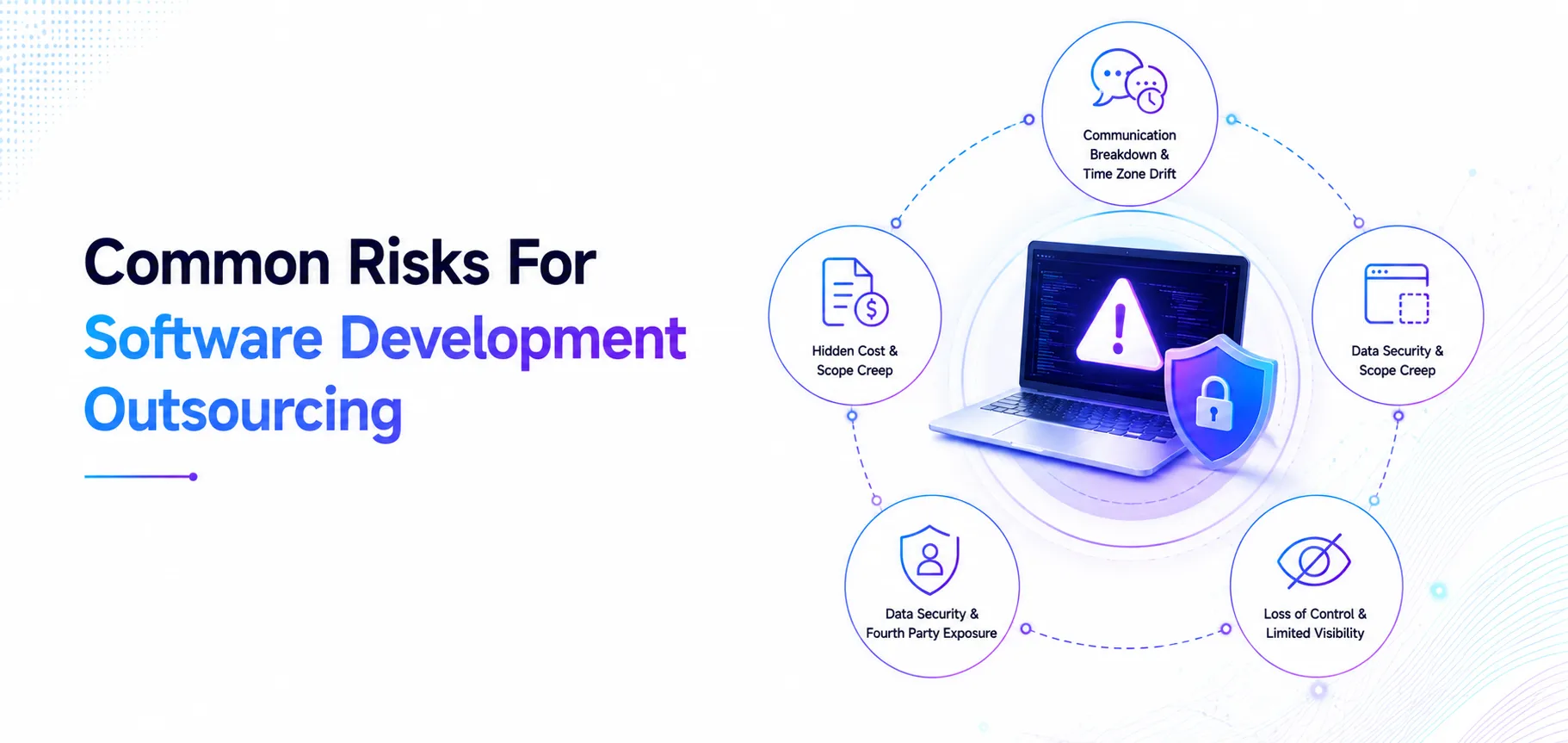
Common Risks of Software Development Outsourcing
Outsourcing software development is generally effective. But “most of the time” isn’t good enough when the failure cases involve blown budgets, leaked data, or a product that never ships. So, here are some of the common risks that businesses have to go through:
1. Communication Breakdown & Time Zone Drift: A large time zone gap can mean you only get one round of feedback per day. So, if a sprint has a few unclear requirements, ambiguity can drift for days before anyone catches it. Over a six-month project that drifts into weeks of delay.
2. Hidden Cost & Scope Creep: The quote you get rarely matches the final invoice. Scope creep is one of the most consistent risks in outsourcing, and unclear requirements are usually the root cause. Vague requirements get interpreted differently by the vendor than you intended, and “small clarifications” turn into billable change requests.
3. Data Security & Fourth Party Exposure: When a vendor has access to the production systems, customer data, or financial records, their breach becomes your breach.
4. Loss of Control & Limited Visibility: It’s genuinely harder to track progress and catch bottlenecks before they become delays. This is less about the vendor being trustworthy and more about the structural distance between you and the work.
How To Outsource Software Development: The 5 Steps
For many, from the very beginning, outsourcing will be a challenge. And on the contrary, some organisations will find outsourcing simply easy. Why does this difference occur? It is due to the fact that firms in the latter case know all the steps that we are going to discuss.
1. Decision To Outsource
In the first step, it is important to do a thorough analysis of the current state of affairs and the right approach for your job. Outsourcing is typically done when there is a skill gap that needs to be filled, or to reduce development costs, or to speed up time to market. Some important things to consider include the budget, timeline, and technical requirements.
2. Selecting A Vendor
Researching multiple vendors and assessing them based on their technical expertise, industry experience, and various other factors need to be considered. In this, it is best to request portfolios, case studies, and references to evaluate the quality of their previous work.
3. Contract Signing
At this point, the commitment and obligation of both sides need to be put under contract. This ensures that the project scope, deliverables, timelines, payment terms, confidential obligations, and other important matters are finalised and agreed upon.
4. Cooperation
Once the legal section is complete, the actual software development will happen. However, to make this happen, establish clear communication channels, define report schedules, and assign project managers on both sides. Regular meetings, sprint reviews, and feedback sessions ensure that everyone stays aligned with the project goals.
5. Monitoring
Alongside cooperation, monitoring the tasks and taking regular updates from the development team is completely necessary. Tracking key performance indicators (KPIs), monitoring milestone completion, and reviewing code quality through regular testing and code reviews. To make this one step better, performance should be evaluated continuously rather than only at the end of the project.
6. Project Wrap
Once the project scope is delivered, the outsourced custom software development services come to an end. Now, it is time to discuss the cooperation carefully and the final payment for the task which is an important part of a mobile app development company.
Pros & Cons of Outsourcing Software Development
Many companies in the Americas and Europe outsource some functions of IT today, so the real decision most business owners face isn’t whether outsourcing works but whether it is the right move for the project. Here’s a straight-up look at what you gain, what you risk, and how to tell which side of the ledger is going to matter most for you.
The Pros
a) Real Cost Saving: Outsourcing can cut development costs largely by turning fixed engineering overhead into a variable expense you scale up or down as needed.
b) Access To Talent You Simply Can’t Hire Locally: Outsourcing opens the door to global talent pools, stronger communities in Eastern Europe, Latin America, and Asia, without you having to relocate anyone or compete in an impossibly tight local hiring market.
c) Speed You Can’t Match With In-House Hiring: Building an internal team takes months. This includes sourcing, interviewing, onboarding, and ramping up. Outsourcing partners often have people ready to start in weeks and scale a team up or down as your roadmap shifts.
The Cons
a) Communication Friction Is Real: Many companies that outsource mention communication as a real challenge. This is mainly due to the gaps in time zone and delays on a majority of offshore projects.
b) Costs Can Creep Past What You Budgeted: Scope creep alone can push budgets 20-30% over estimate, and hidden fees can add another 15-25% on top. The “cheap” outsourcing quote and the actual final invoice are often two very different numbers if the contract isn’t tightly scoped from day one.
c) Security & API Risk: Sharing code, credentials, and sometimes customer data with an outside team means your security posture is only as strong as theirs. And your contracts need to spell out IP ownership and data handling explicitly, not assume it.
How To Evaluate A Software Development Outsourcing Partner?
It is important to know how you are going to assess a software development company, and it should not be ignored at all. So, when you go through these, take a deep look and understand each statement:
a) Expertise: In expertise, you will need to evaluate technical skills, industry knowledge, and experience with technologies your project requires. You can do this by reviewing the portfolio, case studies, certifications, and the complexity of projects they have delivered.
b) Reputation: To understand the reputation of a software development outsourcing company, you must check client testimonials, online reviews, and references. Moreover, keep an eye on the evidence of consistent delivery, reliability, and quality.
c) Cultural Fit: Another factor that needs to be considered is the cultural fit. This might be complicated at first glance, but it includes communication style, work ethic, time zone compatibility, and strong business values.
d) Scalability: One of the benefits of outsourcing software development is scalability. But you need to quickly scale up or down based on how the project evolves. However, consider the hiring capacity, resource availability, and the ability to support long-term growth.
e) Security: Here, you need to consider compliance and guidelines that are to be followed. Compliance standards such as GDPR, ISO/IEC 27001, SOC 2, or various others need to be followed.
f) Cost Structure: You must also not ignore the budget of the project. You need to look beyond the hourly rate and understand the total cost of engagement. Going one step ahead, the transparency of the pricing must be ensured with clear information on billing models, project scope, and any additional fees.
Latest Software Development Outsourcing Trends
If you outsourced software development a few years ago mainly to save money, it’s worth taking another look at the market. The game has changed, and if your outsourcing strategy hasn’t kept up, you could be leaving both money and talent on the table. Here’s what’s actually driving software development outsourcing right now and what it means for your business.
1. AI Is Now Baked Into Outsourcing Relationship Itself
Outsourcing firms aren’t just building AI features for clients, they are using AI internally to deliver faster, leaner teams. Expect smaller “core” teams supplemented by AI tooling that speeds up coding, testing, and QA, rather than the large, hours-heavy teams of the past.
2. Nearshoring Is Gaining Ground On Offshoring
Offshore development still leads the market, but nearshoring, partnering with teams in nearby time zones. This is true for locations such as Latin America, the USA, Eastern or Western Europe, and they are growing faster. The appeal is straightforward: overlapping work hours, easier real-time collaboration, and fewer cultural friction points during fast-moving agile projects.
3. Vendors Are Becoming Partners, Not Just Staff
Firms are also offering more hybrid engagement models, blending staff augmentation, dedicated teams, and project-based work to fit how each client actually operates instead of forcing a one-size-fits-all contract.
4. Low Code & Rapid Application Development Are Reshaping Delivery
Low-code platforms are moving from niche tools to mainstream infrastructure, with a large number of new enterprise applications now built this way. This has created outsourced teams built specifically around rapid, low-code delivery using tools like OutSystems, Mendix, or Microsoft Power Apps.
5. Quality Assurance Is Getting Automated
As delivery speeds up, QA is scaling to match with automated testing tools and practices growing fast as part of standard outsourcing engagements. This matters more than ever now that AI-assisted coding means more code is being written and shipped faster.
Software Development Outsourcing Checklist You Need To Know
Most outsourcing failures don’t start with bad code. They start weeks earlier with a vague scope, a vendor picked on price alone, or a contract that never addresses who owns what. So, here’s a practical checklist to work through before you sign anything.
a) Set Realistic Budget & Timeline: Get a sense of typical ranges for your project type before you start collecting quotes, so you can immediately spot a suspiciously low bid. As cheap development quickly gets expensive when you factor in rework and rebuild trust.
b) Validate Experience With Your Specific Tech Stack Using Evidence, Not Claims: Ask for comparable past projects, not a generic capabilities list. A portfolio that looks impressive on a website isn’t the same as proven delivery in your exact domain.
c) Confirm Working Hour Overlap: If your project needs real-time collaboration, make sure there’s enough shared working time for daily decisions to actually happen live, not just async check-ins that stack up delays.
d) Check Code Review & QA Practices: Ask specifically whether they use pull request reviews before merging code and how automated testing fits into their process. Good teams have structure systems for this, not ad hoc habits.
e) Nail Down IP Ownership & Data Protection Terms Explicitly: Don’t assume you own the code and IP by default. Get it written into the contract along with clear data handling and compliance obligations.
Why Choose Techugo?
For 11+ years, Techugo has been the mobile app development outsourcing partner for many of the business houses globally.

Conclusion
Reduced cost, access to global talent & expertise, and delivering projects efficiently without compromising quality are what outsourcing is really good at. Choosing the right outsourcing model and evaluating potential partners based on experience, scalability, security, and reputation are essential for long-term success. A well-planned outsourcing strategy also enhances flexibility, speeds up time to market, and allows organisations to focus on their core objectives. Therefore, you must choose the best outsourcing partner so you can focus on core operations.
FAQs
Q) What are the main benefits of outsourcing software development?
Ans) Main benefits include lower development costs, access to a global talent pool, faster time to market, improved scalability, and the ability to focus on core business operations.
Q) How much does software development outsourcing cost?
Ans) Typically, hourly rates range from $20 – $60 in Asia, $30 – $80 in Eastern Europe and Latin America, $70 – $180 in Western Europe, and $100 – $250+ in North America.
Q) Which countries are best for outsourcing?
Ans) Popular outsourcing locations include India, Vietnam, the Philippines, and Ukraine due to their skilled developer communities, competitive pricing, and proven experience in delivering software projects for global businesses.
Q) How can businesses ensure security when outsourcing for software development?
Ans) Working with vendors that follow recognised security and compliance standards, implement strong data protection measures, sign NDAs, and maintain secure development practices.

Get in touch
We'd love to hear from you.