

 SA
SA
 KW
KW
 IE
IE AU
AU UAE
UAE UK
UK USA
USA
 CA
CA DE
DE
 QA
QA ZA
ZA
 BH
BH NL
NL
 MU
MU FR
FR















📌 Key Takeaways
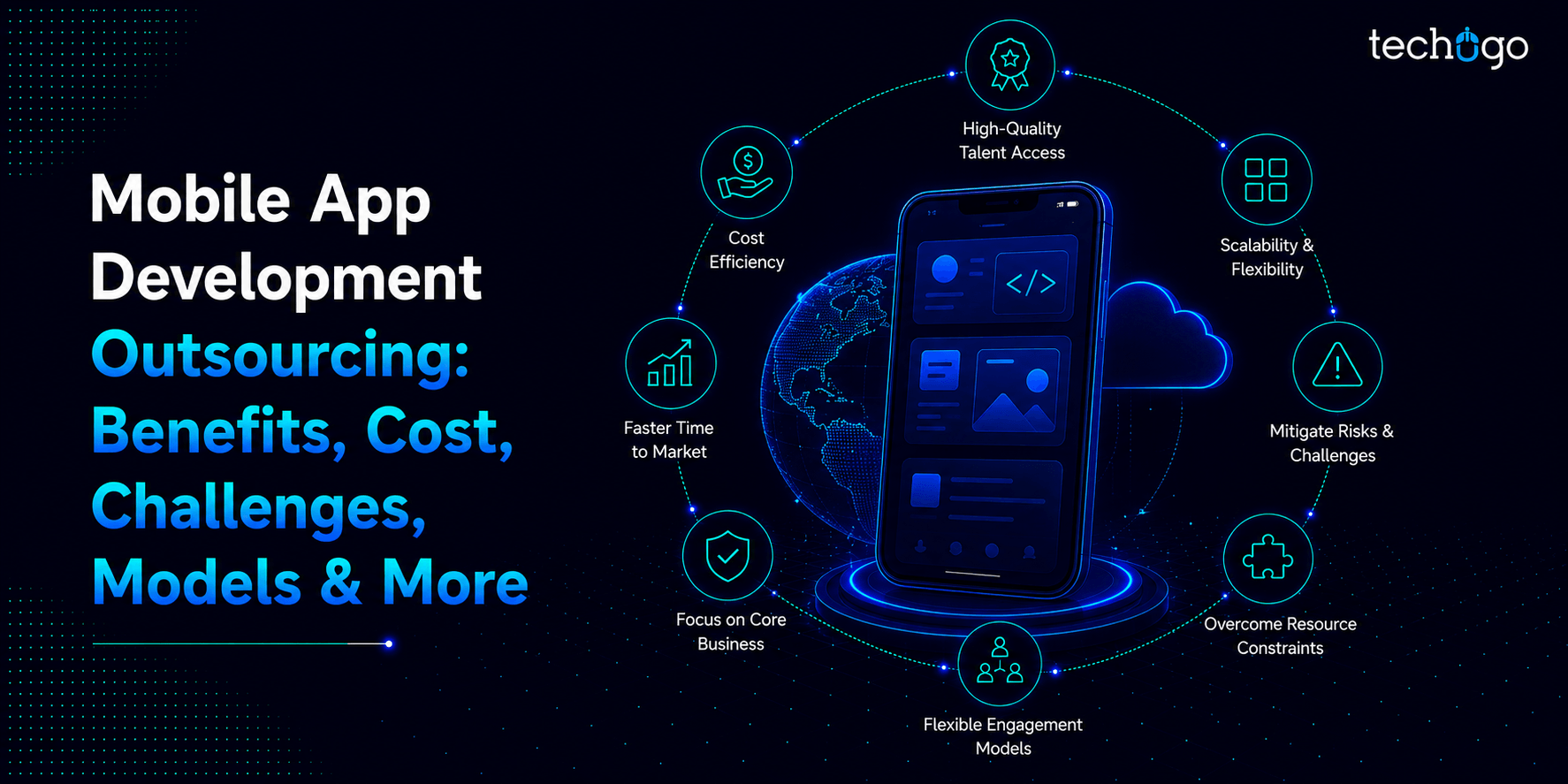
- Outsourcing mobile app development helps businesses save time, reduce costs, and access skilled talent without building an in-house team.
- The mobile app development cost varies widely based on complexity, features, and technology choices, so planning early is important.
- Choosing the right engagement model (fixed, dedicated, or time & material) directly impacts project flexibility and outcomes.
- Natural Language Processing (NLP) is enhancing user experience through smarter chatbots, search, and voice-based features.
The best apps aren’t always built by the people who dreamed them up.
That might sound counterintuitive, but it’s true – and a lot of successful companies have figured this out the hard way. Building an in-house dev team sounds great in theory. In practice?
It’s slow, expensive, and honestly kind of a gamble.
That’s where the decision to outsource mobile app development comes in.
More and more companies – startups trying to ship fast, enterprises trying to move like startups – are handing off their mobile app development to outside partners. Not because they gave up, but because they got smart. Why spend six months recruiting engineers, onboarding them, and hoping your team gels, when you could be working with people who’ve already built exactly what you’re trying to build?
The right outsourcing partner brings the expertise, the process, and the headcount without the overhead. You get speed. You get flexibility. You get people who’ve solved the problems you’re about to run into, before you even knew they existed.
So in this post, we’re getting into all of it: the real benefits of outsourcing mobile app development, what it actually costs, the pitfalls people fall into (and how to avoid them),how AI is quietly changing the whole game and more.
Let’s read…
Benefits of outsourcing mobile app development for businesses
Here’s the thing – when businesses decide to outsource mobile app development, they’re not just trying to save money. They’re trying to move smarter. And the ones who get it right? They’ll tell you it was one of the better calls they made.
Here is what businesses actually gain:
Access to specialized talent
Not generalists. Not someone who’s “pretty good with React Native.” We’re talking specialists – developers, designers, QA engineers – who’ve built products like yours before and have the scars to prove it. That kind of expertise is hard to hire for. It’s much easier to plug into.
Faster time to market
Hiring takes months. Onboarding takes more. By the time an in-house team is ready to ship, the market’s already moved. With mobile app development outsourcing, you skip all of that and work with a team that’s already in motion.
Significant cost savings
Full-time engineers are expensive – and that’s before you factor in benefits, equipment, and everything else that comes with a permanent hire. Outsourcing means you’re paying for great work, not maintaining a headcount.
Focus on what you do best
This one doesn’t get talked about enough. When the dev work is handled, your people stay in their lane – strategy, customers, growth. Nobody’s getting pulled in twelve directions trying to do everything at once.
Scalability on demand
Big launch coming? New market to crack? Good app development outsourcing services let you bring in more firepower exactly when you need it – and pull back when you don’t. That kind of flexibility is genuinely hard to build internally.
Reduced risk
Experienced outsourcing partners come with processes already baked in: QA, milestone reviews, accountability structures. Fewer surprises, more predictable outcomes. That matters more than most people realize until something goes wrong.
The benefits of outsourcing mobile app development go way beyond the obvious. Sure, you save money but what you’re really gaining is time you can’t get back, expertise you’d spend years building, and the kind of flexibility that lets you react to the market instead of just hoping you planned for it. That’s not an outsourcing decision. That’s a business advantage.
When should you outsource mobile app development?
Knowing when to outsource mobile app development can save you months of hiring headaches, blown budgets, and opportunities you’ll never get back. And honestly? It’s rarely about how big your company is. It comes down to one question: can your current team actually deliver this, fast enough and at the quality you need?
One of the most underrated mobile app development tips is to think about outsourcing early before hiring becomes the thing that’s slowing everything down.
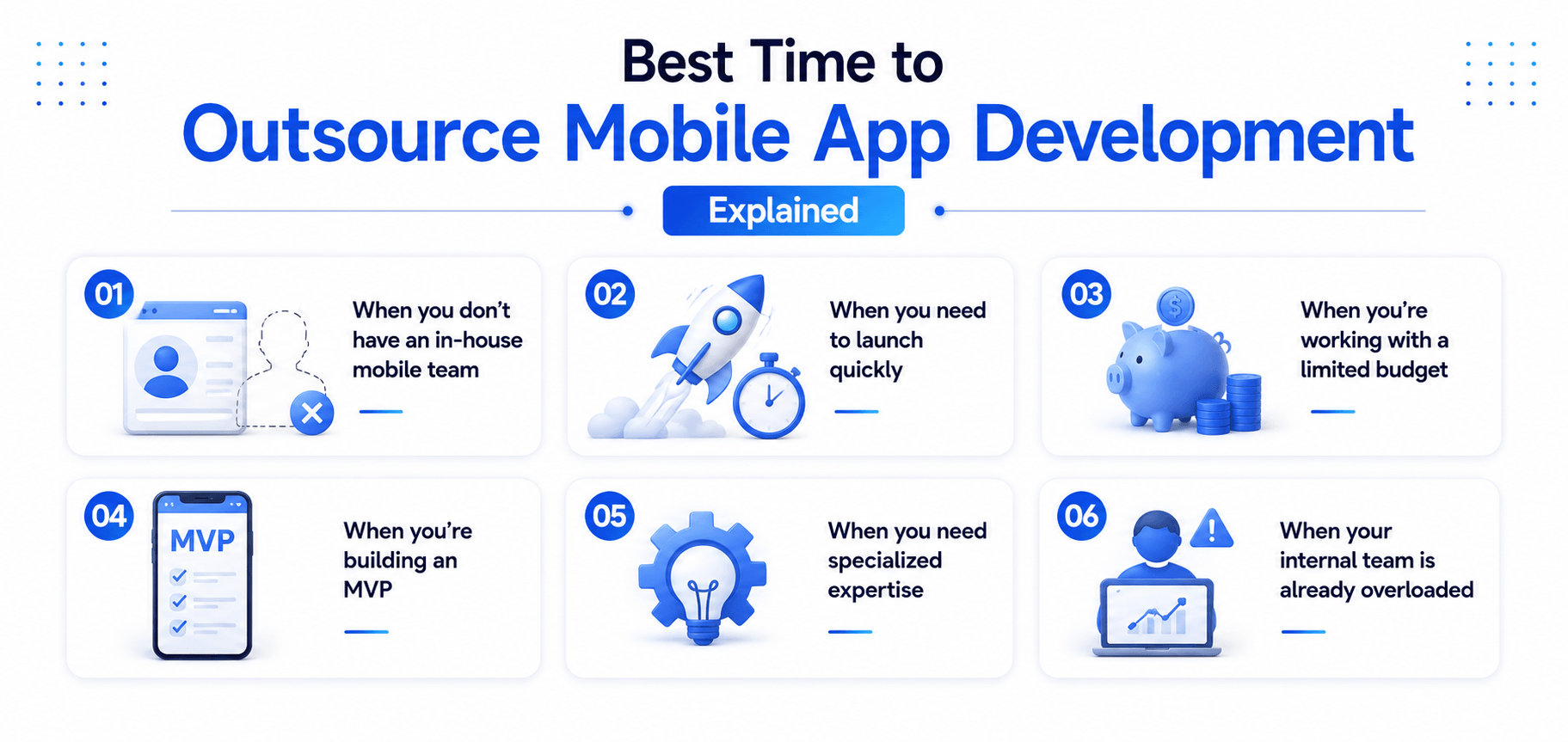
These are the situations where it makes sense:
When you don’t have an in-house mobile team
If your company doesn’t have experienced iOS, Android, or cross-platform developers, mobile app development outsourcing gets you in front of specialists immediately – no months-long hiring process, no onboarding lag, just people who can get to work.
When you need to launch quickly
Markets don’t wait. If competitors are already shipping, you can’t afford to spend three months building a team before a single line of code gets written. Outsourcing means you start now, not later.
When you’re working with a limited budget
Senior engineers are expensive. Add equipment, benefits, and everything else that comes with a full-time hire and it adds up fast. Outsourcing lets you pay for the work and the expertise (not the overhead that comes with carrying permanent headcount).
When you’re building an MVP
At the MVP stage, speed and learning are everything. You don’t need a big internal org – you need something real in users’ hands as quickly as possible so you can start getting feedback that actually means something.
Also Read – Understanding MVP App Development Costs
When you need specialized expertise
AI recommendations, real-time chat, payment integrations, complex cloud infrastructure – this stuff is hard, and not every team has people who’ve done it before. The right outsourcing partner fills those gaps without you having to go on a six-month talent hunt.
When your internal team is already overloaded
Sometimes it’s not about capability – it’s about capacity. Your team is heads-down on core products, operations, customer support. Outsourcing keeps that critical work moving without asking already-stretched people to take on even more.
Rule of thumb
If time-to-market, specialized skills, or hiring constraints are what’s blocking you – it’s probably time to seriously consider mobile app development outsourcing. The point was never to replace your internal team. It’s to give your business what it needs to launch, learn, and scale without waiting on things you can’t control.
Types of mobile app development outsourcing models
The following are some of the most common types of mobile app development outsourcing models used by businesses today –
- Onshore outsourcing: Basically teaming up with a dev team in your own country makes communication and day-to-day collaboration way easier since you’re not dealing with weird time gaps.
- Nearshore outsourcing: This is when you work with teams in nearby countries – similar time zones, similar culture, so things just sync up better without going full offshore.
- Offshore outsourcing: Hiring developers from far-off countries mainly to cut costs while still getting access to solid talent from around the world.
- Hybrid outsourcing: A mix of both – you keep some work in-house and bring in outside teams too, so you get more control plus extra flexibility and expertise when needed.
At the end of the day, picking the right model really comes down to how complex your project is, what your budget looks like, and how involved you actually want to be in the process.
Freelancers vs agencies: what should you choose for mobile app development outsourcing?
Once you’ve decided to outsource mobile app development, the next question hits pretty quickly – who do you actually trust with it? A freelancer? An agency? Both have their place, and honestly, picking the wrong one can cost you more than just money.
There’s no universal right answer. It really comes down to your budget, how complex the project is, your timeline and where you want this product to be a year from now.
Here’s how the two actually compare:
| Factor | Freelancers | Agencies |
| Cost | Usually lower upfront costs | Higher initial investment |
| Expertise | Typically specialized in one area | Access to developers, designers, QA engineers, and project managers |
| Scalability | Limited capacity | Can quickly scale resources as project needs grow |
| Project Management | Usually self-managed by the client | Dedicated project management and structured processes |
| Reliability | Depends on an individual | Backed by an entire team and established workflows |
| Communication | Direct communication with the developer | Organized communication through project leads |
| Speed of Delivery | May be slower for larger projects | Faster execution due to multiple specialists working together |
| Risk Management | Higher dependency on one person | Lower risk with team-based delivery and quality assurance |
| Long-Term Support | Can be inconsistent | Ongoing maintenance and support services are typically available |
| Best For | Small projects, prototypes, and short-term tasks | Complex applications, enterprise projects, and long-term development |
When to choose a freelancer
If you’re building something simple, testing an early idea, or genuinely working with a tight budget – a freelancer can absolutely work. The costs are lower, the setup is faster, and for straightforward projects, that’s often all you need.
When to choose an agency
If you’re building something that needs to scale, something business-critical, or something that requires designers, developers, and QA all pulling in the same direction – an agency is the safer bet. This is especially true for cross-platform app development outsourcing, where everything (development, testing, UI/UX, deployment) has to work seamlessly across multiple devices and operating systems. That’s not a one-person job.
At the end of the day, if the project is simple and budget is tight, a freelancer might be enough. But if you’re serious about building something that lasts… a complex product with real growth plans – an experienced agency will give you the reliability, the scalability, and the peace of mind that a solo hire just can’t.
Step-by-step mobile app development outsourcing process
Step 1. Define project requirements
Honestly, the first step is just sitting down and getting really clear on what you’re building – what’s the app actually supposed to do, who’s it for, what features do you really need versus what’s just nice to have. And don’t skip the budget and timeline talk either. The more you figure out upfront, the less stuff blows up later. It also makes it way easier to find a dev team that actually fits what you need.
Step 2. Select the right outsourcing partner
Take your time picking who you work with. Look at their past projects, see if their experience actually lines up with what you’re building, and don’t be afraid to ask for client references or read reviews. A good partner makes everything smoother – bad ones can turn into a nightmare real quick.
Step 3. Finalize the engagement model
Once you’ve picked a partner, you’ll need to figure out how you want to actually work together. Most companies go with either fixed-price, a dedicated team, or time-and-material – just depends on your budget and how much flexibility you want as things move along.
Step 4. Develop and test the application
This is where things really start moving. The team starts designing and building the app, and testing happens alongside that too. You’ll want to stay involved – regular updates, feedback, that kind of thing – so the final product actually turns out the way you imagined it.
Step 5. Launch and provide ongoing support
Once everything’s tested and ready to go, you launch. But that’s not really the finish line – apps need upkeep. Updates, bug fixes, monitoring how it’s performing… that stuff keeps it running well and competitive long after launch.
Mobile app development outsourcing cost breakdown
One of the first things businesses usually ask before they outsource mobile app development is pretty simple: how much is this actually going to cost?
Well… it depends. And that’s probably not the answer most people want to hear, but it’s true. Every app is different, so the cost can be very different too. A startup might only need a basic MVP with a few core features, while another business could be building a much larger platform with advanced integrations, security requirements, and a whole lot more going on. Because of that, there isn’t really a fixed price. Still, understanding what affects the cost can make budgeting a lot easier, and help you avoid surprises later on.
| App Complexity Level | Estimated Cost Range | Best For |
| Basic App Development | $30,000 – $60,000 | MVPs and startups validating a product idea quickly |
| Mid-Level App Development | $50,000 – $150,000 | Custom applications with unique features and integrations |
| Advanced Enterprise App Development | $150,000 – $300,000+ | Large-scale applications requiring advanced security, integrations, and scalability |
Factors that influence the app development outsourcing cost
The overall mobile app development cost depends on several things, not just the initial project scope. And honestly, that’s where a lot of businesses get caught off guard because what looks like a simple app at first can end up needing a lot more work than expected.
Project complexity
This is a big one. A simple MVP app development project, focused on just the essential features, will usually cost less. But once you start adding custom functionality, advanced workflows, integrations and extra features… the budget starts climbing pretty quickly. That’s just how it is.
Development approach
The technology stack matters too. For example, choosing between Flutter app development and react native app development can affect timelines, maintenance, and overall costs. One option might get you to market faster, but another could make more sense in the long run, so it really depends.
Scalability requirements
If you’re planning for growth, then you’ll probably need to invest more upfront. Better architecture, stronger performance, future-ready infrastructure – all of that takes extra time and effort. It costs more now, but it can save you headaches later.
Enterprise features
Enterprise mobile app development projects are usually more expensive, and for good reason. Security requirements, compliance standards, third-party integrations, large user bases, all of these things add complexity. And when complexity goes up, costs usually follow.
At the end of the day, there isn’t one number that works for every project. Some apps can be built relatively quickly, others take months and require much bigger teams.
So, while the ranges above can give you a good starting point, the final cost will always depend on what you’re building, how you’re building it, and where you want it to go in the future. Honestly, that’s what makes app development pricing a little tricky in the first place.
Challenges in mobile app development outsourcing & their solutions
When Businesses outsource mobile app development, it sounds pretty simple at first like you just hire a team and boom app is ready, but frankly it doesn’t really work like that.
These are some common problems that show up a lot, and if you don’t handle them properly, the whole project can go off track.
Finding the right development partner
This is probably the biggest headache. There are so many companies offering custom app development services, and almost all of them claim they are “the best”, so yeah it gets confusing real quick.
Solution: Don’t just trust words, check their actual work, past apps, case studies and stuff. And if you need multiple platforms, going with a proper cross platform app development company makes life easier because everything stays more organised instead of dealing with different teams.
Communication issues & expectations not matching
Even if the team is good, sometimes what you say and what they understand is not the same thing, and then the final output feels different from what you actually wanted.
Solution: Just be clear from day one, write things down properly, and keep checking updates regularly, because small misunderstandings early can turn into bigger issues later, therefore it’s better to stay involved a bit.
iOS and Android development together
Working on iOS App Development and Android app development together can get tricky because both platforms behave differently, and sometimes the same feature just doesn’t feel the same on both.
Solution: Plan it properly from the start and stick to one direction, because if you keep changing things again and again it just slows everything down and increases the effort for no reason.
At last, outsourcing works fine but only if you don’t just disappear after hiring the team, you need to stay in the loop or things can go sideways pretty fast.
How AI is transforming mobile app development outsourcing
AI is honestly changing how companies outsource mobile app development, because the whole process now feels way faster and less messy than before. Earlier, everything was manual – like every small thing had to be done step by step, but now with AI-driven app development, a lot of stuff like coding, testing, design ideas, and planning gets supported by AI tools, so things move quicker.
Idea → AI Research & Planning → UI/UX Suggestions → Faster Development → Automated Testing → Deployment & Optimization
So basically it’s not like AI is replacing developers or anything, but it’s just making the whole process smoother, and yes less time consuming too, therefore teams can focus on the actual logic instead of repeating boring tasks again and again.
- Faster coding with AI suggestions
- Early bug detection before final testing
- Better UI/UX ideas based on user data
- Faster project planning and estimation
- Less manual repetitive work overall
Because of all this, artificial intelligence app development is kind of becoming normal now in outsourcing projects.
An AI app development company these days works a bit differently too. It is not just pure manual coding, it also uses AI tools to improve speed, accuracy, and overall output quality, so projects get delivered in a better way.
So when businesses outsource mobile app development, going with teams that already use AI feels like a smarter move, because everything just runs more efficiently and with fewer issues.
Now coming to natural language processing (NLP), it is actually a big part of modern apps. NLP helps apps understand human language better, like chatbots, voice assistants, smart replies, search features and stuff like that. And yes NLP is not just a “feature thing”, it is actually becoming a core part of AI-driven app development, especially when apps need to talk or respond like real humans.
Mobile app development outsourcing trends to watch in 2026
The mobile app development space is changing fast, and it’s not slowing down anytime soon. New technologies, shifting business priorities, and rising user expectations are reshaping the way apps get built and outsourcing is right at the center of it all.
If you’re planning to outsource mobile app development anytime soon, it’s worth knowing what trends are actually shaping the industry right now.
So let’s break down what’s really driving change in 2026 – and why it matters for your next project.
Growing adoption of AI-powered development
AI tools aren’t some “nice extra” anymore – they’re showing up everywhere in development workflows. When businesses outsource mobile app development these days, they’re actively looking for partners who use AI for things like coding help, automated testing, planning out the project, and fine-tuning performance. It just makes everything faster and the end product better.
Greater demand for cross-platform development
Nobody wants to pay double to build separate apps for iOS and Android anymore. That’s why cross-platform frameworks keep growing in popularity… they let companies outsource mobile app development in a way that’s more cost-effective, while still giving users a smooth, consistent experience no matter what device they’re on.
Increased focus on cloud-native applications
As businesses look for apps that can actually scale, stay secure, and perform well under pressure, cloud-native development is becoming the go-to approach. Outsourcing partners who really know their way around cloud tech are expected to be in high demand all through 2026.
Stronger emphasis on cybersecurity
With data privacy laws tightening up and cyber threats getting smarter, security just can’t be an afterthought anymore. Businesses now expect their development partners to build security in from day one, not bolt it on at the end.
Rise of specialized outsourcing partners
Instead of going with a general, do-everything dev shop, a lot of businesses are now picking partners who specialize in their specific industry or niche. It just means faster execution and deeper expertise – instead of a generalist trying to figure things out as they go.
Different engagement models in app development outsourcing
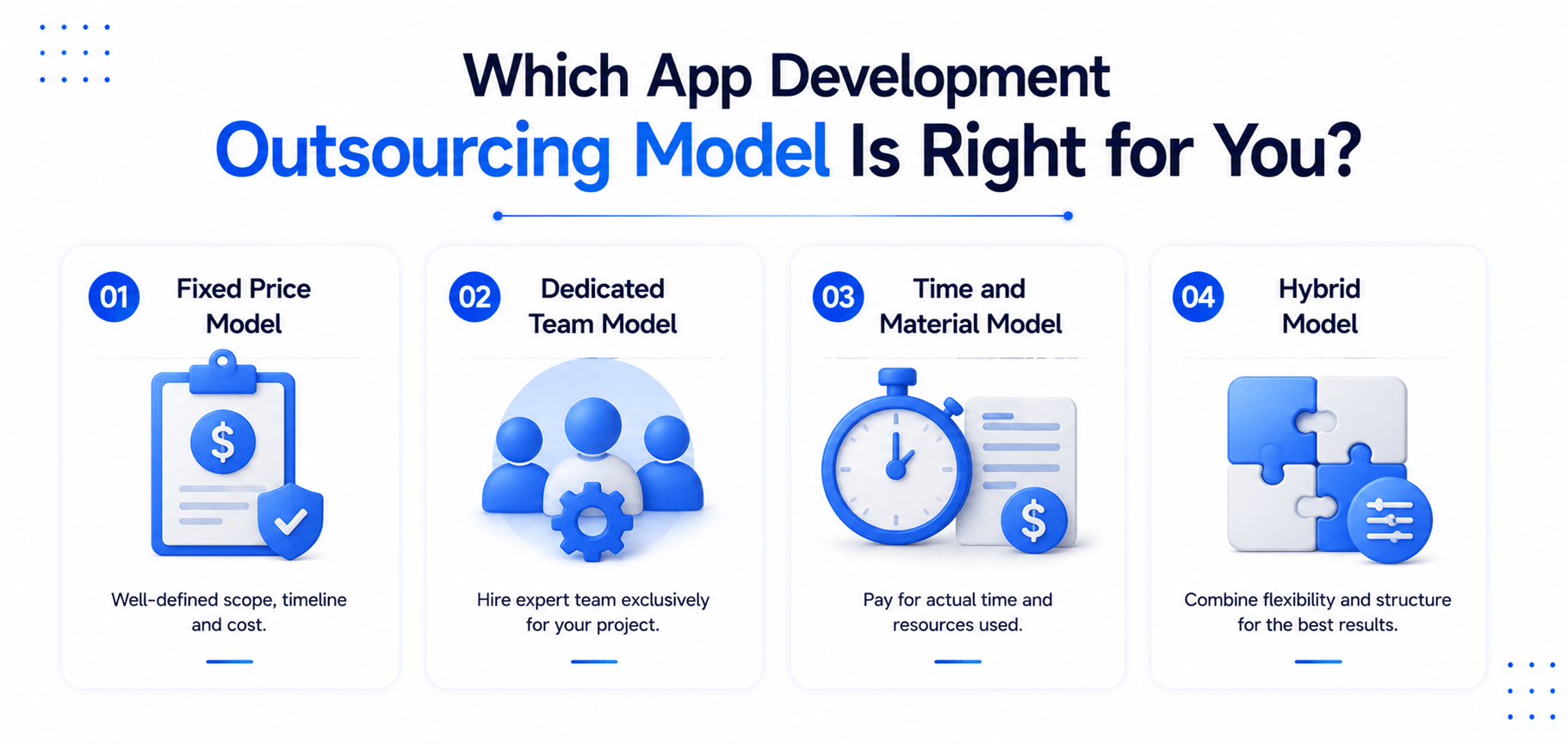
1. Fixed price model
This model is used when everything is clear from the start like scope, features, and timeline. The cost is fixed, so there are no surprises later.
It usually works well for smaller projects or early stage mobile app development outsourcing, where requirements don’t change much during the process.
2. Dedicated team model
Here, you basically get a full team working only on your project, almost like an extension of your own company.
This model is often used in custom app development services, especially when projects are long-term and keep evolving over time. It also works well when you need ongoing work in areas like native app development, where performance and platform-specific optimization matter a lot.
3. Time and material model
In this model, you pay based on actual time and work done, so it is more flexible compared to fixed pricing.
It is commonly used in cross-platform app development outsourcing, where requirements can change during development, and also in projects involving cloud app development, since cloud-based systems often need scaling, updates, and continuous improvements.
5. Hybrid Model
This is a mix of fixed price and flexible models, depending on what the project needs.
It is often used in complex builds where some parts are fixed but others evolve over time, especially in large-scale app development outsourcing projects, and sometimes mobile app development consulting is included here too to help guide decisions across both fixed and flexible phases.
How to pick the right mobile app development outsourcing partner for your business goals
Choosing the right team when you plan to outsource mobile app development is honestly one of the most important decisions, because the company you pick directly affects your app quality, timeline, and even long-term success. So it’s not just about cost, it’s more about trust, process, and how they actually work.
Check their portfolio & real work
First thing, always look at what they have already built. Not just screenshots, but real apps, case studies, and live projects. This gives you a clear idea of whether they can actually handle your type of product or not.
Understand their technical expertise
You should also check what technologies they are strong in. A good company will usually have experience in different areas like backend systems, UI/UX, and platforms such as iOS and Android. This is where most mobile app development tips usually point you, always match their skills with your project needs instead of just going by claims.
Communication and process
Even a skilled team can fail if communication is weak. So check how they share updates, how often they report progress, and how they handle feedback. Because in real projects, clear communication is what keeps everything on track.
Pricing transparency
Cost should always be clear from the beginning. If a company is not transparent about pricing, it usually leads to confusion later. When you outsource mobile app development, make sure you understand what is included and what is not.
Post launch support
The work doesn’t end after launch. Bugs, updates, and improvements will come later, so you need a team that stays available even after the app goes live.
This is why choosing the right mobile app development company is not just about who can build your app, but who can actually support your idea from start to finish.
Future of mobile app development outsourcing
A few years ago, outsourcing was largely seen as a way to reduce development costs.
Today, it’s becoming a growth strategy.
You’d hire an outside team, save some money, get your app built, and that was kind of the whole story. But that’s not really how things work anymore. These days, businesses don’t outsource mobile app development just to tick a box and get something shipped – they are doing it to actually move faster, tap into expertise they don’t have in-house, and stay ahead of the curve when it comes to innovation.
And looking ahead… this shift is only going to get bigger. Outsourcing partners are slowly moving away from being “just the vendor” and turning into actual collaborators. Instead of simply executing what they’re told, they’re getting pulled into bigger conversations – product planning, picking the right tech stack, even shaping long-term digital strategy. It’s less “build what we tell you” and more “help us figure out what we should be building.”
A big part of that comes down to how fast things are moving with AI, cloud tech, and cross-platform tools. None of that is slowing down anytime soon. And here’s the thing: the businesses that keep up won’t necessarily be the ones with the biggest in-house teams or the deepest pockets. It’ll be the ones who know how to bring in the right people, with the right skills, at exactly the right moment.
So really, when you zoom out, the future of outsourcing in mobile app development isn’t just about getting an app made anymore. It’s becoming something bigger than that – it’s about building real, lasting competitive advantage.
The companies that get this early are the ones who’ll end up ahead, while everyone else is still treating outsourcing like it’s 2015.
Techugo: your partner for efficient mobile app development outsourcing
If you are looking for a reliable mobile app development company, Techugo stands out as a globally trusted name focused on building scalable, high-performance digital products designed for real business impact.
From early-stage ideas to full-scale platforms, the focus is always on turning concepts into products that can handle growth, users, and long-term stability without breaking under pressure.
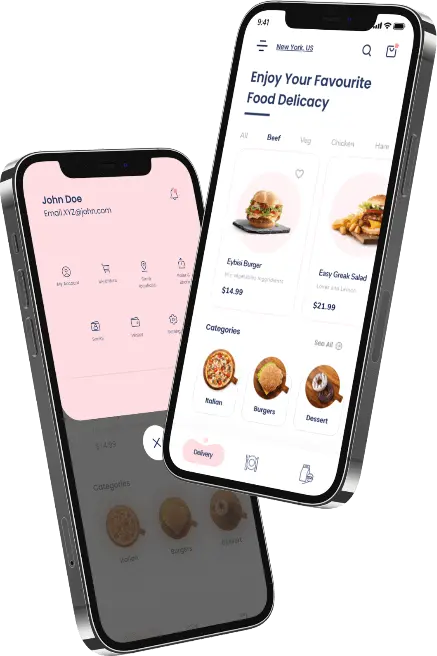
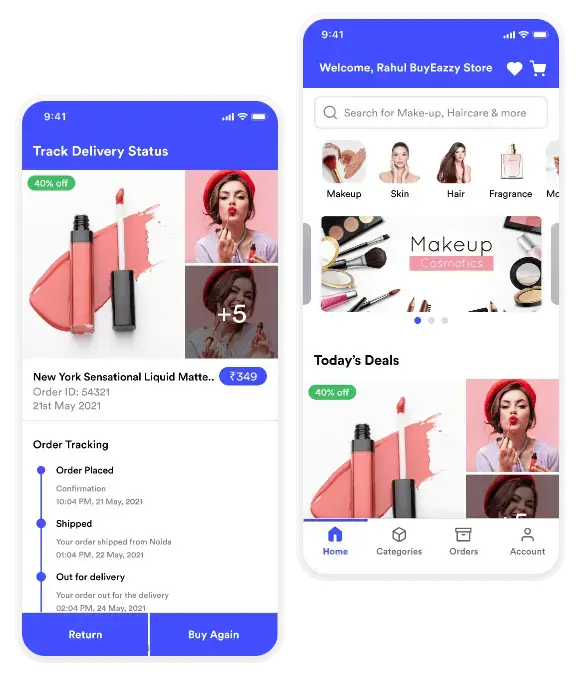
Techugo has worked with brands like JoshCam, MilkBun, Buyeazzy, and Nik Bakers, along with several other fast-growing businesses, helping them build mobile solutions that improve user experience and support real business expansion. These collaborations reflect a strong track record across different industries, with a focus on practical outcomes rather than just development output.
What makes Techugo different is not just development, but the way ideas are shaped into real digital experiences. It is less about “just building an app” and more about understanding what the product should become after launch, how it scales, how users interact with it, and how it performs in real-world usage.
Have a project in mind? Reach out to us anytime, we’ll help you build it.
FAQs
1. What is mobile app development outsourcing?
Mobile app development outsourcing is when a business hires an external team to design, build, and maintain their app instead of doing everything in-house.
2. Why should I outsource mobile app development?
You outsource mobile app development mainly to save time, reduce cost, and access skilled developers without hiring a full in-house team, which makes the whole process more flexible.
3. How much does mobile app development cost?
The mobile app development cost usually depends on complexity:
- Basic apps: $30,000 – $60,000
- Mid-level apps: $50,000 – $150,000
- Enterprise Mobile App Development: $150,000 – $300,000+
4. What technologies are used in mobile app development?
Common technologies include Flutter App Development, React Native App Development, Cloud App Development, and sometimes AI-based features depending on project needs.

Get in touch
We'd love to hear from you.