


 SA
SA
 KW
KW
 IE
IE AU
AU UAE
UAE UK
UK USA
USA
 CA
CA DE
DE
 QA
QA ZA
ZA
 BH
BH NL
NL
 MU
MU FR
FR

















📌 Key Takeaways
- Smart contracts can automate transactions and processes when predefined conditions are met.
- The cost of developing smart contracts may vary from $5,000 to over $150,000 according to the project requirements.
- Development timelines can range from 1–2 weeks for basic contracts to 8+ weeks for complex projects
- Security, testing and audits are important before deploying a smart contract.
A smart contract is basically a set of rules written into code. If these rules are met, then the contract can automatically execute the agreed action on a blockchain, without anyone having to manually trigger that action.
But for businesses, the actual deployment is just the beginning. There are many considerations when developing a smart contract, including selecting an appropriate blockchain, testing the code and ensuring it is secure against vulnerabilities.
In this guide, we’ll cover how smart contract development works, its business benefits, costs, security considerations, and key trends to know in 2026. We’ll also explain what to look for when choosing a development partner for your project.
What are the different types of smart contracts?
There are several types of smart contracts and each is designed for a different purpose. Some common types include:
1. Payment contracts – These automate payments once the agreed conditions are met.
2. Token contracts – These are used to create, issue and manage digital tokens on a blockchain.
3. Escrow contracts – These hold funds until all the agreed conditions are fulfilled.
4. Voting contracts – These can help manage voting processes and record votes on the blockchain.
5. NFT contracts – These handle the creation, ownership and transfer of digital assets.
6. dApp contracts – These support specific functions within decentralized applications.
Smart contract development use cases for businesses
Smart contracts can be used for more than just digital payments. Businesses can use smart contract development to automate processes where certain actions need to happen after specific conditions are met. This can include payments, approvals, ownership transfers, claims and other transactions.
With blockchain smart contract development, these rules are stored and executed on a blockchain, giving businesses a way to record transactions and automate agreed processes without relying on manual intervention at every step.
Some common use cases include:
1. Financial services: Automating payments, settlements, lending and other transactions.
2. Supply chain: Recording transactions and triggering payments when predefined delivery conditions are met.
3. Real estate: Supporting property transfers, payments and ownership records.
4. Insurance: Automating parts of the claims process when predefined conditions are verified.
5. E-commerce: Managing payments, refunds and agreements between different parties.
6. Digital assets: Creating and managing tokens, NFTs & other blockchain-based assets.
Taking it further, a blockchain app development company can also integrate smart contracts with wallets, applications, APIs – and other business systems to create a complete blockchain-based solution.
Get the Right Approach for Your Smart Contract Project
Plan your smart contract around your business requirements, security needs and long-term goals.
How to develop a smart contract: step-by-step process
Developing a smart contract involves several steps, from defining the contract rules to testing the code and deploying it on a blockchain. A clear process can help businesses build contracts that work as intended and fit their wider application.
1. Define the requirements
To begin with, it is essential to determine what the smart contract requires. One must identify the different parties involved, as well as the conditions that will activate the smart contract and what will take place if such conditions are met. This gives the development team clear specifications for the coding of the contract.
2. Choose the blockchain and tools
In this step, it is important to choose the blockchain network that you will utilize. Key considerations in this decision-making process include the costs of transacting in that network, its scalability and security & the tools available for smart contract programming.
3. Write and test the code
The development team can now start developing smart contracts based on the defined rules. The code should cover the required functions, permissions, transactions, and possible outcomes. Thorough testing should follow to identify coding errors and unexpected behaviour before deployment.
4. Review the contract for security
Security testing is an important part of smart contract development. The code should be reviewed for vulnerabilities, access control issues, and other potential risks. For contracts handling valuable assets or important business transactions, an independent security audit can provide an additional review.
5. Deploy and integrate
After testing and review, the smart contract can be deployed to the selected blockchain. It can then be connected with wallets, web or mobile applications, APIs, and other systems.
Once the contract is ready, smart contract application development solutions can help connect it with a complete blockchain-based application.
Which blockchain platforms can run smart contracts?
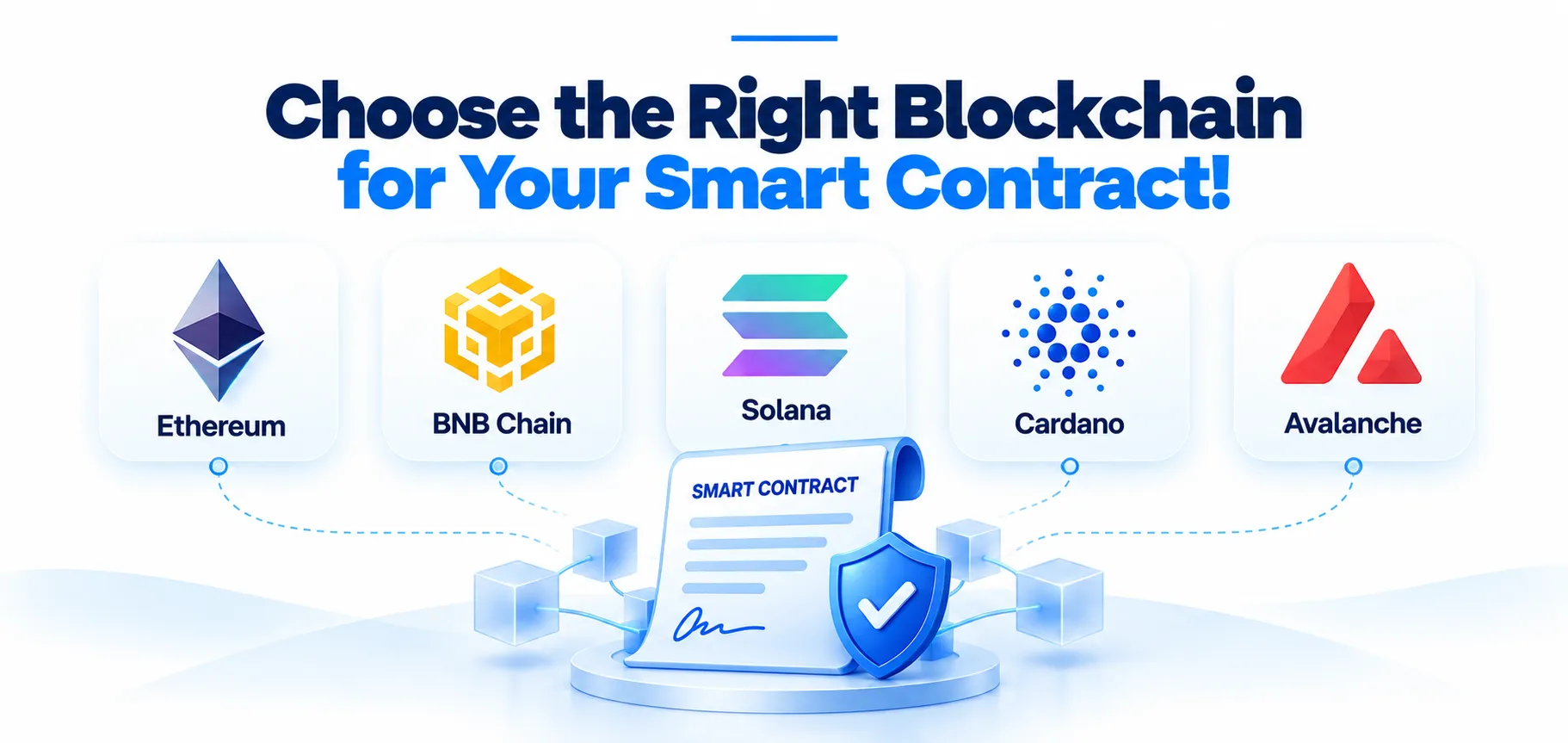
There are quite a few blockchain platforms that support smart contracts. The one you choose will depend on things like what you’re building, how many transactions you expect, your budget and, of course, the tools your development team prefers to work with.
Here are some of the commonly used options –
1. Ethereum – Ethereum is one of the most popular blockchains used for smart contracts. It has a thriving developer ecosystem and applications are being deployed, ranging from decentralized applications to digital assets and financial applications.
2. BNB Chain – BNB Chain supports smart contracts and works with many of the tools used for Ethereum development. It is commonly used for decentralized applications, digital assets and blockchain-based transactions.
3. Solana – Solana is known for handling a high number of transactions while keeping fees relatively low. It is used for smart contracts, decentralized apps, digital assets & other blockchain projects.
4. Cardano – Cardano supports smart contracts and can be used to build decentralized applications and automate blockchain-based processes. Cardano smart contracts are also used for managing digital assets and transactions.
5. Avalanche – Avalanche is a smart contract platform that is compatible with Ethereum development tools. It can be utilized for decentralized applications, financial services and other blockchain options.
You don’t necessarily have to choose a blockchain based on popularity alone. Transaction costs, scalability, security, available tools, and your application requirements all matter. A blockchain smart contract development company can help you compare these factors and choose a suitable network before starting smart contract application development.
How much does smart contract development cost in 2026?
The expenses related to creating a smart contract can vary depending on the requirements, although a lot depends on the complexity of the project.
This is also why the pricing you see from top smart contract development companies can differ significantly.
Here’s a general breakdown of smart contract development costs:
| Smart contract type | Typical features | Estimated cost |
| Basic | Simple token, escrow, basic NFT contract | $5,000–$15,000 |
| Standard | Multi-function contract, staking, DAO features | $15,000–$40,000 |
| Advanced | DeFi, cross-chain functionality, complex integrations | $40,000–$100,000 |
| Enterprise | Multiple contracts, advanced integrations, extensive security requirements | $100,000–$150,000+ |
How long does it take to develop a smart contract?
The time required to develop a smart contract depends on its complexity, features and testing requirements. Here’s a general estimate of how long different types of smart contracts may take to develop:
| Smart contract type | Estimated development time |
| Basic | 1–2 weeks |
| Medium complexity | 2–4 weeks |
| Complex | 4–8+ weeks |
| Enterprise-level | 8+ weeks |
Key benefits of smart contracts for businesses
1. Automate routine processes
When certain conditions are fulfilled, smart contracts are able to carry out specified actions automatically. A smart contract development service provider can guide businesses through recognizing functions to automate and creating contracts compliant with their particular needs.
2. Reduce transaction time
Once the required conditions are fulfilled, a smart contract can execute the agreed action without waiting for additional manual processing. This can help businesses complete transactions faster and improve overall process efficiency.
3. Improve transparency
Smart contract terms and transaction records can be stored on the blockchain, making them easier for relevant parties to verify and track. Smart contract consulting services can help businesses understand where this approach fits into their existing processes.
4. Reduce operational costs
By automating repetitive processes and reducing reliance on intermediaries, smart contracts can help businesses manage some transaction and administrative costs more efficiently.
5. Strengthen security
Smart contracts use blockchain technology & predefined rules to execute transactions. When properly developed and tested, they can help reduce certain risks associated with manual processes. Businesses can also use DeFi Development Services to build smart contracts for decentralized finance applications.
6. Support accurate execution
Because the contract follows predefined conditions, the agreed actions can be carried out consistently once those conditions are met.
Automate routine tasks, reduce manual processing and make business transactions more efficient.
Want to Get More From Smart Contract Development?
Challenges to consider before developing a smart contract
Before you start developing a smart contract, there are a few things worth considering. Security, development costs, blockchain selection and the complexity of the contract can all affect the development process and final outcome.
Take a look:
1. Security vulnerabilities
A small error in a smart contract can affect how it handles transactions or digital assets. Proper testing and security audits are important before deployment. Businesses using custom smart contract development services can also have the contract designed around their specific security requirements.
2. Complex development requirements
As the number of functions/integrations increases, smart contracts can get harder to create. Before you create your own smart contract, it’s essential to define the purpose and requirements of your contract.
3. High deployment costs
The development and deployment of a smart contract can have different costs based on the complexity of the contract and the network that is being used. The development, testing, auditing and deployment costs should be taken into consideration by businesses in planning the project.
4. Limited flexibility after deployment
Once a smart contract is deployed, changing its code may not be straightforward. This makes proper planning and testing important before going live (especially for projects that may need to integrate with other blockchain applications).
5. Choosing the right blockchain
Different blockchain networks have different transaction speeds, fees and technical requirements. The right choice depends on how the smart contract will be used. For example, businesses working on cryptocurrency exchange development may need to consider the network’s transaction capacity, security and compatibility with other exchange components.
Future trends that will influence smart contract development
1. Greater use of AI in smart contracts
AI may increasingly be used alongside smart contracts to analyse data, identify patterns and support automated decision-making. This might lead to new use cases for smart contracts in finance, supply chains and other sectors.
2. More focus on smart contract security
As smart contracts are used for more valuable transactions, security will become even more important. Better testing tools, automated code checks & thorough audits can help developers spot potential issues before the contract goes live.
3. Growth of DeFi applications
The continued development of decentralized finance can create demand for smart contracts that support lending, borrowing, trading and other financial services. This may also increase the need for smart contract services that can handle more complex DeFi use cases.
4. Cross-chain smart contracts
As businesses use multiple blockchain networks, there may be greater demand for smart contracts that can work across different ecosystems. This can make interoperability an important area of development in the coming years.
5. More business-focused use cases
Smart contracts are likely to move beyond cryptocurrency-related applications as businesses explore their use in areas such as supply chain management, digital identity, payments and agreements. This could lead to smart contract development solutions in areas such as NFT marketplace development, built to meet specific business needs.
AI use cases in smart contract development
AI can be used in different parts of smart contract development, from writing and checking code to analysing blockchain data. It can also help businesses automate certain processes and identify unusual activity.
Some common AI use cases in smart contract development include –
1. Code generation and review: AI tools can help developers write smart contract code, review it – and spot possible improvements.
2. Security checks: AI assesses code to discover potential weaknesses in smart contracts prior to their implementation.
3. Blockchain data analysis: AI processes vast quantities of blockchain information to identify trends and gain useful information.
4. Fraud detection: AI watches transactions in order to recognize irregular behaviour.
5. Automation of decision-making: AI works alongside smart contracts in order to activate a process depending on the situation and the established criteria.
How to choose the best smart contract development company
1. Check their experience
Look at the company’s previous smart contract projects and experience with similar blockchain applications. If you are planning cryptocurrency wallet development, make sure the team understands wallet security, blockchain integrations and transaction handling.
2. Review their technical expertise
Investigate the experience of the development team when it comes to the blockchain network, coding languages and tools required for the project. Their experience with DeFi, NFTs, token development or other blockchain applications can also be useful.
3. Consider security practices
Ask about their testing process, code reviews and smart contract audits. Before you hire a smart contract development company, also compare their pricing, development timeline, communication process & post-development support.
Build your smart contract with Techugo
Techugo provides assistance in creating smart contracts for your business. Our support starts with defining the contract requirements and continues through the development process. As a top-tier mobile app development company, we also work with blockchain technology to develop smart contract solutions that are secure and reliable for different business needs.
Stop putting your smart contract project on hold. Share your business requirements with us and let’s get started!
FAQs
Q. What is smart contract development?
Smart contract development involves creating blockchain-based programs that automatically execute predefined actions when specific conditions are met.
Q. How much does it cost to develop a smart contract?
Smart contract development can cost around $5,000 to $150,000+. However, the price can change based on complexity, features, blockchain network, testing and security requirements.
Q. How long does it take to develop a smart contract?
A basic contract may take 1 to 2 weeks, while medium-complexity contracts can take 2–4 weeks. Complex or enterprise-level contracts may take 4–8+ weeks.
Q. How can I choose a smart contract development company?
Look at the previous blockchain projects, technical expertise, security practices, development process and post-development support of the best smart contract development companies. Also compare their pricing before making a decision.
Q. What Are the Different Types of Smart Contracts?
The main types of smart contracts include smart legal contracts, application logic contracts, token contracts, decentralized finance (DeFi) contracts, and DAO contracts. Each type serves a different purpose, from automating legal agreements and token transactions to managing decentralized applications, financial services, and autonomous organizations.

Get in touch
We'd love to hear from you.