

 SA
SA  KW
KW  IE
IE AU
AU UAE
UAE UK
UK USA
USA  CA
CA DE
DE  QA
QA ZA
ZA  BH
BH NL
NL  MU
MU FR
FR 

















📌 Key Takeaways
- Realistically, software development costs range from $25,000 to $100,000.
- Your features, technology stack, development team, and integrations will have the biggest impact on the final cost.
- Choosing the right pricing model and creating an accurate software development cost estimation can help you avoid unexpected expenses.
- If your project qualifies, capitalizing software development costs can improve your financial reporting.
Every business (and yours is probably no different) reaches a point where off-the-shelf software just isn’t enough. And it’s because it was not built for you. Maybe your team is juggling manual processes or your customers expect more than what you’re giving them. Sometimes your operations have just outgrown the tools you were using. So that’s where custom software comes in.
Now before you start planning your project, you might have this question in your mind –
“How much does software development cost?”
We have the answer.
In this guide, you’ll find the real software development costs, plus we will break down the factors that affect them, the hidden costs, models and everything else you need to know as a business investing in custom software so that you know exactly what you’re getting into – before you invest.
Software development cost estimation for 2026: what should you expect to pay?
Below is the software development cost breakdown you are looking for –
Estimated cost of software development in 2026
| Project Type | Estimated Cost |
| MVP or Basic Software | $25,000–$40,000 |
| Mid-Size Business Software | $40,000–$70,000 |
| Enterprise Software | $70,000–$100,000+ |
What does this mean for you?
It means your average custom software development cost is between $25,000 and $100,000+.
1. If you’re just starting out and want to test your idea – expect to invest $25,000 – $40,000 in an MVP.
2. If you’re already running a growing business that needs something more capable, budget for $40,000 – $70,000.
3. And if you are an enterprise with complex needs (AI, integrations, heavy security) plan for $70,000 – $100,000 or more.
All three work as long as you have the right dev partner by your side, and a clear picture of the cost of software development before you commit.
This is why software development cost estimation matters. You don’t want to be halfway through a project and then realize your project has gone over budget because there is no one accountable for integrations or scaling needs. A proper estimate saves you from that.
Pro tip: Work with a software development consulting company that has good experience. They’ll assess what you actually need, point you toward the right tech, figure out the scope and hand you a number you can trust (before development starts).
Factors affecting software development cost
So what actually drives the average cost of custom software development? It’s not just about how many features you want. A lot goes into it, from how complex your idea is to the tech needed to build it. Two businesses can want similar software and still end up paying totally different amounts, because their users, requirements, and long-term goals aren’t the same.
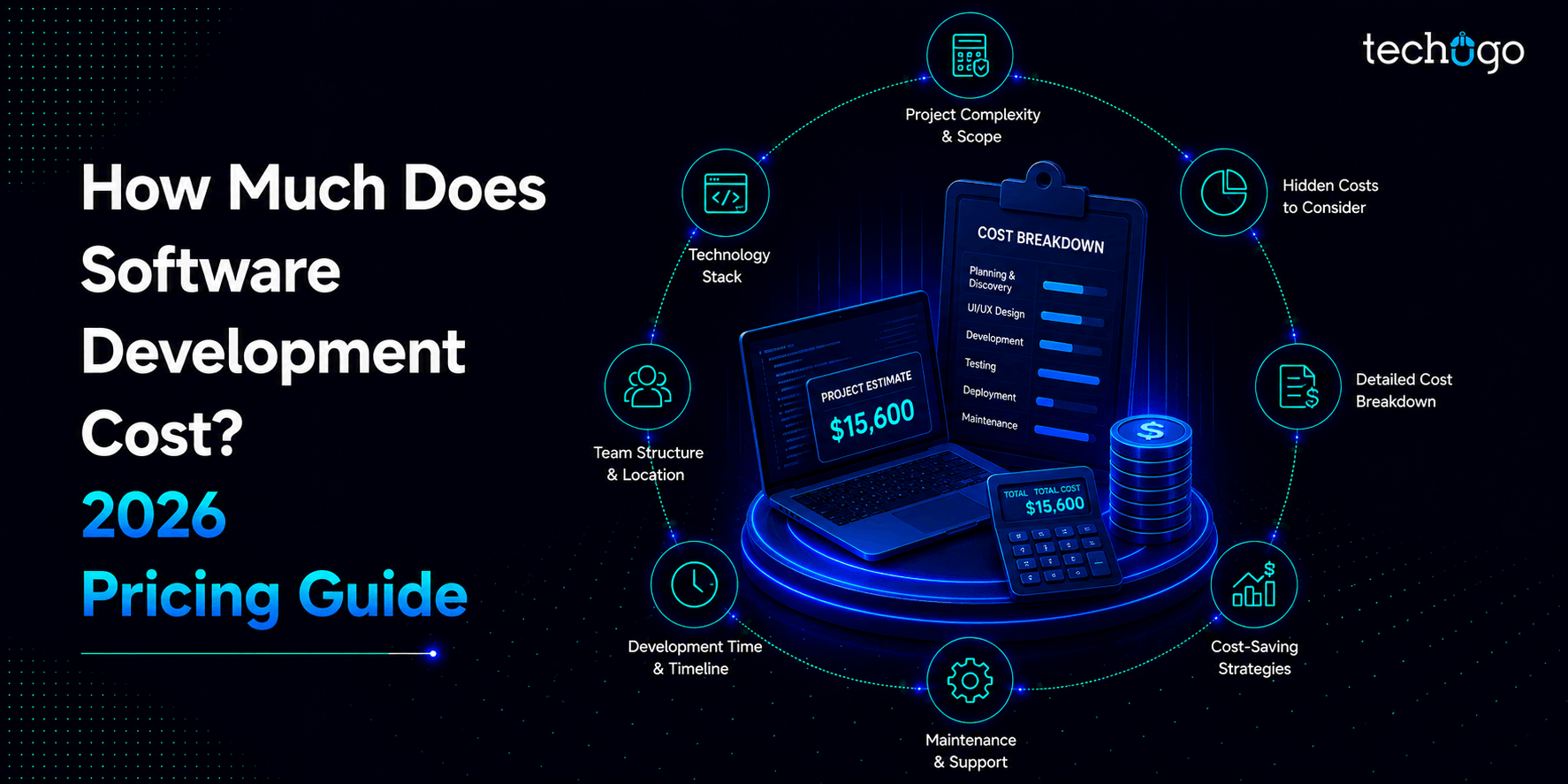
If you’re wondering how much does it cost to develop software, here are the biggest custom software development cost factors:
1. Complexity and scope – more moving parts means more time and money.
2. Features – every feature you add, from payments to AI, adds to the bill.
3. UI/UX design – simple interfaces cost less; custom experiences cost more.
4. Tech stack – your choice of languages, frameworks & cloud tools matters.
5. Integrations – connecting to CRMs, APIs, or payment gateways takes extra work.
6. Security and compliance – non-negotiable if you’re handling sensitive data.
7. Your dev team – in-house, freelance, or agency, rates vary a lot.
8. Scalability – building for growth now saves you a rebuild later.
9. AI and emerging tech – powerful, but it comes with specialized costs.
All of this will add up to your final cost to develop software – and knowing these factors ahead of time helps you plan smarter.
Build vs buy software development costs, benefits, risks
1. Build custom software
Building your own software from scratch means you get to shape it exactly around how your business runs.
Yes, custom software development costs are higher going in, but over time you’re not stuck paying for features you’ll never need, and you’re definitely not locked into someone else’s licensing model.
A lot of companies get around the sticker shock by teaming up with offshore developers. If you find the right partner, you can bring down your offshore software development cost quite a bit without sacrificing quality.
You just have to be picky about who you work with.
Benefits
- Built around your actual workflows
- Scales and adapts as you grow
- You control security, integrations, updates
- No waiting on a vendor’s roadmap
Risks
- Bigger upfront investment
- Takes longer to build
- You own the maintenance long-term
2. Buy off-the-shelf software
Buying something ready-made is the fast lane. It’s already built, so you’re up and running quickly, and it usually costs less to start.
The catch? It wasn’t built for you specifically.
As you scale, you’ll likely run into walls around customization and integrations, and those subscription fees add up.
Benefits
- Cheaper to start
- Quick to deploy
- Vendor handles the upkeep
- Already proven, low setup effort
Risks
- Limited flexibility
- Recurring costs that creep up
- May not play nice with your other systems
- You’re dependent on the vendor’s timeline
So which one’s right for you?
Time to decide!
But before deciding, it really pays to sit down and do some honest estimating software development costs. Not just sticker price, but timeline, team, and long-term upkeep. If your business runs a little differently than most, custom is usually worth it. If your needs are pretty standard, buying off-the-shelf will get you moving faster. Choice is yours.
The hidden cost of custom software development: what businesses miss
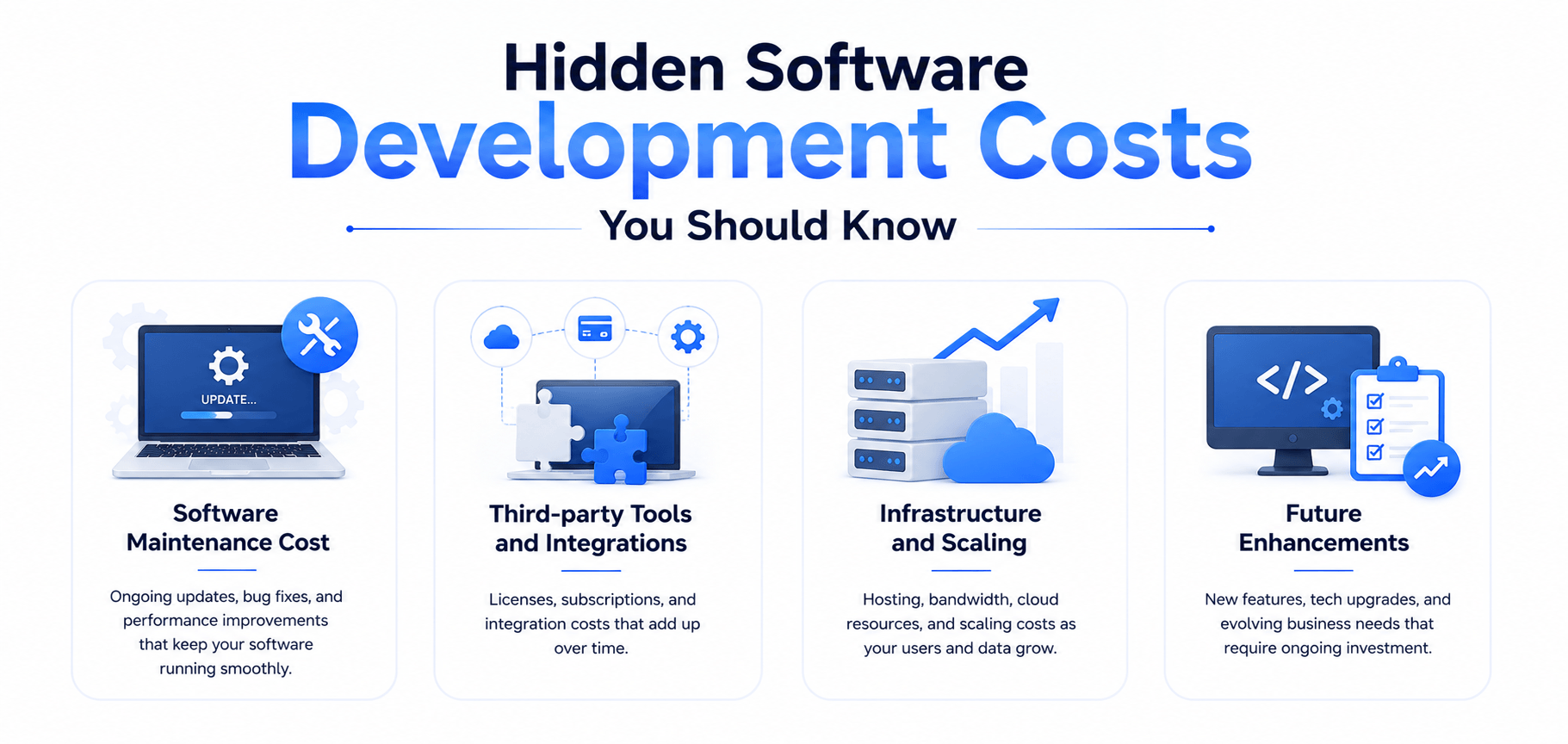
1. Software maintenance cost
Launching is not the ultimate. In fact, the start of ongoing work. Bug fixes, security patches, and performance upgrades – all fall under software maintenance cost, and skipping them just means paying more later.
2. Third-party tools and integrations
Payment gateways, CRMs, analytics – most apps need a few of these to function. They’re useful, but the licensing fees and API charges add up over time, and people often forget to budget for that.
3. Infrastructure and scaling
More users means more hosting, storage & server power. This is often underestimated, particularly in projects with a higher enterprise software development cost, where bigger infrastructure and stronger security just come with the territory.
4. Future enhancements
Software needs to grow with the business. Take custom LMS software development for example, most start with basic learning features, then later add things like AI recommendations or reporting, which adds to the cost over time.
How to estimate software development cost (step-by-step)
Step 1: Define your project requirements
First things first – get clear on your business goals, target users, must-have features, integrations, and timeline. The more defined your scope, the easier and more accurate your cost estimation for software development becomes.
Step 2: Calculate the development effort
One of the easiest methods for software development cost calculation is figuring out total hours needed – design, development, testing, deployment, project management.
Software Development Cost = Total Development Hours × Hourly Rate
So say your project needs 1,000 hours at $30/hour – your estimated cost would be $30,000.
Step 3: Use a bottom-up estimation approach
Out of all the software development cost estimation methods out there, bottom-up tends to be the most reliable. Instead of guessing at the whole project cost, break it down – module by module, feature by feature. Then add it all up.
Step 4: Account for additional costs
Don’t forget hosting, APIs, licenses, maintenance, and future updates. These ongoing costs matter just as much as development itself when you’re looking at the real average cost of software development.
Following this process would give you a realistic budget and keeps your project on track long after launch.
Software development pricing models & cost trends
1. Fixed price
This one works best when you already know what you need exactly – clear requirements, set timeline, defined deliverables. You’ll know the total cost upfront, which is nice, but if you want changes mid-way, expect the budget and timeline to shift too.
2. Time and material
Here, you pay for actual hours worked and resources used. It’s a good pick for projects that keep evolving, since you get flexibility and only pay for what’s actually done.
3. Dedicated development team
With this setup, you get a team working solely on your project for a fixed monthly rate. Great for long-term work, enterprise-level software or anything needing continuous development and maintenance.
When picking among these pricing models for software development, it depends on your project type – and figuring out the best custom software development pricing models for your business usually means comparing flexibility against predictability.
Current cost trends in software development
Some of the latest trends in software development influencing costs in 2026 are:
1. AI adoption – it is pushing budgets up as businesses add smarter features
2. Cloud-native apps remain in high demand
3. Offshore software development is still a go-to for cutting costs while accessing skilled talent
4. Compliance and cybersecurity need bigger investment (especially in regulated industries)
5. Low-code and AI tools are helping teams move faster
6. Even SaaS app development cost is shifting as businesses lean more into subscription-based, scalable models
How AI influences custom software development cost
1. AI features can increase development costs
If you decide to add features like machine learning models, chatbots, predictive analytics, or automation, it would extend your budget. For this, you will need specialized skills, solid data, strong infrastructure and constant fine-tuning. All of this adds to the AI software development cost.
2. AI can reduce development time and expenses
That said, AI coding assistants, automated testing, and smarter workflows can actually speed things up and boost productivity, which helps bring timelines and costs back down.
3. Factors that impact AI development costs
Now let’s talk about the final cost. It basically depends on how complex the AI features are, what data you need, integrations, security, and of course the ongoing maintenance cost.
Interestingly, many businesses are also comparing the cost of outsourcing software development to see if it works out cheaper than building an in-house AI team.
Capitalized vs. Expensed software development costs
All software development costs don’t get treated the same way when it comes to accounting. Some can be capitalized (basically recorded as an asset and recognized gradually over time) while others need to be expensed right away, meaning they hit your books as a cost the moment they happen.
| Category | Capitalized Software Development Costs | Expensed Software Development Costs |
| Meaning | Costs recorded as an asset since they’re expected to bring value down the line. | Costs recorded immediately since they don’t really create a lasting asset. |
| When Recognized | Usually kicks in for eligible development work once certain criteria are met. | Usually applies to research, planning, maintenance, and everyday ongoing work. |
| Examples | Coding, development, testing, and implementation costs for software projects that qualify. | Initial research, feasibility studies, training, bug fixes, routine maintenance. |
| Financial Impact | Costs get amortized over the software’s useful life. | Costs cut into your current-period income right away. |
Getting a handle on capitalization of software development costs can make a great difference in how healthy your financials look on paper.
Benefits of capitalizing software development costs
1. Improved financial reporting
Capitalizing software development costs basically means you’re not dumping all your expenses on one quarter’s books – you spread them out to match when the software starts making a return.
2. Better cash flow and profitability
It reduces upfront costs, enhancing short-term profitability. By the way, this is one of the key benefits of capitalizing software development costs.
3. Stronger budgeting and cost management
Tracking qualifying costs demands better documentation, improving visibility into spending and estimates.
4. Increased business value
Capitalized software becomes a balance sheet asset and it strengthens your company’s financial position.
5. Supports long-term technology planning
Pairing software development cost capitalization with a smart software development process helps you plan upgrades and maximize ROI.
How to reduce software development costs without compromising quality
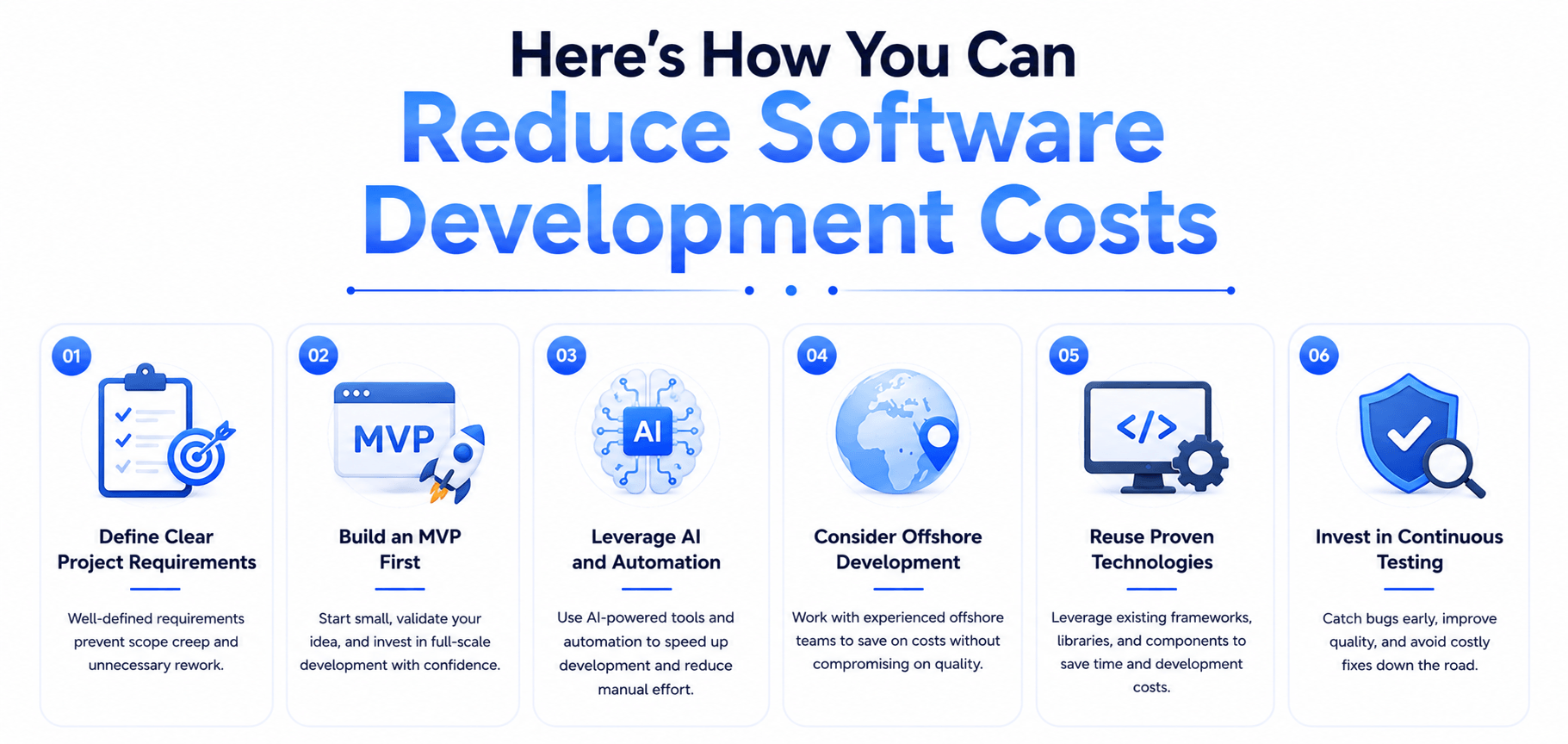
1. Define clear project requirements
This one sounds obvious, but it’s where most projects go sideways. If you don’t map out your goals, features, and timeline before you start, cost estimation for software development project becomes unreliable and scope creep will eat your budget alive. .
2. Build an MVP first
Haste makes waste. So do not try to build everything on day one. Trust me, get the core features out the door first, see what your actual users think, and build from there.
3. Leverage AI and automation
AI coding assistants and automated testing genuinely save time now. It’s not the hype you think it is because it actually helps teams ship faster and spend less without sacrificing quality.
4. Consider offshore development
Worth doing the math here. Comparing the cost of offshore software development against hiring locally can open up real savings, as long as you’re careful about who you partner with.
5. Reuse proven technologies
Why reinvent the wheel? Frameworks, APIs, and existing components save time and money – this matters a lot when you’re watching mobile app development cost closely.
6. Invest in continuous testing
Catching bugs is a part of continuous testing. And investing in it is always cheaper than fixing them later. The earlier you know this, the better.
How Techugo helps you optimize your software development budget
At Techugo, we genuinely believe good software shouldn’t cost you more than it needs to, you should get long-term value without the unnecessary price tag. As a prominent mobile app development company, our whole approach is about helping businesses figure out the right scope, pick a development path that actually makes financial sense, and build something scalable that fits where they’re headed.
We’ve been doing this for over 10 years now, and between our agile practices, AI-powered workflows, and a very skilled team, we’re able to keep both timelines and budgets in check – without making you sacrifice quality anywhere along the way. Whether it’s calculating accurate cost estimates from the beginning, designing the UI/UX, building and testing the product, or sticking around for support after launch – we’re with you through the entire process.
So if you’re planning your next software project, let’s talk. Techugo will help you build the right solution without overspending.
Conclusion
Software development is not cheap. It doesn’t have to drain your budget either. The key is knowing where to invest, where to save and choosing a development partner that understands your goals. If you’ve been wondering how much does it cost for software development, the range is – $25,000 – $100,000. But remember that it can exceed. This range is based on what you are building so plan carefully, and if you do so… you will end up with software that delivers value long after it’s launched.
FAQs
1. How much does custom software development cost?
In 2026, most custom software development projects fall between $25,000 and $100,000+, with the final cost varying based on your features, project complexity – and business goals.
2. What factors affect the cost of software development?
The biggest factors are your project’s scope, the features you need, the technology used, your development team, and whether you need ongoing maintenance.
3. How can I estimate a software development project cost?
Start by outlining your requirements and must-have features. Then, work with a software development company to get a realistic estimate.
4. Is offshore software development cost-effective?
Yes, it often is. Offshore development can help you reduce costs while still giving you access to experienced developers.

Get in touch
We'd love to hear from you.