

 SA
SA  KW
KW  IE
IE AU
AU UAE
UAE UK
UK USA
USA  CA
CA DE
DE  QA
QA ZA
ZA  BH
BH NL
NL  MU
MU FR
FR 















📌 Key Takeaways
- A custom LMS gives you the freedom to build a platform around your business.
- Good planning, the right features and smooth integrations matter just as much as the development itself.
- LMS development costs vary widely, so the final budget depends on what you actually need.
- AI is now becoming a standard part of modern LMS platforms rather than an optional feature.
- A well-built custom LMS is easier to scale, easier to maintain and far more flexible than most off-the-shelf solutions.
Businesses tend to outgrow off-the-shelf learning platforms sooner than they expect.
Reasons being:
- limited customization
- unnecessary features
- and integration challenges
And these can make employee training harder instead of easier.
Solution? Custom LMS software development. So instead of bending your training programs to fit a generic platform, you build one around your actual goals, workflows, and the people who’ll be using it every day. Onboarding, compliance training, customer education – whatever the use case, a custom LLM gives you the flexibility to do things your way.
If we look at the stats, North America accounted for over 36.9% of the global corporate LMS market in 2024 and made it the largest regional market. (Source: Grand View Research)
Well, there’s still a lot to look at.
So we’ll cover everything you need to know about LMS software development in this guide – from features, the cost and development process to implementation.
Why businesses choose custom LMS software development over off-the-shelf platforms
Below is why businesses’ first choice is custom LMS software development –
- It’s built around your business (your team isn’t stuck adapting to some generic platform’s idea of how training should work).
- You get the flexibility to add features of your choice.
- Integration gets a lot easier! HRMS, CRM, ERP, payroll and the third-party tools you’re already running.
- It scales properly as your team grows, new training programs get added and user numbers climb.
- Security and compliance hold up better too, with role-based access, data encryption & the industry-specific regulations you’re working under.
- You get to personalize the learning experience (includes – AI, adaptive learning paths, custom dashboards).
- And maybe most importantly, you own the whole thing. Your platform, your data, your future enhancements – nobody else’s roadmap dictating what you can and can’t do.
You see, generic platforms are built for everyone, which means they’re built for no one in particular. LMS software development means the platform bends to your workflows (not the other way around).
Off-the-shelf gets you live fast and cheap upfront. And if we talk about the con – you’re stuck with their feature set, their pricing per seat, and their update schedule. Custom costs more and it does take longer to build… but at least you’re not fighting the platform six months in.
I’m sure that now we can say that developing a custom learning management system is better than developing an off-the-shelf platform.
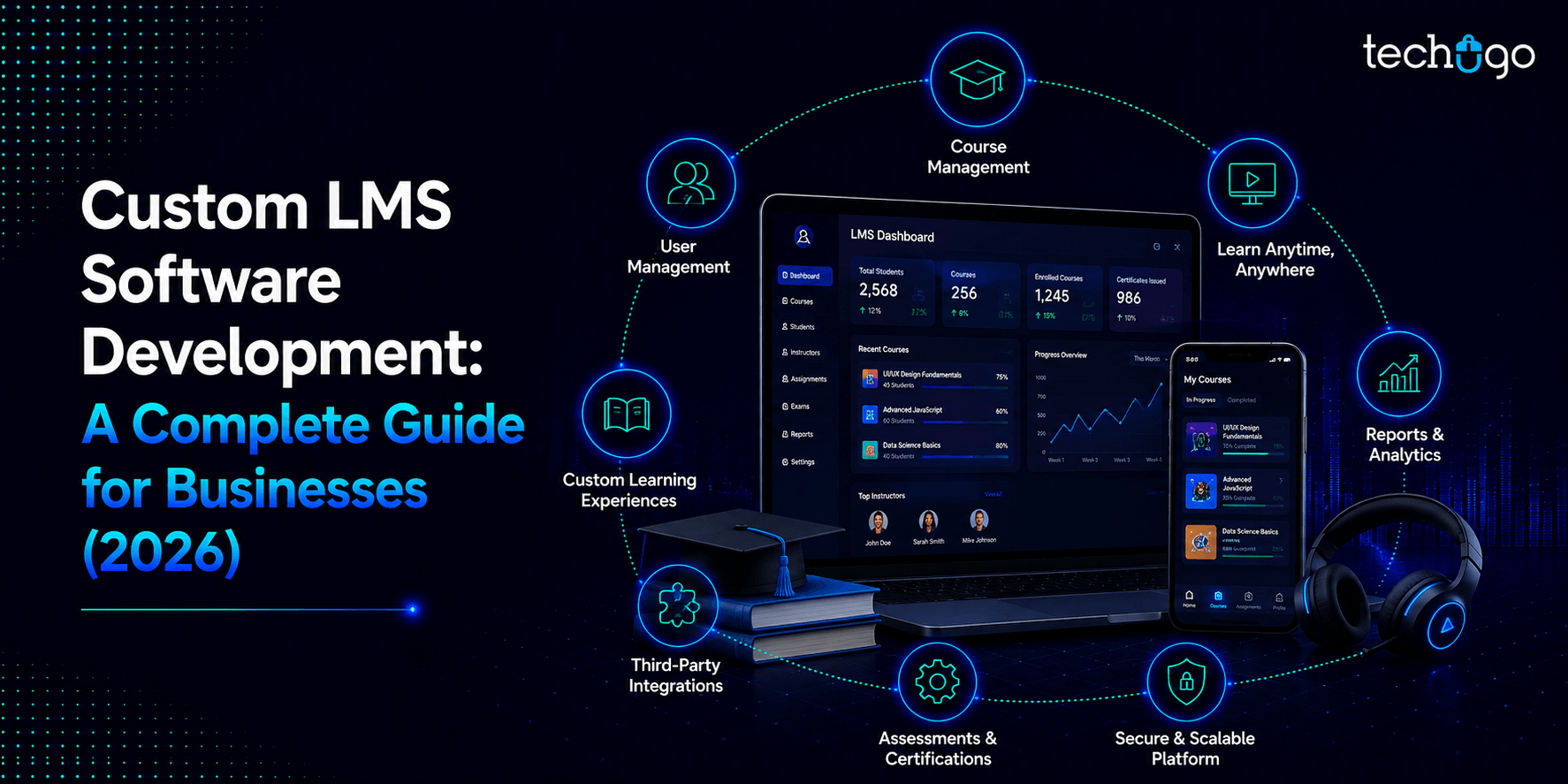
Top LMS software features to include in your platform
Totally agree – bloated LMS platforms are difficult to work with. That’s the reason why so many teams are moving to custom LMS software development today. When you go with custom LMS development, you’re not stuck paying for a dozen features you’ll never include, you build around the needs of your workflows.
If I had to name a few LMS software features that earn their spot on any modern platform, I’d say:
1. User management & role-based access
Admins, instructors, managers, learners – everyone gets access based on what they actually need to do, nothing more.
2. Course creation & content management
A simple way to build, organize and update training material without digging through five different tools.
3. Assessments, quizzes & certifications
To track how learners are actually doing, and let the platform handle certificates automatically once they’re done.
4. Progress tracking & analytics
Reporting on completion rates, performance & whether the training’s actually working.
5. AI-powered recommendations
The platform nudges people toward the right next course based on how they’ve been using it.
6. Gamification
Badges, points, leaderboards (might be small but it genuinely helps keep people engaged).
7. Notifications & reminders
Push notifications to automatically remind learners about deadlines, updates and upcoming training.
Why it’s worth partnering with experts??
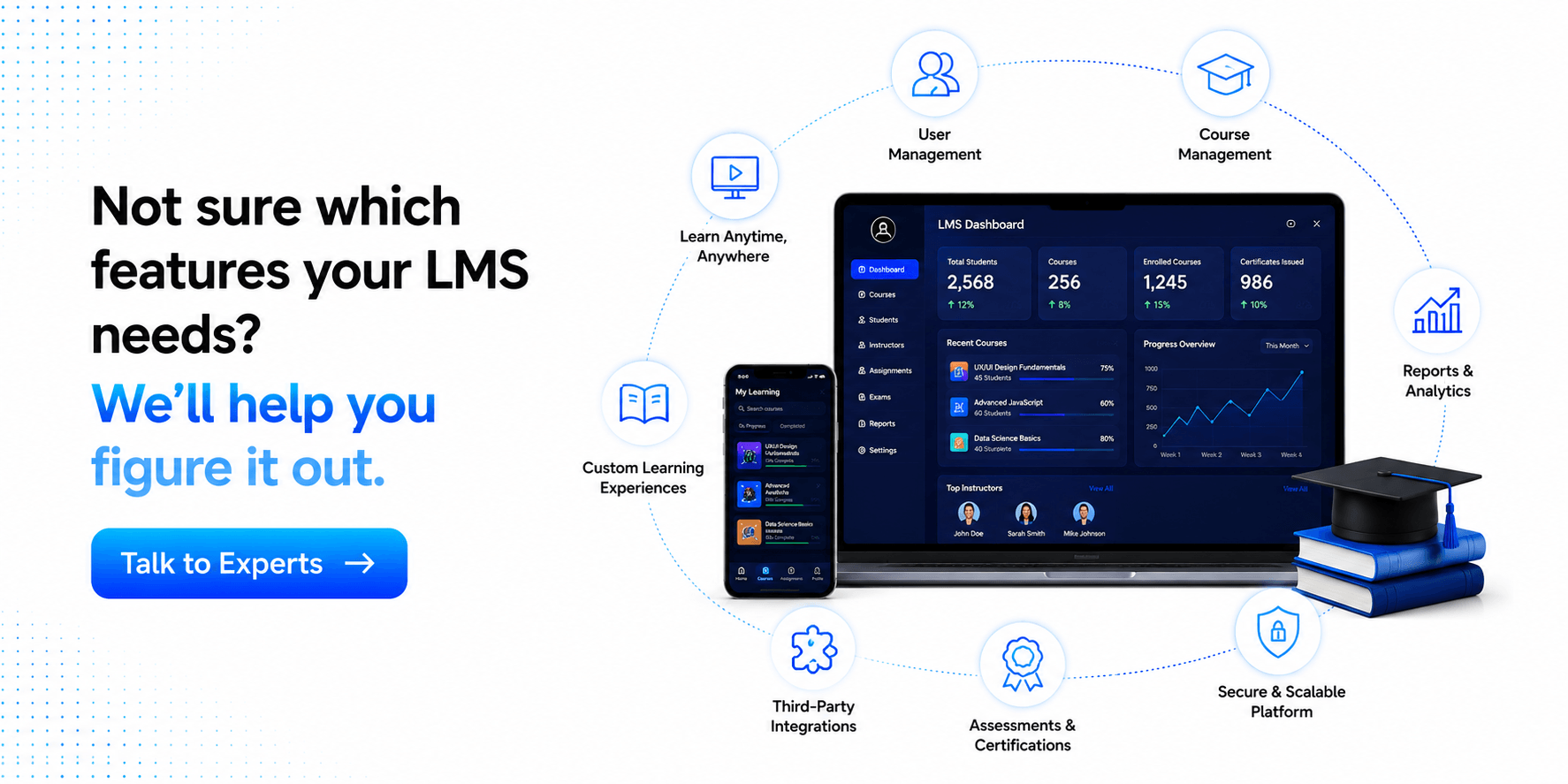
Getting all of this right isn’t something you want to wing. So it’s always smart to work with an experienced LMS software development company. They know how to build these features so they fit your existing systems and hold up as your business grows.
Common types of LMS software used by businesses
The features you need for custom LMS software development often depend on the type of LMS you choose.
So let’s take a look at the most common options.
- Cloud-based LMS – Best if you want quick setup, automatic updates and access from anywhere. It’s usually the preferred LMS software for small businesses because of its affordability.
- On-premises LMS – Installed on your own servers (also gives more control over data and compliance).
- Custom LMS – When pre-built platforms don’t meet your standards… a custom learning management system lets you build exactly what you need.
- Open-source LMS – Great choice if you’ve got an in-house dev team that wants to customize without starting from zero.
- Enterprise LMS – This is where you’d look at LMS software for enterprises. It’s built for large teams, multiple locations, tighter security and deep integrations with existing systems.
Industries that benefit from custom LMS software development
Education sector
Schools, colleges, and universities are leaning on LMS platforms to run online classes, manage assignments and exams and keep track of how students are actually progressing. It just makes the whole learning experience feel more organized and way more interactive than the old school way of doing things.
Corporate and IT industry
Businesses are using LMS systems for onboarding new hires, building up employee skills and keeping training ongoing rather than a one-time thing. This way, teams don’t fall behind whenever new tools or processes get rolled out.
Healthcare industry
All the hospitals and healthcare organizations depend on LMS platforms for training, certifications and compliance learning since maintaining high standards for patient care is necessary.
It’s actually one of the reasons why so many providers now turn to a healthcare app development company to build their LMS platforms.
Banking & fintech Industry
The fintech and banking sector uses LMS platforms for –
- compliance training
- fraud prevention education
- regulatory updates
- financial product training
Because the rules are so strict, employees have to stay aligned, therefore a lot of firms have been choosing a fintech app development company to build something that actually gets the compliance side right.
Retail and E-commerce
Now comes retail businesses. You see them using LMS tools for training staff in customer service, product knowledge, sales techniques, all so that the customer experience ends up better and so does performance.
Step-by-step custom LMS software development process
1. Discovery and planning
We always start by talking things through. What are you trying to train people on, who’s using the platform, what content are we working with, and what does the business actually need? From there, we scope the project, figure out the integrations that matter and then build a roadmap for learning management system development. Sounds tedious, but skipping this step can almost cause you costly rework later.
2. UI/UX design
Once that’s settled, designers start sketching wireframes and prototypes –
- dashboards
- workflows
- the whole interface
The goal is basically to keep it simple enough that course management doesn’t feel like a chore.
3. Development & integrations
Then developers get to work on course management, assessments, progress tracking, certifications, reporting & notifications. If you want more or if mobile learning is part of your strategy, eLearning app development and mobile app development services can be incorporated so people can learn from anywhere, on any device.
4. Testing and deployment
Now before going live, everything should be thoroughly tested. And even after it’s out in the world, your custom LMS development isn’t done.
There’s still a lot of work to be done afterwards, like –
- Ongoing updates
- bug fixes
- Performance and security monitoring
- Feature enhancements as needs evolve
- Scaling support as your platform grows
Custom learning management system implementation
1. Configure the platform for your business
Once development is complete, the LMS is configured, so that it matches your structure and branding, and it also matches user roles, permissions and workflows too. Through custom LMS software development; businesses are able to adapt the platform, so that it supports their unique goals instead of just relying on default functionality (because that rarely works).
2. Integrate with your existing tech stack (data migration)
An LMS that lives on its own island isn’t much use. A modern LMS should work alongside the tools you already use and have been using for years. Here, integrating HRMS and CRM, ERP, and communication platforms creates LMS software solutions that centralize tasks.
3. Drive adoption with expert guidance
You can build the best LMS in the world and it’ll still flop if no one knows how to use it. That’s why it is important to invest a little in software development consulting services.
4. Scale and optimize over time
Your business isn’t going to stay the same size forever, so your LMS shouldn’t either. You can always go for SaaS product development so you get cloud scalability, updates that happen automatically, better security, and new features rolling out over time.
Benefits of custom LMS software development
A custom LMS does a lot more than just manage courses. Here are some of the key benefits your business can expect –
Personalized learning experiences
A custom LMS lets you build learning paths, assessments, certifications, and dashboards around your goals. And with eLearning software development, you can add gamification, interactive content, personalized recommendations… after all, that’s what actually keeps learners engaged.
Scalability as your business grows
Your LMS should be able to grow right alongside your business. And it’s a custom platform that makes it easy to add new users, new departments, new courses, new features without the whole thing slowing down.
Seamless third-party integrations
A custom LMS can integrate with HRMS, CRM, ERP, communication tools, payment gateways & analytics platforms. And these integrations help in –
- creating connected workflows
- reducing manual data entry
- improving operational efficiency
Stronger security and compliance
Since the platform is built specifically for you, for your business, security features and compliance requirements can be implemented from the very start of your custom LMS software development project.
Better return on investment
You only pay for what you need, so it saves money long-term instead of piling up licensing costs for features you’ll never touch.
Competitive advantage
The biggest advantage you get out of this is – competitive advantage. It lets you stand out. A lot of businesses searching for LMS software in USA end up going custom because it just adapts as they grow without major redevelopment.
Estimating the cost of LMS software for businesses of all sizes
How Much Does an LMS Cost?
So what does it actually cost? Well, it depends.
The cost of LMS software is based on how complex the platform is, the features, how many integrations you need and how much customization goes into it. A basic LMS with the standard stuff is obviously going to cost less than a fully custom eLearning platform that is built for advanced features, big user bases and enterprise-level integrations.
Below is a general estimate of what businesses can expect to invest based on the scope of the project…
| LMS Type | Estimated Cost | Best For |
| Basic LMS | $15,000 – $40,000 | Startups and small businesses |
| Mid-Level Custom LMS | $40,000 – $100,000 | Growing businesses that require custom workflows, third-party integrations, mobile compatibility, certifications & analytics. |
| Enterprise Custom LMS | $100,000 – $250,000+ | Large organizations building a fully custom eLearning platform with advanced security |
These are just estimates, though. Your final number depends on your tech stack, your team, and what support you need after launch.
Keep in mind – If you’re going the custom LMS software development route, you’ll pay more upfront than you would for an off-the-shelf tool. But you’re getting something built around your actual business, so it makes it a worthwhile investment in the long run. Also, it’s never too late to opt for Custom LLM development services.
How long does it take to develop a custom LMS?
| LMS Type | Key Features | Estimated Time |
| Basic LMS | Course management, user login, simple dashboard | 2–3 months |
| Mid-Level LMS | Mobile support, reporting, role-based access | 3–6 months |
| Advanced LMS | AI features, analytics, integrations, cloud setup | 6–9 months |
| Enterprise LMS | Full customization, AR/VR, advanced security, scalability | 9–12+ months |
Now we can see that it’s the features that decide whether it will take 2 months or 12 months to build your custom LMS. It’s clear that the more advanced and specialized your requirements are, the more time and effort go into getting them right.
AI trends shaping custom LMS development in 2026
1. AI-powered personalized learning
AI learning becoming personalized is the biggest trend right now. AI looks at how learners are actually doing (their behavior, progress, skill levels) and builds learning paths around that.
2. Generative AI for content creation
This is probably the part that saves the most time. With Generative AI Development Services, you can generate quizzes, assessments, summaries, even interactive exercises in minutes (stuff that used to take your team weeks to put together).
3. Intelligent AI assistants
One after another, almost every platform is adding AI assistants/AI chatbots. They answer questions, recommend courses, give instant feedback, send reminders, basically guide people through the platform so learning feels less like a maze.
4. Predictive analytics and skill gap analysis
AI isn’t just tracking progress either, it’s spotting trends and flagging skill gaps before they become a problem. That gives businesses real data to work with when refining training strategies.
5. Smarter education software development
This is where education software development is heading as of now. Any decent LMS software company worth choosing is building this in now. They are using AI for everything like compliance tracking, smarter reporting, and personalization which is really what makes custom LMS software development worth the investment as workforce needs keep changing.
Future of LMS software beyond 2026: what to expect
1. Rise of custom LMS software development for enterprises
Gradually, enterprises are moving away from generic LMS platforms. You can see why they are doing this. Because these platforms are just too rigid, businesses need something that fits their own workflows so they get more flexibility.
2. Shift toward mobile-first & cloud-based LMS systems
Everything’s going mobile-first and cloud-based. People want to train on their own time, from their phone, without waiting around for updates to roll out properly.
3. Integration of immersive technologies like AR and VR
AR and VR are upgrading LMS platforms by creating interactive, real world learning simulations that basically improve engagement and knowledge retention.
4. Growth of data-driven and analytics-powered learning systems
Advanced analytics are helping organizations track learner performance, identify skill gaps & optimize training outcomes in an effective manner.
5. Enhanced cybersecurity and data privacy in LMS platforms
Because so much data is involved, security was always going to become a bigger deal, so now it has to be a priority for every business out there (be it small or enterprise-level).
Key challenges businesses face during custom LMS development
Defining clear requirements
First off, figuring out the requirements is usually harder than expected. There are so many businesses out there that don’t know exactly what they want at the start. Things keep changing midway. And the consequence? Everything slows down.
Solution: Write down exactly what you need before development starts.
Integrating with existing systems
Then there’s integration with existing systems. Your LMS has to work with tools like HRMS, CRM, ERP, and other stuff teams already use. This is actually very hard to deal with (especially if older systems are involved).
Solution: Check your existing tools early and let enterprise LMS development services handle the hard integrations.
Balancing scalability and performance
Scalability and performance is another thing people often overlook. It works fine with 100 users but what happens when it’s 10k?
Solution: Only good planning can save you from this challenge. (Pro tip – build on scalable & cloud-based architecture from day one).
Ensuring security and compliance
Security and compliance are also a big one. You shouldn’t take it lightly since you’re dealing with user data, training records and everything else.
Solution: Add security and compliance checks from the start, not at the end.
Driving user adoption
And finally, user adoption. You can build the best LMS ever, but if people don’t actually use it or find it confusing, then it’s kind of pointless.
Solution: Keep it simple, train people properly. After all that’s what good custom LMS software development is really about.
Why partner with Techugo for your custom LMS software development?
Choosing the right development partner can make all the difference to the success of your LMS.
That’s something we take seriously at Techugo.
Our team won’t just help you build the LMS software you desire. We create learning platforms that are secure, scalable and completely designed around your business goals. From the initial discovery phase to deployment and ongoing support… our team will work closely with you at every stage of the project.
As a renowned mobile app development company, we also help businesses extend learning beyond the desktop by developing mobile applications for Android and iOS. We take the time to understand your training requirements, user journeys and long-term objectives before building a solution that fits your organization.
In a way, that’s what allows us to create an LMS that truly supports your business instead of forcing you to adapt to the platform.
When you partner with us, you’re investing in a future-ready learning platform built to deliver long term value.
If you’re ready to build a custom LMS, we’d love to be a part of the journey. Connect with us today!
FAQs
1. What is custom LMS software development?
It’s the process of building a learning management system that’s designed specifically for your business. Instead of relying on pre-built features, you get a platform that’s customized around your training goals, workflows & users.
2. How much does custom LMS software development cost?
Custom LMS software development would cost you around $15,000 to $250,000+, (depending on the platform’s complexity, features, integrations & AI capabilities).
3. Can a custom LMS integrate with my existing business systems?
Absolutely. A custom LMS can integrate with tools like HRMS, CRM, ERP, payment gateways, video conferencing platforms and other third-party applications to create a connected learning ecosystem.
4.Is a custom LMS worth the investment?
If your business has unique training requirements or plans to scale, then yes.

Get in touch
We'd love to hear from you.