 SA
 KW
 IE
 AU
 UAE
 UK
 USA
 CA
 DE
 QA
 ZA
 BH
 NL
 MU
 FR



















📌 Key Takeaways
- Define clear business goals before choosing a digital transformation services provider.
- Choose an expert with a specialty in software development, AI, automation, cloud computing, or system integration.
- Evaluate technical capabilities to ensure the partner can build secure, scalable, and reliable digital solutions.
- Review previous projects and case studies to evaluate the partner’s problem-solving abilities, technical experience, and measurable results.
- Watch for red flags such as unrealistic promises, unclear deliverables, poor communication, and lack of credible client references.
Whether you want to automate daily tasks, modernize legacy systems, build digital products, or use AI, choosing the right digital transformation partner can make a significant difference. However, with so many technology companies offering digital transformation services, how do you know which one is right for your business?
The answer lies in understanding your business goals, evaluating technical expertise, reviewing past projects, and finding a partner who can convert your vision into practical goals. A reliable partner should understand your challenges, recommend suitable technologies, and support your business throughout the transformation journey.
But first, we must understand what a digital transformation partner actually is.
Who Is A Digital Transformation Partner?
A digital transformation partner is an external organization or an expert who knows and helps businesses modernize tools, operations, and workflows. They are not like your basic vendor or staffing agency. Digital transformation consulting partners have their own strategy, integration of technology, change management, and end-to-end execution needed to achieve goals.
From a functional point of view, a digital transformation partner is responsible for these:
1. Strategizing: They audit the viability of the system in place, define the KPIs, and build a blueprint for scale and growth.
2. Systems Integration: Interlinks legacy platforms, cloud transformation, and data pipelines with the help of APIs.
3. Implementing Emerging Technology: AI, machine learning, AR/VR, and business-relevant emerging technologies are deployed.
4. Change Management: Reshaping internal workflows and teaching staff to work with new tools.
5. Continuous Support & Maintenance: Maintenance, security monitoring, and scaling are just some of them.
Ready To Choose The Right Digital Transformation Partner?
Discover how an ideal partner can help you streamline operations, modernize systems, and accelerate growth.
Why Choosing A Digital Transformation Partner Matters
To go towards effective digital transformation and reap its benefits, huge investments in technology, people, time, and business processes are necessary. However, if you choose the wrong software development consulting from a specialist, then your business will suffer, and ultimately you.
So, here are some of the important reasons why your choice matters:
1. A Clear Digital Strategy
Going digital will always lead to scalability and better brand awareness. Don’t you agree? Well, this is actually true but along with it is important to understand what your business aims to achieve. Do you want to enhance customer engagement, minimize manual work, increase revenue, or go for legacy application modernization?
Thus, the best digital transformation partner makes sure all the objectives are defined, and a proper blueprint is made.
2. Reducing Unnecessary Costs
When building a business, it is easy to take on unnecessary costs while a substitute solution might be lying just there in which the cost is low. Sometimes upgrading an existing system or integrating two business applications can actually solve the problem.
3. Access To Experts
Cloud computing, application development, data analytics, cybersecurity, automation, and AI are where the expertise is in. However, to implement such advanced technologies, the expertise won’t come cheap. You will need to spend money and give enough time to develop thorough systems. Unifying all these areas may also lead to ERP development.
4. Implementation Process Accelerates
An established partner usually follows known development practices, testing methods, and project management principles. These practices help to recognize risky aspects of projects and thus avoid unwanted delays. While each project has its own timeline, working with an efficient group makes it possible to implement a project in a more structured and predictable way.
5. Helps In Improving Scalability & Security
The technology you are using will be completely different just a few years from now. So, it is worth mentioning that a suitable digital transformation consulting partner considers future growth a key component. Besides this, some key areas they should address are data protection, access controls, security testing, compliance requirements, and beyond.
What Digital Transformation Services Can You Expect?
Digital transformation is made up of various services, and not every one of those fits your business. The services you choose should depend on your challenges, industry requirements, existing infrastructure, and more.
Let’s take a deep dive into the digital transformation professional services, which include:
1. Digital Transformation Consulting: Understanding where your business stands today and what needs to change is what digital transformation consulting is all about. Evaluating current systems, identifying operational issues, any technology gaps, and offering a suitable roadmap is what a consulting team will do.
2. Custom Software & Application Development: Quite often, ready-made software cannot fit into the current structure. Therefore, the best thing is to go for custom solutions to meet such requirements.
3. Cloud Migration & Modernization: Without access to computing resources, applications, and data without depending completely on traditional infrastructure, cloud technology helps you do this. Thus, a reliable partner provides effective cloud migration services and modernizes older ones.
4. AI & Business Process Automation: Reducing repetitive work, processing information faster, and making better use of data is what AI & business process automation does. Thus, depending on the requirements, the partner develops AI-powered customer support tools, automates document processing, and introduces predictive analytics, among many things under AI development services.
5. Data Analytics & Business Intelligence: As part of software development services, the expert integrates data sources, develops dashboards, automates reporting, and establishes reliable data management practices. When these actions are taken, you can identify trends, monitor performance, understand customer behavior, and make more informed decisions.
6. System Integration & Legacy Modernization: You can hire a digital transformation partner to integrate systems through API, integration platforms, or any other appropriate way of connection. This enables avoiding duplication of data, streamlining the data exchange, and making it possible for the employees to do their work in a more efficient way.
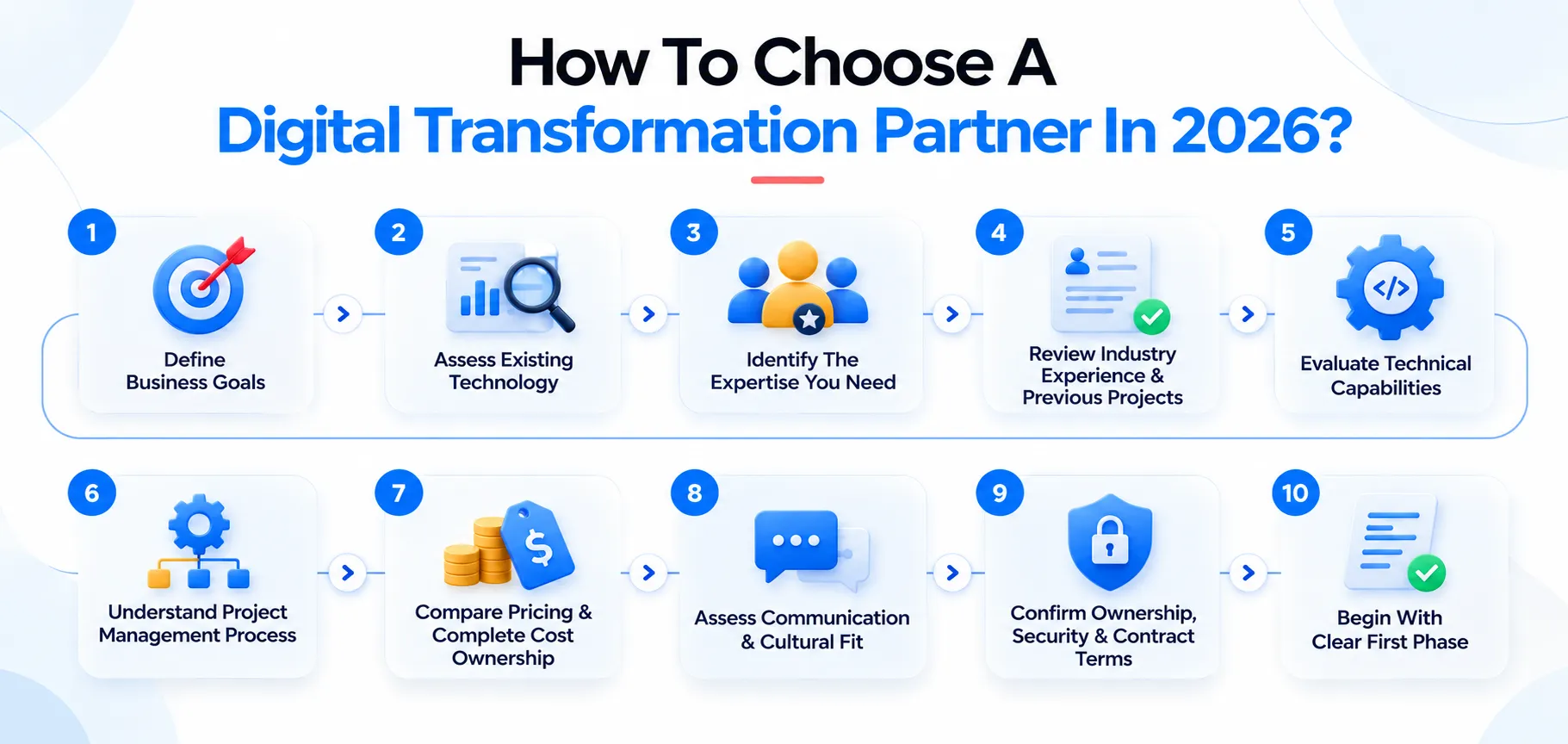
How To Choose A Digital Transformation Partner In 2026?
It becomes simple when you follow a systematic approach to choose the right digital transformation partner. Rather than basing the choice alone on price or reputation of the firm, you need to evaluate the key factors when choosing an AI digital transformation partner.
Therefore, when you ask, “How do I choose a digital transformation partner?”, here are the key steps to follow:
1. Define Business Goals
The first step is to identify problems that you want to solve.
For example: you might want to reduce or contain manual processes, enhance customer retention, perform legacy modernization, or maybe launch a new product.
But to do this, it is important to understand that the goals need to be measurable.
So, instead of saying, “We want to improve operational efficiency”, you could say, “We want to reduce the time required to process customer orders by 25%.”
2. Assess Existing Technology
Before contacting firms specializing in digital transformation, evaluate your existing technology landscape. Identify the software you use, how information is shared among different systems, what type of user challenges occur, and what processes depend on manual input.
Take into account your IT infrastructure, integrity of data being used, safety of data, and integration issues.
3. Identify The Expertise You Need
Not every digital transformation expert covers all the areas. Some focus on enterprise system integration and cloud infrastructure, while others specialize in mobile applications, AI solutions, automation, or SaaS development. So, create a shortlist based on the expertise that you require.
4. Review Industry Experience & Previous Projects
Find digital transformation service providers that understand workflows, customer expectations, and the regulatory environment. However, experience in your exact industry should not be the only deciding factor. A provider with strong technical expertise and relevant experience in a similar business problem may also be a good fit.
In this scenario, it is better to review case studies, project examples, and client references to get a better outlook on what the service will look like.
5. Evaluate Technical Capabilities
It is important for the digital transformation partner to communicate its technical choices in a way that is understandable.
Make sure to ask questions about strategy for architecture, software engineering, integration, management of data, testing, deployment, and security. If your project involves the use of the cloud, artificial intelligence, or enterprise systems, check that the experts have the necessary experience in these fields.
6. Understand Project Management Process
You can always ask the best digital transformation partner for data and AI about how they plan projects, track progress, manage risks, and handle changes. Find out who you will primarily contact and how frequently you will connect.
But on the other hand, it is also useful to understand whether the team works in Agile sprints and follows a milestone approach.
7. Compare Pricing & Complete Cost Ownership
Do not judge proposals only on the initial development cost. The total amount you invest includes consulting services, licenses for software, cloud infrastructure, integrations, testing, training, support and maintenance costs, security updates and future upgrades.
Request that each of your shortlisted partners explain what the estimate contains, on what assumptions it is based, and what cost factors could drive up the final cost.
8. Assess Communication & Cultural Fit
Within the initial discussions, observe whether the team or the expert actually listens to your concerns and answers the questions you ask. Here, you need to consider time zone differences, language requirements, the decision-making process, and the level of access you will have to the project team.
9. Confirm Ownership, Security & Contract Terms
Before entering into a contract, make sure to discuss who owns the intellectual property, who has access to the source code, who is responsible for data protection, what confidentiality applies, and how third-party software is licensed.
Another important point in defining the contract is to describe the scope of the project, the milestones, payment terms, criteria for project acceptance, changes requested, warranties, support arrangements, and termination conditions.
10. Begin With A Clearly Defined First Phase
According to your aims, you could start with one of the following types of engagement. The teams can test hypotheses, verify possibilities, and identify how the teams can cooperate before they go for a full-scale rollout.
What Questions Should You Ask From A Digital Transformation Partner Before Hiring?
Understanding what the best digital transformation partner for data and AI offers and will reveal are two different things. Therefore, asking questions that are directly linked to the success or failure of your business is crucial.
So, here are some of the questions that might be crucial when you go into those meetings:
Q) How will you understand our business goals before recommending technology?
Why It Matters: Helps you know if the expert follows a business-first approach or not.
Q) Have you delivered projects with similar challenges or complexity?
Why It Matters: Shows whether the team has relevant practical experience.
Q) What services will you provide directly and what will be outsourced?
Why It Matters: Clarifies the actual team capabilities and accountability.
Q) Which technologies do you recommend and why?
Why It Matters: Reveals recommendations are based on your requirements rather than technology trends.
Q) How will you integrate your existing systems?
Why It Matters: Helps evaluate its understanding of your current infrastructure.
Q) How will you protect our data and systems?
Why It Matters: Clarifies its approach to security, privacy, and risk management.
Q) What is your estimated timeline, and what could delay delivery?
Why It Matters: Helps set realistic expectations and identify dependencies.
Q) How do you manage scope changes and unexpected technical changes?
Why It Matters: Reveals how the team handles uncertainty.
Q) What will the project cost, and what is excluded from the estimate?
Why It Matters: Helps you understand the scope of full financial commitment.
Q) How do you measure project success?
Why It Matters: Ensures the outcomes are connected to business objectives.
In the meeting, you do not need to ask every question. Start with the ones that are relevant to your project, then explore technical, commercial, and operational details as your shortlist becomes smaller.
How To Evaluate Portfolio, Case Studies & Client Testimonials?
A digital transformation company can give you an idea of its experience, but the number of projects it has completed doesn’t necessarily indicate how well it will handle your requirements. Therefore, to make a better decision, look beyond screenshots, client logos, and general claims of success.
1. Look For Relevant Project Experience: If your goal is to build a digital customer platform, give a thorough look to the company’s experience with user design, backend architecture, performance, and scalability. Relevant experience is a strong indicator of how well your project will be.
2. Examine The Problem & Solution: Explain the client’s original challenge, the solution implemented, and the reasoning behind the approach; all should be explained by the case study. Explaining the problem-solving approach through a case study is more informative than anything else.
3. Check Whether Results Are Measurable Or Not: Look for concrete outcomes such as reduced processing time, fewer minor errors, improved application performance, lower infrastructure costs, or increased digital adoption. Not every successful transformation produces an immediate revenue increase.
4. Evaluate Technical Expertise: If you are looking for technology in the polished interface, then it’s simply the wrong approach. It is important to ask about the project’s architecture, system integrations, security requirements, deployment process, and scalability concerns.
5. Verify Client Testimonials & References: Determining the level of communication, reliability, responsiveness, and delivery quality is what client testimonials can help solve. All of these factors will help you determine the best AI and automation partner for digital transformation.
Red Flags You Should Watch When Choosing A Digital Transformation Services Partner
1. Be cautious of digital transformation services partners who promise exact results, immediate success, or quick delivery without understanding your business needs.
2. Avoid companies or experts that fail to define project deliverables, timelines, milestones, and responsibilities.
3. If a partner recommends AI, cloud computing, or automation without explaining how it solves your business challenges.
4. A low-cost proposal may exclude essential services such as testing, security, ownership, documentation, maintenance, or post-launch support.
5. Delayed responses, vague explanations, missed meetings, and inconsistent updates can indicate potential collaboration problems.
6. Be cautious if the partner cannot demonstrate relevant experience, explain its technical decisions, or provide examples of similar projects.
7. A reliable partner should be able to protect sensitive data, manage access controls, identify vulnerabilities, and handle security incidents.
8. If a company makes impressive claims but cannot provide credible project examples or client references, verify its experience before proceeding.
9. Digital solutions require ongoing maintenance, updates, and improvements. Avoid a digital transformation services partner that cannot explain how they will support your solution after deployment.
Want To Transform Your Business Without Unnecessary Costs?
Partner with digital transformation partners at Techugo who can identify the right solutions for you.
In-House Team vs Digital Transformation Partner: Which Is Better?
Should you build your own digital transformation team or work with an external partner? To this question, there is no universal answer. The right choice depends on your budget, internal capabilities, project complexity, and long-term technology requirements.
So, let’s compare the two approaches:
| Comparison Factor | In-House Team | Digital Transformation Partner |
| Initial Investment | Often higher because of recruitment, salaries, and tools | May require less upfront investment in permanent staffing |
| Access To Expertise | Depends on the skills available within your organization | Can provide access to a wider range of specialists |
| Speed of Team Setup | Recruitment & onboarding may take time | An established provider may be able to begin sooner |
| Business Knowledge | Develops in-depth knowledge of internal processes over time | Needs onboarding and collaboration to understand your business |
| Control | Greater direct control over priorities and daily work | Control depends on the contract and collaboration model |
| Flexibility | Scaling capacity may require hiring or restructuring | Scope and team size may be adjusted based on the agreement |
| Long-Term Continuity | Knowledge remains within the organization, subject to staff retention | Continuity depends on the provider, documentation, and contract |
What Is Techugo’s Approach Towards Digital Transformation?
When evaluating the best custom software development partner for digital transformation, it is essential to know its approach connects technology decisions with real business objectives.
Techugo is a digital product development company. Businesses considering Techugo for a transformation initiative should evaluate its relevant capabilities, project experience, technical approach, and delivery against their specific requirements.
The Final Word
It is essential to collaborate with the right digital transformation partner, as this can determine your efficiency, customer satisfaction, expenses on technology, and success in the long term. Its role is not just to implement the software. It also needs to understand the client’s objectives, check their existing systems, suggest means offered by technology, and accompany them through understanding the transformation process.
Before you choose a provider, you need to know what you want, be sure that the provider is qualified enough, check their success stories, and think about costs. You also need to pay attention to communication methods, security measures taken, and terms of the contract.
FAQs
Q) How long does a digital transformation project usually take?
The duration of the project is influenced by the level of complexity. The scope of the project, existing infrastructure, and used technologies all play a role in determining how long a project may last. Small upgrades to a system may take only weeks, while more complex projects could take several months or more than a year to complete.
Q) What industries benefit most from digital transformation services?
Industries such as healthcare, finance, retail, manufacturing, education, logistics, and real estate can benefit from digital transformation.
Q) Can small businesses afford digital transformation services?
Yes, small businesses can work with a digital transformation partner by starting with specific business needs rather than transforming everything at once. So, prioritizing high-impact improvements, such as workflow automation or cloud adoption, can manage costs while delivering measurable value.
Q) When should a business consider changing its digital transformation partner?
A business may need to reconsider its partnership when the provider repeatedly misses agreed milestones, fails to meet contractual obligations, cannot adapt to changing business requirements, or provides inadequate technical support.

Get in touch
We'd love to hear from you.