

 SA
SA
 KW
KW
 IE
IE AU
AU UAE
UAE UK
UK USA
USA
 CA
CA DE
DE
 QA
QA ZA
ZA
 BH
BH NL
NL
 MU
MU FR
FR















📌 Key Takeaways
- Healthcare CRM software helps providers engage patients better, communicate more effectively and deliver more personalized care.
- It helps healthcare providers with all the routine work like organizations scheduling, reminders & follow-ups.
- Budget-wise, it’s a range. You’re generally looking at $25k on the low end up to $300k+ depending on how many features, integrations and compliance boxes (HIPAA etc.) you need to check.
- Going custom generally means that your CRM can connect with EHR/EMR, telemedicine & billing.
A missed follow-up can cost you more than a missed diagnosis.
Hard to believe? But it’s true.
And this is not an exaggeration. It can cost you a lot if the patient feels forgotten.
In healthcare, it is often the little things that patients remember. Little things like getting a reminder before their appointment or it could be them being updated about their reports.
This is where healthcare CRM software development comes in handy. It will give your healthcare organization one place to manage every patient interaction. It will make communication more consistent, care more personalized and your day-to-day operations much easier to handle.
In this guide, we’re going to break down everything worth knowing about building healthcare CRM software. The must-have features, why it’s worth the investment, how the development process works, real-world use cases, what affects the cost, the challenges you might run into, and the amount it will cost you in 2026.
Why healthcare CRM software development services matter more than ever
Okay, here’s why more and more providers are putting money into healthcare CRM software development these days:
-
Personalized patient experiences
You get one complete view of a patient’s history, preferences, and past interactions so care feels more personalized.
-
Better communication
Reminders, follow-ups, prescription refill alerts, health updates, all of it running automatically across the channel the patient prefers.
-
Less admin work
No more drowning in manual scheduling, registration and record-keeping. Staff finally get time back to pay attention to their patients.
-
Stronger patient retention
Staying in touch consistently, being proactive instead of reactive – that’s what keeps patients coming back.
-
Smarter decisions
Real time reports and analytics that show you what’s working and what’s not, engagement-wise and operationally.
-
Security and compliance built in
The better healthcare CRM software development services out there make sure data stays secure, regulations are met, and everything integrates smoothly with what you’re already using.
-
Room to grow
As you add locations or your patient volume grows, CRM software development for healthcare lets you scale without you having to redo what’s working already.
Curious to know what the stats say?
Well, according to Grand View Research, the global healthcare CRM market was valued at USD 21.5 billion in 2025 and is expected to reach USD 35.7 billion by 2033 (expanding at a 6.2% CAGR). It is a very clear sign that healthcare organizations are moving beyond traditional patient management and investing in technologies that foster stronger, long term patient relationships.
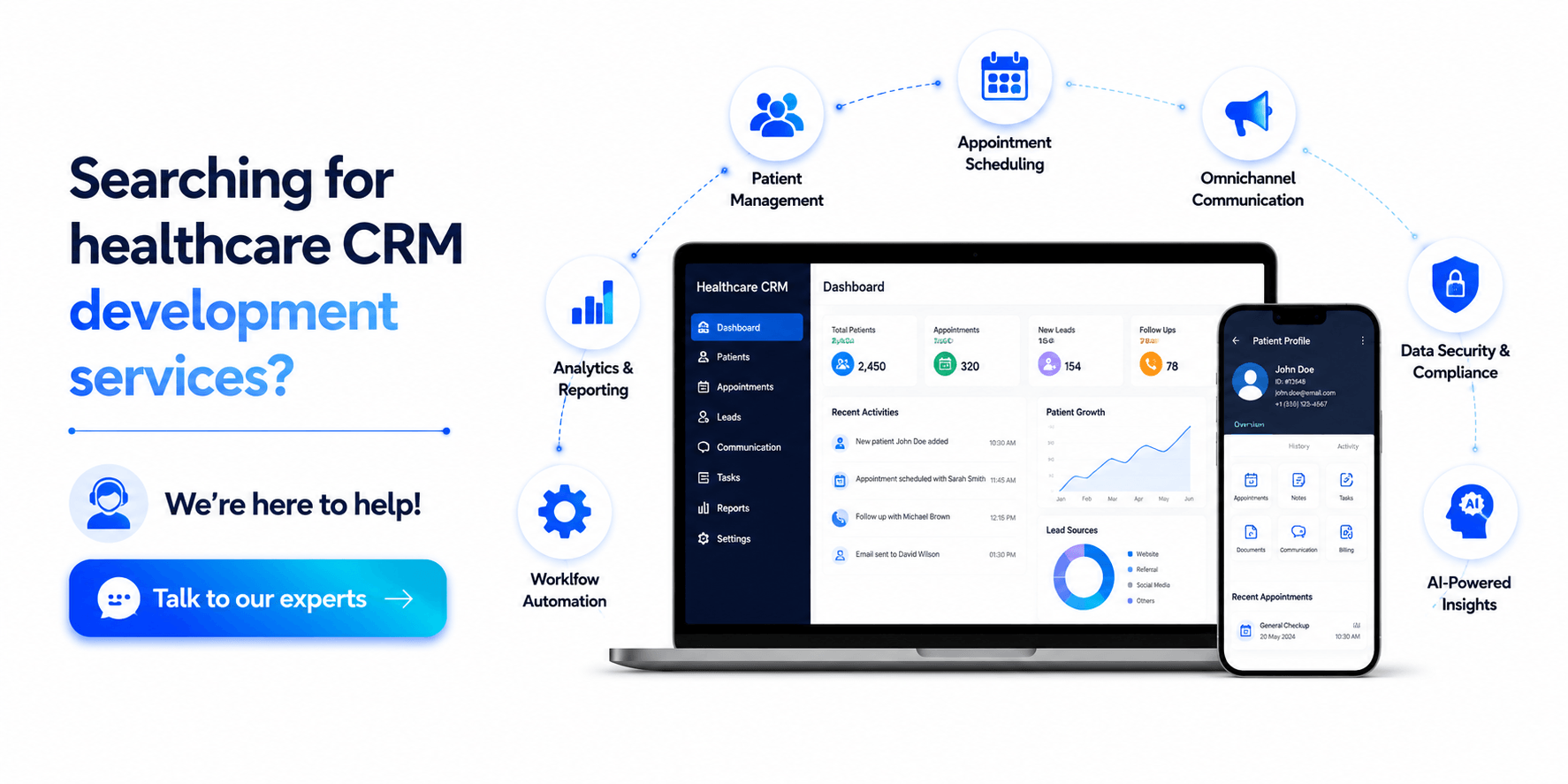
Healthcare CRM vs. EHR: what’s the difference?
Although healthcare CRM and EHR systems are often mentioned together, they serve very different purposes.
An EHR (Electronic Health Record) is basically designed to store & manage a patient’s clinical information. While a healthcare CRM focuses on building and maintaining patient relationships through personalized communication, engagement & service management.
The table below will show you the actual differences between a healthcare CRM and an EHR system.
| Parameter | Healthcare CRM | EHR (Electronic Health Record) |
| Purpose | Builds & manages patient relationships | Stores and manages medical records |
| Primary Users | Admin staff, patient coordinators, marketing teams | Doctors, nurses and clinical staff |
| Data | Appointments, communication, feedback, preferences | Medical history, diagnoses, prescriptions, lab reports |
| Primary Focus | Patient engagement and experience | Clinical care and treatment |
| Key Features | Reminders, follow-ups, outreach, and analytics | Clinical records, e-prescriptions, treatment plans |
| Business Value | Boosts patient retention and operational efficiency | Improves care quality and compliance |
| Integrates With | EHR, billing, telemedicine, and HMS | CRM, labs, pharmacies & billing systems |
Rather than replacing one another… healthcare CRM and EHR systems complement each other. While an EHR ensures healthcare professionals have access to accurate clinical information, CRM solutions help providers deliver timely communication, personalized experiences and stronger patient relationships. A reliable healthcare CRM software development company can build customized platforms that integrate with EHR systems and allow organizations to get the best of both worlds through CRM software development for healthcare.
Types of healthcare CRM software
1. Patient relationship management CRM
The one most practices lean on first is Patient Relationship Management CRM. It’s basically your command center for reminders, follow-ups, feedback loops, personalized outreach – the everyday stuff that makes the patients come back to you. A lot of people searching for the best healthcare CRM software are really just looking for this.
2. Marketing & patient acquisition CRM
This one’s for growth. It tracks leads, automates campaigns, manages referrals & shows you what’s working so you’re bringing in new patients while also keeping current ones engaged.
3. Care coordination CRM
Care coordination CRMs streamline communication between physicians, specialists, care teams and of course – patients. When integrated with EMR Software Development solutions… they provide staff with access to relevant patient information, making care transitions and follow-ups much more efficient.
4. Specialty-specific CRM
There are some providers that require CRM systems which are customized to their specialty (like dental clinics, mental health practices, fertility centers & multi-specialty hospitals). These solutions include – workflows, communication tools and compliance features built for specific healthcare settings. As CRM software development becomes more advanced… businesses are increasingly investing in customized CRM platforms that align with their unique patient engagement requirements.
Essential features of healthcare CRM software
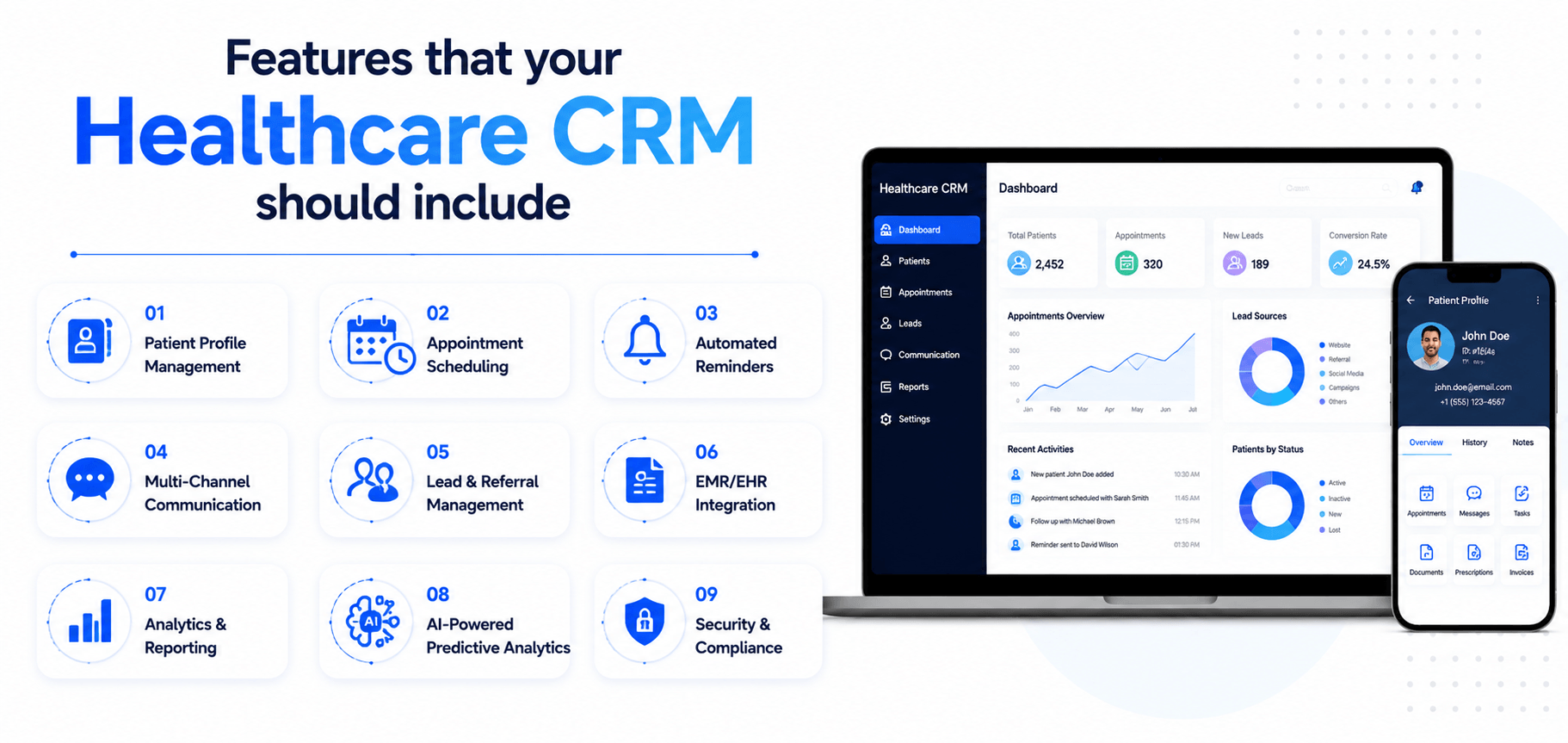
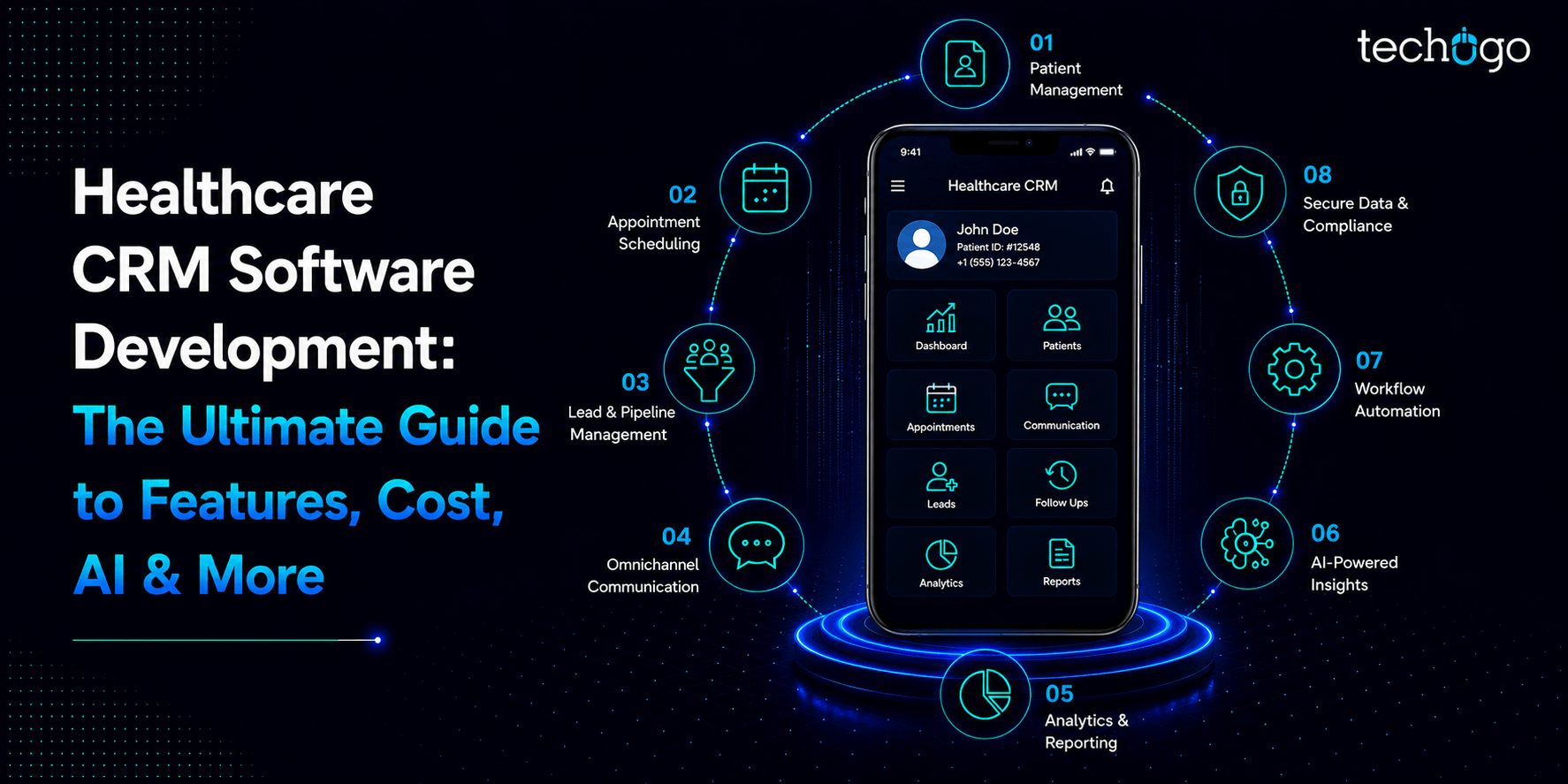
If you’re investing in healthcare CRM software development, these are the features you shouldn’t skip.
1. Patient profile management
You want one centralized database – contact info, medical history, appointment records, communication preferences, interaction logs – so staff aren’t hunting across systems just to get the full picture of a patient’s journey.
2. Appointment scheduling & automated reminders
Easy booking plus automated reminders (SMS, email, phone) and helps reduce missed appointments automatically.
3. Multi-channel communication
Email, SMS, calls, portals, chat – ideally all in one place. Consistency here is what actually moves engagement and follow-up rates.
4. Lead & referral management
Tracking prospective patients, physician referrals and campaigns tells you exactly where new patients are coming from. This is exactly what good patient relationship management software is supposed to do.
5. EMR/EHR integration
Connect the healthcare CRM platforms to clinical systems, and providers see patient info in one place (without having to switch tabs).
6. Analytics & reporting
Dashboards on engagement, appointments, campaigns and efficiency give you something to act on.
7. AI-powered predictive analytics
This AI feature flags patients at risk of missing appointments, dropping off treatment plans, or requiring proactive follow-ups.
8. Security & compliance
Role-based access, encryption, audit logs – non-negotiable. A lot of teams bring in offshore software development partners here too, building secure, scalable CRMs while staying compliant.
HIPAA compliance checklist for healthcare CRM software development
Building a healthcare CRM means you’re also handling some of the most sensitive data out there. So security has to be included by default from day one.
Here’s a quick HIPAA checklist worth keeping close –
- Encrypt patient data, both at rest and in transit no exceptions.
- Set up role-based access so people only see what they actually need.
- Turn on multi-factor authentication. And at this point it’s non negotiable.
- Keep detailed audit logs of who’s doing what and when.
- Stick to secure APIs and HIPAA-compliant cloud infrastructure.
- Only collect and store the patient info you actually need (nothing extra).
- Run security audits and vulnerability checks regularly.
- Get BAAs signed with every third-party vendor you’re working with.
- Make sure solid backup and disaster recovery plans are in place, just in case.
Real-world use cases of medical CRM software development
-
Hospitals & multi-specialty healthcare networks
If you’re running a hospital, you’ve got a lot going on at once. It’s not just about treating patients, you also have multiple care teams to coordinate, departments that need to stay connected and follow-ups to deal with.
This is why we have CRM platforms. They will help you –
- coordinate patient journeys
- automate follow-ups
- improve communication between departments
-
Clinics & private practices
For smaller clinics, it’s more about the basics done well.
It involves – simpler scheduling, automated reminders and managing patient interactions in a way that builds long-term relationships instead of one-off visits.
-
Diagnostic labs & imaging centers
Here, CRM software handles test scheduling, notifies patients the second reports are ready, and automates communication so patients aren’t left wondering what’s next.
-
Telehealth providers
Telehealth businesses need proper healthcare CRM platforms that can manage virtual consultations, onboarding, follow ups and post-appointment engagement (all from one place) since everything’s already happening remotely anyway.
-
Specialty healthcare providers
Dental clinics, mental health practices, fertility centers – these providers usually end up working with medical CRM software development services since off-the-shelf is just not enough for their workflows or compliance needs.
A lot of them team up with a healthcare app development company to get a CRM built for how they operate.
Benefits of healthcare CRM software
The benefits of healthcare CRM software go far beyond just managing patient data. Read further and find out all the other benefits it offers –
1. Stronger patient relationships
A healthcare CRM keeps every patient interaction in one place – and because of that it is easier to deliver personalized communication, timely follow ups and consistent care.
So,
- First it builds trust.
- And second, it keeps patients loyal over time.
2. Fewer administrative tasks
From scheduling to reminders to follow up messages – the CRM takes repetitive work off your staff’s plate so that they can focus more on patient care instead of paperwork (which honestly is the whole point).
3. Better team collaboration
When information is centralized and everyone can see the communication history, doctors, nurses & admin staff stay on the same page. This reduces delays and you can see the improvement in coordination.
4. Improved patient retention
Personalized outreach and preventive reminders – they help patients stay connected, so they’re not just leaving after one visit.
5. Better data security & compliance
If you go with the best HIPAA compliant healthcare CRM software, you’re protecting sensitive patient info through encryption, role-based access, audit logs and everything that is built to meet healthcare regulations.
6. Scalable for future growth
Through healthcare CRM software development, you can build something that grows, and many combine it with mobile app development services too.
So patients get:
- Patient portals
- Appointment booking
- Secure messaging
- On-the-go access to healthcare services
Healthcare CRM Software Development Process
Step 1. Define business goals and requirements
Start with the basics: who’s actually going to use this thing? Hospitals, clinics, insurers, independent providers?
You have to be clear on the problems you are solving and the workflows you need to support from the start. And if there’s any claim or payer functionality involved… it’s worth looking into health insurance software development requirements upfront (retrofitting compliance later is expensive).
Step 2. Plan features and choose the right tech stack
From there, list all of your core features (scheduling, patient profiles, billing, communication, analytics) & pick a tech stack that won’t box you in as you grow.
Step 3. Design a user-friendly and secure interface
Then comes design. Doesn’t matter how good your backend is if a nurse or front desk person opens the app and can’t find anything. So keep the navigation simple and make sure each role sees only what they need.
(Tip – build security in from day one).
Step 4. Develop and integrate core healthcare systems
The real work of healthcare CRM software development happens during integration. By now, your CRM is ready. All that’s left is to connect it with EHR/EMR systems, telemedicine tools, labs and payment platforms so that every platform works as one.
Step 5. Test, deploy & continuously optimize
Finally test thoroughly, confirm HIPAA compliance, launch – and keep iterating based on real feedback. A good healthcare CRM solution is never really “finished”. It just evolves with the people using it.
Healthcare CRM Software Development Cost Breakdown
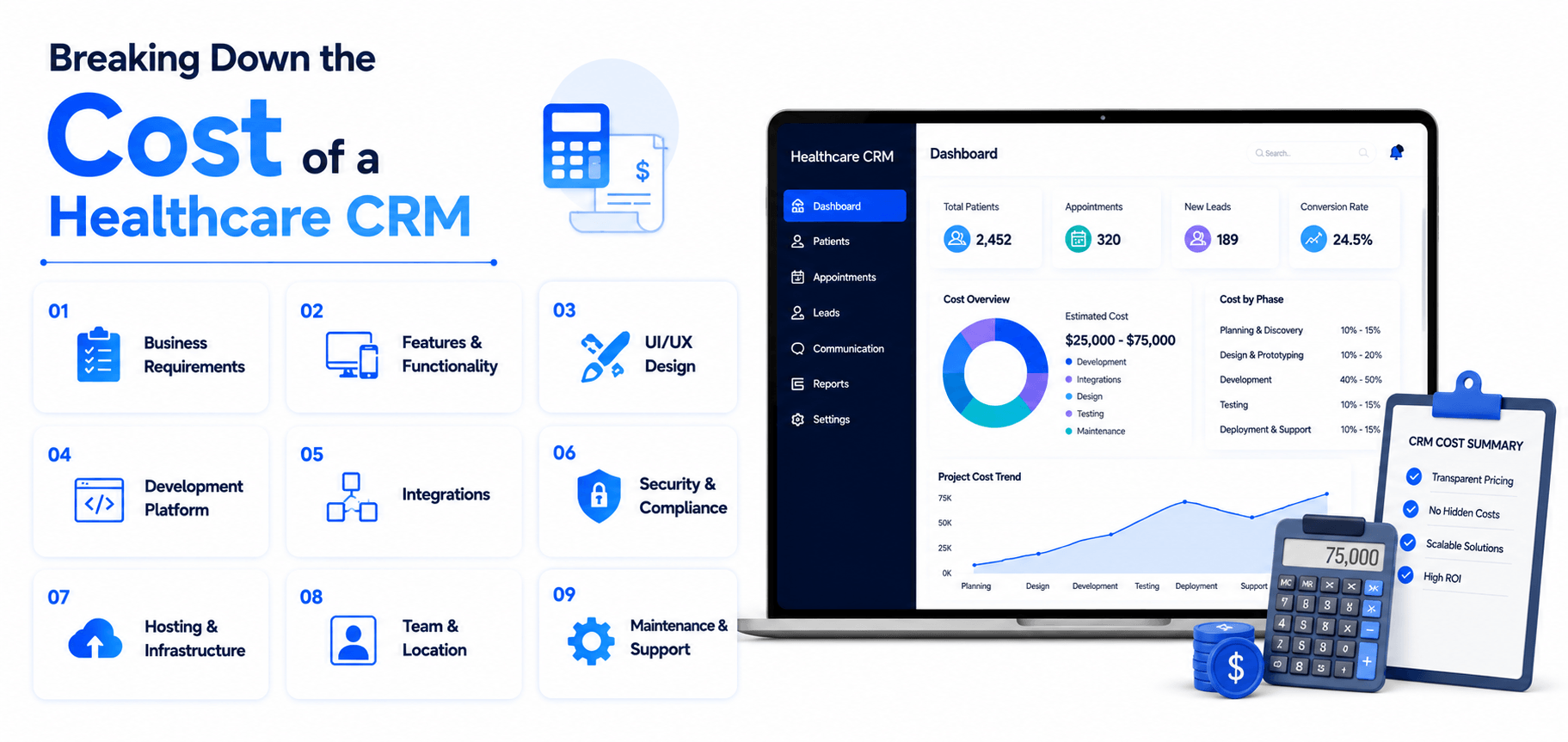
If you are investing in a healthcare CRM software, you should have a budget of approximately $25,000 – $300,000+.
However, the ultimate cost to build a healthcare CRM software may vary based on your project type.
The table below will clear all your doubts –
| Project Type | Estimated Cost | Timeline | Best For |
| Basic Healthcare CRM | $25,000 – $50,000 | 3–5 months | Small clinics and startups |
| Mid-Level Healthcare CRM | $50,000 – $150,000 | 5–8 months | Growing healthcare providers |
| Enterprise Healthcare CRM | $150,000 – $300,000+ | 8–12+ months | Hospitals, healthcare networks, and large organizations |
As you’d expect, the custom CRM software development cost goes up as you add advanced features like EHR/EMR integrations, telemedicine, AI chatbots, analytics, and patient portals. Likewise, the software development services you choose also play a big role in the overall budget.
An experienced healthcare development team may cost more beforehand. But it also means better code quality, better security and a platform that is easier to scale.
Common healthcare CRM software development challenges & their solutions
1. Ensuring data security and HIPAA compliance
Healthcare CRMs handle really sensitive patient info. And this is why security and compliance are a top priority because if you fail to meet regulatory standards, it can lead to legal penalties, and reputational damage, and of course loss of patient trust.
Solution: You build HIPAA compliant healthcare CRM software by implementing end-to-end encryption, role-based access control, multi-factor authentication, and regular audits, so that compliance testing happens throughout the development lifecycle.
2. Integrating multiple healthcare systems
A CRM rarely works in isolation. It has to connect with EHR/EMR systems, telemedicine platforms, labs and billing. But integrating these (especially legacy systems) can be technically challenging, therefore teams often get stuck here.
Solution: Use standardized APIs and interoperability standards like HL7 and FHIR because that’s what keeps data exchange smooth between every connected system.
3. Low user adoption
It doesn’t matter how much thought went into your patient relationship management software if your users find it difficult to adopt.
Solution: You focus on intuitive UI/UX, and role-based dashboards, and ensure there’s proper onboarding too, so that doctors, nurses, and admin staff, they can start using the platform.
4. Scaling as your organization grows
Healthcare organizations change constantly. It can be challenging for your platform to keep pace.
Solution: During healthcare CRM software development, go with scalable cloud architecture and a modular design so growth doesn’t mean rebuilding everything from scratch.
AI Trends Shaping Healthcare CRM Software Development in 2026
-
AI-powered patient insights
More and more healthcare CRMs are using AI to dig through patient data and spot patterns that would take a human way longer to catch. This helps providers actually understand what patients need, customize how they communicate & basically improve the overall care experience.
-
Intelligent automation
Appointment reminders, follow-up messages, admin work – AI’s handling a lot of that repetitive stuff so you don’t have to. This also means healthcare teams get to spend more time with patients instead of tasks.
-
Predictive analytics for better decisions
AI-driven analytics can help organizations get ahead of things like – predicting patient behavior, flagging potential risks early, and planning resources smarter (means providers can make proactive calls instead of reactive ones and care ends up feeling more personalized).
-
Conversational AI and virtual assistants
Chatbots and virtual assistants are showing up in healthcare CRMs more than before. Patients get quick answers, can book appointments – and pull up info without sitting on hold waiting for someone to pick up.
Top healthcare CRM platforms compared for 2026
There’s no such thing as “best” healthcare CRM out there. Or is there?
Well the answer depends on what you need. A solo clinic and a hospital network are going to have completely different priorities, whether that’s budget, how much customization you want, or how strict your compliance requirements are.
I put together a comparison of some of the top healthcare CRM platforms for 2026 below, so you can see what each one actually brings to the table and figure out which fits your situation best.
| Platform | Best For | Key Strengths |
| Salesforce Health Cloud | Large healthcare organizations | AI-powered patient engagement, workflow automation, scalability |
| Microsoft Dynamics 365 | Enterprise healthcare providers | Seamless Microsoft ecosystem integration, analytics, automation |
| HubSpot CRM | Small to mid-sized practices | Easy to use, affordable, patient communication tools |
| Zoho CRM | Clinics and specialty practices | Cost-effective customization, workflow automation |
| Creatio | Healthcare organizations with complex workflows | No-code customization, process automation, omnichannel engagement |
How to choose the best healthcare CRM software
The truth is, there isn’t one healthcare CRM that is perfect for everyone. The right choice depends on your organization’s goals, workflows and future growth plans.
So before making a decision, ask yourself a few key questions –
1. Scalability: Can the CRM grow as your patient base and services expand?
2. Integrations: Does it connect seamlessly with your EHR/EMR, billing, telemedicine, and other healthcare systems?
3. Compliance: Is it HIPAA compliant and equipped with robust security features?
4. Customization: Can it be tailored to match your workflows and specialty requirements?
5. Ease of use: Will your staff be able to adopt it quickly without extensive training?
If off-the-shelf platforms don’t meet your needs, it’s better that you invest in healthcare CRM software development.
Future of healthcare CRM software development beyond 2026
1. Hyper-personalized patient engagement
AI is going to get a lot better at reading between the lines, picking up on a patient’s behavior, history and preferences to send reminders, treatment plans and wellness tips that actually feel relevant to them.
2. Predictive and preventive care
CRMs are also heading toward catching problems before they become problems. They are already flagging high risk patients earlier, spotting who’s likely to miss their next appointment and giving providers a chance to step in before a small issue turns into a costly one.
3. Connected healthcare ecosystems
And it’s not going to stop at just the CRM. Expect deeper integration with EHRs, wearables, remote monitoring tools, and telehealth – basically giving providers one full picture of a patient’s journey.
Why businesses worldwide choose Techugo for healthcare CRM software development
Businesses choose Techugo because we understand healthcare.
As a mobile app development company that is globally trusted, we have been helping healthcare organizations for over a decade.
Whether you’re a startup or an enterprise ready to modernize what you’ve already built, we care about your goals. Our team uses tools like Flutter, Node.js, React Native, AI and modern cloud platforms so that you get a product that is fast, reliable and actually pleasant to use.
We’ve spent enough time in healthcare to know that healthcare regulations need careful attention and the stakes are real. So we handle everything end to end, and build it in a way that won’t fall apart the moment you start to grow.
So what’s stopping you from partnering with us?
This is your sign. Get in touch with our team and let’s take your healthcare project to new heights.
FAQs
1. What is healthcare CRM software?
Healthcare CRM software helps providers keep track of patient interactions, appointments, communication and important data (all in one place).
2. How much does it cost to build a healthcare CRM?
It usually costs anywhere between $25,000 and $300,000+. The final price depends on things like features, integrations, security requirements and how complex you want the platform to be.
3. How long does healthcare crm software development take?
It depends on what you’re building. A basic CRM may take a few months while a feature-rich solution with custom integrations can take longer.
4. What features should a healthcare CRM have?
At the very least, it should include patient profiles, appointment management, communication tools, analytics, automation and EHR/EMR integrations.

Get in touch
We'd love to hear from you.