

 SA
SA
 KW
KW
 IE
IE AU
AU UAE
UAE UK
UK USA
USA
 CA
CA DE
DE
 QA
QA ZA
ZA
 BH
BH NL
NL
 MU
MU FR
FR
















📌 Key Takeaways
- EMR systems are no longer just digital records – they’re making healthcare faster, simpler, and more connected.
- Doctors and staff save time when workflows are automated and patient data is instantly accessible.
- AI, cloud, and real-time integrations are shaping the next generation of EMR platforms.
- Security and compliance aren’t optional, they’re the backbone of every EMR solution.
- The right EMR partner matters, because good software should make healthcare feel effortless, not complicated.
A doctor shouldn’t be wasting half their time digging through patient files but in many hospitals, that’s still been the reality for years.
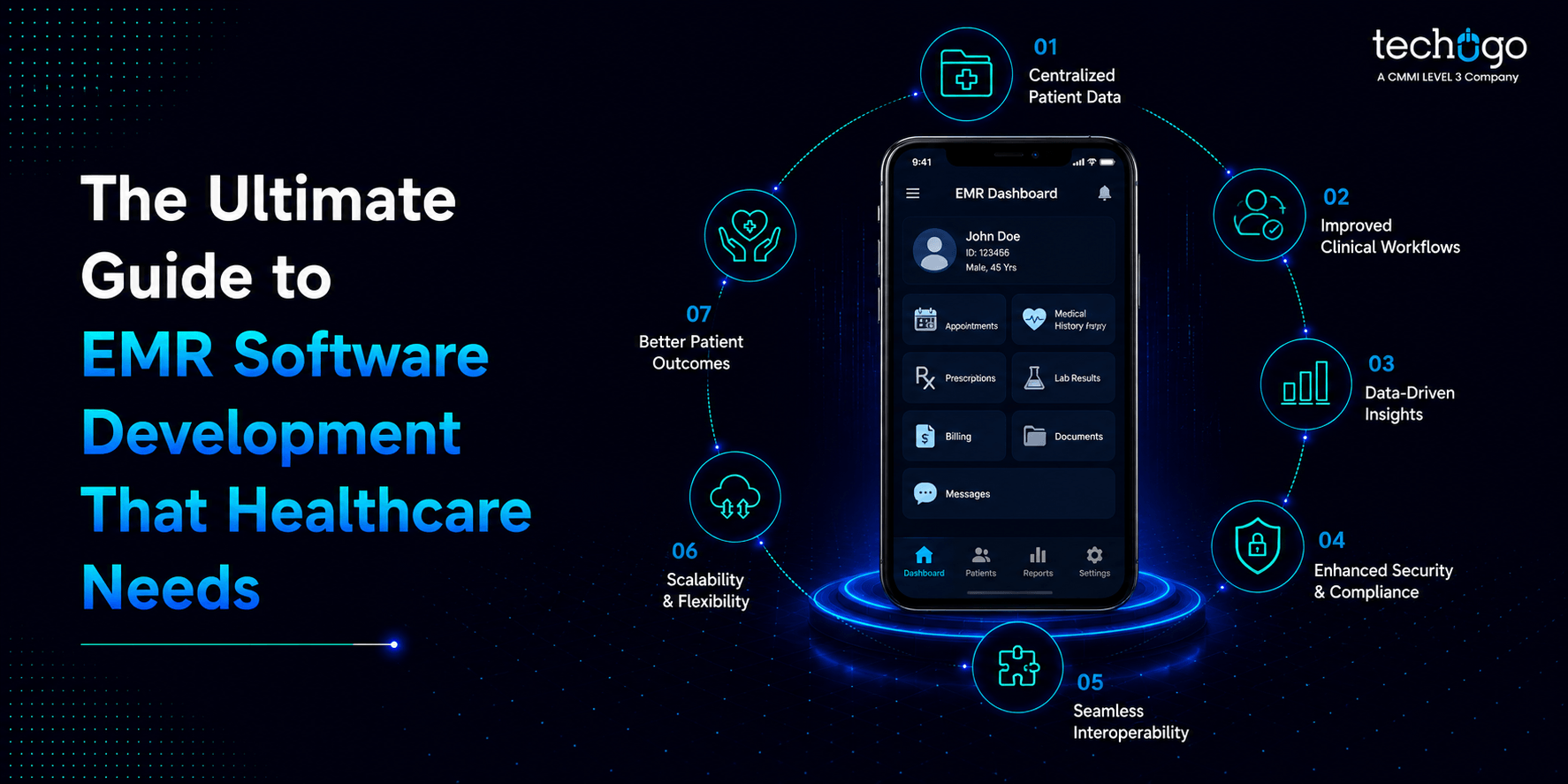
That’s exactly why EMR software development has become such a big shift in modern healthcare. It’s no longer just about digitizing records; it’s about making patient information instantly accessible, usable, and secure across the entire care system. From medical history to prescriptions and diagnostics, everything is now moving into unified digital platforms that help doctors focus more on treatment and less on paperwork.
And this shift isn’t small. In the U.S. alone, the EMR market was valued at around USD 2.31 billion in 2024 and is expected to grow at about 4.1% CAGR from 2025 to 2030 (source: Grand View Research), showing how quickly healthcare systems are investing in digital transformation.
Instead of wasting time switching between systems or tracking down reports, medical staff can now access complete patient information in seconds – right when they need it most.
And as healthcare becomes more complex, this shift isn’t just useful anymore – it’s becoming essential.
In this guide we’ll break down the key features of EMR systems, their benefits, the development process, compliance and security requirements, technology stack, cost factors, challenges, and the latest AI-driven trends shaping the future of EMR software.
Why EMR software development is becoming a business priority in healthcare
Healthcare has reached a point where “digital transformation” is no longer a buzzword – it’s survival.
Hospitals and clinics are dealing with growing patient loads, tighter regulations, and constant pressure to deliver faster, more accurate care. And in that reality, old-school record keeping just doesn’t hold up anymore.
That’s where EMR software development quietly becomes a business priority, not just an IT upgrade.
Instead of juggling paper files, scattered systems, and delayed reports, healthcare providers are moving toward centralized digital platforms that actually make their day-to-day work easier.
With EMR development, a few things change almost immediately:
- Patient records stop being “search tasks” and become instantly accessible
- Doctors spend less time on admin work and more time on actual care
- Departments can finally work with the same real-time data
- Errors caused by manual entry start dropping significantly
From a business point of view, it’s even bigger than that. EMR systems help hospitals reduce operational friction, improve resource utilization, and scale without constantly increasing overhead costs. That’s a big deal in a sector where efficiency directly impacts both revenue and patient outcomes.
This is also why demand for a reliable EMR software development company has gone up. Healthcare providers aren’t just looking for software – they want systems that are secure, compliant, and actually built around how real hospitals work, not just how software is supposed to work on paper.
At the end of the day, EMR isn’t just about digitizing records anymore. It’s about building a healthcare system that runs smoother, faster, and smarter without burning out the people working in it.
Build a Secure EMR Solution
Develop secure, scalable EMR software tailored to your healthcare needs.
Must-have features of EMR software development
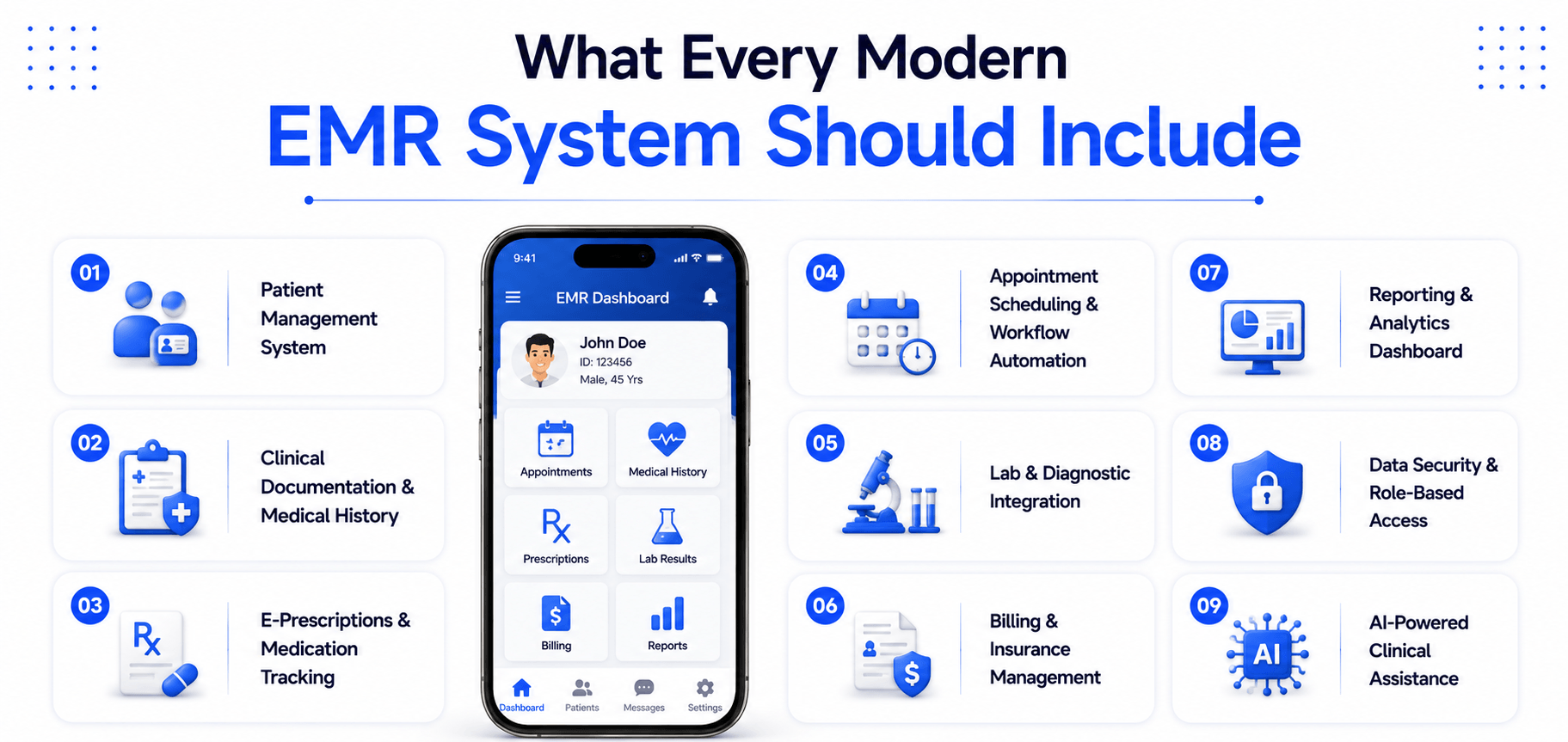
-
Patient management system
At the center of any EMR system is the patient record. It keeps everything – basic details, medical history, past visits – in one place so doctors don’t have to dig through files or switch between systems.
-
Clinical documentation & medical history
Doctors can just write things as they go – diagnosis, treatment notes, progress updates – and it all stays properly organized and easy to pull up later when needed.
-
E-prescriptions & medication tracking
Prescriptions become cleaner and more reliable. No handwriting confusion, no missed details… just a straightforward digital record that also helps track medications properly.
-
Appointment scheduling & workflow automation
It takes the chaos out of scheduling. Appointments are managed automatically, staff don’t have to constantly coordinate and things generally just run more smoothly.
-
Lab & diagnostic integration
Instead of waiting for reports or chasing updates, everything from labs and diagnostics shows up directly in the system. Doctors can see results as soon as they’re ready.
-
Billing & insurance management
Billing becomes less of a back-office struggle. A lot of the manual work gets removed and insurance processing becomes quicker and more structured. In many setups, this level of control is usually achieved through custom EMR software development tailored to the hospital’s workflow.
-
Reporting & analytics dashboard
Rather than guessing how things are going, hospitals can actually see it – patient flow, performance, workload patterns – all in one place.
-
Data security & role-based access
Not everyone needs access to everything. The system quietly takes care of that, making sure sensitive patient data only goes where it’s supposed to.
-
AI-powered clinical assistance
This is where EMR systems are starting to feel very different from before. AI helps doctors pick up patterns in patient data, summarize information faster, and support decisions without replacing the doctor’s judgment. It’s slowly becoming part of how modern EMR development actually work day to day.
If you talk to hospital staff, they won’t say “we need more features.” They’ll say things like “this slows us down” or “this takes too many clicks.” And that’s the real insight most EMR systems miss – healthcare doesn’t need more complexity, it needs systems that quietly make the chaos easier to handle.
Different types of EMR systems in healthcare
Not every healthcare organization works the same way – and honestly, why would every EMR system? A small neighborhood clinic has completely different priorities than a hospital network juggling thousands of patients a day. That’s exactly why EMR software development has branched out into so many different directions.
Take a look…
Cloud-based EMR systems
These are probably the most popular right now, and it’s easy to see why. Cloud-based EMR solutions let you pull up patient records from anywhere, there’s no server room in the basement to worry about, and scaling up as you grow is way less of a headache.
On-premise EMR systems
For organizations that want everything under their own roof. More control over your data, more control over security – but yes, you’re also taking on more responsibility to keep things running.
Specialty-specific EMR systems
This one makes a lot of sense when you think about it. A dermatologist’s day looks nothing like a cardiologist’s or a pediatrician’s. Why should they all be forced into the same software? Specialty-specific systems are built around the exact workflows, documentation needs, and day-to-day realities of a particular field – so clinicians can actually focus on their patients instead of fighting their tools.
Hospital EMR systems
Hospitals are genuinely complex – multiple departments, huge patient volumes, billing, diagnostics, scheduling all happening at once. These systems are built to hold all of that together without falling apart.
Enterprise EMR systems
For organizations spread across several locations, these give you a centralized way to stay consistent and keep information flowing between facilities without things getting messy.
Custom EMR systems
Sometimes none of the ready-made options quite fit. That’s when custom EMR software development makes the most sense – building something around how your team actually works, rather than bending your workflows to fit a generic product.
Integrated EMR systems
These tackle a different problem: getting all your moving parts – labs, pharmacies, billing, telehealth – to actually talk to each other. Through proper EMR integration services, organizations can make sure nothing slips through the cracks.
AI-powered EMR systems
This is genuinely exciting territory. AI is starting to change what EMR systems can do. We’re talking about systems that can spot patterns in patient data, handle documentation automatically, and give clinicians better decision support – all while cutting down on the administrative grind.
Which type is right for you?
Honestly, that depends entirely on your organization – your size, your workflows, your budget, where you’re headed. There’s no universal answer. The smartest move is finding something that fits the way you already work, not the other way around.
Benefits of EMR software development
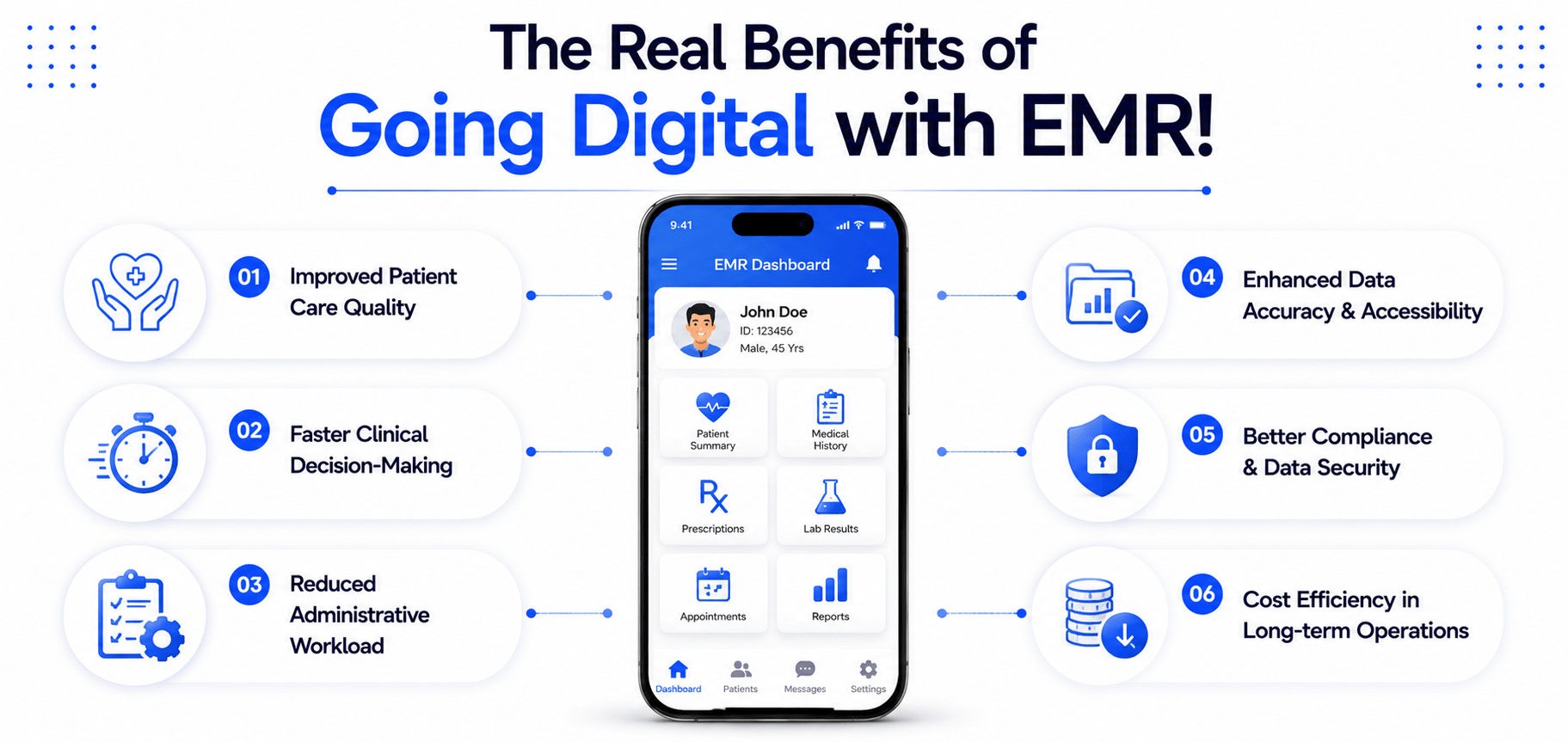
Improved patient care quality
Having the full picture of a patient’s history right in front of you changes everything. Doctors can make better calls, care feels more personal, and nothing important gets missed. That’s honestly one of the biggest reasons organizations put real thought into custom software development – because a system built around your specific workflows just works better for everyone involved.
Faster clinical decision-making
There’s no time to be digging through files or chasing down a report when someone needs help now. EMR systems cut all that out. Everything’s already there, so the focus stays where it belongs – on the patient.
Reduced administrative workload
Ask any nurse or doctor what eats up their day and paperwork is always on the list. Scheduling, documentation, billing – EMR systems handle a big chunk of that automatically. That’s the time people get back to actually doing their jobs.
Enhanced data accuracy & accessibility
Handwritten notes and manual entry are where things go wrong. Digital records are cleaner, easier to access, and way less prone to those kinds of slip-ups. And with features like HL7 EMR Integration – labs, pharmacies, and hospitals can share data seamlessly instead of operating in silos.
Better compliance & data security
Patient information is about as sensitive as it gets. EMR systems help organizations stay on the right side of regulations while keeping that data locked down with encryption, access controls, and audit trails.
Cost efficiency in long-term operations
The upfront cost is real, but so are the savings down the line. Less paperwork, fewer errors, smoother day-to-day operations. Good EMR software developers will also build with growth in mind, so you’re not back to square one every time your organization expands.
How to build an EMR system: step-by-step development process
Requirement analysis and planning
Before anyone writes a single line of code, there’s a lot of listening that needs to happen. EMR software development starts with really understanding how an organization operates – the workflows, the pain points, the compliance requirements, where they want to be in five years. Get this part wrong and everything built on top of it is shaky.
UI/UX design
Doctors and nurses are busy. They’re not going to sit through a tutorial or fumble through a confusing interface between patients. The design has to be clean, intuitive, and built for people who are moving fast. If the software slows them down, it’s already failing at its job.
Backend and frontend development
This is where EMR development really comes to life. The frontend needs to feel effortless for the people using it every day, while the backend is quietly doing the heavy lifting – managing records, handling security, keeping everything running smoothly even as patient volumes grow.
Integration with third-party systems
Healthcare doesn’t run on one platform. Labs, pharmacies, insurance providers, telehealth tools – they all need to talk to each other. That’s where solid EMR software development services come in, making sure data flows between systems without friction instead of getting stuck somewhere in the middle.
Testing and quality assurance
With something this important, there’s really no room for “we’ll fix it later.” Every feature gets put through its paces – bugs, security gaps, compliance checks – before anything goes live. It has to work right the first time.
Deployment and maintenance
Launching is honestly just the beginning. Like any serious healthcare app development project, EMR systems need constant attention – updates, security patches, performance tweaks. Regulations change, technology moves forward, and the system has to keep up with all of it.
Compliance & security in EMR system development
- Healthcare regulations overview
Healthcare data isn’t something you can afford to be casual about. HIPAA in the US, GDPR in Europe, and a whole range of regional standards exist for a reason – patient information is sensitive and the rules around it are strict. Compliance isn’t an afterthought either, it has to be baked in from day one. It’s a core part of EHR and EMR software development, making sure organizations stay on the right side of the law while actually protecting the people they serve.
- Data security measures
A username and password isn’t going to cut it anymore. Modern EMR systems layer in encryption, multi-factor authentication, role-based access controls, and secure backups to keep patient records safe – whether they’re sitting in storage or moving between systems. This is especially important for cloud-based EMR solutions, where data needs to stay protected while still being accessible across different locations and devices.
- Audit and monitoring systems
Security doesn’t end at launch. The best EMR platforms keep detailed activity logs, track compliance in real time, and run regular audits to catch anything suspicious before it turns into a real problem. It’s the kind of ongoing vigilance that most people don’t see but absolutely cannot skip.
Why compliance matters in EMR systems?
This isn’t just about dodging fines – though those are very real. It’s about trust.
One data breach can seriously damage a healthcare organization’s reputation, finances, and legal standing all at once. That’s why a lot of providers turn to EMR consulting solutions to help them make sense of complex regulations, tighten up their security practices, and make sure they’re not caught off guard when the rules change.
Technology stack used in EMR system development
Building an EMR system is a lot more involved than just digitizing patient records. You’re creating a platform that has to be secure, scalable, and reliable enough to handle massive amounts of sensitive data – which is why EMR system development requires serious technology decisions from day one.
Here’s a look at what typically goes into the stack:
Frontend technologies – React, Angular, and Vue.js are popular picks for building interfaces that are fast, clean, and easy to navigate – because nobody has time for clunky software in a busy clinical setting.
Backend Frameworks – Node.js, .NET, Java Spring Boot, and Django are commonly used to handle the complex workflows and data processing that healthcare environments demand behind the scenes.
Databases – PostgreSQL and MySQL work well for structured patient records, while NoSQL databases step in for larger volumes of unstructured data.
Cloud Infrastructure – AWS, Azure, and Google Cloud give organizations scalability, disaster recovery, and secure storage without a massive hardware investment every time they grow.
Interoperability Standards – HL7 and FHIR make sure your EMR can actually communicate with labs, pharmacies, insurance providers, and telehealth platforms without things getting lost in translation.
The right stack matters!
The best EMR software development companies choose technology based on compliance needs, scalability, and long-term goals – not trends. That’s what separates the top EMR software solutions from everything else.
Cost to develop EMR system: factors & estimates
The cost to develop EMR system can vary significantly depending on the number of features, compliance requirements, integrations, security measures – and the overall complexity of the platform. A basic solution designed for a small clinic will cost far less than an enterprise-grade system built for a multi-location healthcare network.
As a general estimate, EMR software development projects typically range from $150,000 to $500,000+, with costs increasing as additional functionality and integrations are added.
| EMR System Type | Estimated Cost | Best For |
| Basic EMR System | $150,000 – $250,000 | Small clinics and private practices |
| Mid-Level EMR Solution | $250,000 – $400,000 | Growing healthcare organizations requiring advanced workflows and integrations |
| Enterprise EMR Platform | $500,000+ | Large hospitals, healthcare networks, and multi-location providers |
What affects the cost?
Several factors influence the final development budget:
| Cost Factor | Impact on Development Cost |
| Features & Functionality | Advanced capabilities such as AI-assisted documentation, analytics, and telehealth increase development effort. |
| Third-Party Integrations | Connecting laboratories, pharmacies, insurance providers, and external healthcare systems adds complexity. |
| Compliance & Security | HIPAA, GDPR, encryption, audit logs, and access controls require additional development and testing. |
| Custom Workflows | Tailoring the platform to match specific organizational processes increases development time. |
| Scalability Requirements | Systems designed for thousands of concurrent users require stronger infrastructure and architecture. |
| Mobile Accessibility | Supporting mobile healthcare workflows may require additional investment through flutter app development or react native app development to deliver cross-platform experiences. |
Why enterprise EMR systems cost more?
Large healthcare organizations come with a lot of moving parts – advanced reporting, multi-location management, high-volume data processing, strict access controls, and the need to connect with a dozen different systems at once. All of that adds up, and it adds up fast. It’s honestly why enterprise app development projects in healthcare tend to sit at the higher end of the budget range – because the complexity is just on a different level.
Quick insight: The cheapest EMR system isn’t always the most cost-effective one. In healthcare, long-term value.
Ready to Build Your EMR Software?
Get a custom EMR solution with the right features, security, and integrations.
How to find experienced EMR software developers?
EMR software development is nothing like building a regular business application. You need people who actually understand healthcare – the workflows, the compliance requirements, the security concerns, the way everything has to connect. The development team you choose can make or break the whole project, so it’s worth being thoughtful about it.
Look for healthcare industry experience
This isn’t an area where you want someone learning on the job. Developers who’ve worked in healthcare before already know the pitfalls – and that kind of experience saves you a lot of headaches down the road.
Evaluate their technical expertise
Look at what they’ve actually built. Are they comfortable with cloud infrastructure, HL7, FHIR, secure data management? Past projects will tell you a lot more than a sales pitch will.
Assess their integration capabilities
Your EMR won’t exist in a vacuum. Labs, pharmacies, insurance providers, telehealth platforms – it all needs to connect. Make sure the team has real experience building and managing those kinds of integrations.
Ask about their consulting approach
The best partners do more than write code. Teams that offer EMR consulting solutions can help you think through requirements, optimize workflows, plan for compliance, and make smarter technology decisions before development even starts.
Consider mobile capabilities
Healthcare is increasingly on the move. If your team also offers mobile app development services, they can extend your EMR to smartphones and tablets – which makes life a lot easier for clinicians who aren’t always at a desk.
Review post-launch support and maintenance
Going live is just the beginning. Security updates, compliance changes, performance improvements – these don’t stop after launch. A good development partner sticks around for all of it.
Don’t focus on price alone
The cheapest option rarely turns out to be the cheapest in the long run. In healthcare software, expertise genuinely matters – and the right team upfront will save you far more than you’d save by cutting corners on cost.
Challenges in EMR software development (and how to overcome them)
Key Challenges in EMR Development + Fixes
Data migration issues
A lot of healthcare providers are still working off legacy systems or years of paper records. Getting all of that into a new platform is messy – incomplete data, duplicates, different formats. It takes time.
How to overcome it: Do a thorough data audit before migration even starts. Clean it up early and the transition becomes a lot less painful.
Regulatory compliance requirements
HIPAA, GDPR, regional regulations – the rules are strict and they keep changing. Missing the mark on compliance isn’t just a technical problem, it’s a legal and financial one.
How to overcome it: Treat compliance as a core part of development, not something you bolt on at the end. Working with an experienced EMR software development company means security and privacy standards get built in from day one.
System integration complexity
Labs, pharmacies, billing systems, insurance providers, telehealth platforms — getting all of these to actually talk to each other is one of the harder parts of EMR development.
How to overcome it: Standards like HL7 and FHIR exist for exactly this reason. Plan integrations early rather than treating them as an afterthought.
User adoption resistance
You can build the most technically impressive system in the world and it still won’t work if people don’t want to use it. Staff who are comfortable with existing workflows don’t always welcome change.
How to overcome it: Involve healthcare professionals early in the process, keep the design intuitive, and invest in proper training. When people feel heard and supported, adoption goes much more smoothly.
Balancing security with accessibility
Clinicians need fast access to patient information – but that can’t come at the expense of security.
How to overcome it: Role-based access controls, multi-factor authentication, encryption, and continuous monitoring strike that balance without making authorized users jump through unnecessary hoops.
Keeping up with evolving healthcare technology
AI, cloud computing, telemedicine – healthcare technology moves fast and systems that aren’t built for growth get left behind quickly.
How to overcome it: Build with scalability in mind from the start. A flexible architecture means you can add new features and integrations without tearing everything down and starting over.
The bottom line
Most EMR challenges aren’t really about technology – they happen when technology, compliance, and real-world workflows stop talking to each other. Organizations that plan carefully, bring end users into the process, and work with the right development partners are the ones that end up with systems that actually hold up.
Emerging AI trends in EMR software development
A few years ago, EMR systems were mostly digital filing cabinets. Today, they’re starting to do a lot more than just store information – and AI is a big reason why.
Here’s where things are heading:
- Doctors spending less time typing and more time treating patients
One of the biggest shifts is AI-powered documentation. Through AI development services, healthcare organizations can automate note-taking, transcribe consultations, and reduce the endless administrative work that often contributes to clinician burnout.
- EMR systems that don’t just store data – they learn from it
AI can analyze patient histories, lab results, and clinical records to highlight trends, flag potential concerns, and support faster decision-making when time matters most.
- Generative AI becoming a digital assistant for healthcare teams
Thanks to generative AI development services, EMR platforms can now generate patient summaries, draft clinical notes, and quickly pull relevant information from thousands of records in seconds.
- Predicting problems before they become emergencies
Instead of reacting to health issues after they happen, AI is helping providers identify risks earlier, creating opportunities for more proactive and preventive care.
- Less administrative chaos behind the scenes
Scheduling, resource allocation, patient flow management – many of the operational tasks that traditionally required manual effort can now be optimized with AI-powered automation.
The bigger picture? EMR systems are slowly evolving from record-keeping tools into intelligent healthcare platforms. And honestly, we’re probably only seeing the beginning of what’s possible.
Why choose Techugo for your EMR software development project?
The right EMR can transform healthcare operations. The wrong one can slow them down for years.
That’s where the challenge lies. Healthcare professionals need technology that simplifies workflows, not adds to their workload. As an award-winning mobile app development company, Techugo builds secure, scalable, and intelligent EMR solutions that streamline operations, improve patient care, and support long-term growth for healthcare organizations.
Here’s why clients choose Techugo:
- Healthcare-Focused Expertise – Extensive experience developing custom healthcare and EMR solutions.
- Compliance-First Approach – Solutions designed with HIPAA, GDPR, and healthcare security standards in mind.
- AI-Driven Innovation – Advanced automation, analytics, and intelligent workflows powered by modern AI technologies.
- Seamless Integrations – Easy connectivity with EHRs, telehealth platforms, billing systems, and third-party tools.
- Scalable Architecture – Future-ready EMR solutions that grow alongside your organization.
- End-to-End Development Support – From strategy and design to deployment, maintenance, and optimization.
Shall we get started? Let’s build an EMR that actually works for your team – talk to Techugo today!
FAQs
1. Why is EMR software important for healthcare organizations?
EMR systems improve patient care, reduce paperwork, streamline clinical workflows, and enable faster, data-driven decision-making for healthcare professionals.
2. What technologies are used in modern EMR development?
Modern EMR systems use technologies like AI, cloud computing, data analytics, APIs, and interoperability frameworks to enhance efficiency and connectivity.
3. Is EMR software secure and compliant?
Yes, well-built EMR systems follow strict standards like HIPAA and GDPR to ensure patient data security, privacy, and regulatory compliance.
4. How much does it cost to develop EMR software?
The cost of EMR software development typically ranges from $150,000 to $500,000+, depending on features, complexity, integrations, and customization needs.
5. What is the difference between EHR and EMR software development?
EHR software development focuses on building systems that allow data sharing across multiple healthcare providers, while EMR software development is centered on managing patient records within a single clinic or hospital.

Get in touch
We'd love to hear from you.