

 SA
SA
 KW
KW
 IE
IE AU
AU UAE
UAE UK
UK USA
USA
 CA
CA DE
DE
 QA
QA ZA
ZA
 BH
BH NL
NL
 MU
MU FR
FR













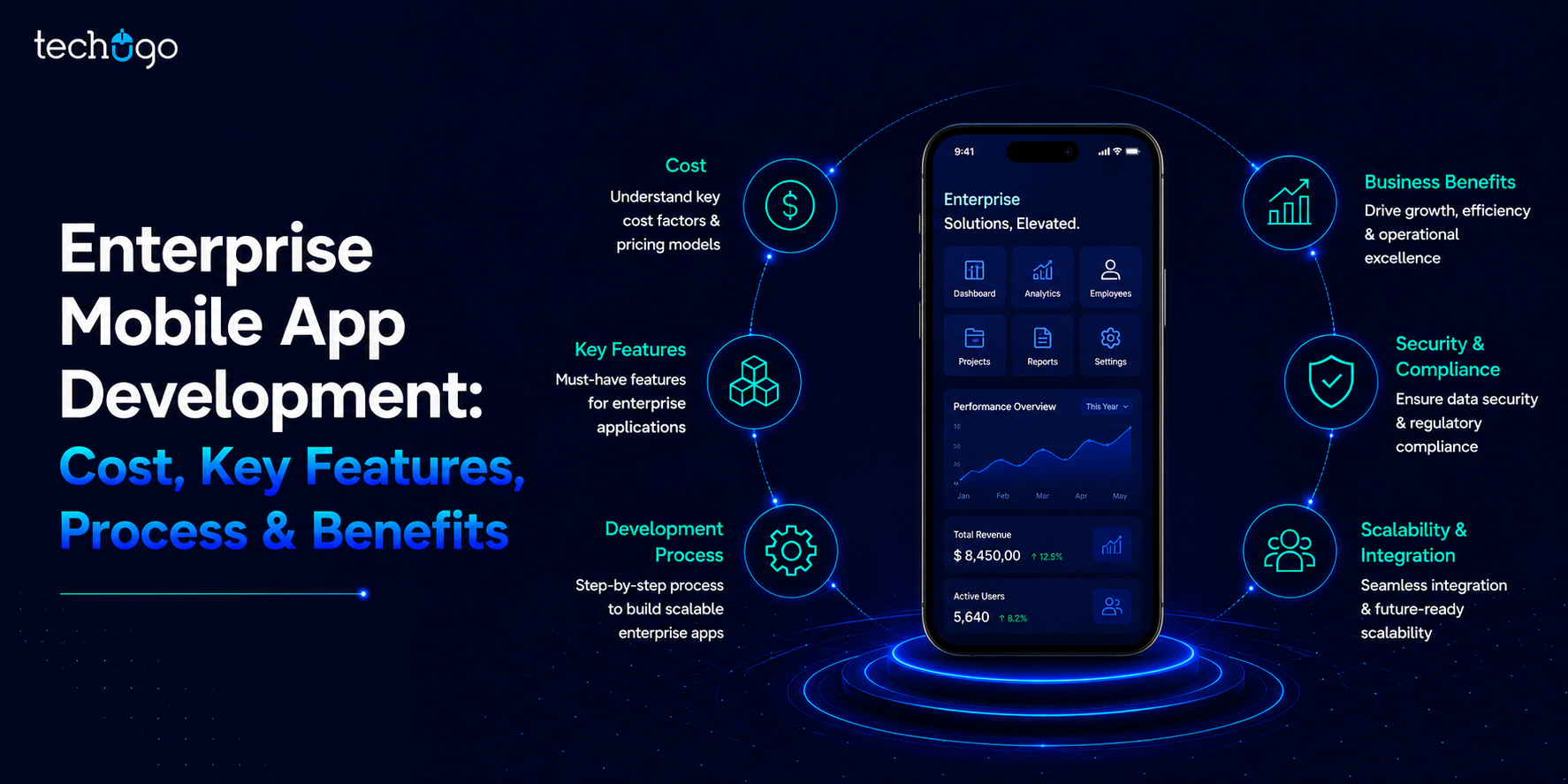


📌 Key Takeaways
- Enterprise apps help businesses replace messy, disconnected workflows with faster and more efficient processes.
- Mobile-first solutions give employees access to tools, data, and approvals from anywhere, improving productivity and collaboration.
- Features like automation, analytics, integrations, and strong security are what separate enterprise apps from standard business applications.
- Building an enterprise app is a long-term investment, with costs typically ranging from $150,000 to $300,000+ depending on complexity.
The businesses winning today are the ones removing friction from every process.
As organizations grow, that becomes easier said than done.
Most teams are stuck juggling spreadsheets, endless email threads, and tools that don’t talk to each other. None of it was built for the way businesses actually run today. That’s why enterprise mobile app development has become such a big deal – it gives organizations a real way to clean up their operations, increase productivity and access what they need from anywhere.
The numbers back it up too. According to recent market research the U.S. mobile app development market was sitting at over $60 billion in 2025 and is on track to blow past $150 billion by 2034. AI, automation, enterprise mobility – it’s all pushing that growth forward.
And here’s the thing people often forget – your employees and your customers have high expectations now. They want to approve something from their phone, pull up data on the road, manage operations without being chained to a desk. If your tech can’t do that, you’re already falling behind.
So in this guide, we’re going to walk through everything – what enterprise mobile application development actually involves, the benefits, the different types, features you can’t skip, what it costs, and where the technology is heading.
Why businesses are investing in enterprise mobile app development
The bigger a business gets, the harder it becomes to keep everyone on the same page.
More employees, more departments, more data – and suddenly the systems that used to work just… don’t anymore.
That’s the reality a lot of companies hit. They’re running on disconnected tools and manual processes, and it shows – things slow down, communication breaks down, and productivity takes a hit. It’s one of the biggest reasons so many companies are putting real money into enterprise mobile app development right now. They need workflows that actually connect people and information, not fragment them further.
Then there’s the mobility piece. People aren’t working from one desk in one office anymore. They’re remote, they’re traveling, they’re making decisions on the go – and they expect their work tools to keep up. Mobile solutions make that possible and honestly make collaboration a whole lot smoother too.
A lot of companies are also leaning on enterprise apps for enterprise workforce management – giving managers one place to track performance, assign tasks, and keep an eye on operations without bouncing between five different platforms.
Of course, building something that’s actually secure and scales with your business isn’t simple. That’s why a lot of organizations bring in an enterprise mobile app development company that gets both the technical side and the business side – because the tech needs to grow with you, not hold you back.
At the end of the day, this isn’t just about going mobile. It’s about building faster, smarter processes and giving your business the flexibility to compete in a world that’s only getting more digital.
Types of enterprise mobile applications businesses invest in
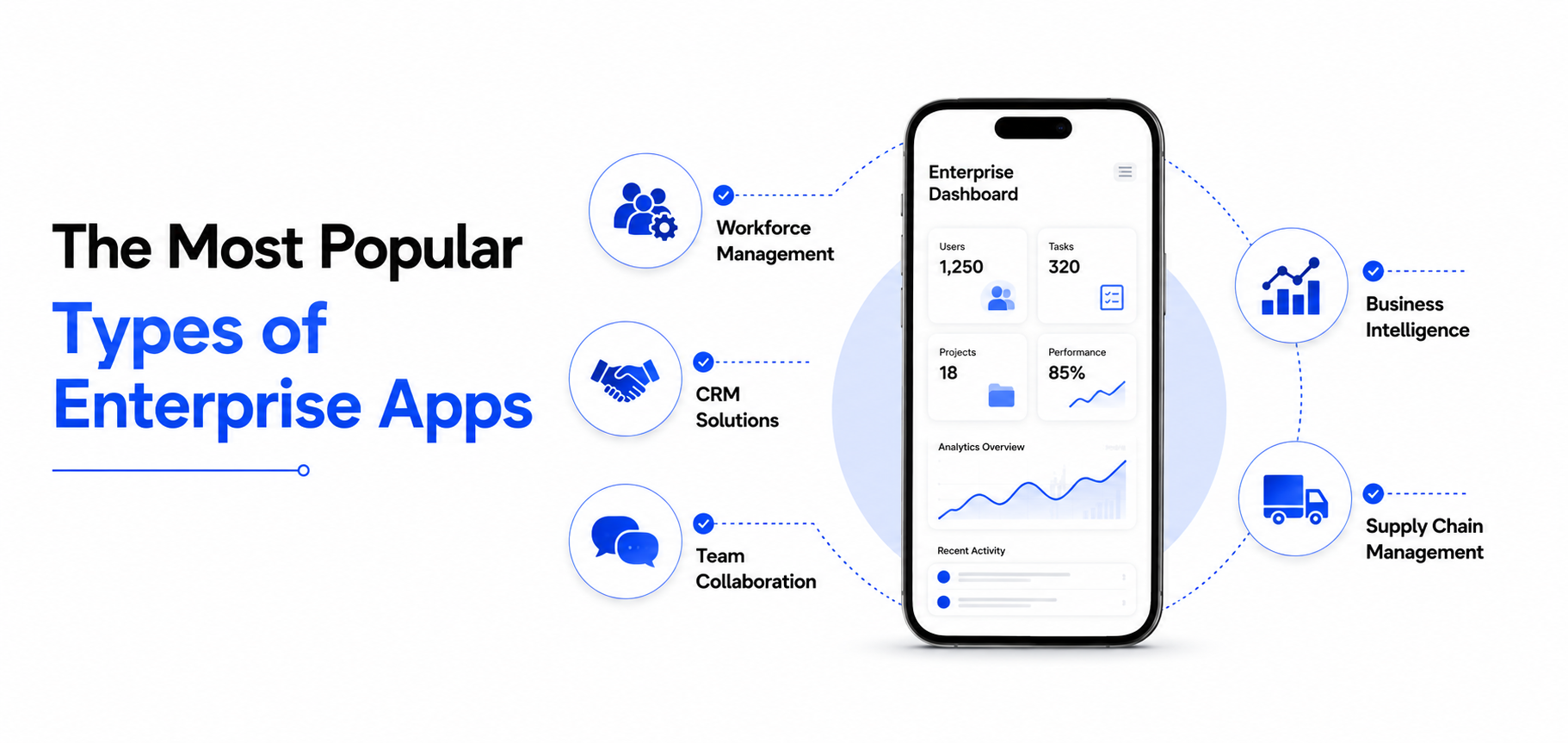
When people talk about enterprise mobile app development, they’re really talking about a whole range of solutions businesses use to get more done, run smoother, and help teams work together better. So let’s go through some of the most common types of enterprise mobile applications companies are investing in these days.
1. Enterprise workforce management apps
These are basically the apps that help businesses keep track of schedules, attendance, task assignments, and how employees are performing – all from one central place. Good enterprise workforce management tools make life easier for managers and keep employees connected even when they’re out in the field or working remotely.
2. Customer relationship management (CRM) apps
These let teams keep all their customer info in one spot, track every interaction, and respond to customers faster – which, at the end of the day, just helps build stronger relationships.
3. Enterprise collaboration apps
Think messaging, file sharing, project management, video calls – basically anything that helps teams communicate and actually get work done together, no matter where everyone’s sitting.
4. Business intelligence and analytics apps
These give businesses access to real-time reports and performance numbers so leadership can make smarter, faster decisions instead of guessing.
5. Supply chain and inventory management apps
Companies rely on these to keep tabs on inventory, track shipments, manage suppliers, and basically get full visibility into what’s happening across their supply chain.
At the end of the day, as more businesses lean into digital transformation, enterprise mobile app development isn’t going anywhere – it’s still one of the best ways companies can build the right tools to boost efficiency, improve collaboration, and fuel long-term growth.
Business benefits of enterprise mobile app development
These days, businesses aren’t just digitizing for the sake of it – enterprise mobile app development has turned into a real strategic move, not just some IT checkbox to tick off. These apps genuinely help companies run smoother, work together better, and react quicker when the market shifts.
1. Improved operational efficiency
Enterprise apps basically put everything employees need (systems, data, tools) right in their pocket. That means less manual back-and-forth, fewer delays, and teams that just get more done without all the friction.
2. Enhanced enterprise workflow automation
This is honestly one of the biggest wins. Enterprise workflow automation takes all those repetitive, annoying tasks – approvals, reporting, passing data between teams – and just handles them automatically. Less room for human error, and decisions move a lot faster across the board.
3. Better employee productivity
When people can pull up business apps from anywhere, they can actually get work done, stay in the loop, and access whatever info they need – no matter where they are. That kind of flexibility makes a huge difference, especially for remote teams or anyone working out in the field.
4. Faster business decision-making
With real-time dashboards and reports right there, decision-makers don’t have to wait around for information – they can see what’s happening and act on it immediately, with way more confidence.
5. Scalable solutions for future growth
Good enterprise apps aren’t built just for today… they’re built to grow with you. Whether you’re adding more users, expanding into new markets, or plugging in new tech, these solutions are flexible enough to keep up.
The most overlooked benefits of enterprise mobile app development have little to do with technology itself. What businesses are really investing in is speed – speed of communication, speed of decision-making, and speed of execution. And in today’s market, that speed often becomes a competitive advantage.
Must-have features of enterprise mobile applications
Look, building an enterprise app that just “works” isn’t really the goal here. If you want something that actually sticks around and delivers value down the line, enterprise application development has to go way beyond the basics – it needs to nail productivity, security, collaboration, and efficiency, all at once, across the entire organization.
So here’s what actually matters when you’re building one of these.
1. Employee self-service features
Nobody wants to email HR just to check their schedule or update their address. Letting employees handle that stuff themselves – requests, updates, routine tasks – takes a ton of pressure off the admin side and just speeds everything up.
2. Real-time communication and collaboration
Messaging, file sharing, task management, quick check-ins – this is what keeps teams actually connected, especially when half the company isn’t even in the same building, let alone the same city.
3. Role-based access control
Not everyone should be able to see everything – that’s just asking for trouble. Role-based access makes sure employees, managers, and admins only get into what’s relevant to them. Keeps things organized and a lot safer too.
4. Data analytics and reporting
When leadership has real dashboards and real numbers in front of them, they can actually make decisions fast instead of relying on gut feeling or outdated reports.
5. Enterprise-grade security
This part really isn’t optional. Multi-factor authentication, encryption, secure APIs, compliance – if you’re handling sensitive business data, all of this has to be locked down properly.
6. Third-party integrations
A good enterprise app shouldn’t feel like its own isolated island – it needs to talk to the tools you’re already using, like CRM, ERP, HR platforms, cloud systems, whatever your stack looks like. Honestly, a lot of the better enterprise mobile app development platforms out there are built specifically to make these connections easy instead of a headache.
7. AI-powered capabilities
Smart search, predictive insights, virtual assistants, automated workflows = this stuff isn’t some futuristic extra anymore. It’s quickly becoming just… expected.
So whether you end up working with an enterprise mobile app development company or a mobile app development company in USA, knowing these core features ahead of time really helps make sure whatever gets built actually holds up – and keeps delivering value long after it launches.
Build an Enterprise Mobile App for Your Business
Turn complex business workflows into a secure, scalable mobile solution with custom features, integrations, automation, analytics, and enterprise-grade security.
Step-by-step process of enterprise mobile app development
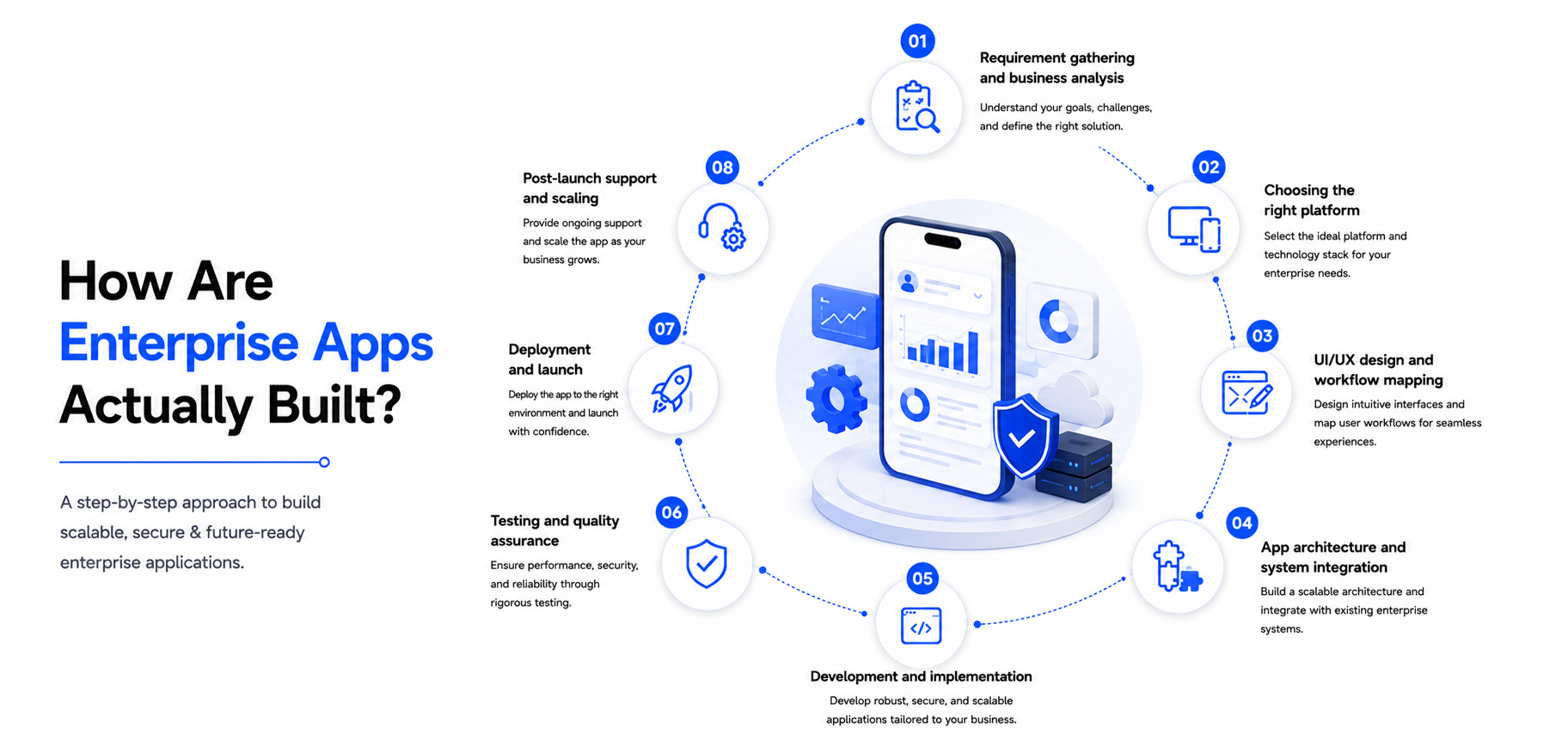
So what does enterprise mobile app development actually look like in practice? It’s basically a structured way of building apps that are scalable, secure, and powerful enough to handle complex business workflows – not just some quick app you throw together over a weekend. Mobile app development for enterprises takes real planning, proper system integration, and picking the right enterprise mobile app development platforms if you actually want something that holds up long-term.
Let’s break down the process step by step to see how it is carried out in real-world projects.
1. Requirement gathering and business analysis
Everything starts here – figuring out what the business actually needs, who the different users are, and what challenges they’re dealing with day to day. This step makes sure that the mobile app is actually built around real workflows, not just assumptions.
2. Choosing the right platform
This decision matters more than people realize. The mobile app development platforms you go with directly affect performance, scalability, and how well everything integrates down the line – and the right choice really depends on your company size, existing tech stack, and where you’re planning to grow.
3. UI/UX design and workflow mapping
This is where things get designed to actually make sense – clean, intuitive interfaces that simplify messy enterprise processes and make navigation easy, no matter which type of user is logging in.
4. App architecture and system integration
Here’s where the technical backbone gets built – an architecture that can handle heavy data loads securely, plus integration with systems like ERP and CRM so data flows smoothly instead of getting stuck in silos.
5. Development and implementation
Now the actual building happens. Developers work on both the frontend and backend using agile methods, which keeps things moving fast and flexible, with room for improvements along the way.
6. Testing and quality assurance
Before anything goes live, the app gets put through serious testing – performance, security, usability, scalability – all of it. The goal is making sure it actually meets enterprise-grade standards, not just “good enough.”
7. Deployment and launch
Once testing checks out, the app finally goes live – whether that’s internal deployment or app stores – and it’s done in a structured way so business operations don’t get disrupted.
8. Post-launch support and scaling
The work doesn’t stop at launch. Ongoing monitoring and updates keep things running well, and a lot of businesses end up teaming up with an on-demand app development company to help with scaling and continued improvements over time.
Key industry use cases for enterprise solutions
Enterprise mobile apps aren’t really a “one size fits all” kind of thing – different industries use them in totally different ways, depending on what problems they’re actually trying to solve.
Let’s look at how a few key sectors are putting these apps to work.
1. Healthcare enterprise apps
In hospitals and clinics, healthcare enterprise apps are being used for things like managing patients, scheduling appointments, handling electronic health records (EHR), and keeping doctors and staff in sync in real time. Basically, they cut down on manual mistakes and help patients get better, faster care.
Also Read – EHR and Medical Record Automation: A Comprehensive Guide
2. Fintech enterprise applications
Over in banking and finance, fintech enterprise applications are doing the heavy lifting for secure digital payments, catching fraud before it becomes a problem, processing loans, and keeping financial data organized and accurate. They’re what allow banks and financial institutions to move faster while still staying secure and able to scale.
3. Logistics management apps
For companies dealing with supply chains and transportation, logistics management apps are honestly a game-changer — tracking shipments, managing entire fleets, optimizing delivery routes, and giving real-time visibility into what’s actually happening on the ground. That means fewer delays, lower costs, and a lot less guesswork.
At the end of the day, no matter the industry, these enterprise solutions are doing the same basic job – keeping teams coordinated, data accurate, and business processes moving faster than they would otherwise.
How much does enterprise mobile app development cost?
Now let’s talk about the final cost.
Well it depends on a bunch of things – how complex the app is, what features you need, how many systems it has to connect with, and how much it needs to scale down the road. With mobile app development for enterprises, you’re generally looking at a bigger investment than your average app, simply because there’s a lot more going on under the hood – stronger architecture, serious security, and deep integrations with stuff like ERP, CRM, and analytics tools.
In terms of actual numbers, you’re typically looking at somewhere between $150,000 to $300,000+, depending on the scope and how technical things get. If you’re going for something simpler – basic dashboards, user management, some reporting features – you’ll likely land on the lower end of that range. But if you’re talking about more advanced builds, like ones with AI capabilities, real-time data processing, cloud infrastructure, or a bunch of system integrations, the cost can climb pretty quickly from there.
This is where the budget goes for enterprise apps
| App Complexity Level | Estimated Cost Range | Key Features |
| Basic Enterprise App | $150,000 – $200,000 | User management, dashboards, reporting, basic integrations |
| Mid-Level Enterprise App | $200,000 – $260,000 | API integrations, workflow automation, role-based access, analytics |
| Advanced Enterprise App | $260,000 – $300,000+ | AI/ML features, real-time processing, cloud scaling, complex integrations |
Get a Custom Enterprise App Development Estimate
Plan your enterprise mobile app with a clear development roadmap, technology strategy, feature breakdown, and cost estimate tailored to your business requirements.
Overall, the enterprise mobile app development cost should be seen as a strategic investment that drives efficiency, automation, and long-term digital transformation rather than just a one-time expense.
Major challenges in enterprise application development
The idea of enterprise mobile application development sounds straightforward on paper but anyone who’s actually been through it knows it’s anything but. Here are the real challenges that come up almost every time:
1. Legacy system integration is a constant headache – Most enterprises are already running on older systems that weren’t built to talk to modern applications. Getting everything to work together without breaking something is genuinely painful.
2. Security at scale is a whole different beast – It’s not just about having a password login. Enterprise apps handle massive amounts of sensitive business data and the security requirements that come with that are serious and complex.
3. Managing multiple user roles and permissions – Enterprises have hundreds or thousands of users across different departments all needing different levels of access. Getting that right without creating loopholes or confusion takes real planning.
4. Scalability pressure – The app needs to handle growth without slowing down or crashing. What works for 500 users today has to work for 50,000 users tomorrow.
5. Keeping everyone aligned – Multiple stakeholders, different departments, conflicting priorities – getting everyone on the same page throughout development is often harder than the technical work itself.
6. Compliance and regulatory requirements – Depending on the industry, there are strict rules to follow. One oversight can turn into a very expensive problem.
7. Maintenance and updates – Enterprise apps aren’t a one-and-done situation. They need constant updates, patches, and improvements which require long-term commitment and resources.
Honestly… the technical side is only half the battle. The organizational and human side of enterprise development is where things get really complicated.
How artificial intelligence is transforming enterprise apps
AI isn’t just some buzzword getting thrown around anymore – it’s actually changing how enterprise apps work, behind the scenes and on the surface too. A few years ago, “smart features” basically meant a chatbot that could answer two or three pre-set questions. Now? AI is doing real work – predicting outcomes, automating entire workflows, and helping employees get things done faster without even thinking about it.
Customer and employee support is probably where this shift shows up the most. The chatbots businesses are building today aren’t the clunky, “click here for option 1, 2, or 3” bots from a few years back. They actually understand context, handle messy or complex questions, and get smarter the more they’re used which is a big part of why working with a proper enterprise AI chatbot development company has become the go-to move instead of trying to slap together a basic bot in-house.
And it’s not just about customers anymore either. These assistants are popping up inside internal enterprise apps too, quietly making life easier for employees. A few ways that’s playing out:
1. Faster access to data: instead of digging through dashboards or asking IT for a report, employees can just ask and get an answer instantly.
2. Self-service requests: things like leave applications, expense approvals, or IT tickets can get filed and tracked without waiting on someone else to action them.
3. Quicker troubleshooting: common issues get resolved on the spot through the chatbot, instead of sitting in a support queue for hours.
Beyond chatbots, AI is also reshaping how enterprise apps handle decision-making. Predictive analytics can flag potential issues – like inventory shortages or cash flow problems – before they actually happen. Automated workflows are taking over repetitive tasks like approvals, data entry, and reporting, freeing up teams to focus on higher-value work instead.
Because of how deep this integration needs to go, a lot of businesses are choosing to work with an experienced enterprise AI development company rather than trying to build these capabilities from scratch in-house. It’s not just about adding AI features for the sake of it… t’s about making sure those features are actually built securely, scaled properly, and integrated cleanly with existing business systems like ERP and CRM.
And as this tech keeps evolving, the businesses that adopt it early are the ones that’ll end up with a real edge over everyone else still doing things the old way.
Future trends in enterprise mobile app development
Where’s enterprise mobile app development actually headed? Frankly… it’s all about building smarter, faster, more scalable systems – not just apps that “work,” but ones that can actually adapt as business needs keep changing.
Now that we’ve seen how enterprise apps are transforming today, let’s look at what the future holds.
-
AI-driven automation and intelligence
AI isn’t an add-on anymore – it’s becoming a core part of how mobile app development works. We’re talking real automation, predictive insights, and smarter decision-making baked right into everyday business processes.
-
Cloud-native and scalable systems
More and more enterprise apps are being built cloud-native from the ground up. That means better flexibility, easier scaling, and smooth performance whether you’re running operations in one office or across multiple countries.
-
Stronger security and compliance
As data risks keep growing, businesses aren’t taking chances anymore – advanced security layers, encryption, and real-time threat detection are becoming standard, not optional extras.
-
Faster development with low-code tools
Low-code and no-code platforms are seriously speeding things up too. They’re helping cut down development time without sacrificing quality, so businesses can get their apps out the door faster.
How to choose the right enterprise app development company
Picking the right enterprise mobile app development company is honestly trickier than it sounds. There are thousands of agencies out there all making the same promises… so how do you actually cut through the noise and find the right fit?
Also Read – How to Choose a Mobile App Development Company in 2026
1. Look for enterprise-specific experience: Building a consumer app and building an enterprise app are completely different things. You need a team that understands complex workflows, large user bases, and internal system integrations.
2. Check how they handle security: Enterprise apps deal with sensitive business data. If security isn’t a core part of their development process, that’s a red flag.
3. Their portfolio should speak for itself: Ask for real examples of enterprise apps they’ve built. Not mockups, not concepts – actual shipped products with real results.
4. Scalability has to be in their DNA: Your app needs to grow as your business grows. Make sure they’re thinking about that from day one, not as an afterthought.
5. Post-launch support is non-negotiable: Enterprises can’t afford downtime. You need a partner who sticks around after delivery and keeps things running smoothly.
6. Communication matters more than you think: You want a team that’s transparent, responsive, and treats you like a partner rather than just another project on their list.
Take your time with this decision. The right company won’t just build your app – they’ll actually understand your business.
Why leading enterprises choose Techugo for mobile app development
Creating a successful enterprise application requires more than just technical expertise – it demands a deep understanding of business processes, scalability, security, and long-term growth.
At Techugo, we combine innovation with industry expertise to create enterprise solutions that deliver measurable business value.
As an industry-leading mobile app development company, we help businesses design, develop, and scale custom applications tailored to their unique operational needs. From workflow automation and system integration to AI-powered capabilities and cloud-native architectures, our team focuses on building solutions that are secure, future-ready, and performance-driven.
What sets Techugo apart is our ability to align technology with business goals. Whether you’re looking to modernize internal operations, improve customer experiences, or accelerate digital transformation, we deliver enterprise applications that are built to grow alongside your business.
With a proven track record across industries including education, entertainment, healthcare, fintech, logistics, retail, and more, Techugo has helped brands like Stekla, JoshCam, and Nick Baker transform complex ideas into scalable digital solutions. From streamlining operations to building innovative customer experiences, we create enterprise applications that are built to grow alongside your business.
Now it’s your turn to build what’s next.
Got a big idea and even bigger business goals? Let’s build the app that gets you there.
FAQs
1. How much does enterprise mobile app development cost?
The enterprise mobile app development cost typically ranges from $150,000 to $300,000+, depending on app complexity, features, integrations, and scalability requirements.
2. What platforms are used for enterprise mobile apps?
Businesses use various enterprise mobile app development platforms such as cross-platform frameworks, native development tools, and cloud-based solutions to ensure performance, flexibility, and scalability.
3. Why do enterprises invest in mobile app development?
Enterprises invest in mobile app development for enterprises to streamline operations, automate workflows, improve communication, and enable real-time decision-making.
4. How is AI used in enterprise mobile apps?
AI is used for automation, predictive analytics, chatbots, and decision-making support. Many companies prefer to hire enterprise AI development company to integrate these capabilities.

Get in touch
We'd love to hear from you.