


 SA
SA
 KW
KW
 IE
IE AU
AU UAE
UAE UK
UK USA
USA
 CA
CA DE
DE
 QA
QA ZA
ZA
 BH
BH NL
NL
 MU
MU FR
FR

















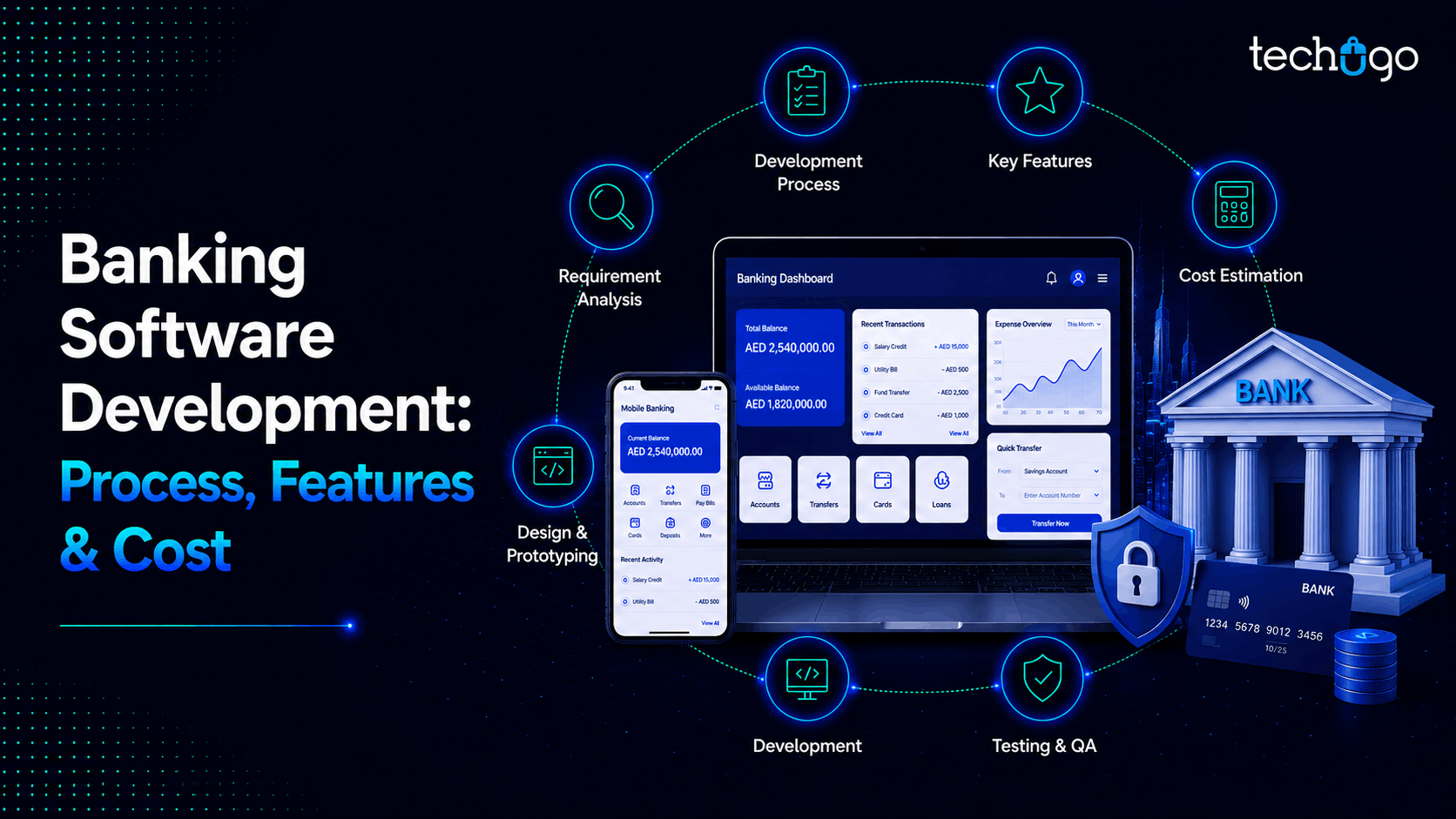


📌 Key Takeaways
- Banking software development is about building secure, scalable and customer-first digital experiences.
- AI, machine learning & automation are truly changing how banks handle security these days.
- Cost-wise, banking software development can range anywhere from $30,000 to $300,000+ – really depends on the complexity and features involved.
- Picking the right tech stack and development partner? It’s more important than most people think (especially when compliance is non-negotiable).
- At the end of the day, investing in custom banking software is how financial institutions stay ahead and keep up with what customers actually expect.
Banking today looks nothing like it did a decade ago. Why would it? After all, everything from transfers, payments, and loan applications can be done through a mobile app from anywhere.
And that’s the whole reason banking software development blew up.
You could be anywhere, in the middle of nowhere and still get your transactions done in a few taps. That’s all it takes now (all thanks to banking software).
You might not know but behind every tap, every transaction, every “payment received” notification, there’s a massive amount of software holding it all together. Core banking software, mobile apps, real time payment engines – none of this runs on goodwill.
So in this guide we’ll go through the types of banking software, key features, how it’s built, what it costs, use cases and basically everything you need to know from scratch.
Why banking software development is worth investing in 2026
Fact check: if your bank still feels like it’s running on 2015 infrastructure, your customers already know. They feel it every time their app starts bugging and every single time they have to call support for something that should’ve been a two-tap fix.
That’s money walking out the door.
Banking software development isn’t some future-facing investment you make to stay relevant in 2026. It’s survival. And the banks that get that? They didn’t get there by accident. They put good amount of money into building systems that work today. They are already working with a banking software development company to make it happen.
One more fact check:
McKinsey found that mobile-leading banks increased deposit account openings to 381 accounts per 1,000 active customers in 2023 – representing 35% growth since 2021 which is a big deal.
Clearly, the proof is right there in the data.
So is it worth investing in? A big YES! But more importantly… can you really afford not to?
Banking software market statistics & trends
1. The global banking software market was valued at around USD 35–45 billion in 2023 (varies by research firm).
2. It is projected to grow at a CAGR of ~8–12% from 2024 to 2030.
3. Over 75% of banking interactions are now conducted through digital channels (online + mobile).
4. The U.S. banking software market was valued at ~USD 2.9–3.1 billion in 2025–2026 and is projected to reach ~USD 5.6 billion by 2033
Clearly, digital adoption is the new normal for banking. These numbers say it all. Just take a closer look at the data, you will notice the same few patterns over and over in how banks build & scale their software these days.
Roughly speaking, these patterns point to some key trends shaping the future of banking software development.
The trends shaping banking software are –
1. Cloud adoption is accelerating as banks shift from legacy systems to scalable cloud infrastructure.
2. AI + automation is the standard now (mostly for fraud detection and credit scoring).
3. Cybersecurity is going up a lot lately, which makes sense with how much digital transaction risk there is now.
4. Real-time payments and digital wallets are replacing traditional transaction systems in so many regions.
5. Modernizing legacy systems is also a top priority for large banks in the U.S.
Key types of banking software in the financial industry
It’s pretty obvious that not all banking software will do the same thing.
Here’s what actually makes up the full picture.
1. Core banking software
See, everything starts here. Your accounts, your transactions, your data – it all sits in the core. You don’t notice it when it works but you absolutely notice when it doesn’t.
2. Mobile banking apps
This is the face of your bank now. Not the branch, not the ATM. The app itself. Digital banking software is what your customers wake up and open every morning – and people have zero patience for one that’s slow or broken.
3. Payment processing software
Moves money from A to B. Quite simple right? Wrong. Because there’s a whole maze of real-time settlements, card networks & cross-border transfers all happening at once. Get any part of that wrong (like delay or one failed transaction) and your customer is already texting their friend about switching banks.
4. Fraud detection and security software
Someone’s always trying something (as in fraud) and putting your financial security at risk. Fraud detection and security software is what stops them.
5. Loan and credit management systems
The whole lending process (from someone hitting “apply” to their final repayment) runs through these systems.
Pros: less paperwork, fewer errors & faster decisions.
6. Banking analytics platforms
Data is useless if you can’t read it. It answers all these questions – what’s working, what isn’t and where the money is actually going.
It doesn’t matter if you’re building from scratch or upgrading what you have already, working with a top fintech app development company makes the difference between software that just exists and software that actually performs.
Custom banking software vs off-the-shelf banking software
So when you’re picking banking software, it basically comes down to two routes: build something custom for your bank or go with an off-the-shelf solution that’s already out there.
Both have their place. But the right call depends on your budget and basically also how unique your processes actually need to be.
Here’s a quick breakdown to help you decide.
| Aspect | Custom Banking Software | Off-the-Shelf Banking Software |
| Development Approach | Built from scratch for specific business needs | Pre-built ready-made solution |
| Customization | Highly flexible and fully customizable | Limited customization options |
| Deployment Time | Longer development and implementation time | Quick deployment |
| Cost | Higher initial investment | Lower upfront cost |
| Scalability | Easily scalable based on business growth | Limited scalability depending on vendor |
| Integration | Seamless integration with custom systems and APIs | Limited integration flexibility |
| Security | Tailored security features and compliance controls | Standard security features provided by vendor |
| Maintenance | Managed internally or by dedicated teams | Handled by vendor with regular updates |
| Best For | Banks needing unique workflows and long-term control | Businesses needing fast market entry |
In the end, the choice depends on you. Whether you want full control with custom systems or faster deployment with ready-made solutions – it’s your call.
Core features every banking software needs
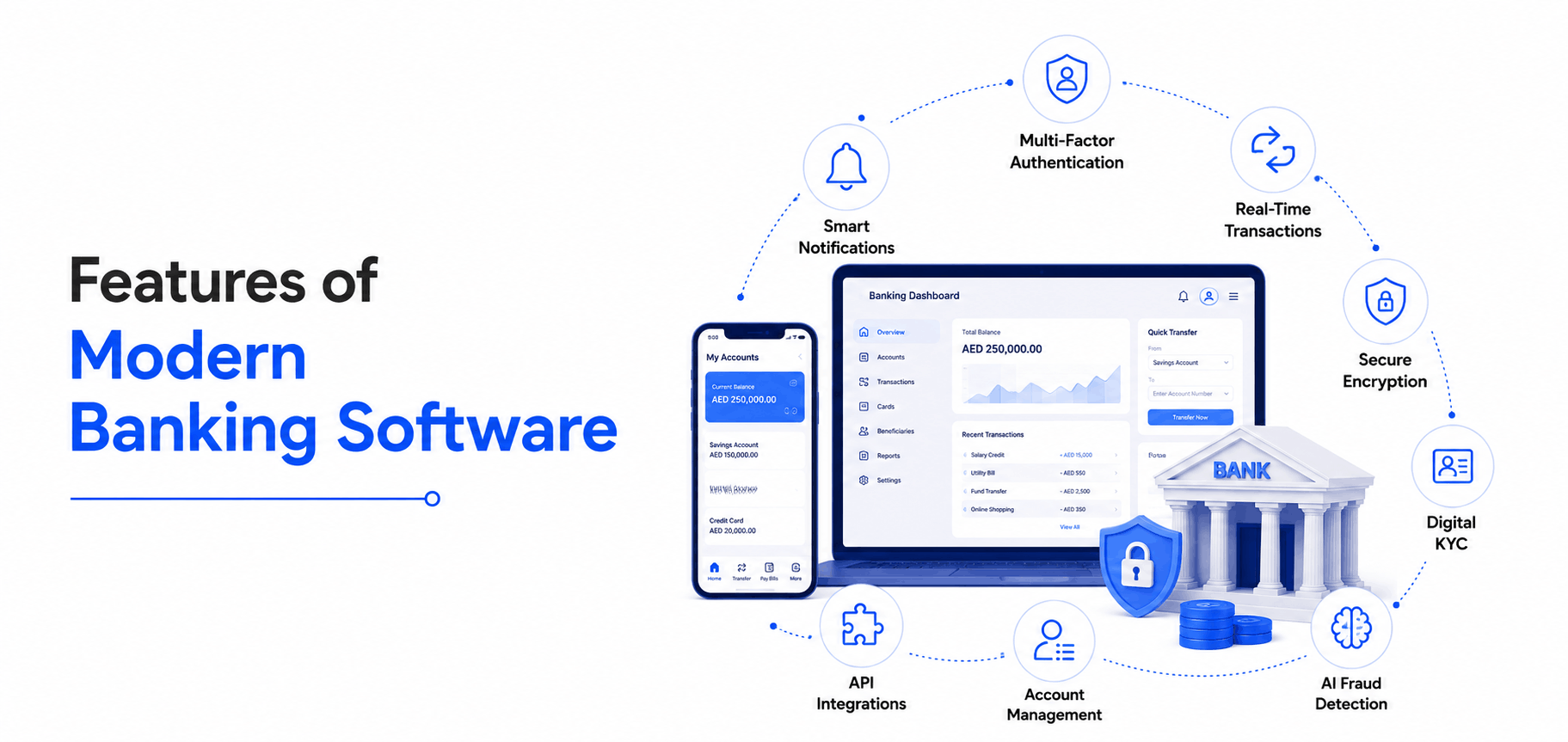
1. Multi-factor authentication (MFA)
Adds an extra layer of verification beyond just a password. Includes – OTPs, biometrics, or authenticator apps. So even if someone gets hold of your login credentials, they’re still not getting in.
2. Real-time transaction processing
Processes payments, transfers and settlements the moment they’re initiated.
3. Secure encryption standards
Protects sensitive financial data both in transit and at rest. Like a non-negotiable foundation in any serious core banking software development project.
4. KYC & digital onboarding
Verifies your customer’s identity digitally during sign-up – ID checks, document uploads, the works. Also cuts onboarding time down massively without skipping compliance steps.
5. AI-powered fraud detection
Monitors transactions in real time and flags anything that looks off. It works just like your security guard.
6. Account management features
Covers everything your customers need day-to-day like checking balances, making transfers, downloading statements, updating details.
7. Notifications & alerts
Sends instant updates for transactions, logins, and suspicious activity. Keeps your users informed and cuts down on unnecessary support calls.
8. API integrations
You might consider it optional but it’s more than it. It basically connects your software to payment gateways, credit bureaus and other third-party tools.
Key layers of core banking software architecture
. Centralized banking system design
So, core banking architecture is basically built to pull all the banking operations into one unified system. It lets banks manage accounts, transactions, loans, deposits, and customer data in real time, so there’s no fragmentation across branches.
. Layered architecture structure
Most systems follow a layered setup too, usually split into presentation, application and data layers. This keeps things organized, but it also makes the system way easier to scale and maintain.
. API integration
These days, banks are leaning more toward microservices and API-driven setups, since it’s just easier to integrate with fintech platforms, payment gateways, mobile apps and digital wallets that way.
. Security and compliance framework
Security isn’t a subsequent thought either, it’s baked right into the architecture with –
- encryption
- fraud detection
- and compliance checks running throughout.
. Cloud-based core banking evolution
A lot of this is shifting to the cloud now, since it gives you real-time processing, better uptime and way more scalability than older monolithic systems.
Key stages in the banking software development process
Stage 1. Discovery and requirement gathering
You basically just need to figure out what the bank wants and what rules they have to follow before the banking software development project even starts. No point of building something nobody asked for.
Stage 2. Planning and solution design
Then you map out wireframes, flows & the structure. Custom banking software development really needs this because every bank is different.
Stage 3. Development and integration
This is the stage where it gets built for real. Developers put together the core features and connect third party tools while also locking down security. Teams usually pull from SaaS product development so the platform can actually scale down the line.
Stage 4. Testing & deployment
Now is the time for testing. You test it properly before it goes live. And after that you just keep monitoring and updating it so nothing breaks down the line.
How much does it cost to build banking software?
In 2026, if you are building banking software, it will cost you around $40,000 to $500,000+.
But the amount you end up spending depends on your platform’s complexity, security requirements, integrations and feature set.
A simple banking application with core functionalities will naturally cost less but if it is an enterprise-grade digital banking software with AI capabilities and advanced analytics… it will require a significantly larger investment.
Now let’s take a look at how the cost range is divided:
| Software Type | Estimated Cost |
| Basic banking app | $40,000 – $80,000 |
| Mid-level digital Banking Platform | $80,000 – $200,000 |
| Advanced digital banking software | $200,000 – $350,000 |
| Enterprise banking solution | $350,000 – $500,000+ |
So, what can we infer from this?
Well, the price tag isn’t just for development hours. You’re also paying for security, compliance, system integrations, testing and the infrastructure you need for the platform to work.
In fact compliance requirements and security standards often account for a substantial portion of the budget. That’s why many financial institutions partner with experienced providers who offer banking software development services.
(If you are having second thoughts about whether you should or should not invest, just think about long-term scalability and you will get your answer.)
Banking software development tech stack overview
The tech stack of banking software development differs based on whether you’re talking to a legacy bank or a fintech company.
But here’s how it usually works:
. Backend: Java (Spring Boot) and .NET are still the go-to for core banking but if you’re on a newer team, you’re probably using Python or Node.js for APIs.
. Databases: For data you will mostly see PostgreSQL, Oracle, or SQL Server handling the money-related transactions since they need strong consistency.
. Infrastructure: Cloud (AWS, Azure) with Kubernetes is the norm now – but there are still a lot of banks running legacy on-prem systems alongside it.
. Security: OAuth2, encryption and PCI DSS compliance, so yes, you don’t really get a choice here, it’s non-negotiable.
. Frontend: React or Angular for web, and Swift/Kotlin if you’re building mobile apps.
Key benefits of banking software development
-
Improved security
Frankly, security is one of the biggest reasons banks invest in software development in the first place. You need something that actually protects customer data and keeps fraud risks low because one breach and it is over.
-
Better customer experience
Customers want banking to be fast and available whenever they need it. Through custom software development services banks can build digital experiences that actually feel smooth and keep customers coming back.
-
Increased operational efficiency
Manual processes just slow everything down and everyone knows it. Banking software takes care of the repetitive stuff so teams can actually focus on work that matters.
-
Easier regulatory compliance
Financial rules keep changing and staying on top of them is genuinely not easy. Good banking software helps you stay compliant without it becoming a legal headache every few months.
-
Scalability for future growth
Future isn’t promised. What works today, who knows if it will work two years from now as the bank grows.
So your platform needs to be ready for it.
That is why financial & banking software development services focus on building platforms that can add new features and handle more users without everything falling apart.
Use cases of banking software development in 2026
1. Digital banking platforms
This is basically the most common thing banking software development companies build. A platform where users can check accounts, transfer money, pay bills, all without stepping into a branch. Pretty standard but necessary.
2. Payment processing systems
Banks need transactions to be fast and secure across apps, websites and POS channels. No one is waiting around for a payment to go through in the big 2026.
3. Fraud detection & risk management
Generative AI development services are handling fraud detection now. Why? Because it catches weird activity early and flags it before it even turns into a real problem. It’s great to be honest, when you think about how much fraud risk that cuts down.
4. Loan and credit management
Who wants to wait weeks for a loan decision? No one. And there’s no need either. Because we have automated systems that handle applications, check eligibility & push approvals through way faster with barely any manual work involved.
5. Customer onboarding and KYC automation
Digital KYC just makes the whole verification process less painful. Faster onboarding and still fully compliant which is honestly the best of both worlds.
6. Financial decision-making tools
And then on top of all that – good banking software gives institutions the analytics and reporting they actually need to make smarter decisions and not just guess their way through things.
Major challenges in banking software development & their solutions
1. Security concerns
Look, dealing with sensitive data every single day is no joke. Whether it’s banking software development or AI-powered financial platforms, security remains a top concern.
. Solution: Financial systems handle sensitive data making strong protection measures essential from day one.
2. Compliance requirements
Regulations are strict. They vary everywhere and they keep changing. Staying aligned with all of that in banking software development is honestly a never ending job.
. Solution: You build compliance into the platform itself so it adapts as regulations change instead of scrambling to catch up every time.
3. System integration
Payment gateways, CRMs, core banking systems – everything needs to seamlessly work together. Getting that to actually work without something breaking is in a way one of the messiest parts of building anything in finance.
. Solution: APIs and custom integrations are what make everything connect smoothly without the constant back and forth.
4. Performance at scale
Transactions are happening nonstop and slowing down is just not an option. Businesses using AI development services need infrastructure that can handle the pressure without flinching.
. Solution: Scalable cloud infrastructure and optimized architecture keep things running fast no matter how much the workload grows.
5. High user expectations
Users want everything fast. And not just fast but accurate and reliable as well. Organizations that invest in custom LLM development services have to deliver on that because the moment it feels off, people just stop trusting it
. Solution: Investing in proper AI training, continuous testing and personalized experiences is what keeps users actually satisfied.
Emerging AI innovations in banking software systems
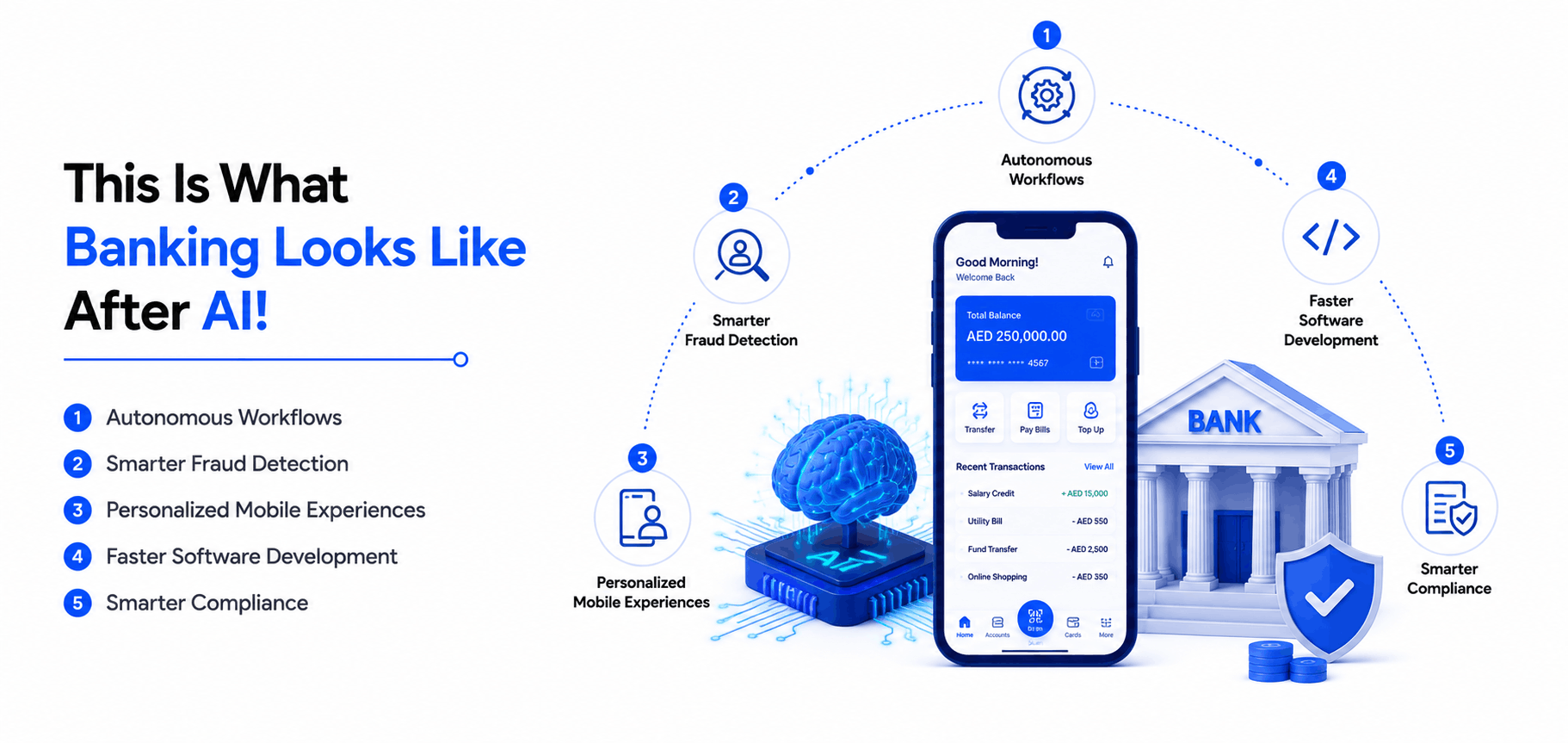
1. Autonomous workflows
Banks are done with manual, step-by-step processes. AI now handles entire workflows – loan approvals, onboarding, customer queries – end to end (with barely any human involvement needed).
2. Smarter fraud detection
Machine learning in the banking industry has changed how banks catch fraud. Instead of rigid rules, systems now learn patterns, flag anomalies instantly and make credit decisions in real time.
3. Personalized mobile experiences
Today’s mobile app development services go way beyond basic banking. AI customizes every interaction (like spending breakdowns, savings nudges, product suggestions).
4. Faster software development
GenAI is cutting down the time it takes for banking software development. Writing code, running tests and generating docs that used to take weeks now take days.
5. Smarter compliance
AML and KYC used to be slow. Now AI handles identity checks and risk monitoring in real time, making compliance faster and far more accurate.
How to choose the right banking software development company
-
Industry experience
Look for actual banking experience (not the general software work). As you know that compliance and security require careful handling, so you don’t want a team learning on your dime. Check past projects and talk to previous clients if you can.
-
Security standards
You’re handling sensitive financial data, so encryption, PCI DSS compliance and audit practices should be something that cannot be compromised from your side.
-
Tech stack flexibility
A good company should handle both modern frameworks and older banking infrastructure, since most banks run hybrid systems anyway.
-
Communication
You want a team that’s transparent, gives regular updates and doesn’t go quiet for weeks.
-
Long-term support
Banking software needs ongoing maintenance, so think about your product and check if they offer post-launch support.
How Techugo helps in scalable banking software development
Truth is, most banks struggle to scale their digital systems without running into performance issues. And more often than not, that comes down to how the system was built in the first place.
So in order to fix that, our team at Techugo works with financial institutions to design banking platforms that actually grow with them.
As a top-tier mobile app development company, we focus on modular architecture, cloud integration, and strong security so that scaling stays seamless. And the great thing is, we also bring in AI and automation to make systems smarter and more efficient. Which means banks can confidently expand their digital services while keeping everything fast, reliable and compliant.
So, are you ready to start your own banking software development project? If yes, then reach out to our team today!
FAQs
1. What is banking software development?
Banking software development involves creating secure digital solutions for banks – including mobile banking apps, payment systems and financial management platforms.
2. How much does banking software development cost?
Well, in 2026 the cost typically ranges from $40,000 to $500,000+ depending on your project’s features, complexity & security requirements.
3. Why is AI important in banking software development?
AI helps automate processes, detect fraud, personalize customer experiences and also improve decision-making across banking platforms.
4. How long does it take to develop banking software?
On average… a banking software project takes 4 to 12 months to develop (the timeline ultimately will depend on your project’s scope).

Get in touch
We'd love to hear from you.