

 SA
SA
 KW
KW
 IE
IE AU
AU UAE
UAE UK
UK USA
USA
 CA
CA DE
DE
 QA
QA ZA
ZA
 BH
BH NL
NL
 MU
MU FR
FR


















📌 Key Takeaways
- Healthcare digital transformation involves telemedicine, EHRs, AI, healthcare chatbots as well as remote patient monitoring.
- Healthcare organisations need to consider data security, system integration, staff training, compliance and costs prior to digitalisation.
- AI in healthcare can help with diagnosis, analysis of patient data, automation of routine procedures, and provision of assistance to patients.
- Digital health is projected to become a $181.25 billion market in 2026, growing at about 8.44% a year through 2031.
Healthcare has always been about people. But these days, technology is becoming a pretty big part of how those people receive care.
We’ve come to a time where we do not need to depend exclusively on legacy systems. You now have virtual visits, electronic health records, AI diagnostics and remote patient monitoring as part of how care gets delivered.
That kind of digital transformation in healthcare is enabling healthcare organizations to do more than just “keep up”; it’s improving the patient experience, streamlining everyday operations, and helping teams make better use of all the data they have. At the same time… healthcare software development makes it possible to build secure, connected solutions tailored to the needs of providers and patients. So in this guide, we’ll walk you through the benefits, key technologies, challenges, costs, use cases, and what’s next for digital healthcare.
Understanding Digital Transformation in Healthcare
Healthcare digital transformation is a much wider transformation in the delivery of healthcare services, information management and patient interaction. This can include anything from telemedicine and electronic health records to AI, cloud computing, remote monitoring and connected medical devices. In combination, these technologies are being used to make healthcare more accessible, connected and convenient for both patients and providers.
Why Is Digital Transformation Important in Healthcare?
Any idea how much healthcare has changed over the last few years?
Well, according to Statista, the global digital health market is projected to generate $181.25 billion in revenue in 2026 with revenue expected to grow at a CAGR of 8.44% through 2031. With that kind of growth, the importance of digital transformation in healthcare can be seen in a few key areas:
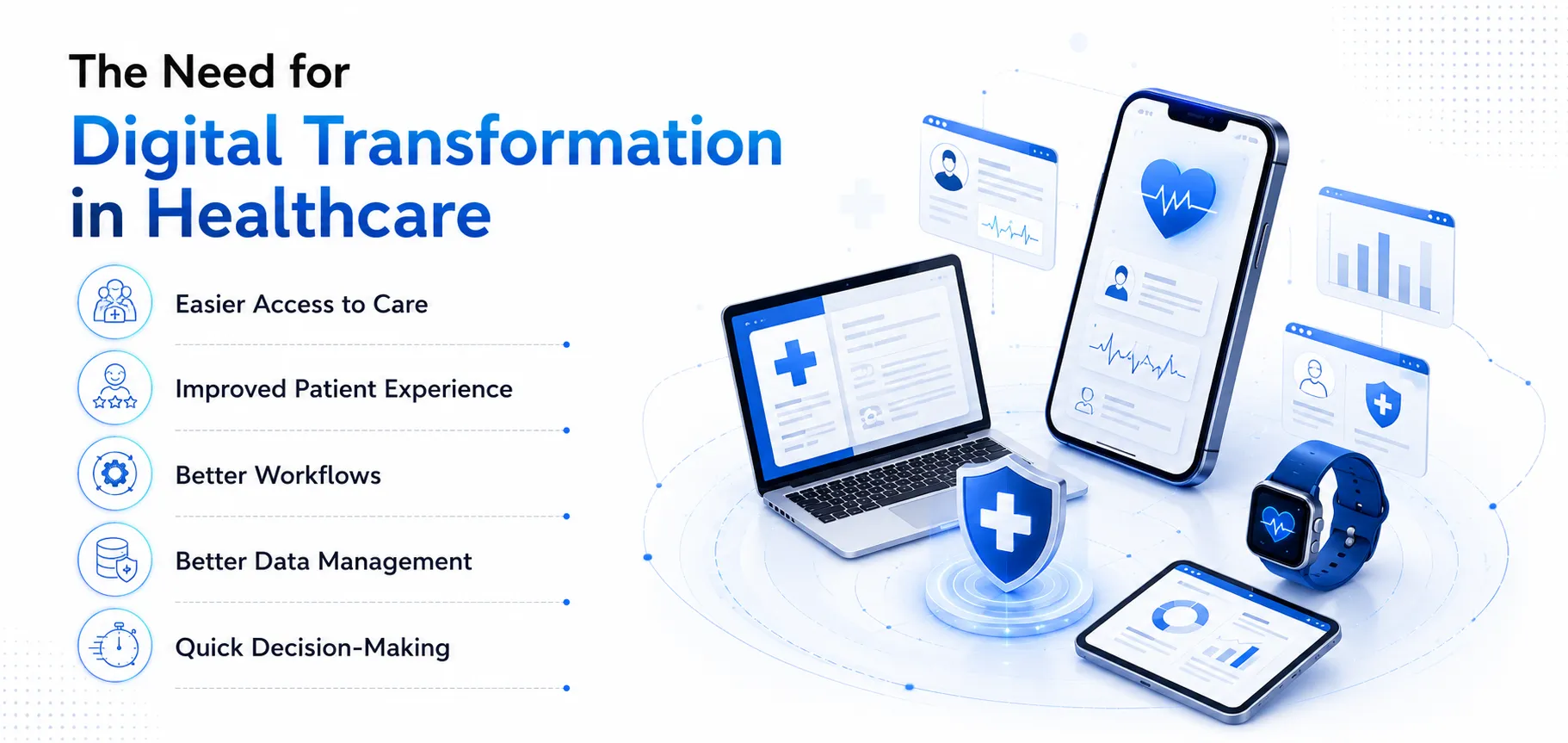
1. Easier Access to Care: As telemedicine app development becomes increasingly popular, individuals can receive a virtual consultation and distance care without having to wait a few weeks to get one.
2. Improved Patient Experience: Online scheduling, digital records and virtual visits mean less hassle in the day-to-day health care experience.
3. Better Workflows: Digital systems can reduce manual work and simplify repetitive tasks for healthcare teams.
4. Better Data Management: Systems are linked so patient data is more easily accessed, organized and truly used.
5. Quick Decision-Making: Faster decisions can be made due to real-time data which means doctors and care teams can make calls faster, and those calls tend to be better informed too.
Technologies Behind Digital Transformation in the Healthcare Industry
The digital transformation in healthcare sector runs on a handful of key technologies – some you’ve probably used already, while others handle tasks you may not see.
Here are some of the key ones you’ll see today:
| Technology | What It Brings to Healthcare |
| Artificial Intelligence (AI) | Supports diagnosis, patient monitoring, predictions and routine tasks |
| Telemedicine | Enables virtual consultations and remote care |
| Electronic Health Records (EHRs) | Keeps patient information in one place |
| Cloud Computing | Makes storing and accessing healthcare data simpler and more flexible |
| IoMT | Connects medical devices and lets healthcare teams keep track of patient data remotely |
| Big Data Analytics | Turns large amounts of healthcare data into useful insights |
| Blockchain | Adds another layer of security for data sharing, identity & transactions |
| Wearable Devices | Collects health data such as heart rate, activity and sleep patterns |
Benefits of Digital Transformation in Healthcare
These days, the benefits of digital transformation in healthcare can be seen in many parts of the healthcare experience. The digital transformation of healthcare can improve how patients get care, how providers deal with day-to-day info, and how fast decisions get made when it counts.
So here are some of its key benefits:
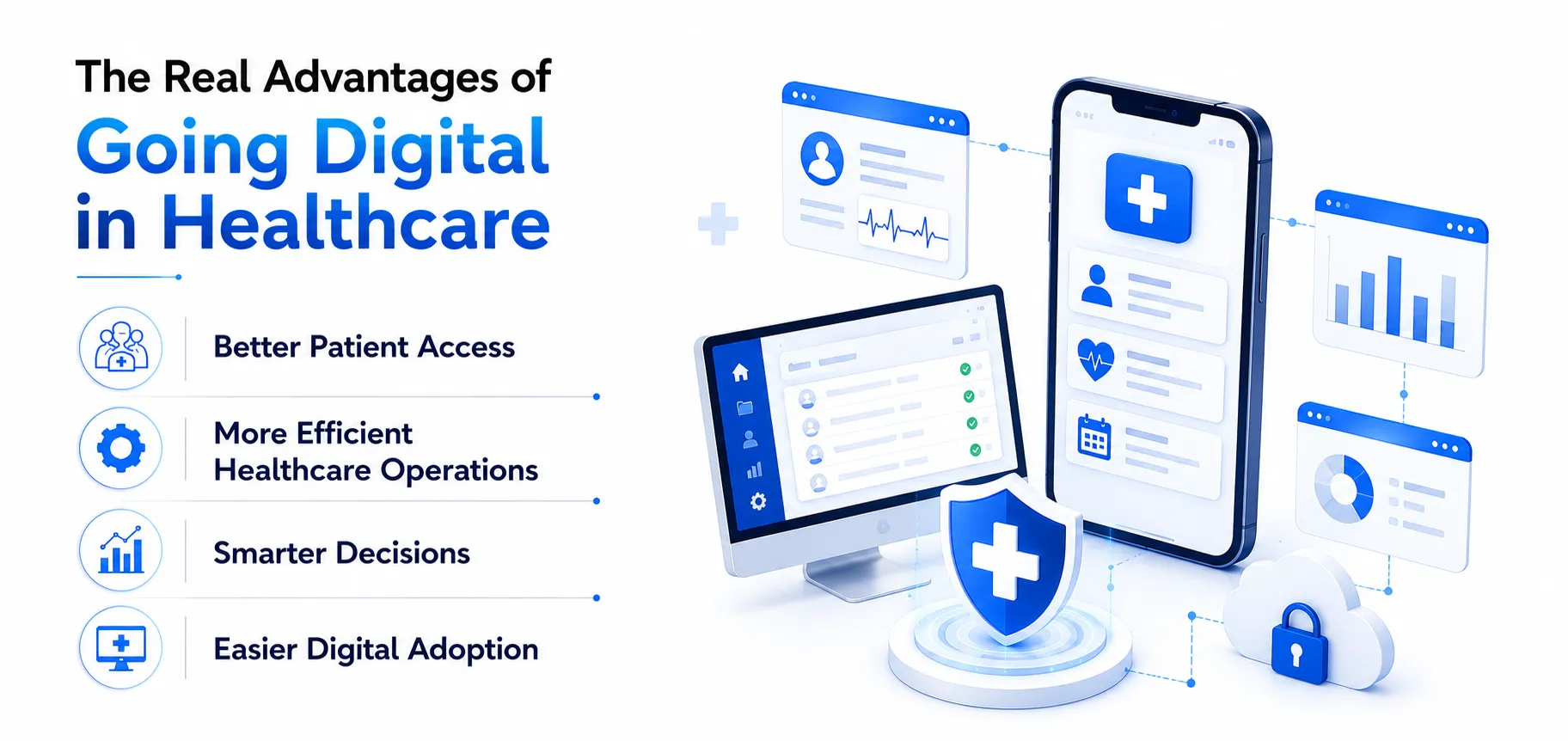
1. Better Patient Access
You don’t always have to show up in person in order to be seen, because with telemedicine, health apps, and online booking, patients have options now. That matters a lot for people living far from a clinic, or anyone who struggles to travel; it is a real problem for many.
2. More Efficient Healthcare Operations
Digital tools can help streamline repetitive administrative tasks and improve patient information retrieval. This has the potential to save healthcare providers a lot of time in paperwork and more time on patient care.
3. Smarter Decisions
Healthcare professionals can benefit from AI, EHRs, and remote monitoring tools for helpful data during moments of need. This can help in providing a better diagnosis, better treatment planning, and better monitoring of the patients.
4. Easier Digital Adoption
A well-designed digital transformation strategy can support healthcare organisations in adopting new technologies without causing disruption to their current operations. Digital transformation strategy consulting can help organisations determine which technologies to work with, prioritize investments – and create a realistic digital growth plan.
How Healthcare Organizations Can Implement Digital Transformation
Starting digital transformation and healthcare initiatives doesn’t mean changing everything at once. It’s better if you start with the areas where technology can solve a real problem, whether that is appointment booking or remote care.
A practical approach usually starts with these steps –
1. Identify What Needs to Change
Review the areas that slow things down or cause issues. This may involve appointment scheduling, patient communication, medical records or billing. After the problem is understood, the selection of a solution that is helpful is easier.
2. Choose Technology That Fits
Just because a technology is new – doesn’t mean you need it.
Use the right tools for the right job, such as telemedicine, cloud systems, AI or remote monitoring.
3. Don’t Overlook Security
Patient data needs to be protected from the very start. For developers constructing an application, a HIPAA-compliant healthcare app can keep sensitive health data from being compromised while ensuring that the standards are fulfilled.
4. Roll It Out Step by Step
Give your team some time to get used to the new system. Start with proper training, keep an eye on how things are going & make adjustments where needed before expanding further.
Challenges of Digital Transformation in Healthcare
Digital transformation in healthcare can bring a lot of improvements, but getting there isn’t always that easy. Healthcare digital transformation involves more than adding a few new tools.
A few of the biggest challenges healthcare organisations may face include:
1. Working With Existing Systems
Most healthcare organisations already have different systems running for records, billing, appointments, and communication. Getting all of that to work smoothly alongside new technology takes time – and a fair amount of careful planning.
2. Keeping Patient Data Secure
Healthcare data is about as sensitive as it gets so security has to be part of the conversation at every stage. Whether you are moving records to the cloud or investing in EMR software development, strong security measures and proper access controls are increasingly important.
3. Getting Staff On Board
A new system is only as good as the people actually using it. Staff need real training and time to adjust, especially when new technology reshapes workflows they’ve relied on for years.
4. Managing the Cost
Typically, when your organization is going through digital transformation, you’re making a pretty big investment – software, infrastructure, security, training, sustained maintenance and other hidden costs. That is why it’s better to concentrate on solutions that address real issues, not on new technology.
How AI Supports Digital Transformation for Healthcare
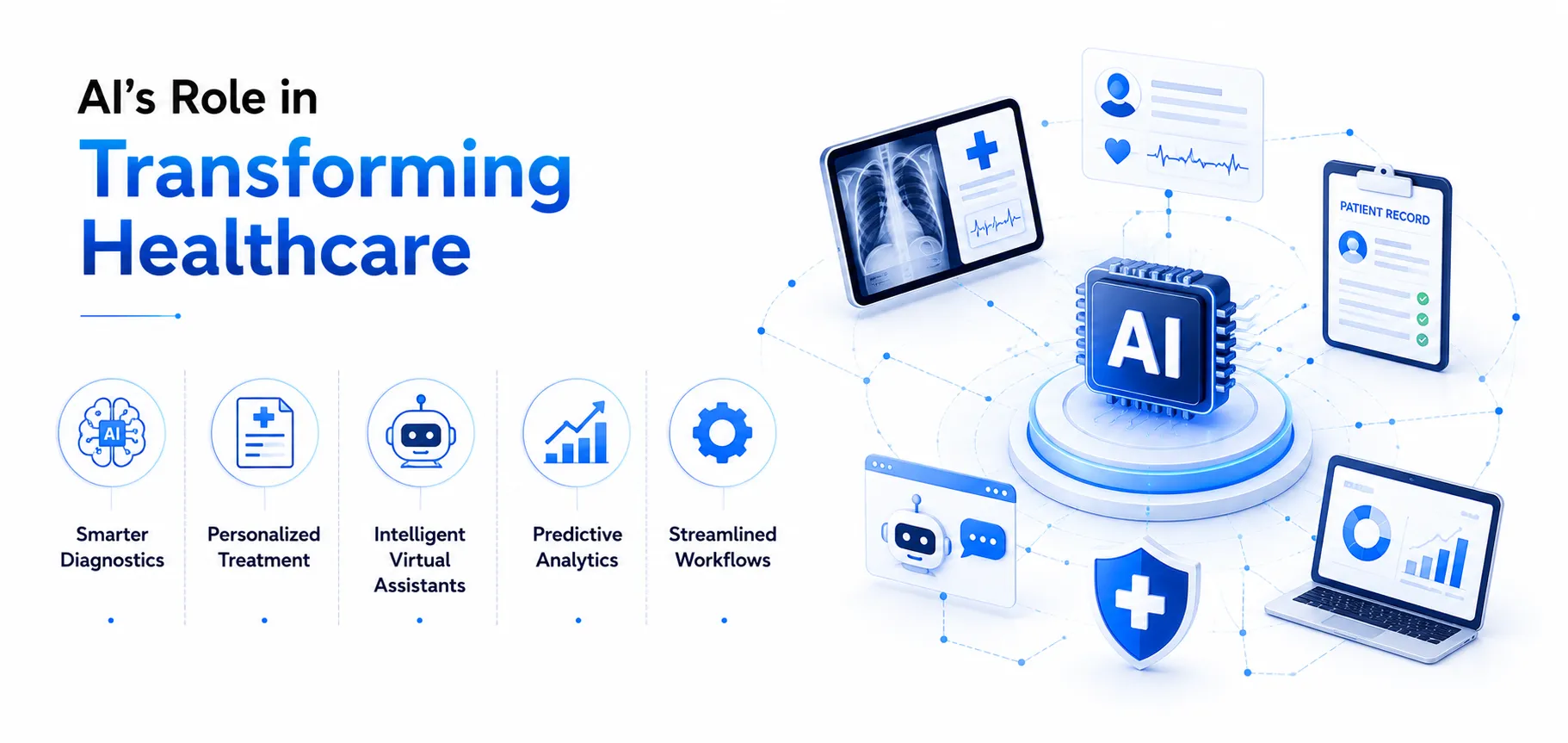
AI is turning into a genuinely practical part of healthcare and digital transformation these days – it’s helping teams get through everyday tasks and handle patient info without drowning in it.
And to be clear, the point was never to replace healthcare professionals. It is to hand them better tools and lighten the manual load they’re dealing with.
Here’s the simple version of how it works:
Patient data → AI looks at it → you get useful insights → a healthcare professional reviews them → care decisions get better informed
Some of the more common uses of AI in healthcare right now:
1. Patient support – answering the common questions, sending reminders
2. Data analysis – spotting patterns buried in huge amounts of patient data
3. Diagnosis support – helping professionals weigh symptoms and test results
4. Personalised care – shaping treatment plans around what a specific patient actually needs instead of a generic template
5. Routine tasks – automating tasks like scheduling and documentation
At its best, that’s really what digital transformation in healthcare comes down to – AI takes the routine work off people’s hands so they’ve got more time for the parts of the job that need a human.
Where Digital Transformation Is Being Used in Healthcare
1. Use Case 1. Telemedicine and Virtual Care
Patients can consult physicians via video calls, obtain prescriptions and follow up on treatment without having to be at a clinic all the time.
This sort of digital technology in healthcare helps improve access to care – particularly for those who reside in remote areas or face challenges getting to and from appointments.
2. Use Case 2. Healthcare Chatbots
With healthcare chatbot development… organizations can build chatbots to handle frequently asked inquiries, assist patients in locating pertinent details, remind them of appointments and guide them through fundamental processes. They can also help to eliminate some of the basic questions that staff deal with on a regular basis.
3. Use Case 3. Digital Health Records
EHRs streamline patient information storage, retrieval and sharing for authorised healthcare providers.
This can save time and get providers what they need without the back-and-forth.
4. Use Case 4. Remote Patient Monitoring
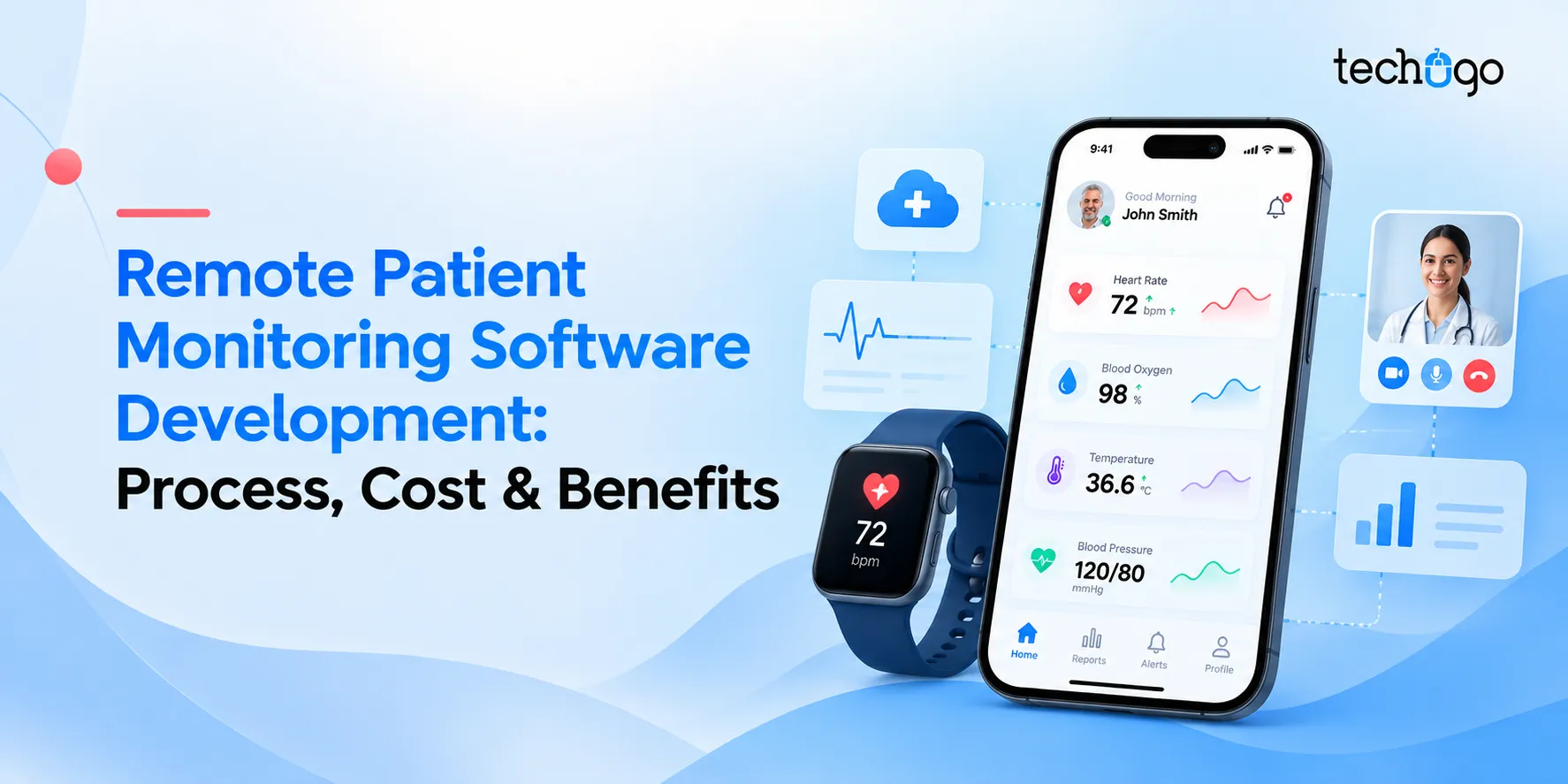
Connected devices can collect health data such as heart rate, blood pressure or glucose levels and share it with healthcare teams. This allows patients to be monitored without requiring them to visit a facility as often.
Future Digital Trends in Healthcare to Watch
So, the future of digital health is likely to bring more connected tools and smarter systems, and it’s making things easier for patients and providers who just want to manage care without the hassle. You have probably noticed that some digital trends in healthcare are already gaining attention, and they could become a much bigger part of everyday healthcare in the years coming up, so it’s worth paying attention now rather than later.
1. AI-Powered Healthcare
AI is expected to play a bigger role – in diagnosis support, patient monitoring, medical research, and also administrative work, because there’s just so much paperwork and routine tasks piling up for staff to handle. And as these tools improve, they have been slowly becoming a more regular part of digital transformation in healthcare; therefore it’s not really optional anymore for a lot of providers.
2. More Connected Healthcare
Healthcare is becoming less tied to the clinic.
Wearables and connected medical devices are facilitating the collection of health information beyond the confines of hospitals and clinics. This could make remote monitoring and personalised care more common, so that people get looked after even when they’re not in a waiting room.
3. Smarter EHR Systems
The focus of EHR software development will be moving beyond simply storing patient records. Future systems may offer better data sharing and automation, and AI-supported insights are making information more useful to healthcare professionals.
4. Greater Focus on Personalised Care
Healthcare is gradually moving towards care that is more suited for individual patients, and with better data and connected technologies, providers can gain a clearer picture of each patient’s needs.
How Much Does Healthcare Digital Transformation Cost?
The price for digital transformation in healthcare can differ significantly based on what you are going to create or modernize. A simple telemedicine application will not be the same cost-wise as a complex healthcare platform.
For digital transformation in healthcare, costs can typically fall into these ranges:
| Project Type | Estimated Cost |
| Basic digital solution | $20,000 – $50,000 |
| Mid-level healthcare platform | $50,000 – $120,000 |
| Advanced healthcare solution | $120,000 – $250,000+ |
| Enterprise-level transformation | $250,000+ |
But What Affects the Cost?
Various factors determine the final cost of the project. Among these factors are the required features, the tech stack, needed integrations, security measures and additional platforms you want to support.
For instance, medicine delivery app development may require features such as
- prescription uploads
- order tracking
- pharmacy integration
- payments
- Notifications
Data Security, Privacy and Compliance in Digital Healthcare
Data Encryption: The patient data has to be encrypted, both when it’s at rest and during transmission, because if it’s not, unauthorized access becomes way too easy. It’s basically the first line of defense you have.
Access Controls: You need role-based access and authentication too, so that only authorized users are able to view sensitive information.
Privacy Compliance: Depending on the market and the type of data being handled, you have to follow applicable regulations, such as HIPAA, GDPR or India’s DPDP framework.
Regular Security Audits: Risk assessments have to be conducted, access activity monitored and vulnerabilities addressed – regularly, not just once.
Secure Integrations: Third-party APIs, cloud services, healthcare systems you connect with – they all have to meet appropriate security and privacy requirements too. So even if your own system is credible, weak integrations can still put everything at risk and that’s something a lot of platforms overlook.
How to Choose the Right Healthcare Technology Partner
Digitalization of healthcare can be a lot easier to manage with the right technology partner. When deciding on one, you should consider:
- Healthcare experience: Ensure they have healthcare experience and understand healthcare workflows, patient needs and challenges in the space.
- Technical expertise: Check if their team will have the ability to manage the technology, integrations, security and other aspects that your project requires.
- Relevant portfolio: Go through their past work in healthcare to determine if they have experience working on something similar to your project.
- A clear strategy: The right partner will help you to develop a practical healthcare digital transformation strategy, rather than just development.
- Right-fit services: Their digital transformation services should match your goals as well as budget.
Why Partner With Techugo for Digital Healthcare Solutions?
You don’t want to hand a healthcare project to just any tech team. There’s a lot to think about, from patient data to security. Techugo understands these details.
As a top-tier mobile app development company, Techugo brings experience in developing digital products for different healthcare needs. From an MVP to a more extensive digital product, our expert team can help you throughout the development, testing, launch and beyond.
So, why not start now? Connect with our team to get your healthcare project started.
Conclusion
Healthcare is taking a more digital approach. There’s a lot that technology can do to make things easier. You have plenty of options today, from AI and telemedicine to digital records.
But it is important to remember that it is not about taking it all or doing “all of it” at once, but about what works for your organisation. Even healthcare CRM development can prove beneficial for teams when it comes to handling patient relationships. Start with what your patients or team actually need, choose the right technology, and take it from there. That’s a much better place to start digital transformation in healthcare.
FAQs
Q. What is digital transformation in healthcare?
It basically means using digital tools to make healthcare services easier to deliver, manage, and access. This can include – AI, telemedicine, EHRs, apps & remote monitoring.
Q. Why is digital transformation important in healthcare?
It can make everyday healthcare tasks faster and easier. Additionally, it makes communication between patients and providers more convenient.
Q. What are some examples of digital transformation in healthcare?
Telemedicine, digital health records, healthcare chatbots, remote monitoring, AI tools and patient portals are some common examples.
Q. How does AI support digital transformation in healthcare?
AI can help with patient data, diagnosis support, chatbots, monitoring & routine administrative tasks.

Get in touch
We'd love to hear from you.