

 SA
SA
 KW
KW
 IE
IE AU
AU UAE
UAE UK
UK USA
USA
 CA
CA DE
DE
 QA
QA ZA
ZA
 BH
BH NL
NL
 MU
MU FR
FR


















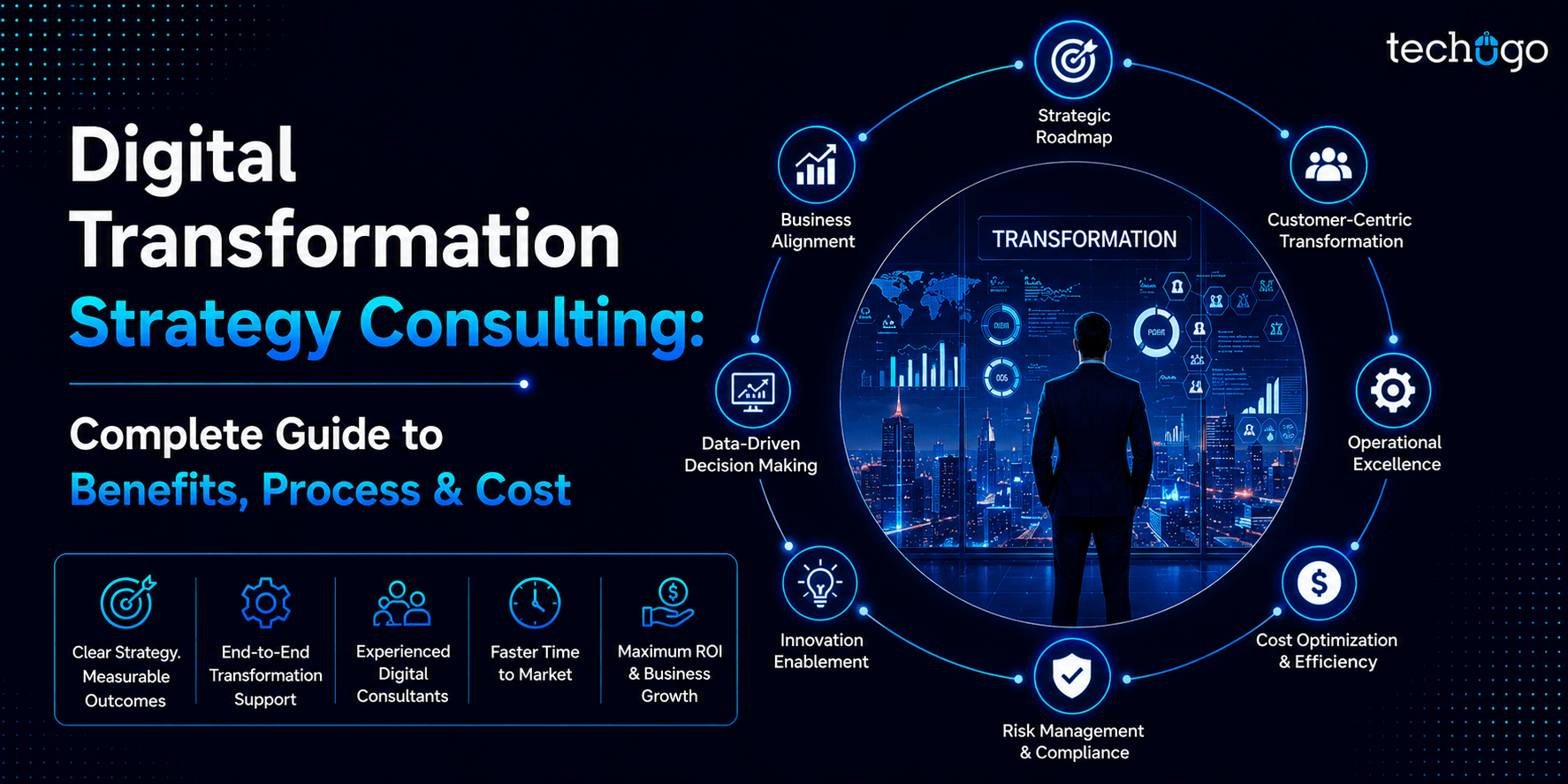


📌 Key Takeaways
- The digital transformation cost ranges from $10,000+ to $100,000+ depending on various factors.
- Digital transformation in eCommerce, fintech, retail, manufacturing, and other areas is driving the next wave of business growth.
- In 2026, technologies like cloud computing, AI, big data analysis, IoT, and cybersecurity are driving digital transformation.
By the end of 2030, almost 20,000 businesses will be shut. It’s not a bluff but the consequence of not applying digital transformation strategies into your business and systems as per the trend. According to Gartner’s report, 75% of IT work is expected to be performed by humans augmented with AI, while the remaining 25% will be handled entirely by AI.
That’s a powerful shift whose effect can be seen from now on. But the real question is –
Is simply adopting AI or the latest technology enough to stay competitive?
The answer is an absolute NO.
Technology is not in itself what transforms a business. Even the best tools can become costly in terms of money and effort if they are used without a clear transformation strategy. This is precisely why digital transformation strategy consulting has become one of the top priorities for modern enterprises. Rather than pursuing all the latest technologies, companies are concentrating on developing a structured plan that aligns technology with growth, customer needs, operational efficiency, and long-term financial strength.
If you are confused about where to begin with digital transformation, you are at the right place. This guide provides information and advice on strategy and consulting services, costs and ROI, and the latest trends to help you build a clear path to business success for the long term.
What Is Digital Transformation & Why It Matters Today
Digital transformation is a two-word term that itself iterates the definition. The process of transforming a business or system digitally is known as digital transformation. But it goes much deeper than its name, it’s not just adding new features to upgrade the system with AI, cloud or buying the latest software.
A digital transformation strategy is a well-thought-out roadmap that helps businesses to get faster and smarter. Digital Transformation planning is the complete planning from the requirement gathering to execution that defines how businesses use latest technologies to improve regular operations, enhance customer experiences, streamline processes, and achieve long-term business objectives.
Over the last 5 years, it has been shown how fast industries like manufacturing, healthcare, banking, retail, education, logistics, and professional services are adapting through smart digital transformation strategies.
Still thinking why these businesses are more focused on digital business transformation strategy?
Here are some of the benefits of digital transformation:
- Improve every customer interaction
- Make decisions backed by data
- Adapt faster to change
- Grow with scalable operations
Why Every Modern Business Needs a Digital Transformation Strategy Before Investing in Technology
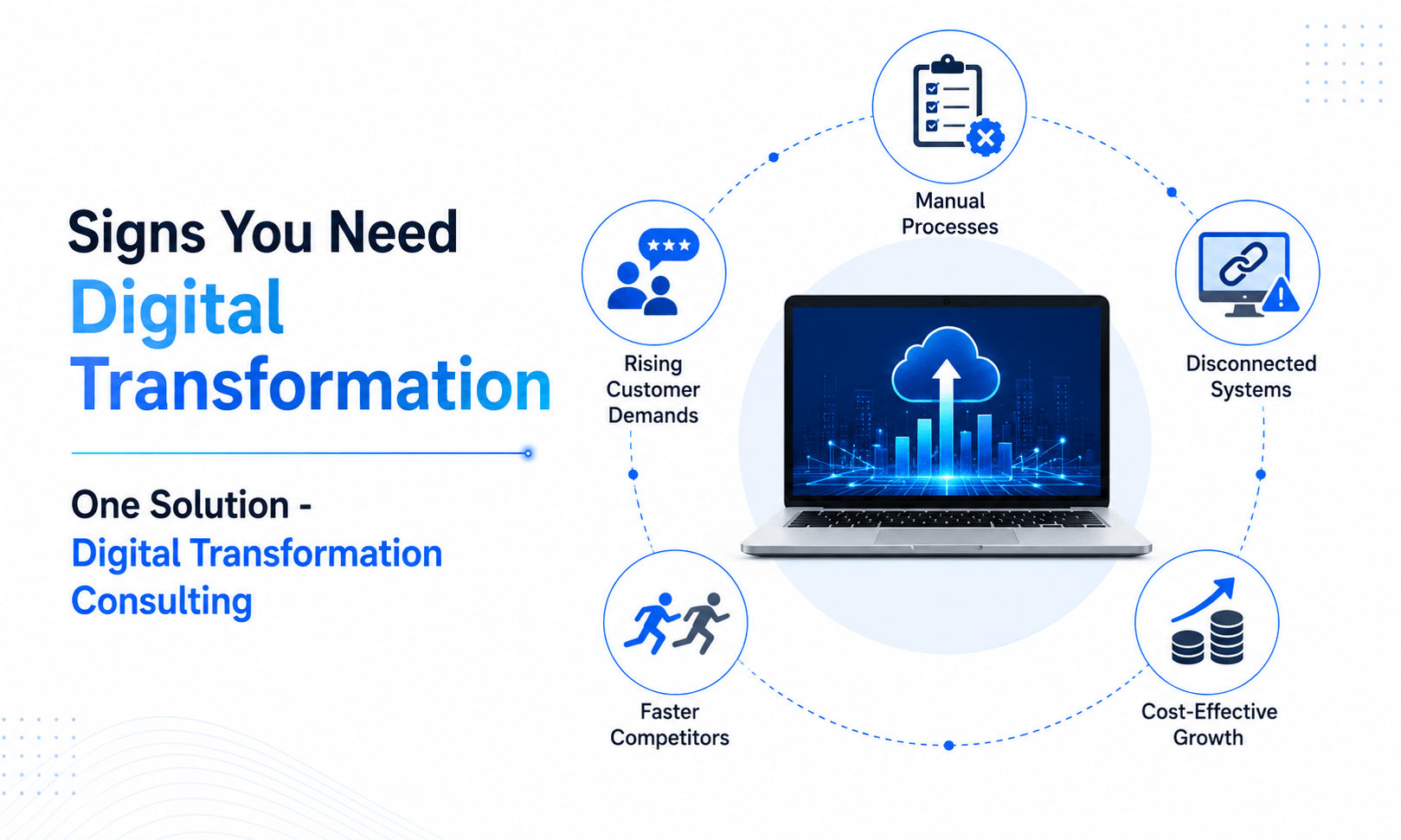
If you are in doubt whether this trend is meant for your business or not. Well it’s one of the common queries businesses have because in this highly evolving world, trends come and go but not all are worth chasing. In this case, there are generally two scenarios –
- Your goal is to just exist in the market without scaling your business.
- Your goal is to grow your business and reach customers around the world.
If the second one is your preference, digital transformation services are a MUST. But how would you find which area of your business needs digital transformation? Here are five common cases to consider-
1. Manual tasks are making your operations less efficient.
2. Your customer demands new features that are causing you user base losses.
3. Your teams struggle because data is spread across multiple tools.
4. Your competitors and even startups are innovating faster and staying ahead of you.
5. You want to achieve sustainable growth without a matching increase in costs.
Core Benefits of Digital Transformation Strategy Consulting for Enterprises
Digital transformation already took place in the tech driven world. Every industry is being transformed by technology. From digital transformation in classrooms, ERP solutions for universities, automation of manufacturing, to AI-driven systems for retail, are embracing intelligent software. Here are some of the major benefits businesses across industries are leveraging today.
-
Automate repetitive tasks
Digital automation is one of the main opportunities available for digital transformation that can bring about immediate success. With automation, your business will run much more smoothly, efficiently, and effectively by having your staff do less repetitive work. The result? Your staff spends less time working on routine tasks and more time being productive and growing your business.
-
Improve customer experience
Customer happiness solely depends on experiences, the more they enjoy the product experience the more they will be happy. The secret of their happiness is quick support for their queries and a seamless experience. These user experience-rich functionalities are made possible by a digital business transformation strategy that brings loyal customers.
-
Reduce operational costs
So everyone believes that expanding any business comes with expanding expenses but the truth is that choosing the right digital transformation consulting enables businesses to streamline processes without increasing costs. Means automated work, seamless employee management and an increase in productivity at lower operational costs.
-
Build a future-ready business
The future is fully dependent on digital systems, now, every feature, integration, and any other requirements demand technological compatibility. So having the right digital transformation framework helps your business to remain growth-oriented.
-
Seamless Team Collaboration
Managing multiple teams at a time with real-time accessibility is only possible with internet-connected systems. Transforming your systems creates a uniform connected platform where information, files, projects, etc can be easily shared, keeping everyone aligned. Better collaboration means fewer bottlenecks and more productive teams.
-
Better Data Visibility
Every business deals with a lot of data and information, while the one that understands the difference is a more valuable company. Through digital transformation consulting services, business owners can check data from anywhere, which helps them to make informed decisions.
-
Higher Return on Investment (ROI)
Technology is the future so the future revenue outcome is directly dependent on it. So deciding on the digital transformation strategy consulting for your business can help your business be efficient, cost-effective, productive, and provide enhanced customer experiences. This will ensure your investment generates good returns.
How Leading Consultants Implement Digital Transformation Strategy Framework
A successful digital transformation strategy framework is not just about changing everything in your established business overnight. It is proper planning in which business objectives, goals, conditions and other aspects are determined, and then according to their future scope, it is suggested from where the transformation should be started.
And the best part, you don’t need to transform your entire system at once, you can do it at your own pace and budget according to the result achieved. Every transformation comes with easy and achievable steps that can easily maximize results without making it expensive.
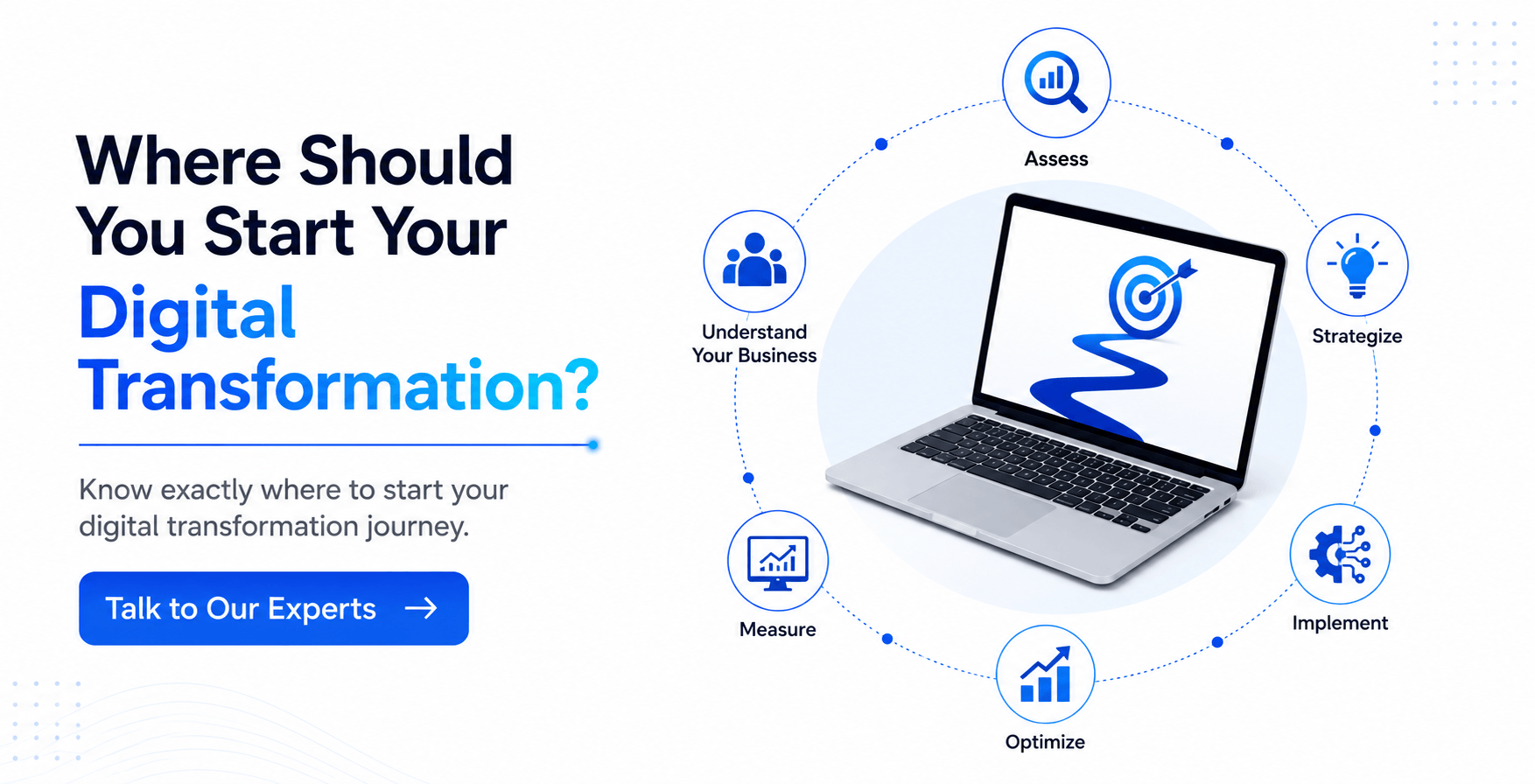
Step 1: Assess Your Current Business Landscape
The transformation journey starts here. From evaluating your current business stage, legacy system checks, workforce capabilities, and overall digital maturity. This helps digital transformation consultants to understand the possible areas where digital transformation is needed to be done.
Step 2: Define Clear Business Goals
Technologies should depend on the business goals. The next step is to conduct a stakeholder meeting to get aligned with their vision, objectives and expected outcomes with the transformed systems. This ensures direct growth and increased revenue opportunities for the business bringing long-term competitiveness.
Step 3: Identify High-Impact Opportunities
A digital transformation strategy consultant works with executives to define measurable goals, prioritize business outcomes, and develop a scalable approach to digital business transformation. This ensures all technology spend is aligned solely to drive the growth of the organization, the efficiency of its operations and its competitiveness into the future.
Step 4: Choose the Right Technologies
When the objectives have been outlined, the appropriate technologies that suit specific needs are chosen. Rather than following all trends in opportunities, digital transformation consultancy services give advice on what technologies can boost efficiency, customer service, scalability, and business performance in general.
Step 5: Create a Digital Transformation Roadmap
The company roadmap is decided at this stage through the actionable plan. This roadmap is created to define a company’s milestones, duration, budgets that help businesses to achieve success step by step without any disruption.
Step 6: Prepare Your People for Change
Technology is only valuable if employees adopt it. So employee learning is very important to utilize the full advantages of the system. It includes training, communication, and user adoption to make sure that the user is prepared and confident across the transformation journey.
Step 7: Implement, Measure, and Improve
In the last step, the roadmap is implemented and performance metrics are continuously compared to the KPIs that were defined previously. Companies analyze the adoption rate, ROI, and results of users enjoying it.
How AI Is Changing Digital Transformation Strategy Consulting
Digital transformation strategy consulting is being revolutionized by AI technology. Instead of relying on traditional methods and techniques of analysis and planning, companies now use artificial intelligence to draw conclusions and make forecasts, automate the process of decision-making and optimize their business processes. As a result, digital transformation specialists can develop more intelligent strategies and implement them without any risks.
1. AI easily identifies business opportunities by analyzing existing data and process scope.
2. Predictive analytic features of AI functionalities improve the decision-making ability of the system using real-time insights.
3. The best use of AI in digital transformation is the reduction of manual efforts and costs by eliminating unnecessary labour costs.
4. Automate internal workflow of all aspects of the organization, whether it’s finance, HR, operations, customer service, or supply chains.
5. AI gives personalized treatment to your user base through personal notification, chatbot and behavior analytics.
6. Machine learning helps optimize business operations by continuously learning from historical data.
7. Generative AI speeds up content creation, development of software and work within organisations.
8. The use of AI in cybersecurity can also identify threats more quickly and enhance compliance with industry regulations, among other benefits.
9. Digital transformation consultants leverage AI to predict ROI and focus on the highest-impact business initiatives.
10. Through AI optimization, the digital transformation roadmap can easily adjust according to market changes.
Essential Digital Transformation Consulting Approach Every Organization Should Expect
Let’s be honest, in the market, many digital transformation consulting companies promise to transform you, but not every time they deliver what they claim. Sometimes it might be migrating cloud servers or implementing AI technologies to automate workflows.
The best digital transformation consulting services actually start with knowing your needs, not just implementing technologies into systems. True digital transformation consulting providers first find out what is actually holding your business back, uncover the growth opportunities and then recommend solutions that are actually tailored to your business goals, budget and future vision.
So, if you’re planning to work with a consulting partner, here are the services you should expect.
1. Strategy Before Technology
A great consultant doesn’t begin with a demo of software. They’ll get to know your business, your challenges and your vision for the future, then work backward to develop a realistic digital transformation roadmap. Because without one, even the best technology can be a costly mistake.
2. Finding What’s Slowing Your Business Down
Every business has invisible bottlenecks - manual approvals, repetitive tasks, siloed systems, or antiquated workflows. Consultants work hard to find these problems and suggest better ways of working, whether it’s through automation or process improvement.
3. Modernizing Your Technology Stack
Still operating on legacy systems? It’s pretty common but they shouldn’t be slowing your business down. One of the biggest products a digital transformation consulting service can help you move to is modern, scalable technologies such as cloud platforms, integrated business applications, and secure digital infrastructure.
4. Making AI and Automation Actually Useful
AI is everywhere in 2026, but not every company needs every AI tool. A great consultant tells you where AI, automation, and machine learning can really save time, make things more accurate, or improve customer experiences as opposed to just putting technology into place because it’s the “right” thing to do.
5. Turning Business Data into Better Decisions
Every business has valuable data but not every time do they leverage the actual benefit from it. Consultants help organize that data into meaningful dashboards, reports, and insights so leadership can make faster, smarter decisions without relying on guesswork.
6. Creating Better Customer Experiences
Customers don’t care how much technology you’ve invested in they want to know how easy it is to do business with you. So consultants work to enhance every customer interaction, be it your website, mobile app, CRM, support system or entire digital journey.
7. Keeping Your Business Secure
The need for cybersecurity increases as your business gets more digital. Security, compliance and data protection are baked into the strategy from day one not tacked on after the fact when things get complicated, provided by trusted digital transformation consulting services.
8. Helping Your Team Embrace Change
One of the best parts of digital transformation is enabling your people to succeed. The good consultant concentrates on education, advice and change management, so that rather than fighting new systems your team is at ease with them.
9. Continuous Improvement
The implementation is just the beginning. Leading digital transformation consulting services and solutions regularly evaluate performance, monitor business results, uncover new opportunities, and adjust strategy as your business evolves. Because at the end of the day, digital transformation is not a destination – it’s a journey to continual improvement.
At the end of the day, a good consulting firm is not going to try to sell you more technology. They are there to help with business problems, to guide you through complex decisions, and to help your organization grow with confidence. That is real digital transformation consulting.
Common Digital Transformation Challenges and How to Overcome Them
| Challenge | Solution |
| Lack of a Clear Digital Strategy | Aligns technology investments with business objectives through a digital transformation strategy to achieve measurable growth. |
| Resistance to Organizational Change | Help your team by providing product training and leadership support to improve business operations through smart transformative systems. |
| Legacy Systems Holding Back Growth | Don’t upgrade all systems at once, modernize applications progressively with cloud technologies and scalable infrastructure. |
| Budget & Cost Constraints | Deliver transformation in stages by prioritizing projects with immediate business benefits. |
| Data Silos & Poor Data Quality | Poor data quality will be improved by the adoption of transformative systems through connected systems, data governance, and advanced analytics. |
| Cybersecurity & Compliance Risks | Transformed systems are secured at every stage with cybersecurity implementation. |
| Integration Challenges | Leverage APIs, middleware, and cloud platforms to ensure seamless system connectivity. |
| Difficulty Measuring ROI | Continuously track KPIs, ROI, and operational performance throughout the transformation process. |
| Lack of Digital Skills & Expertise | Upskill internal teams and collaborate with a trusted digital transformation consulting company to successfully implement transformation. |
Digital Transformation Cost: What Influences Pricing and ROI?
The cost of digital transformation is one of the first questions every business stumbles upon. The honest truth is: it depends. There is no set price as each company’s goals, technologies and digital maturity are different. A startup focused on automating a couple of workflows will have a vastly different budget than an enterprise bringing multiple business units across different geographies together.
The good news? Digital transformation is not an expense but rather an investment. If done strategically, the cost savings and increased revenues in the long term may even outweigh the cost of implementing the changes. An investment that saves you money. The trick here is choosing the right technologies at the right time, not trying to change everything at once.
Estimated Digital Transformation Cost by Business Size
- Start-ups & SME: $10,000 – $25,000+
Simple automation, CRM deployment, cloud migration, website refresh, and productivity tools.
- Medium-Sized Businesses: $30,000 – $50,000+
BPA, integration of ERP/CRM, analytic platforms, cybersecurity upgrades and workflow enhancements.
- Large Enterprises: $60,000 – $100,000+
Enterprise-scale cloud migration, AI implementation, legacy system modernization, data platforms, enterprise security and multi-department digital transformation.
What Factors Affect Digital Transformation Pricing?
Scope of Work – The larger your transformation objectives, the greater the investment. It is far less costly to automate a single department than to re-engineer the entire enterprise.
Existing Technology Infrastructure – If you already have modern systems in place, it’s easier to add on. However replacing legacy systems typically involves more time, integration, and resources.
Number of Business Processes – Changing customer service alone is way cheaper than digitizing HR, finance, operations, supply chain, and sales, all at once.
Technology Stack – The type of technologies selected also affects the total cost of digital transformation. AI solutions, enterprise ERP systems, cloud infrastructure, cybersecurity platforms, IoT and custom software development all have varied implementation costs.
Customization & Integrations – The level of customization required for your systems, whether it requires custom workflows or integrations or other integrations, determines how much custom work is involved.
Training Employees & Managing Change – People are the only ones who can derive value from technology, and a technology is only as good as the people who know how to use it. Training employees, onboarding teams, and running change management are usually a few of the forgotten yet vital components of building a successful transformation budget.
What Determines Your Return on Investment (ROI)?
A higher budget doesn’t automatically guarantee better results. ROI depends on how effectively your digital transformation strategy solves real business problems and creates measurable value.
1. Faster Operations
For a successful business, one of the important aspects is less supervision and faster operations. A transformed system speeds up daily operations giving quicker turnaround time and smoother coordination across every department.
2. Lower Operating Costs
Automated systems reduce manual work, effort, unnecessary paperwork and maintenance cost, which saves a lot of upfront cost, making it a smart and sustainable system.
3. Better Customer Experience
Along with cost-saving functionality, digitally transformed systems help businesses to deliver a more seamless user experience through websites, mobile apps, and customer support through a unified system.
4. Increased Revenue Opportunities
A digitally connected system can easily analyze market trends, through which it can suggest subscription-based services, and can also run customer preference-based marketing campaigns that create new ways to improve revenues.
5. Better Decision-Making
Large amounts of data without any systematic planning and analytic power can be unused or even misused sometimes but digitally transformed systems help businesses to reduce bottlenecks and help them to respond quickly to changing market conditions.
6. Scalability for Future Growth
Perhaps the greatest ROI is that you are prepared for tomorrow. Successful digital transformation equates to your company being able to grow more efficiently without incurring the same level of cost growth.
Future Digital Transformation Trends Shaping Business Strategy in 2026 and Beyond
1. AI Will Drive Smarter Business Decisions
In 2026, AI is the most talked-about topic for every business, it makes smart decisions in seconds by analyzing datasets and customer behaviors while improving overall productivity.
2. Automation Will Move Beyond Simple Tasks
Task automation will be more accurately done by these as long as data and patterns are recognized by the system over the period of time. In results, the efficiency will be increased with low operational cost and minimal manual observation.
3. Data Will Become the Foundation of Every Strategy
Digital data is becoming a more valuable asset for the company. A digitally transformed system gives high security with real-time analytics and predictive insights that help businesses to respond more safely and faster according to the market conditions.
4. Cloud-First Will Become the New Standard
For growing businesses, cloud-based business is a new trend to improve security, enable remote collaboration, strengthen security, and deploy new applications much faster than traditional infrastructure allows.
5. Continuous Innovation Will Replace One-Time Transformation
Digital transformation is not a one-time project for any business in any industry. Whether it’s digital transformation in fintech, ecommerce, or any other industry, continuous adoption of new technologies always helps businesses to meet customers’ expectations and market demands.
How to Choose the Right Digital Transformation Consulting Company
When it’s time to invest in the right digital transformation consulting company, evaluating all aspects is a sign of a smart business owner. It helps you identify the right opportunities, build a clear strategy, and ensure every investment delivers measurable business value. Before choosing a partner, make sure they check these essential boxes.
Key Factors to Evaluate
- Industry Experience
- Strategic Consulting Approach
- End-to-End Service Portfolio
- Technology Expertise
- Customized Solutions
- Proven Client Success
- Scalable Implementation
- Security & Compliance Knowledge
- Transparent Communication
- Post-Implementation Support
Conclusion
Digital transformation is not just an initiative for future growth, it’s the revolution of how modern businesses are going to compete and innovate in the upcoming years. Whether you are a startup or already established in the market that wants to modernize your legacy system, well-structured digital transformation services ensure every penny of your money gives a measurable profit and business outcomes.
At Techugo, our motive is to offer services according to your business needs that actually fulfill the saying – technology is the new rulebook of success. So even if you are taking a first step towards a digital journey to accelerate an existing initiative, the right strategy and the right partner can make all the difference.
Transform smarter, scale faster, and innovate with confidence. Techugo is your trusted digital transformation partner.
Frequently Asked Questions
1. How long does a typical digital transformation project take?
The duration of most digital transformation projects ranges from 3 months to 18 months, based on biz size, complexity of project, and scope of implementation. Transformations on an enterprise-wide scale may take longer, while smaller projects might only take a few months to complete.
2. How much does digital transformation consulting cost?
The pricing of digital transformation consulting depends on the business requirements, kinds of technologies used and the size of the project. Small companies are investing anywhere from $10,000 to $50,000, with enterprise initiatives easily going from $300,000 to in excess of $1 million.
3. What’s the difference between digital transformation and digitalization?
Digitalization is the process of changing related to a digitized form, whereas digital transformation is a cultural and organizational change of adopting digital technologies for a broader use promoting innovation and business development.
4. Can digital transformation increase eCommerce sales and customer retention?
Yes, with proper digital transformation strategies, eCommerce and retail businesses can upgrade their operations through transformed legacy systems. Business owners can send personalized notifications and recommendations that automatically increase eCommerce sales and customer retention.
5. What technologies are commonly used in digital transformation projects?
Modern businesses leverage various technologies in 2026, including AI, cloud computing, agentic AI, generative AI, big data analytics, IoT etc to achieve immense business growth.
6. Can small and medium-sized businesses benefit from digital transformation consulting?
Absolutely. Digital transformation consulting enables small and medium-sized enterprises to automate their processes, cut down expenses, enhance customer experience and scale efficiently without the need for enterprise-scale budget.

Get in touch
We'd love to hear from you.