

 SA
SA
 KW
KW
 IE
IE AU
AU UAE
UAE UK
UK USA
USA
 CA
CA DE
DE
 QA
QA ZA
ZA
 BH
BH NL
NL
 MU
MU FR
FR










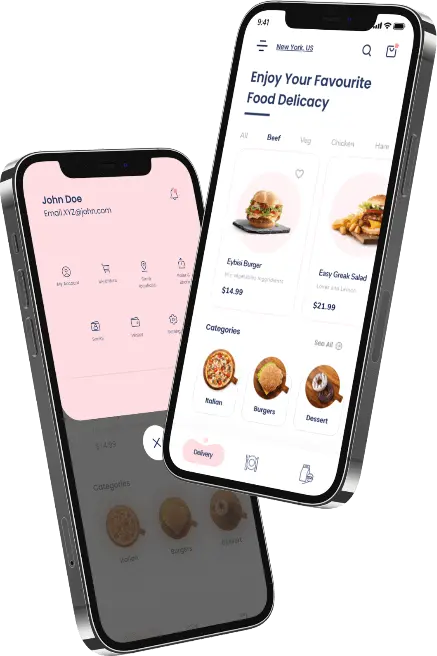

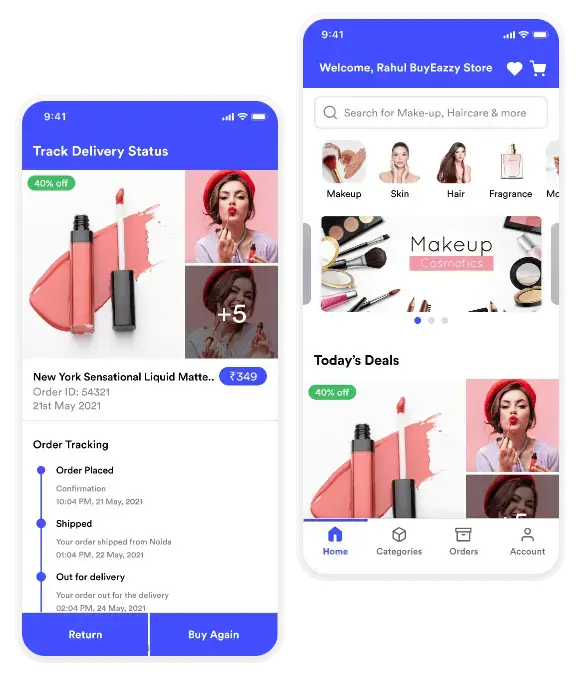






Some brands are scaling fast while others struggle. The gap isn’t random; it’s being created by how quickly businesses adapt to change.
Digital transformation in e-commerce is making all the difference. But how?
Selling online today isn’t just about having a website or listing products. It’s about how efficiently your systems run, how well your tools actually work together, and how easy it feels for customers to go from just browsing to buying.
With things like AI-driven personalization, automation, and cloud platforms, the way e-commerce works today looks completely different from what it used to be.
And it’s not a small upgrade. It’s a complete rethink of how online businesses function, compete, and grow.
Let’s have a look…
Understanding Digital Transformation in E-Commerce: A Simple Breakdown
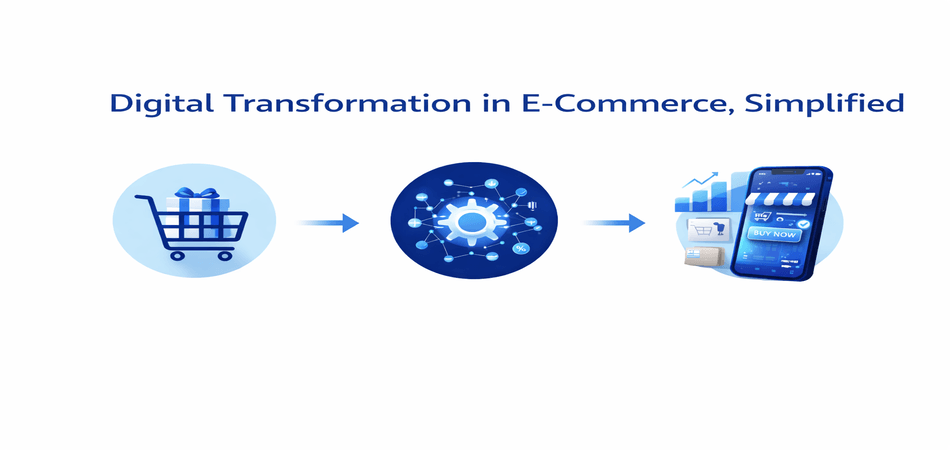
Let’s be honest, digital transformation in e-commerce isn’t just about taking your store online anymore. That’s the basic level. What’s happening now goes far beyond that. It’s about how your entire business functions, connects, and delivers a smooth experience from the first click to the final checkout.
Now, many get confused here. Digitization implies transforming assets into the digital form items are listed on the Web, online payments are accepted. But the shift is bigger. It is when tools, data and processes work together in an intelligent manner. Orders are completed quicker, customer experiences are smooth and the shop is virtually responsive to the needs of customers. Digitization is not digital, but optimization.
Why does it matter? There has been a drastic change in the customer demand. Consumers want fast services, customized suggestions, and perfect mobile services. When the shop seems lethargic, cumbersome or old, customers are forced to leave to a rival store that performs. Competition is intense and it is no longer sufficient to be online.
That is why it is so crucial to introduce digital transformation in e-commerce. It helps brands stay ahead. Shopping is quicker, smarter and less isolated. AI provides product recommendations that are precise. Boring duties are addressed through automation. Chatbots are also effective in solving problems. Everything is maintained well through cloud platforms. Not only technology, but it simplifies shopping, turns it into an individual and a bit entertaining.
It is not really about the tech itself, at the end of the day. That is what that technology makes possible. A better experience. A faster journey. An easy to interact brand. The brands shining today do not simply sell as a result of this reason. They are digitally transforming the entire process of buying into an easy one.
But what’s making all of this possible in the first place? It all comes down to the key technologies driving e-commerce digital transformation.
So, What Technologies Are Powering E-Commerce Digital Transformation?
If everything we talked about so far feels fast, seamless, and almost effortless, that’s because it is. But none of it happens on its own.
There’s a powerful mix of technologies working together to make digital transformation in e-commerce actually work in real life. And at the center of it all? AI, automation, and the cloud.
Let’s break it down in simple terms.
AI in E-Commerce: Making Shopping Feel Personal
Ever noticed how some online stores just get you? You browse one product, and suddenly you’re seeing recommendations that feel spot-on. That’s AI in e-commerce doing its thing.
AI helps brands understand customer behavior. What people click on, how long they stay, what they ignore, and then use that data to personalize the experience. From product recommendations to dynamic pricing and even personalized emails, AI makes every interaction feel more relevant.
And it’s not just about recommendations. Chatbots powered by AI are now handling customer queries instantly, 24/7. No waiting, no frustration. Whether it’s answering questions, tracking orders, or helping users find the right product, AI-driven chatbots make the entire experience smoother.
In short, AI in e-commerce turns a generic store into a personalized shopping experience. And that’s a huge win in today’s competitive market.
E-Commerce Automation Tools: Doing More, Manually Less
Now imagine running an online store where every order, update, and message had to be handled manually. Sounds exhausting, right? That’s exactly why e-commerce automation tools have become essential.
These tools are able to address repetitive jobs hence businesses are able to concentrate on growth rather than the ad-hoc day in day out. The process of order processing becomes automatic. There are real time updates of inventory. Email, discounts and follow up marketing campaigns can be automatically implemented.
For example, when a customer places an order, automation can instantly update stock levels, trigger a confirmation email, and even initiate the shipping process. No delays, no manual errors.
And it doesn’t stop there. E-commerce automation tools also help with abandoned cart recovery, customer segmentation, and targeted promotions. So instead of chasing customers, your system is already engaging them at the right time.
The result? Faster operations, fewer mistakes, and a much smoother experience for both the business and the customer.
Cloud E-Commerce Platforms: Powering Flexibility and Scale
Now let’s talk about what holds everything together: cloud e-commerce platforms.
Unlike traditional systems that are limited and hard to scale, cloud-based platforms give businesses the flexibility to grow without friction. Whether you’re handling 100 orders a day or 10,000, the system adjusts without slowing down.
All this is real time with the cloud e-commerce platforms. You are able to manage your store, track performance, update your products as well as monitor your inventory anywhere. No big infrastructure, no ongoing maintenance, and just a system that is there when you want it.
Another big advantage? Integration. Cloud platforms are also interconnected with other tools (AI systems, automation software, payment gateways, analytics tools, etc.) forming a complete ecosystem. The complete functions as a team and not in silos.
And in a world where speed matters, that kind of flexibility can make all the difference.
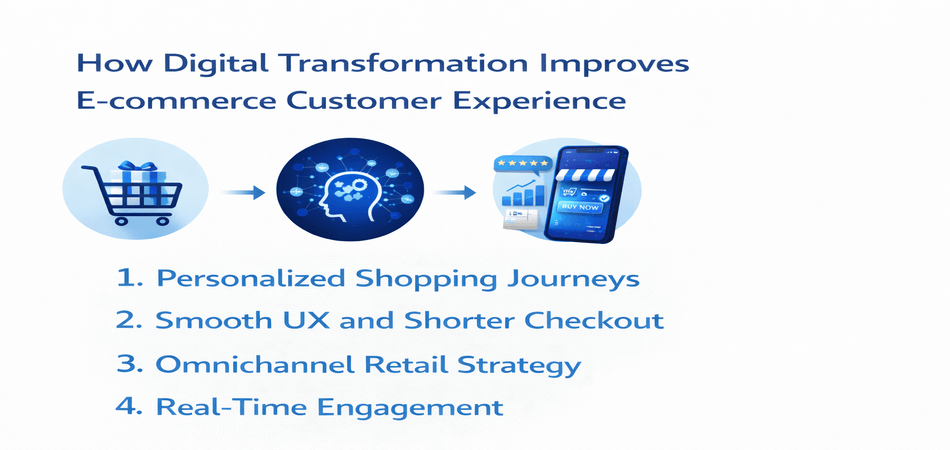
How Digital Transformation Improves E-commerce Customer Experience
Create something like this, add the highlighted text/content to the image
Let’s face it. Today’s customers expect more than just a working website. They want speed, convenience, and a shopping experience that feels made just for them. This is exactly where digital transformation starts to improve the e-commerce customer experience in a real, noticeable way.
-
Personalized Shopping Journeys
Customers do not want to scroll and scroll to get what they desire. They will want you to lead the way in your store. By using technological products such as AI, a brand can develop individualized shopping experiences, relying on how people act. Recommendations of products, personalized offers, all this becomes more relevant. It is as though the store is aware of what the customer wants yet they have not even searched yet.
-
Smooth UX and Shorter Checkout
Any delay in loading a web page, or any complex checkout system is enough to lose a sale immediately. The digital transformation assists in developing a smooth flow of experience where nothing goes wrong. Websites become more responsive, navigation is made easy and the checkout needs only a few clicks to accomplish. No misunderstanding, no superfluous measures. Only a straight way between looking and purchasing.
-
Omnichannel Retail Strategy
Customers are no longer able to shop at a single platform.
They may find out about a product on social media, look at it on your site and buy it with a mobile application. All these touchpoints are linked by an omnichannel retail strategy, thus the experience will be cohesive across all touchpoints. Regardless of where the customer touches your brand, it seems like a single journey.
-
Real-Time Engagement
People do not anticipate having to wait an hour or day before getting a response. They expect instant support. Chatbots, live chat or quick notifications allow brands to now talk to customers in real-time. The response to questions becomes quicker, the problem becomes solved much faster, and the experience is more like a responsive response.
To enhance the e-commerce customer experience at the day-end, one should not add more features. It’s about removing friction. It is about simplifying each and every step, making it quicker and more individual. And that is what digital transformation assists brands to accomplish.
Also Read: How much does it cost to build an e-commerce app in usa?
Mobile Apps: Turbocharging E-Commerce Growth with AI
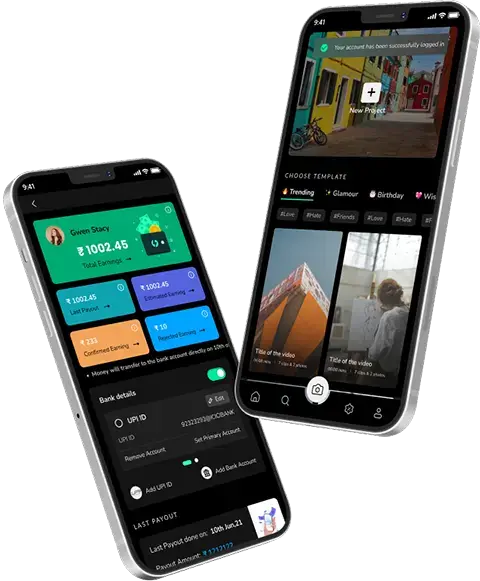
Take a moment and think about how often you shop from your phone. Probably more than you realize. That’s because mobile commerce is no longer just a trend. It has become the default way people browse and buy online.
With more users relying on smartphones, businesses are focusing heavily on mobile-first strategies. And one of the biggest drivers of this shift is e-commerce apps.
Unlike websites, mobile apps offer a more direct and engaging experience. They are quicker, simpler to navigate and specifically created to suit smaller screens. This would make the whole shopping process natural and easy. Introduce AI into the game and apps become more intelligent than ever, with personalized suggestions, able to learn your tastes, and can even direct you to products quicker than you can use a keyboard.
Keeping your customers hooked is what e-commerce apps do best.
Using apps enables brands to maintain a close relationship with the user by sending push notifications. The flash sale, a special discount, a reminder of an abandoned cart, and many more such messages make customers come back in real-time. AI allows timing these messages to perfection and customizing them to specific shoppers, so that they do not feel spammed by them.
The apps are also beneficial in enhancing retention of customers. After a user downloads your app, he/she will be more likely to come back than to visit a site time and time again. Such characteristics as stored preferences, fast checkout, and AI-assisted personalized recommendations simplify the process of repeat purchases as never before.
That’s exactly why businesses are investing in mobile-first strategies. It’s not just about keeping up with trends. It’s about meeting customers where they already are and giving them a faster, smarter, and smoother way to shop.
Mobile apps aren’t just helping e-commerce grow, they’re turbocharging it. With AI making every shopping experience faster, smarter, and totally personal.
Techugo: Your E-Commerce App Development Company for Smarter Growth
Building a mobile app for your e-commerce business can feel overwhelming. Too many buttons, too many screens, and your customers just swipe away.
That’s why you need Techugo.
If you’re in the US, working with an e-commerce mobile app development company like us is a big advantage. We know the market, we know what users expect, and we know how to make an app that feels natural and effortless. Every tap, swipe, and scroll is designed to make life easier for your customers.
We don’t just make apps that work, we make apps your customers actually want to use.
As a leading mobile app development company in USA, Techugo has helped brands across industries launch apps that are fast, intuitive, and personalized. From AI-powered product recommendations to push notifications that actually matter, our apps are designed to make shopping simple, enjoyable, and rewarding.
Over the years, as a trusted e-commerce mobile app development company, we’ve delivered projects that drive real results, higher engagement, more repeat purchases, and measurable growth for our clients.
Our expertise lies in understanding both the business and the user, making sure every app we build not only works flawlessly but also helps brands stand out in a crowded market.
Make your e-commerce app unforgettable. Launch it with Techugo.
FAQs
What is e-commerce digital transformation?
Digital transformation in e-commerce is defined as the initiative to use technology with an aim of improving the operations of these businesses, its customer relationship as well as offering customers more convenient, easier and more personalized shopping experiences.
What are the effects of AI on the development of e-commerce?
In e-commerce, AI can be applied in product recommendation, suggestions, chatbots, and predictive analytics. It will improve the customer contact, quicken the business and boost the conversion.
What are the major technologies that have created e-commerce digital transformation?
The AI tech is what’s actually changing how we shop online. Artificial intelligence in e-commerce, e-commerce order and inventory automation tools, and cloud e-commerce platforms are among the most important technologies, which allow them to be scaled, flexible, and real-time.
Why does customer experience matter when it comes to e-commerce?
An efficient flow of e-commerce customers ensures that attention of the shoppers is preserved, encourages repeat purchases and loyalty. There are such features as tailored tours and rapid check-outs and omnichannel experiences.
What are the roles of mobile apps in the growth of e-commerce?
Mobile applications help in making shopping processes easier, more exciting and convenient. They also allow push notifications, customized recommendations, and quick checkouts thereby helping brands retain customers and make more sales.
What is an omnichannel retail strategy?
Omnichannel retail strategy connects all shopping points, such as, but not limited to the web, mobile application, social media, as well as physical stores, such that the customers have an even and smooth shopping experience throughout the platforms.
What is the place of cloud technology in e-commerce business?
Cloud e-commerce platforms have scalability, real time access and flexibility features. They help the companies to keep up with the rise in traffic, to structure the data and be able to respond promptly to the dynamism in the market.

Get in touch
We'd love to hear from you.