

 SA
SA
 KW
KW
 IE
IE AU
AU UAE
UAE UK
UK USA
USA
 CA
CA DE
DE
 QA
QA ZA
ZA
 BH
BH NL
NL
 MU
MU FR
FR














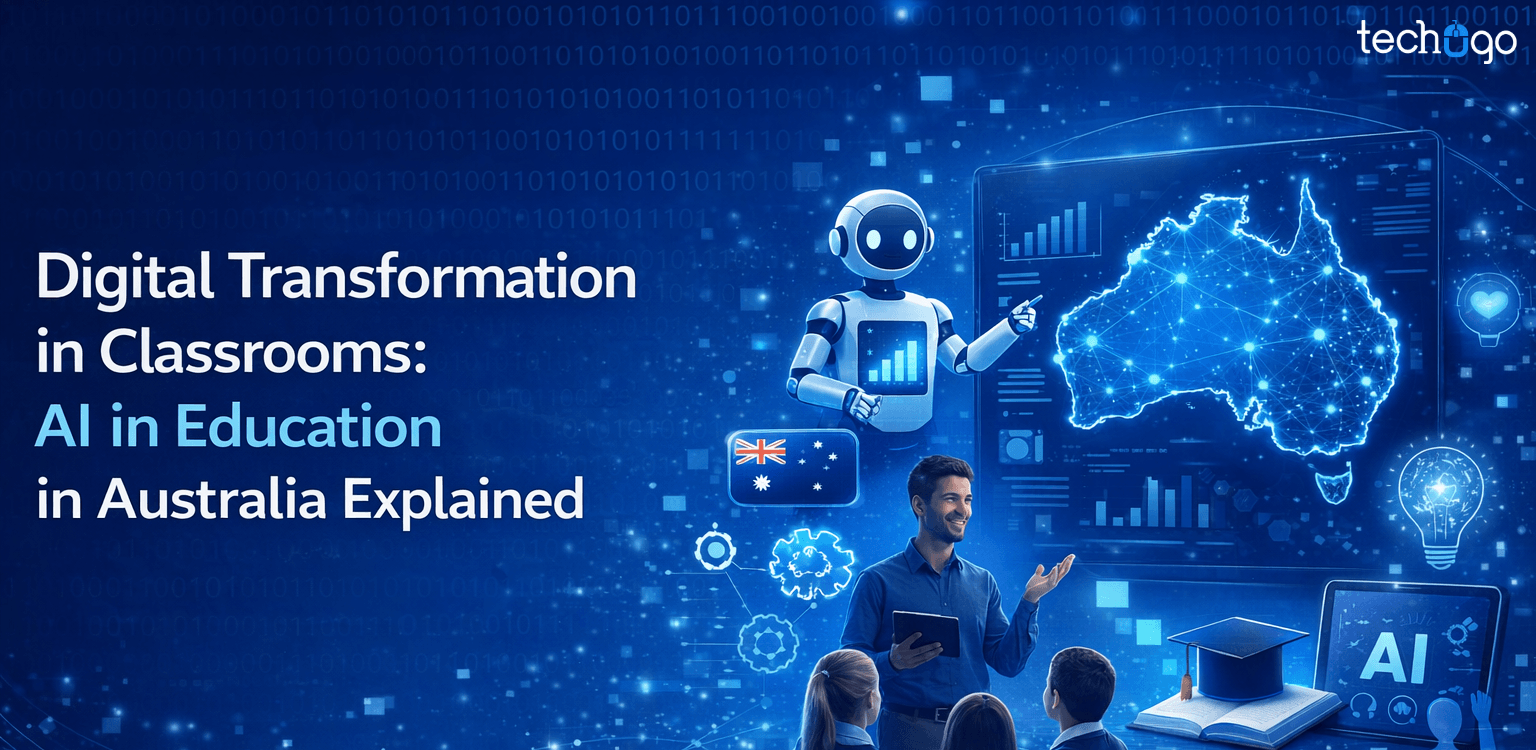


Ever had one of those moments where you explain something twice… and the second time, you instinctively say it differently because the first way didn’t click? Now imagine a classroom that can do that for every single student, instantly.
That’s exactly where AI in education in Australia is heading.
Across schools and universities, things are starting to change. Learning is no longer the same for everyone. It’s becoming more flexible. More personal. More in tune with each student. And if you look at the latest AI education trends in Australia, you’ll see this shift clearly.
Lessons are adjusting. Feedback is faster. Students can learn at their own pace. It doesn’t feel as rigid as before.
So, let’s take a closer look at how AI is shaping education across Australia, and what it really means for the way we learn.
AI in Education: What’s Actually Changing in Australia?
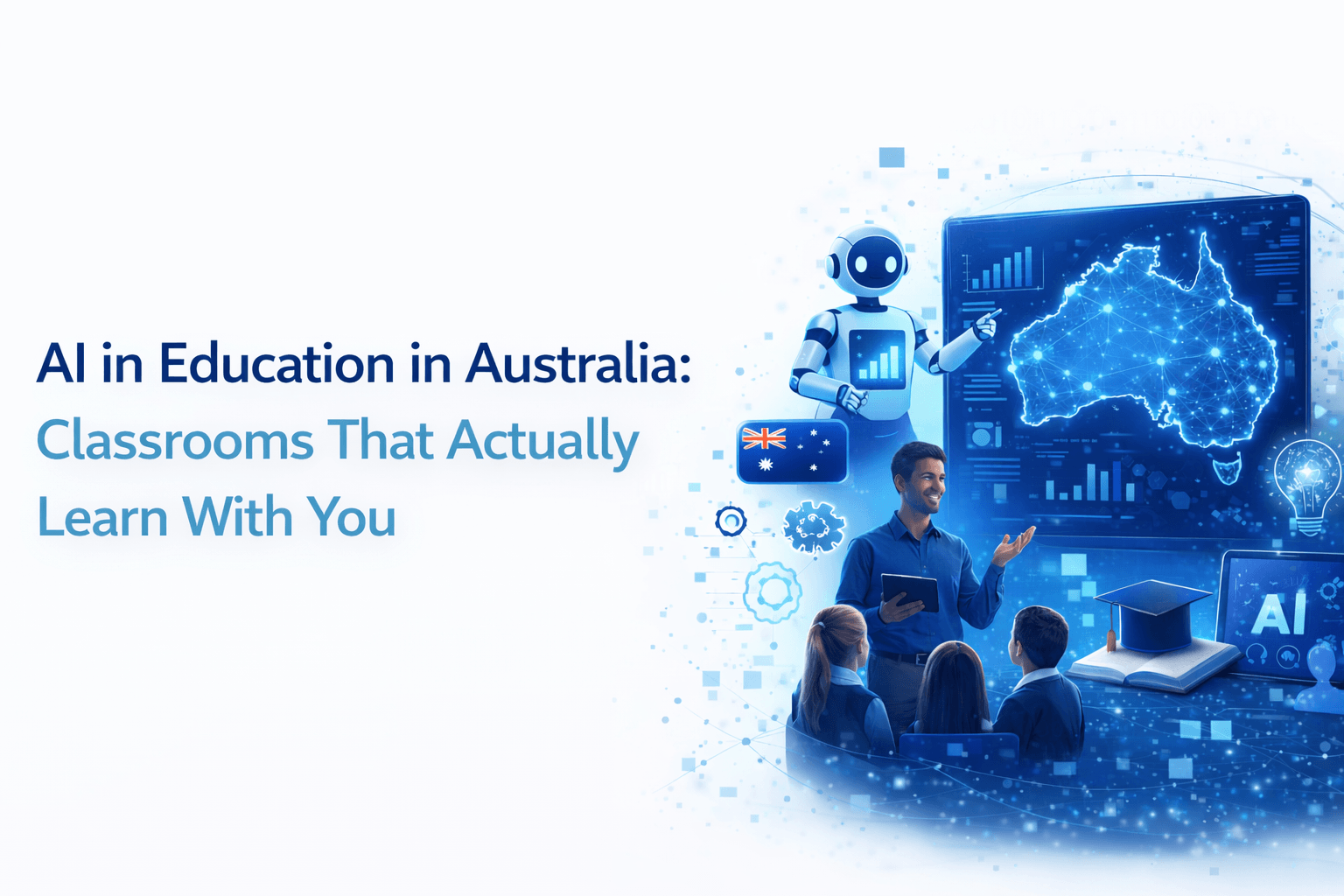
What if school finally worked the way you do?
Artificial intelligence in education isn’t about replacing teachers or turning classrooms into something out of a sci-fi movie. Let’s clear one thing up first. AI in education isn’t here to replace teachers or turn classrooms into something out of a sci-fi movie. It’s here to make learning work better for you.
Think about it. Have you ever felt like a lesson was either too fast or too slow? Like, it just didn’t match how you learn? That’s the gap AI is trying to fix.
Also Read – Understanding How AI in eLearning Is Revolutionizing Education in Dubai
At its core, AI in education is all about understanding students better. It looks at how you’re performing, where you’re struggling, and what you’re good at. Then it adjusts things. Maybe you get extra practice where you need it. Maybe you move ahead faster where you’re already strong. This is part of the larger digital transformation in education, making learning simple, smart, and effective.
It can also take a lot off a teacher’s plate. Grading, tracking progress, even creating quizzes. AI can handle all of that. Which means teachers get more time to actually teach, guide, and connect with students (which, let’s be honest, is what really matters).
And this shift is already happening across Australia. Schools and universities are starting to use AI to close learning gaps, support students better, and make classrooms more inclusive.
So no, it’s not just about technology. It’s about making learning feel less frustrating and a lot more in sync with you.
Also Read – How AI in Portfolio Management Works: A Complete Guide
AI Education Trends in Australia: A New Way to Learn
Australia is seeing some really interesting changes in how students learn. And no, it’s not just about more screens in classrooms. It’s about learning that actually adjusts to you.
Let’s break it down…
1. Learning That Adjusts to You
Ever felt like a class was too fast, or way too slow?
Not everyone learns at the same speed. So, why are classes still designed that way? This is among the largest evolutions that are currently occurring in education with AI. Learning is beginning to adapt according to the student, instead of taking place at a particular pace. When something is too fast, you have more practice and time. If it’s too easy, you move ahead. Simple. In Australia, there is an incremental shift towards knowledge-based teaching methods in classrooms that are not based on the one-size-fits-all approach. It is such a little alteration, and learning becomes much less aggravating and natural.
2. Help is Always There
Having a problem that you are trapped in late at night?
It is different this time around because you do not need to wait. In various AI, students can receive help immediately. You are free to ask questions, get clarifications and practice more as you please. It is increasingly prevalent. AI in schools and universities in Australia is making the process of learning less stressful. You are not kept waiting until you have the next lesson; you can work things out as soon as you need to.
3. Learning That Doesn’t Feel Boring
If it’s boring, you’re not paying attention. It’s that simple.
Something education is now beginning to believe. Due to the development of AI, lessons become more interactive and responsive. You receive quicker feedbacks and things do not feel monotonous. It is not about turning it all into a game; it is about making the process of learning easier to remain concentrated on. The change is one of the biggest digital changes in education, and it has already been observable in most of the Australian classrooms.
4. Teachers Who Actually Know Where You’re Struggling
Just imagine that your teacher knows where exactly you are in the wrong place without uttering a word.
That’s what AI is helping with. It monitors progress and indicates the areas where students need assistance, thus the teachers no longer have to make guesses. This implies that the support is timely and not late. This is already transforming the way teachers teach and students learn in most parts of Australia. It brings the entire experience closer and makes it a lot more efficient.
These trends indicate that AI is not being used as a weekly buzzword; it is a revolution that is redefining the way of learning and teaching amongst Australians.
The Future of Education with AI: It’s Already Happening
If you could change one thing about how learning works, what would it be? Or maybe you’ve wondered at some point, “Why does this feel harder than it should?”
The future of education in Australia is closely tied to AI. Imagine walking into a classroom where:
- Each student receives lessons tailored to their learning style.
- Teachers get real-time insights into student comprehension and engagement.
- Universities can predict which courses will be in high demand and allocate resources more efficiently.
It’s subtle. But it changes everything.
And in the future, classrooms won’t work the same way they do today.
Things are not going to simply progress forward in learning. When it does not make sense, it slows down and assists in getting it. And when you are doing fine you need not wait. You keep moving.
The very planning of courses will be different. Australian schools and universities will know what students really care about and what works, thus able to go about it quicker. As an illustration, in case a student begins to struggle, he/she is supported early as opposed to when results are known. And when a person is doing good, he or she takes steps without the restraint.
Learning starts to adapt to what you really need in order to get on instead of everyone doing exactly as you do. Some students need more time. Some move faster. There are people who learn more through examples and others through practice. Now consider the fact that no longer would there be a need to fit myself into a single system.
That’s the change.
This translates to learning being less coercive and more natural to students in Australia. You just tend to be more involved since it is understandable on the way. You are not always trying to keep pace or make things out yourself.
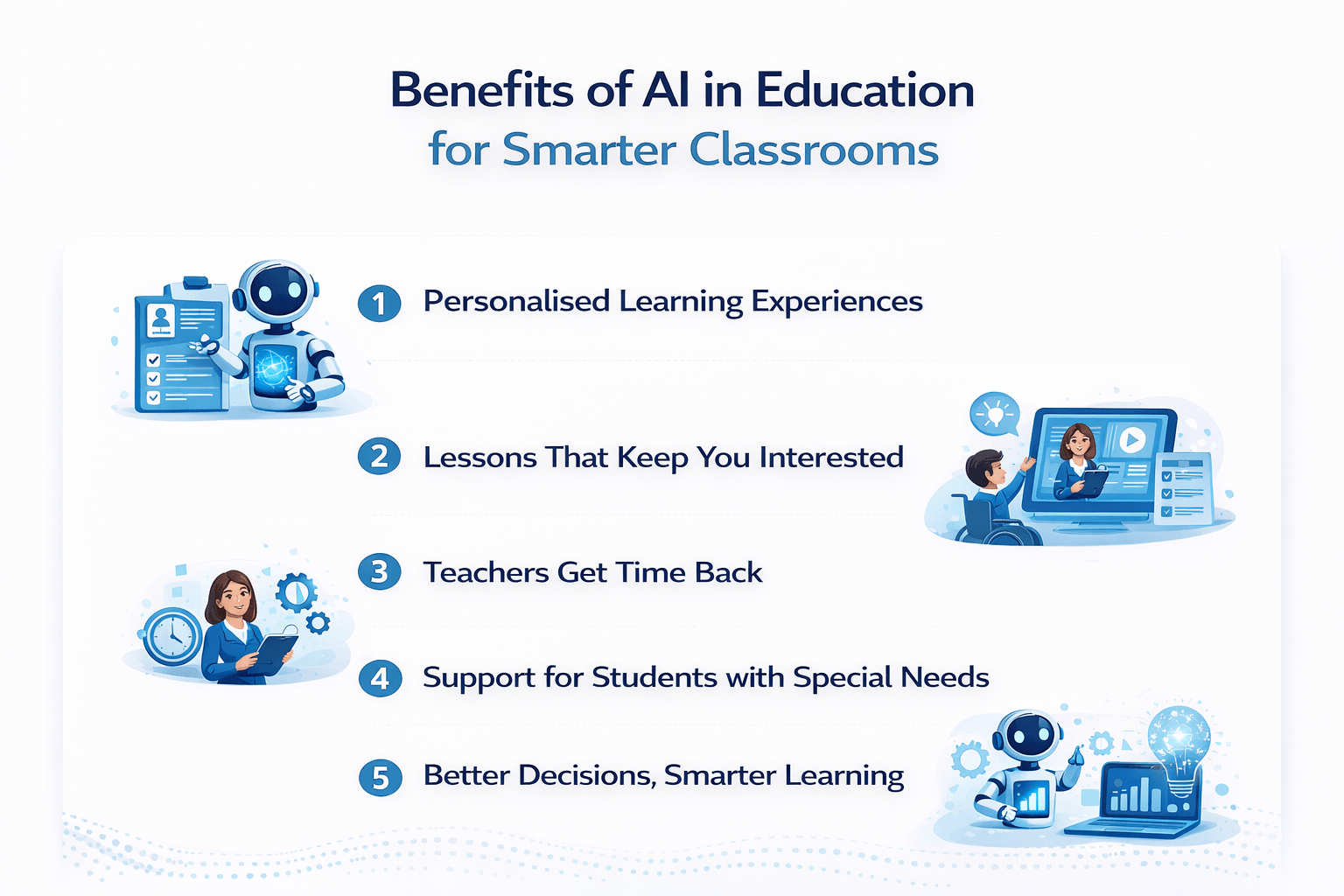
Benefits of AI in Education for Smarter Classrooms
A smart classroom is one where every student is seen. Learning isn’t the same for everyone, because every student isn’t the same.
We often think of classrooms as fixed spaces. Same lessons. Same methods. Same expectations. But that’s slowly changing, thanks to AI in education.
Education in Australia is changing the way students learn, and AI is a big reason why. But it’s not about robots taking over classrooms. It’s about making learning more useful, more supportive, and closer to real life.
Here are some of the key benefits of AI in education in Australia:
1. Personalised Learning Experiences
Every student is unique. And AI allows for learning to match individual needs.
One of the biggest benefits of AI is how it helps students when they actually need it. Sometimes, students get stuck but don’t ask for help. Perhaps they are shy, or perhaps they do not even know that they are falling behind. It is possible to ensure that AI tools can identify subtle changes in performance and provide support at an early stage.
With personalised learning with AI Australia, lessons can adjust based on what a student needs.
By analysing data on student performance, AI platforms can create customised study plans, recommend resources, and even adapt content based on a learner’s pace.
2. Lessons That Keep You Interested
It’s hard to stay focused when lessons feel boring or repetitive.
AI contributes to the fact that learning becomes more interactive and engaging. Be it quizzes within a few seconds, immediate feedback or elements in the form of tiny games, the students remain engaged longer. Students get to learn and retain more information when they perceive learning as an interactive process rather than imposing learning.
3. Teachers Get Time Back
Teaching isn’t just teaching. It involves a lot of additional labor such as grading and monitoring. These tedious duties can be handled by AI.
Teachers do not have to use time in grading assignments, attending to students, and performing other repetitive administrative duties. AI manages them effectively, and educators can devote their time to mentoring and encouraging students.
This helps teachers to have more time in the form of attention to focus on the students. More time to expound on things. Less time to connect.
4. Support for Students with Special Needs
Some students need extra help, and AI makes that easier.
It is not easy to read long texts, write fast and follow everything that occurs in the classroom. This is one of the areas where AI can be of great assistance in a silent yet mighty manner.
Technologies such as text-to-speech can read lessons aloud, and this will benefit students who have issues reading or prefer to listen rather than read. Speech-to-text allows students to say what they say and write everything down, which is not always mandatory, so those who struggle with writing can find a lot of relief through speech-to-text. Such simple aspects as adjusting the appearance of the content or separating it into easier stages can turn the process of learning into something that is much less intimidating.
5. Better Decisions, Smarter Learning
AI is capable of monitoring student performance and pointing to trends over time. Teachers are able to see what works and to whom they may need to assist in a short period. This enables them to take action early enough and enhance the learning process in general.
This is the reason that AI in schools and universities in Australia is gaining prominence. It is rendering education to be more supportive, practical and effective to all.
AI Tools for Students and Educators
The Australian learners are currently able to access an increasing variety of AI-powered learning methods that make the process smarter and more efficient:
- Virtual Study Assistants: AI-based flashcards, tutors, and research assistants.
- Exam Preparation Platforms: AI creates practice questions, simulates tests and points to areas of weakness.
- Language Learning Tools: AI can be used to correct pronunciation, grammar and writing style.
- Collaboration Tools: AI can manage group projects and monitor progress, as well as propose means to enhance teamwork.
In the case of educators, AI software development for education has resulted in grading, plagiarism and performance monitoring tools that are automated. This will enable the teachers to teach and spend less time on tasks.
Techugo: Your Go-To Education App Development Company in Australia
Are you looking for an EdTech development company?
Bringing AI into education is easier with the right partner, and that’s where Techugo comes in. As a leading mobile app development company in Australia, Techugo helps schools and universities create smarter, more personalised learning experiences.
From AI software development for education in Australia to innovative mobile app development solutions, Techugo builds platforms that:
- Adapt Learning to Students – Lessons adjust to each student’s pace and learning style.
- Engage Students Effectively – Interactive apps, virtual tutors, and instant feedback make learning more dynamic.
- Support Teachers – Automate grading, track student performance, and manage administrative tasks.
- Enable Inclusive Learning – Tools for students with special needs, including text-to-speech, speech-to-text, and customised lessons.
- Provide Actionable Insights – Analytics help educators identify learning gaps, improve outcomes, and make data-driven decisions.
With Techugo, schools and universities in Australia can use AI to create classrooms that actually work for students. Technology adapts to them, not the other way around.
AI software that actually gets your students? Yes, it is possible. Let Techugo build you one.
FAQs
1. What is AI in education?
Artificial intelligence technologies in education are applied to enhance learning. It allows differentiating lessons, following up on progress, providing immediate feedback, and assisting teachers with repetitive work, making classes smarter and more efficient.
2. How does AI personalise learning for students?
AI can be used to analyse the performance of students, define strengths and weaknesses, and adjust the lessons. This will make sure that every student is learning at his or her pace, that he or she gets additional practice when necessary and proceeds when prepared.
3. Can AI replace teachers?
No. AI is not meant to replace teachers, but to help them. It does work such as grading, attendance checks, and production of study material, freeing the teachers so that they can engage in mentoring, interacting, and interactive learning.
4. How does AI help students with special needs?
AI provides such tools as text-to-speech, speech-to-text, and customizable lesson types. Such tools also open up learning and lessen the obstacles between students with special needs.
5. What types of AI tools are available for students in Australia?
Here are the types of AI tools that are available for students in Australia:
- Artificial intelligence tutors and virtual students.
- Systems of exam preparation with personalised practice questions.
- Pronunciation, Grammar, and writing language learning tools.
- Group work and teamwork tools.
6. How are educators using AI in classrooms?
Educators apply AI to assist in automating grading systems, tracking performance, detecting plagiarism and designing personalised learning plans. This saves on administrative work and enables the educators to teach.

Get in touch
We'd love to hear from you.