

 SA
SA  KW
KW  IE
IE AU
AU UAE
UAE UK
UK USA
USA  CA
CA DE
DE  QA
QA ZA
ZA  BH
BH NL
NL  MU
MU FR
FR 



















📌 Key Takeaways
- Cloud transformation cost generally ranges between $10,000 and $50,000+ for startups or mid size businesses.
- Over 80% of businesses are now using cloud at the enterprise level.
- The global market for cloud computing reached $1 trillion in 2026.
- The largest providers of enterprise cloud are AWS, Microsoft Azure, and Google Cloud.
The cloud computing market reached the $1 trillion milestone in 2026, which is almost like a dream. Globally, more than 80% of large enterprises are now operating through cloud infrastructure. That’s a huge and visible shift in just a few years, now all the big companies like Netflix, Adobe, Capital One, Airbnb, Spotify, Zomato, and Razorpay, among all globally leading businesses, use cloud transformation consulting to scale their businesses across the world.
Shifting data from legacy software to cloud servers is not as simple as it sounds. It comes with various sensitive operations like handling critical business data, applications, databases, integrations, and security configurations without disrupting daily operations.
One mistake and everything can vanish.
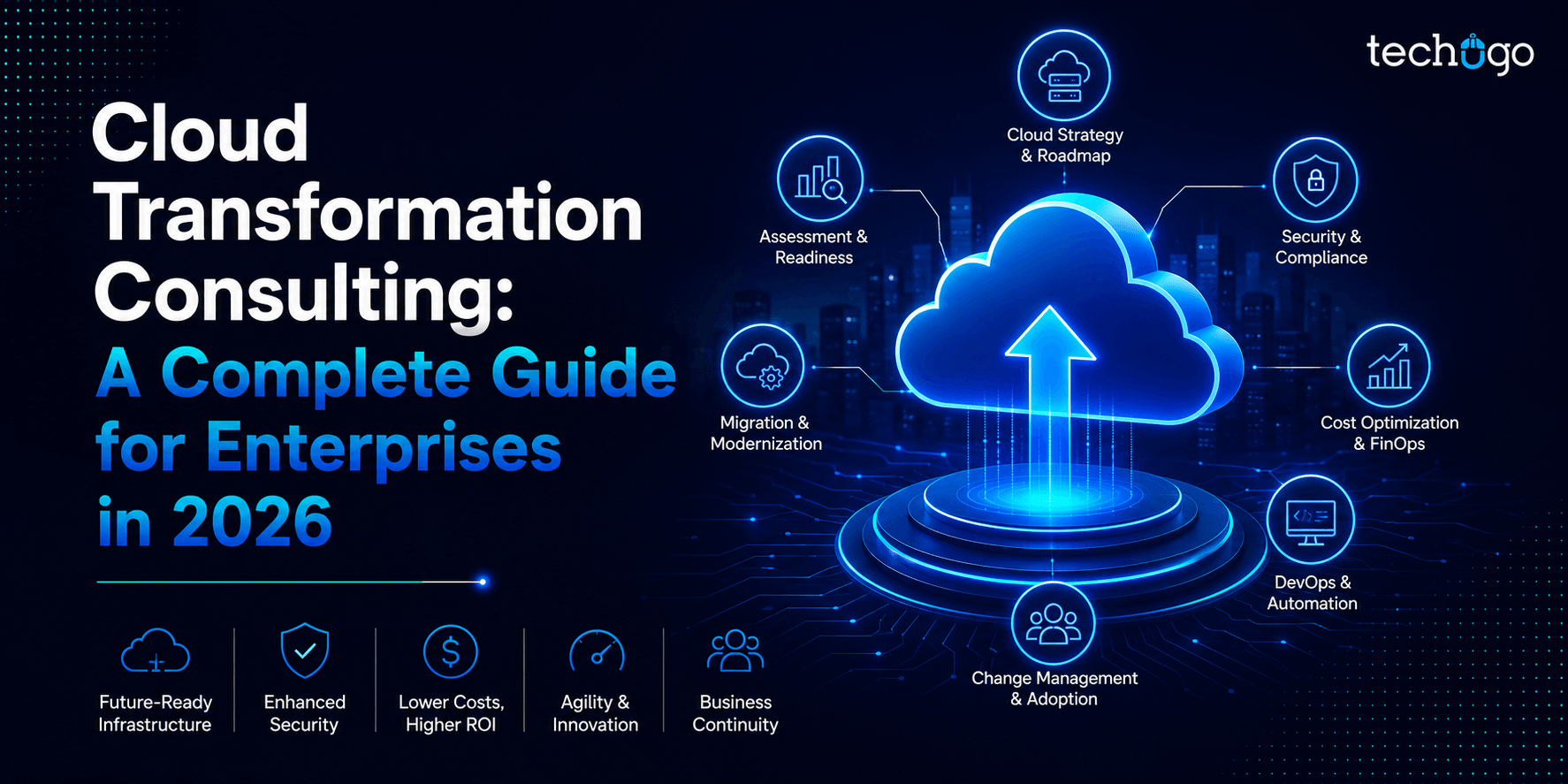
This is where cloud transformation services come into the picture. This is one of the fastest and most in-demand services that help businesses create a clear roadmap, modernize legacy systems, migrate workloads safely, and make the most of their cloud investment.
Let’s dive into how enterprise cloud transformation works and why it’s becoming a must-have strategy for modern enterprises.
What is Cloud Transformation Consulting?
Cloud transformation consulting is a way to reimagine how businesses leverage cloud computing technologies for their operations. In easy words – when businesses want to upgrade their systems in a faster, smarter way through IT infrastructure. Simply, it transforms your business to become ahead in the 2026 digital era.
Cloud transformation is your legacy app modernization tool that really helps your business to leverage the digital functionalities without manual operations.
Why Businesses Need Cloud Transformation Consulting Services in 2026
As we know 2026 is the digital era, everyone from employees, users and business owners wants to access services from anywhere, anytime, and still being stuck with old technologies can literally hold your business back.
It means – No cloud transformation, no future growth.
Faster innovation and technological trends demand faster solutions so choosing cloud transformation is a reliable and smart decision. But why?
Let’s understand:
1. So one of the main benefits of choosing cloud transformation consulting is reduced IT costs, which means less hardware and maintenance costs.
2. A compatible system with modern technology tools gives faster, improved flexibility, and reliability.
3. Through this, you can scale your business at any point in any region, and that too without extra investment.
4. The major reasons why businesses prefer cloud consulting services which are protective and secure best practices.
5. Since the world is in hybrid or remote work, it gives the privilege to work from anywhere without relying on offline servers. It can also help your business to expand globally without offline limitations.
6. Cloud technologies help automate routine tasks, allowing employees to focus on more valuable work instead of manual operations.
7. Cloud transformation consulting leads to happier customers and stronger brand loyalty.
8. For businesses that deal with products, or any services that need smooth management during heavy traffic or sales spikes, cloud consulting is the key.
9. Legacy systems often struggle with data loss, while cloud transformed systems built with faster backup and recovery.
10. A cloud transformation consultant helps businesses to avoid costly mistakes with effective strategies that reduce migration risk and ensure minimal disruption.
Most Common Cloud Transformation Services Businesses Use Today
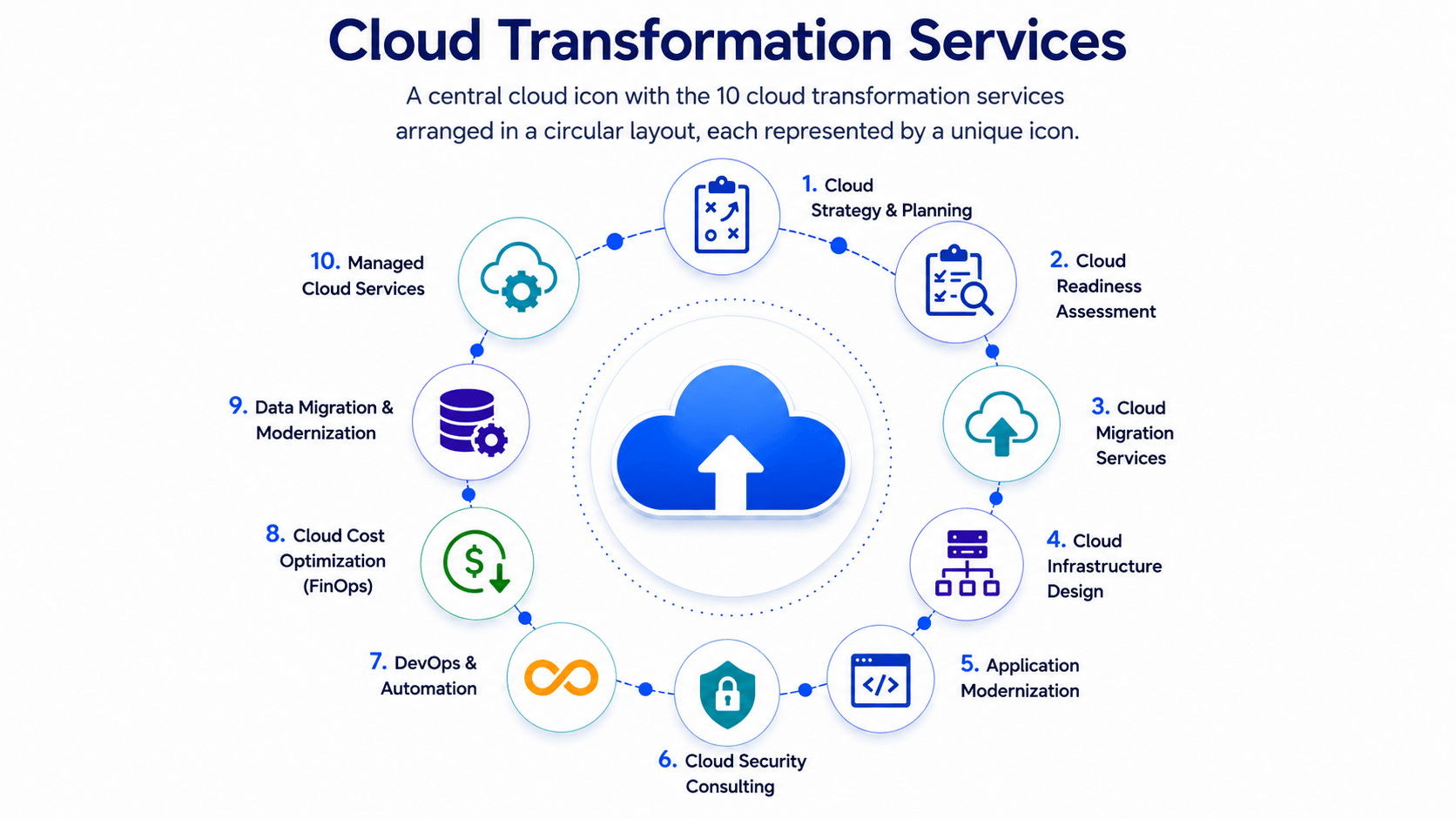
Every company’s cloud journey is different, making cloud transformation services essential for delivering industry-specific strategies, seamless migration, and long-term scalability. Cloud strategy, cloud migration, infrastructure management, security and DevOps all allow companies to redefine their technological risks and plan their way to achieve maximum organizational value.
Here are some of the globally known cloud transformation solutions:
1. Cloud Strategy & Planning
- Understand business vision and IT needs
- Make a customized cloud adoption plan
- Right cloud deployment and platform selection
- Plan overall budget, schedule and stage of deployment
2. Cloud Readiness Assessment
- Analyze your IT and data server infrastructure
- Know if it can be migrated or not
- Find security and performance weaknesses
- Implement with proven cloud strategies.
3. Cloud Migration Services
- Migrate apps, databases and workflows to the cloud server.
- Reduce downtime of software or app during migration
- Perform secure and seamless data migration execution
- Conduct system testing for optimal performance
4. Cloud Infrastructure Design
- Create scalable and secure cloud architecture design.
- Set up networking, storage, and compute services.
- Ensure high-performance infrastructure architecture design.
- Create infrastructure that can support future growth of business.
5. Application Modernization
- Modernize applications from legacy systems.
- Make the application fast and reliable.
- Allow cloud functionalities in the application.
- Enhance user experience and maintainability.
6. Cloud Security Consulting
- Cloud security improvement using best practices.
- Identity and access management implementation.
- Data protection using encryption.
- Compliance with industry standards.
7. DevOps & Automation
- Automate the software and application development and deployment
- Speed up testing and application releases
- Improve communication between development team and IT team
- Faster software delivery with less labour cost.
8. Cloud Cost Optimization (FinOps)
- Check usage of cloud resources in real time
- Find areas where cloud spending can be reduced.
- Ensure workloads run smoothly without extra cost
- Transparent budget and cost reports.
9. Data Migration & Modernization
- Securely transfer business data to the cloud.
- Modernize databases for better performance.
- Improve data accessibility and reliability.
- Ensure data integrity throughout the migration.
10. Managed Cloud Services
- Give full time support
- Handle full time updates, maintenance and bug fixes
- Perform optimal checks for seamless performance
- Minimize downtime.
Cloud Transformation vs Cloud Migration: What’s the Difference?
A lot of business owners think that moving data to the cloud is the cloud transformation but it is only the first step of it. A true transformation involves modernizing applications, optimizing infrastructure, improving security, and automating processes to get more longevity in business.
Cloud migration is just one of the cloud transformation best practices, the main transformation starts from it. To have a clearer picture, refer to the following difference table –
| Aspect | Cloud Migration | Cloud Transformation |
| Meaning | Moves existing applications and data to the cloud. | Redesigns your entire IT environment using cloud technologies. |
| Primary Goal | Shift workloads from on-premises to the cloud. | Improve business operations, innovation, and long-term growth. |
| Scope | Focuses only on migration. | Covers migration, modernization, security, automation, and optimization. |
| Legacy Applications | Usually moved with minimal changes. | Modernized or rebuilt for better performance. |
| Business Impact | Changes where your systems run. | Changes how your business operates. |
| Technology Used | Existing applications on cloud infrastructure. | Cloud-native applications, AI, automation, DevOps, and modern architectures. |
| Time Required | Usually shorter and less complex. | Longer project with a strategic roadmap. |
| Long-Term Value | Better accessibility and scalability. | Greater agility, lower costs, stronger security, and faster innovation. |
| Best For | Businesses looking to relocate workloads. | Businesses looking to digitally transform and future-proof operations. |
Benefits of Cloud Transformation for Modern Enterprise
Is cloud transformation just another tech hype or does it have real value for money? That’s a fair question especially when you hear about it from pretty much every business out there. The truth is, organizations aren’t pouring money into cloud transformation just because it’s fashionable. They’re doing it because it helps them cut costs, improve security, scale faster and build a business that’s ready for the future. Here are just some of the best reasons that it makes it such a valuable investment.
Lightning-fast speed to market
In this lightning-fast evolving market, first come first served provides a lot of benefits to the company. Cloud transformation helps businesses to bring new products, services and features to the market before competitors at a faster speed.
Massive cost savings that make sense
Well to be honest, it is observed that less functional servers are barely helpful for the business for obvious reasons. With cloud, you can only pay for what you use and need.
Stress-free scaling during busy times
Established businesses don’t always stay the same as they are now. Being in the business market, it is important to grow with the times and events. Cloud infrastructure allows businesses to scale during a sudden traffic hike without crashing or slowing down.
Work seamlessly from absolutely anywhere
For businesses, the sky is the limit to grow, so is the working flexibility. Technologies and servers shouldn’t stop you from working from anywhere. Cloud transformation gives secure access to your team so that you can work or access data from anywhere in the world, making it more convenient for global clients and opportunities.
Protect your data with enterprise-grade security
Your company’s data is one of its greatest assets, and loss of it is unacceptable. Today’s cloud computing platforms offer a host of security and protection measures, along with automatic backups, for you to ensure that your data is always safe.
Why Security and Compliance Matter in Cloud Transformation Consulting
Cloud transformation has thousands of advantages whether it’s cost-efficiency, better scalability, or faster innovation but one of the major points that we can not ignore is security and compliance.
For any business dealing with sensitive and important data, it is important to have secure access to it. Most businesses think choosing cloud transformation means automatic security, but it’s not, cloud infrastructure still gives ownership to provide access from your own end.
Here are some of the key security measures that any secure cloud infrastructure provides:
1. Data Encryption
Cloud transformation protects your data in two ways: data at rest and data in transit. This refers to the files that are stored in the cloud and transmitted files or information between users and the system, respectively. Modern cloud infrastructure uses globally accepted encryption standards such as AES-256 for stored data and TLS (Transport Layer Security) to protect data within or on the internet.
2. Identity and Access Management (IAM)
In a successful business, data protection is non-negotiable. Through Identity and Access Management in cloud infrastructure, your business can easily manage access to files and assets. It uses role-based access control (RBAC) to assign permissions based on the employee’s access. The other feature is Multi-Factor Authentication (MFA) in which only verified users can access the data with OTP, biometric verification, etc., ensuring an extra security layer.
3. Regular Security Monitoring
Routine security checks are just like double-checking so you don’t run into problems down the line. It monitors your applications, servers, databases, networks, and users in real-time and continuously looks for anomalies. Therefore, when there is a login attempt from an unknown machine or location, it would immediately alert the security team.
4. Automated Backup & Disaster Recovery
Cloud servers are the ultimate protector of your database, files and sensitive information’s ultimate protector. In other words, your data is protected against server crash, ransomware attack, accidental deletion, or a natural disaster. Cloud servers automatically back up data through scheduled snapshots, redundant storage, and replication, which provide an additional layer of security and remove manual tasks from the process.
5. Compliance with Industry Standards
Secure business wins the trust of users as well as industry authorities. Having a compliant network is a necessity for a successful business cloud transformation. Cloud transformation and migration consulting companies design cloud infrastructure to align with the compliance requirements relevant to your industry. Compliance frameworks like GDPR, HIPAA, PCI DSS, ISO/IEC 27001, SOC 2, and CCPA are fulfilled by cloud transformation services.
6. Regular Security Audits
A successful enterprise cloud migration has regular security reviews to assess cloud infrastructure, applications, and access policies. These assessments reveal previously unknown security vulnerabilities, increase compliance, and keep your company safe from the ever-changing landscape of cyber threats.
7. Patch Management
Many of the cloud transformation challenges stem from outdated software and delayed updates. Cloud platforms make patch management easier by automatically applying security updates, reducing the attack surface, and keeping applications protected against the latest cyber threats.
8. Data Privacy Policies
A secured cloud migration roadmap is not only technical but also charged with preserving customer trust. Cloud infrastructure enables organizations to implement data privacy policies through robust security, encryption, and governance capabilities that protect sensitive data.
Most Common Cloud Transformation Mistakes Businesses Make
Around 18% of organizations encounter data transfer failures when migrating to the cloud, and one of the top reasons isn’t the technology – it’s poor planning. Many enterprises are rushing to move to the cloud without a clearly defined strategy, resulting in downtime, unforeseen costs, security concerns and migration delays.
The major cause? No Cloud Transformation Roadmap.
But without a roadmap, not even the best cloud platforms can lead to a successful transformation. Here are the most common traps companies fall into and how to sidestep them.
1. Legacy Systems That Don’t Fit the Modern World
Some companies continue to use software and legacy systems developed some time back. This poses challenges such as a lack of compatibility, an inability to transform, and being costly to support, hence making cloud transformation hard.
2. No Clear Cloud Strategy
Adopting cloud services without developing an appropriate roadmap will be counterproductive. It will end up wasting valuable time, money, and effort. For any successful cloud transformation, one has to develop an appropriate strategy.
3. Security and Compliance Concerns
Since cloud adoption involves moving company data to the cloud, questions of security and regulatory compliance arise. Failure to adopt appropriate security measures and regulations exposes organizations to serious risks and liabilities.
4. Downtime During Migration
Migrating your server without proper cloud transformation consultancy can cost you unexpected downtime. And I believe no business wants that because it can cause revenue loss. Not choosing the right cloud consulting partner for digital transformation services can increase security risks and reduce your return on investment.
5. Managing Cloud Costs
Cloud computing is relatively inexpensive compared to other technologies, but without keeping an eye on the cost of the technology, one may end up incurring too many expenses. Under-utilization of virtual machines and over-provisioning may cause excessive cloud cost problems.
6. Resistance to Change
Transformation in cloud computing is not only about technological changes; it also involves human changes. Employees can resist new tools and techniques, making training and change management an essential part of the solution.
7. Lack of Cloud Expertise
Not every company has an experienced cloud team on staff. Without those skills, businesses can find themselves struggling with cloud architecture, migration planning, security, and continuous optimization.
8. Integrating Existing Business Systems
Businesses usually have many different systems for finances, personnel management, sales and operations. It is possible to integrate these legacy systems with new cloud services, but it may require some effort from the company.
9. Performance and Reliability Issues
When cloud services are used improperly, companies are likely to encounter slow apps, performance problems, and various discrepancies for the end-users. It is important to monitor and continuously optimize the process in order to make it work effectively.
How to Choose the Right Cloud Transformation Consulting Company
Choosing the right cloud transformation consulting company is as important as choosing the right cloud platform. But how to choose the right one from hundreds of companies? Because one wrong choice can cause migration delays, security gaps, unexpected costs, and poor performance.
Selecting a reliable cloud-native transformation consulting firm can make you an industry leader with long-term growth. Before making a decision, make sure your cloud partner checks all the right boxes.
- Proven Cloud Experience
- AWS, Azure & GCP Expertise
- Enterprise Cloud Specialists
- Legacy System Modernization
- Cloud Migration Expertise
- Cloud Security & Compliance
- DevOps & Automation Skills
- Cloud Cost Optimization
- End-to-End Support
- 24/7 Monitoring & Maintenance
Techugo’s Cloud Transformation Roadmap: A Step-by-Step Approach
Techugo is your cloud transformation partner at every step. We are an industry-leading company that helps startups, big enterprises, and Fortune 500 companies with cloud upgradation, modernization of legacy systems, and building future-ready systems from scratch.
Techugo brings experienced cloud transformation services that deliver real business value, better performance, and long-term growth.
1. Business-First Approach
Your cloud transformation journey starts with knowing your business goals, current pain points, and growth expectations. This makes sure your cloud strategy is designed around your goals, not a specific technology.
2. Roadmap Designed for Success
There is no substitute for direction in a successful change. Techugo prepares the roadmap that enables enterprises to migrate, modernize and scale with least disruption and the highest efficiency.
3. Modernizing Legacy Systems
Legacy software can put the brakes on growth and run up the costs of doing business. Techugo transforms legacy systems into cloud-enabled solutions that are faster, more secure and easier to maintain.
4. Security and Compliance at Every Step
Security becomes the first thing to consider even before the execution of any process starts. It becomes very important to have proper access control, data encryption, a compliance model, and proper monitoring to secure any confidential data of a business.
5. Smarter Cloud Cost Management
Adoption of cloud solutions should make businesses more efficient and not lead to any hidden costs. Proper resource management and appropriate cloud architecture can help clients to use their cloud solution effectively.
6. Seamless Migration with Minimal Downtime
Business processes shouldn’t stop during the transition period. Our cloud transformation and migration consultants conduct good planning to get minimal downtime during transformation.
7. Ongoing Support and Optimization
After implementing cloud solutions, the transformation doesn’t end. Ongoing monitoring and constant optimizations will help maintain the security and performance of the system.
How Much Does Cloud Transformation Cost?
One of the first questions asked is “What is the cost of cloud transformation?” The straightforward answer to this question is – it depends. The cost of the business transformation for a company depends on the size of the business, its current IT infrastructure, migration complexity, and services required.
| Business Size / Factor | Estimated Cost |
| Small Business (Basic Migration) | $10,000 – $30,000 |
| Mid-Sized Business | $30,000 – $90,000 |
| Large Enterprise Transformation | $90,000 – $100,000+ |
Frequently Asked Questions
1. What does a transformation consultant do?
Cloud Transformation Consultants help companies strategize, migrate, modernize, and manage their IT infrastructure in the cloud. They help plan a cloud strategy, analyze current technology, improve security measures, reduce migration risk, and ensure that the cloud transformation aligns with business goals.
2. What is cloud transformation?
Cloud transformation is the process of using concepts of cloud computing in business applications, infrastructure, data, and processes. Unlike cloud migration, which involves moving data to the cloud, cloud transformation focuses on improving scalability and security, among other benefits.
3. What are the 5 types of consulting?
The top 5 services provided by cloud consultants include Cloud Strategy and Planning, Cloud Migration, Application Modernization, Cloud Security and Compliance, and Managed Cloud Services. This entire suite of services is required to ensure your success in an enterprise cloud transformation.
4. Which industries benefit the most from cloud transformation consulting?
Industries like Healthcare, Banking & Finance, Retail & eCommerce, Manufacturing, Logistics, Education, Media & Entertainment, Real Estate, Travel and Government can take advantage of cloud transformation consulting. Cloud transformation can be useful for any company that wants to update its processes.
5. How much does cloud transformation consulting cost?
Cloud transformation consulting costs can range from $10,000 to $50,000 for small companies, between $50,000 and $90,000 for medium-sized firms, and between $90,000 and $100,000+ for large enterprises. It will depend on the factors discussed above.
6. What are the cloud transformation best practices for enterprises?
Top practices for cloud transformation include defining a clear cloud roadmap, evaluating the existing infrastructure, migrating in stages, deploying robust security controls, managing cloud costs, automating deployments using DevOps, and monitoring cloud performance on an ongoing basis.
7. What are the risks of moving legacy applications to the cloud?
Migrating legacy applications without sufficient planning can lead to downtime, data loss, security vulnerabilities, compatibility problems, and inflated cloud expenses. An expertly orchestrated enterprise cloud transformation strategy with application assessment and phased migration also reduces risk and ensures a seamless migration.
8. Why should I choose Techugo as the cloud transformation consulting company?
Techugo is one of the leading cloud transformation consulting companies in the USA, India, UAE, and UK helping startups and enterprise-level businesses to modernize operations while maximizing long-term ROI.

Get in touch
We'd love to hear from you.