

 SA
SA
 KW
KW
 IE
IE AU
AU UAE
UAE UK
UK USA
USA
 CA
CA DE
DE
 QA
QA ZA
ZA
 BH
BH NL
NL
 MU
MU FR
FR




















📌 Key Takeaways
- Hybrid cloud migration allows businesses to run critical systems on-premise while using the cloud for scalability and performance.
- A structured cloud migration plan with phased execution reduces downtime and prevents operational disruption.
- Hybrid cloud is not a one-time setup; it requires ongoing optimization of resources and workloads.
- AI helps cloud systems run better by adjusting resources automatically based on demand.
Cloud is no longer a future-facing strategy – it’s basically the backbone of modern enterprise IT. And as companies push harder into digital transformation, hybrid cloud migration has become the go-to approach, with around 68% of organizations globally already using hybrid cloud models, according to recent industry surveys. It just makes sense when you think about it – businesses need to modernize without ripping apart legacy systems that still matter.
But the thing is, success here really comes down to solid cloud migration planning. You need it so workloads move smoothly, risks stay under control, and everything still aligns with long-term business goals. Without that structure, migration turns messy pretty quickly, so planning ends up being just as important as the move itself.
This hybrid cloud migration strategy guide breaks down everything from strategy and tools to security cost and best practices for successful cloud transformation so you can understand how it actually works in real scenarios and why it matters.
So let’s read…
Hybrid cloud vs multi-cloud: key differences
While both models involve multiple cloud environments, their purpose and structure are actually quite different. This is where cloud migration planning becomes important because you can’t just shift everything randomly – you need a clear idea of how workloads should move across environments.
Hybrid cloud is basically about integration. It connects on-premise systems with cloud platforms so everything can work together (data and applications can move between them without too much friction). It is especially useful for companies that still rely on legacy systems – that is where hybrid cloud architecture really helps keep things stable while still allowing modernization.
Multi-cloud on the other hand is more about diversification. It is when you use multiple cloud providers separately – like AWS, Microsoft Azure or Google Cloud – so you’re not tied down to one vendor and you get better redundancy and flexibility overall.
| Aspect | Hybrid cloud | Multi-cloud |
| Core focus | Integration between on-premise & cloud | Use of multiple cloud providers |
| Infrastructure | Combines private + public cloud | Multiple independent public clouds |
| Primary goal | Modernize legacy systems | Avoid vendor lock-in |
| Data movement | Seamless between environments | Limited or controlled per provider |
| Best For | Enterprises with legacy systems | Cloud-first, scalable architectures |
| Key benefit | Flexibility + gradual migration | Resilience + provider independence |
In simple terms:
- Hybrid cloud = Integration between on-prem and cloud
- Multi-cloud = Using multiple cloud providers separately
When to choose what?
- Hybrid cloud is ideal when legacy systems still play a major role.
- Multi-cloud is preferred for flexibility, redundancy and avoiding dependency on a single provider.
Also Read – Multi Cloud vs Hybrid Cloud: Selecting the Appropriate Cloud Architecture for Your Business
Business benefits of hybrid cloud migration
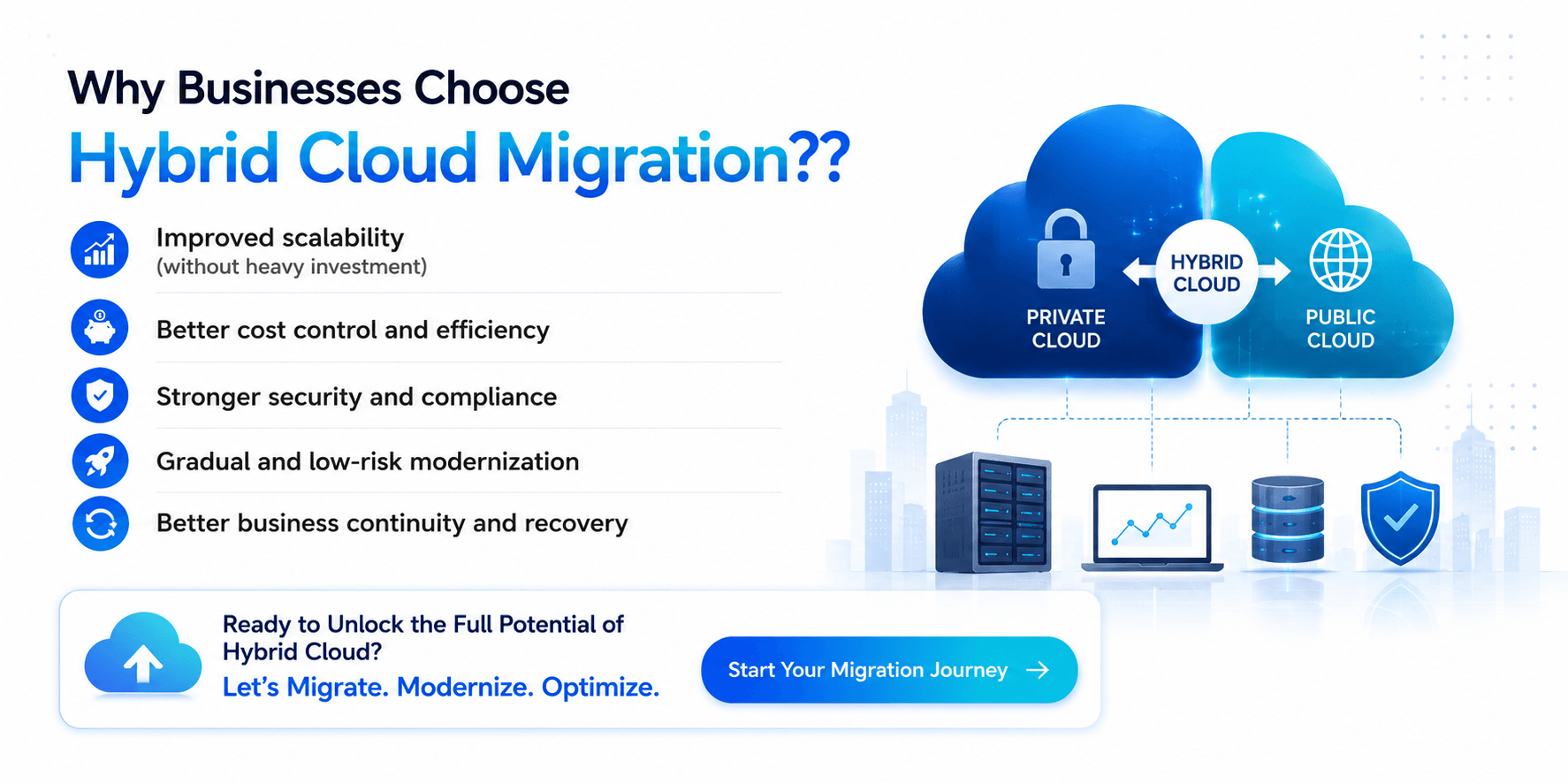
Adopting a hybrid model brings some pretty solid business advantages, especially for companies going through digital transformation and working on benefits of hybrid cloud migration initiatives.
1. Improved scalability (without heavy investment)
You can scale up or down based on demand without having to completely rebuild your existing setup – which makes things a lot more flexible in real time.
2. Better cost control and efficiency
Instead of throwing everything into one system, businesses can split workloads between on-premise and cloud. It usually helps cut down unnecessary spending.
3. Stronger security and compliance
A big plus is that sensitive data can stay on-premise while still using cloud features where needed and this makes compliance and security a lot easier to manage.
4. Gradual and low-risk modernization
You do not have to change everything at once. Companies can modernize step by step so that it feels way safer and less disruptive.
5. Better business continuity and recovery
If something goes wrong, hybrid setups make it easier to keep things running so downtime doesn’t hit the business too hard.
At the end of the day hybrid cloud just helps businesses stay flexible, save costs and stay resilient without messing up day-to-day operations.
Also Read – Introducing the Transformative Power of Cloud Computing for Modern Businesses
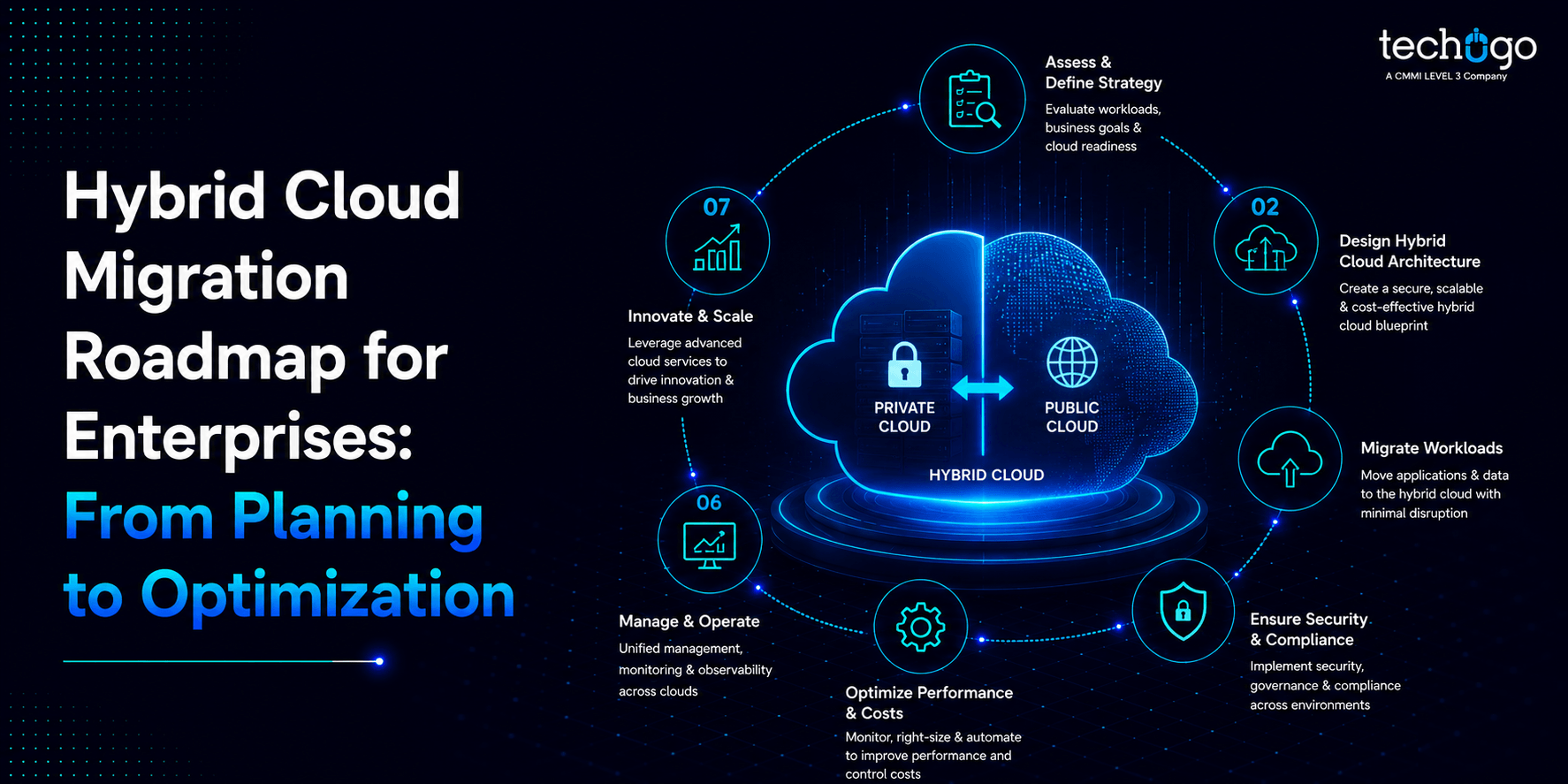
Step-by-step cloud migration roadmap for successful deployment
A successful cloud migration roadmap is not about rushing to the cloud – it is about structured execution. A strong plan ensures stability, security, and performance during transformation.
Step 1. Assess current infrastructure
Start by auditing applications, workloads, and dependencies. Identify:
- What can move to the cloud
- What must remain on-premise
- What needs modernization
This step forms the foundation of your hybrid cloud migration strategy guide.
Step 2. Cloud migration planning
Strong cloud migration planning includes:
- Migration phases
- Risk assessment
- Compliance requirements
- Budget allocation
This stage ensures your migration aligns with business and technical goals.
Step 3. Choose hybrid cloud platforms
Selecting the right best hybrid cloud platforms is critical. Key evaluation factors include:
- Scalability
- Integration capabilities
- Security features
- Cost structure
Popular platforms include services from:
- Amazon Web Services
- Microsoft Azure
- Google Cloud
Each offers strong hybrid capabilities depending on enterprise needs.
Step 4. Execute phased migration
Avoid a big-bang migration. Instead, use a phased approach:
- Start with pilot workloads
- Gradually scale migration
- Monitor performance continuously
- Optimize based on feedback
This reduces downtime and minimizes operational risks.
Step 5. System testing and verification
Do not move forward without verifying everything in a safe setup first:
- Run performance checks across applications under real usage conditions
- Confirm that data moves correctly and stays consistent
- Review security settings and access controls thoroughly
- Resolve any issues before full rollout
This helps ensure the system behaves reliably after migration
Step 6. Cloud performance optimization
Treat hybrid cloud migration as an ongoing process rather than a one-time task:
- Track system health and performance across all environments
- Spot slowdowns, errors, or resource inefficiencies early
- Fine-tune workloads to improve speed and reduce cost
- Adjust infrastructure based on real usage patterns
This is going to keep the hybrid setup efficient, stable, and scalable over time
What most businesses get wrong about hybrid cloud migration is treating it like a one-and-done IT rollout. But it does not work like that. It doesn’t “end” after migration – it keeps shifting as your systems grow, traffic patterns change, and business demands keep evolving.
The real win isn’t just getting workloads into the cloud – it’s what you do after they’re already there. The constant tweaking, balancing, and improving is where the real value actually shows up. And that’s exactly where cloud computing consulting services quietly matter the most – not just in getting you migrated, but in making sure what you built doesn’t stay static for long.
Hybrid cloud security: strategies for safe deployment
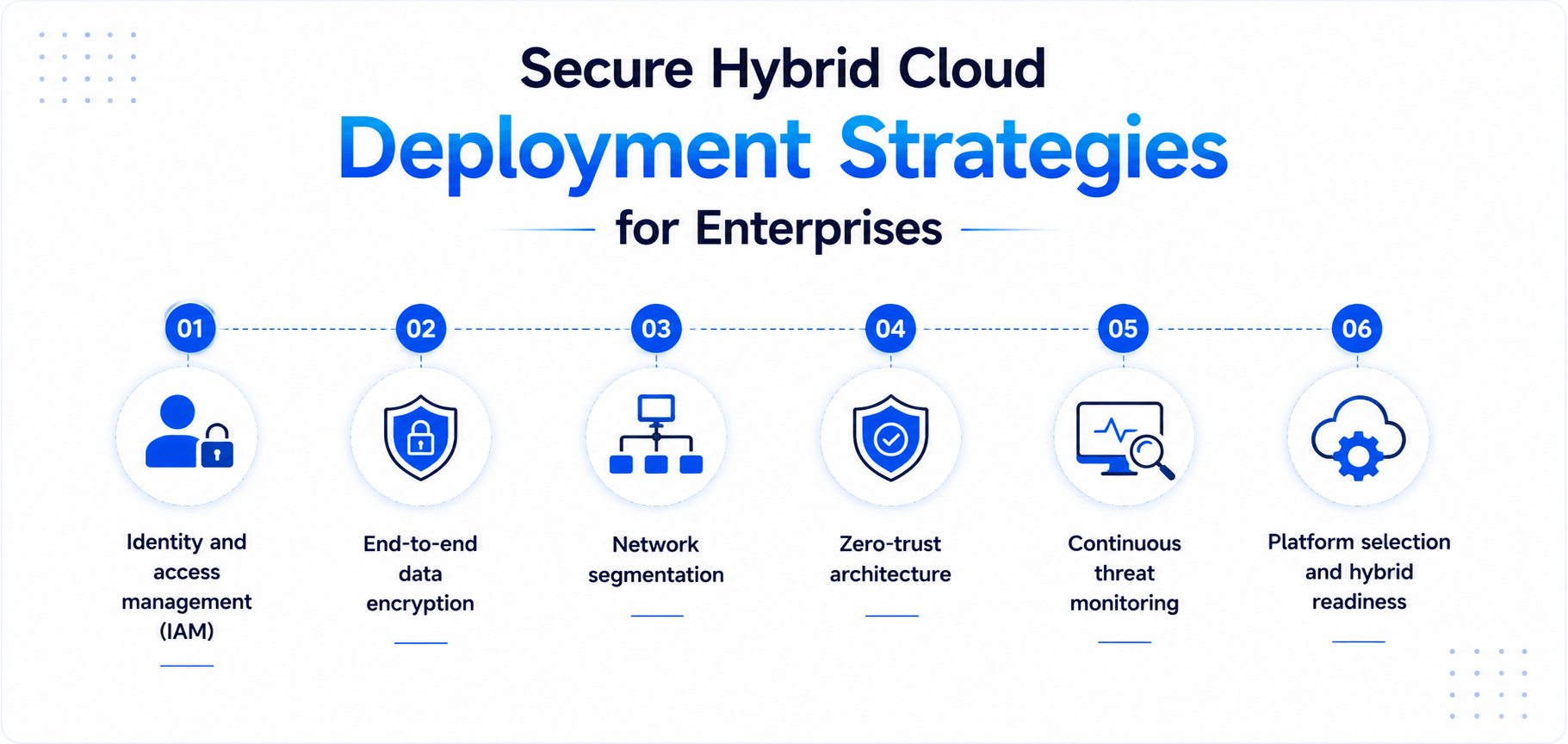
Security is one of the most critical aspects of any hybrid infrastructure, and a strong hybrid cloud security framework ensures safe communication between on-prem and cloud systems, because without that, everything just becomes exposed, unstable.
Key security strategies include:
1. Identity and access management (IAM)
Controls who can access what within a hybrid cloud migration environment, ensuring only verified users, applications, and systems interact with sensitive resources. IAM helps enforce strict authentication and authorization policies across both on-premise and cloud platforms, reducing the risk of unauthorized access… and it also enables role-based access control so employees only get what they actually need, which honestly, is kind of the whole point.
2. End-to-end data encryption
Protects data both in transit and at rest by converting it into unreadable formats for unauthorized users. Even if data is intercepted during transfer between cloud and on-premise systems, encryption ensures it cannot be misused, or even understood really, so yes- it just sits there useless to attackers.
3. Network segmentation
Divides the network into multiple secure zones to limit exposure and control traffic flow between systems. By isolating workloads and applications, organizations can prevent attackers from moving freely across the infrastructure if a breach occurs… because once one area is hit, you don’t want everything else going down with it.
4. Zero-trust architecture
Operates on the principle that no user or system should be trusted by default, even if they are inside the network. Every access request is continuously verified based on identity, device health, location, and behavior patterns – and yes it’s strict, but that’s exactly what makes it essential in modern hybrid cloud architecture setups.
5. Continuous threat monitoring
Involves real-time tracking of system activities across all environments to quickly detect unusual behavior or potential security threats. It supports cloud performance optimization by helping identify issues early, reducing downtime, and improving overall system efficiency across hybrid setups, because things don’t just break loudly anymore—they fail quietly if you’re not watching.
6. Platform selection and hybrid readiness
The effectiveness of these security practices also depends on choosing the best hybrid cloud platforms like:
- Amazon Web Services (AWS) – known for its global infrastructure, advanced security controls, and deep service ecosystem
- Microsoft Azure – preferred for enterprise integration, hybrid capabilities, and strong compliance support
- Google Cloud Platform (GCP) – recognized for data security, analytics-driven protection, and AI-powered threat insights
Selecting the right platform ensures these security strategies actually work in the real world across the entire hybrid cloud migration process because otherwise it all just looks good on paper but doesn’t hold up under pressure.
Common challenges in hybrid cloud migration
Hybrid cloud migration brings flexibility and scalability but it also introduces several challenges that organizations have to deal with.
The systems are not always ready and sometimes they just don’t fit properly into modern environments… therefore things get complicated quickly, especially when cloud infrastructure modernization initiatives are involved.
These are the common challenges that organizations face during hybrid cloud migration:
Legacy system compatibility issues
One of the biggest challenges is integrating older applications with modern cloud environments. Many legacy systems were not designed for cloud-native architectures – because of that migration becomes difficult, sometimes even messy. It was never originally built for this kind of transition so you end up needing refactoring or partial redesign, or both.
Data migration complexity
Moving large volumes of data between on-premise systems and cloud platforms is not simple, and it often creates delays, errors, and even data integrity issues. Because data was spread across systems that were never meant to talk to each other properly, things can break during transfer… and sometimes it just slows everything down unexpectedly.
Compliance gaps
In a hybrid setup data moves everywhere, and that creates exposure, and security rules are supposed to stay consistent but they are not always aligned across environments, therefore compliance becomes harder than expected. You think it is controlled but then gaps appear.
Downtime and operational risks
If hybrid cloud migration planning is weak then downtime happens, and when it happens it affects users, systems, and business operations all at once. Some systems are stable before migration but after poor execution they became inconsistent because timing and coordination were not handled properly.
Cost overruns
Cloud infrastructure modernization projects can get expensive, and sometimes budgets are not enough because resource usage increases, integration becomes heavier, and optimization takes longer than expected. Therefore costs rise & organizations have to adjust plans mid-way, whether they were ready or not.
Also Read – Everything You Need to Know About Cloud-Native App Development
Best practices for hybrid cloud migration
One wrong migration decision can turn a scalable system into a costly bottleneck.
Following the right best practices for hybrid cloud migration helps organizations improve performance, reduce risks, and achieve better control over hybrid environments.
Assess your existing infrastructure thoroughly
Start by properly understanding what you already have in place, and look at your applications, dependencies, performance levels and workloads, so you know what’s actually ready to move and what needs more planning because without this, the migration process becomes unclear and risky.
Choose the right migration strategy for each workload
Don’t treat every workload the same, you pick the right migration approach – lift-and-shift, replatforming, or refactoring – but it depends on complexity and business needs, and sometimes you may even combine approaches so that it fits better.
Segment workloads based on business priority
Be clear about priorities, some systems are more critical than others so you decide what moves first based on impact, performance needs and compliance requirements… and this helps you avoid chaos later.
Enforce strong security and governance controls
Security and governance need to be in place from the start, and you ensure access control, data protection and compliance rules are consistent across both on-premise and cloud environments because if they are not, risks increase quickly.
Follow a structured cloud migration checklist
Before moving anything you use a proper cloud migration checklist so nothing important is missed during planning, execution or testing and it acts like a guide that keeps everything aligned.
Adopt a phased migration approach
It’s better to migrate in phases instead of a big-bang move because this reduces downtime and helps avoid unexpected issues so that systems stay stable even while changes are happening.
Automate repetitive migration tasks
Automation helps a lot during migration, you use tools for provisioning, configuration and scaling, and it reduces manual effort while keeping things more consistent, therefore errors are also reduced.
Test applications before full deployment
Always test in a staging environment first because it helps catch performance issues, compatibility problems or security gaps early, and it saves you from bigger failures later on.
Monitor performance continuously after migration
Once everything is live, keep tracking performance, system health and resource usage so you can detect and fix issues quickly… and sometimes things may look fine but still need tuning.
Optimize resources for cost and efficiency
Cloud isn’t set-and-forget, you continuously optimize resources, remove waste and manage costs so that long-term efficiency improves and spending doesn’t quietly grow out of control.
Role of AI in cloud deployment optimization
AI is honestly changing how cloud systems work in a big way. Instead of everything being manually managed and adjusted all the time, AI just watches how things are running and automatically makes improvements in the background. It reacts to demand, fixes inefficiencies, and basically makes cloud deployment feel way less chaotic.
What makes it useful is how it handles the “boring but important” stuff without needing constant human input. If traffic suddenly increases, it can scale resources up before things slow down. If things calm down, it scales back so you’re not wasting money. It also keeps workloads balanced so no single server gets overloaded while others are sitting idle.
On top of that, it helps with performance and security at the same time, which is kind of a big deal. It keeps optimizing how resources are used and also flags anything that looks unusual or risky in real time.
Some key things AI handles in cloud optimization:
- Predicting traffic and scaling resources automatically
- Balancing workloads so systems don’t get overloaded
- Improving performance continuously in the background
- Spotting security issues or weird activity early
Overall, it just makes cloud deployment feel smarter, smoother, and way less stressful to manage.
Industry use cases of hybrid cloud migration
The adoption of hybrid cloud migration is growing across industries – and it’s not hard to see why. Organizations get the flexibility to modernize on their own terms, without ripping out infrastructure that still works. The way that plays out, though, looks pretty different depending on the sector.
Take a look at how different industries are actually putting hybrid cloud migration into practice:
Healthcare
Healthcare is a good example of where the hybrid model earns its keep.
Patient data is sensitive by nature, so keeping that within private infrastructure isn’t optional – it’s a requirement. But that doesn’t mean everything has to stay locked down. Cloud resources open the door to better analytics, scalable telehealth services, and faster application delivery. The key is pairing that with serious hybrid cloud security practices so compliance doesn’t become an afterthought. Done right, providers can actually improve care delivery without compromising on data protection.
Also Read – Cloud Computing in Healthcare: Benefits and Use Cases
Banking and Financial Services
Banks have their own version of this balancing act. Core financial data (transactions, customer records, fraud signals) needs to live in tightly controlled environments. But customer-facing applications and high-volume workloads are a different story. Hybrid cloud infrastructure gives financial institutions the room to support real-time banking experiences without putting sensitive systems at unnecessary risk. It’s also where cloud migration planning tends to matter most, because the cost of getting the architecture wrong in financial services is higher than almost anywhere else.
Retail and e-commerce
Retailers don’t have the luxury of predicting demand with any real precision. A flash sale or a viral moment can spike traffic overnight, and on-premise systems alone just can’t absorb that kind of pressure. Hybrid environments solve for this – businesses can scale up quickly using cloud resources while keeping the core systems that run day-to-day operations right where they are. The result is more consistent performance when it counts most.
Manufacturing
In manufacturing, the hybrid model connects things that used to operate in silos – production systems, IoT devices, supply chain platforms. Processing operational data closer to where it’s generated makes everything faster and more responsive, while keeping critical systems behind more controlled infrastructure. It’s a practical setup for an industry that can’t afford unexpected downtime.
Government and public sector
Government agencies are dealing with some of the strictest data requirements out there, which makes modernization a slow and careful process. Hybrid cloud migration gives them a path forward that doesn’t mean surrendering control over sensitive information. Thoughtful cloud migration planning is especially important here – agencies need to sequence the transition carefully to meet regulatory requirements while still making meaningful progress toward better digital services.
Future trends in hybrid cloud migration
The hybrid cloud space isn’t standing still. The organizations paying attention to where it’s heading now are going to be in a much stronger position than those who wait to catch up.
-
AI-driven optimization
AI in cloud deployment optimization is already changing how environments are managed. Workload placement, resource allocation, performance tuning – intelligent systems are handling these faster and more accurately than manual oversight ever could. This is only going to deepen.
-
Adaptive security models
Static security frameworks aren’t built for the complexity of modern hybrid environments. The shift is toward real-time, adaptive models that respond to threats as they emerge – paired with compliance automation that removes a lot of the manual overhead teams are used to carrying.
-
Edge computing integration
Processing power is moving closer to where data is actually generated – factories, hospitals, retail floors. Edge computing and hybrid infrastructure are a natural fit, and as edge use cases grow, hybrid environments will increasingly be the architecture holding it all together.
-
Cloud infrastructure modernization
The longer-term push isn’t just about moving workloads – it is about rebuilding the underlying systems to be more automated, resilient, and responsive. Cloud infrastructure modernization is becoming less of a project and more of an ongoing capability that high-performing organizations are building into their operations permanently.
-
Multi-cloud and Interoperability
Organizations are moving away from single-vendor dependency. The trend is toward environments where workloads move fluidly across platforms based on cost, performance, and compliance needs which puts interoperability at the center of how hybrid cloud migration strategies get designed going forward.
-
FinOps & cost intelligence
Scaling a hybrid environment without visibility into spend is a fast way to create problems. FinOps practices are becoming standard – giving teams the real-time cost intelligence they need to optimize resource usage without sacrificing performance.
The direction is clear. Hybrid environments are getting smarter, more adaptive, and more deeply embedded in how organizations operate – and the companies investing in that foundation now are the ones that will scale without friction later.
Cost considerations in hybrid cloud migration
Hybrid cloud migration doesn’t come with a fixed price tag – and that is actually the point.
Costs scale with complexity, not with a one-size-fits-all model. What a mid-sized retailer spends looks nothing like what a regional bank puts in and that gap usually comes down to infrastructure size, compliance requirements and how much of the existing environment needs to be rebuilt versus reused.
That said, going in without a number in mind is how budgets spiral. Here’s a realistic breakdown of what different migration scopes typically run:
| Migration Scope | Estimated Cost Range | What’s Typically Included |
| Small-scale / Pilot Migration | $5,000 – $15,000 | Limited workloads, basic cloud setup, minimal integration |
| Mid-size Business Migration | $15,000 – $40,000 | Multi-department workloads, security configuration, cloud migration planning |
| Large Enterprise Migration | $40,000 – $75,000 | Complex infrastructure, compliance frameworks, custom architecture |
| Full-scale Hybrid Transformation | $75,000 – $100,000+ | End-to-end migration, advanced security, ongoing optimization |
Beyond the initial migration, ongoing costs (like cloud subscription fees, monitoring tools, security management, and support) are worth factoring in early. The organizations that plan for total cost of ownership upfront tend to avoid the budget surprises that catch others off guard six months in.
Done right, hybrid cloud migration pays for itself. Reduced infrastructure overhead, better resource efficiency, and the ability to scale without major capital investment add up quickly – especially for businesses operating at any real volume.
How Techugo helps with scalable app development for hybrid cloud environments
Businesses often realize too late that performance issues start at the development stage, which is why companies like Techugo take a different approach.
Techugo, as a mobile app development company, has been helping enterprises build scalable, high-performance mobile applications for over 10 years. Our development approach is built around agile methodologies, modular architecture, and cloud-ready systems that ensure applications perform smoothly even as user demand grows. This makes it easier for businesses to scale without repeatedly reworking the core product.
Techugo works with modern programming languages and frameworks for both Android and iOS development, along with robust backend systems that support real-time data flow, secure AI integrations, and seamless third-party connectivity for a global user base.
Alongside development, equal importance is given to quality assurance, performance testing, and continuous optimization. This ensures every product is reliable, secure, and capable of handling real-world usage without disruption.
Need support with development, performance optimization, or migration planning?
Reach out to us and see how you can achieve it with minimal risk and maximum efficiency.
FAQs
1. What is hybrid cloud migration?
Hybrid cloud migration is the process of moving applications, data, and workloads between on-premise infrastructure and cloud environments while keeping both systems connected and working together.
2. Is hybrid cloud migration secure?
Yes, if proper security measures like encryption, access control, monitoring, and governance policies are implemented across both environments.
3. What role does automation play in hybrid cloud migration?
Automation helps reduce manual effort, speeds up deployment, minimizes errors, and ensures consistent configuration across systems.
4. What happens after migration is complete?
After migration, systems need continuous monitoring, performance optimization, and cost management to ensure stability and efficiency.

Get in touch
We'd love to hear from you.