

 SA
SA
 KW
KW
 IE
IE AU
AU UAE
UAE UK
UK USA
USA
 CA
CA DE
DE
 QA
QA ZA
ZA
 BH
BH NL
NL
 MU
MU FR
FR
















📌 Key Takeaways
- Legacy application modernization gives businesses more security, scalability, performance and long term cost efficiency.
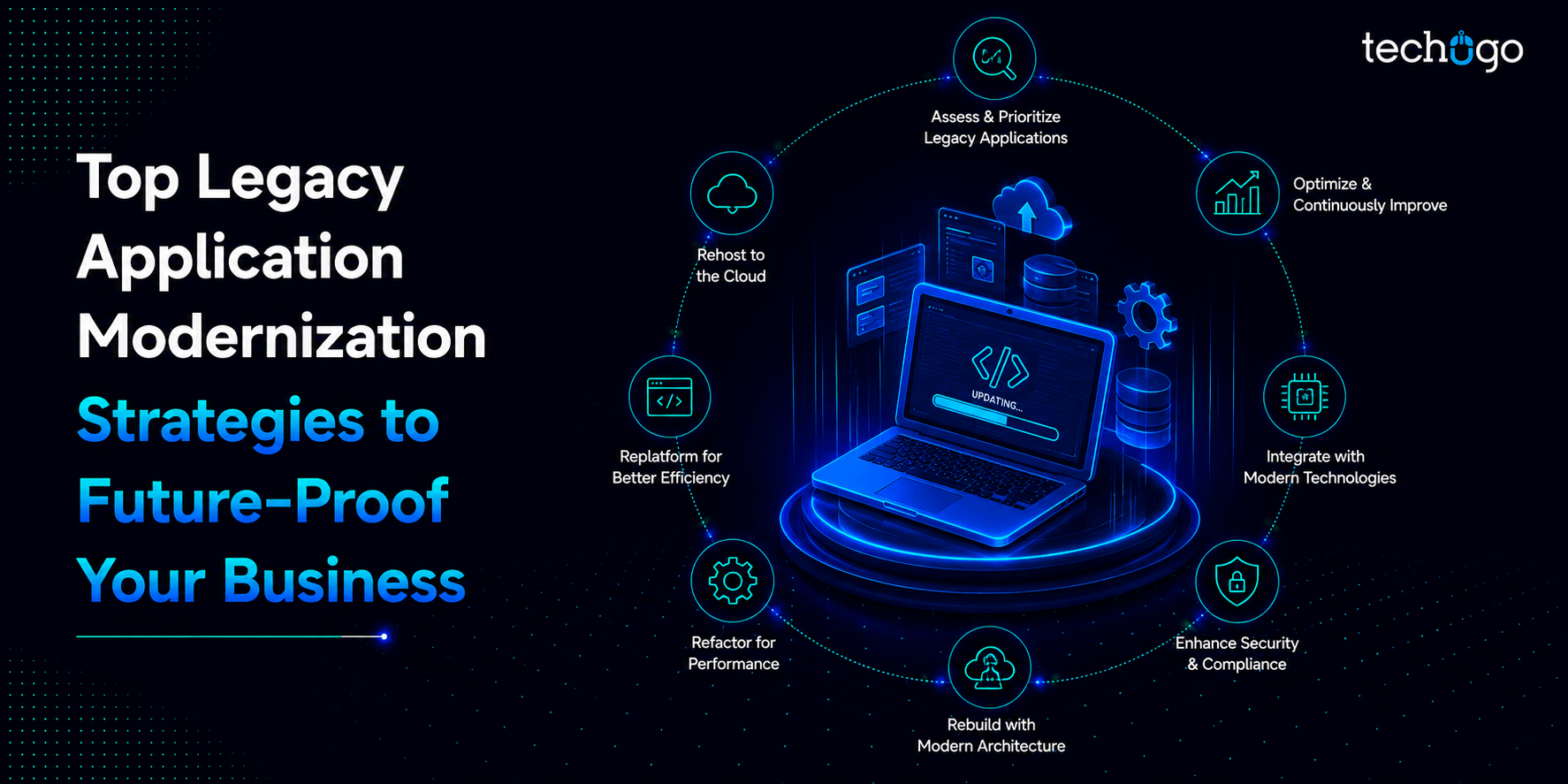
- Choose the right modernization strategy (whether it’s rehosting, refactoring, rearchitecting, rebuilding or replacing) based on your business goals.
- The cost of maintaining legacy systems can reach $40k to $55k annually.
- AI, cloud migration, microservices and GenAI-powered code are shaping the future of modernization in 2026.
- A good modernization partner can help you upgrade with less risk, less downtime and much better long term results.
If you have a business that is still running on software that was built 10, or even 20 years ago, I’m sure you’re not the only one.
Plenty of companies stick with legacy apps because they still work.
But the problem is – “still working” doesn’t always mean it’s helping you move forward.
Even though it’s working, it’s still outdated.
And let’s not forget that legacy systems are expensive to maintain (difficult to scale as well). They can also make it harder to adopt newer tech, like AI, cloud computing, automation, etc. So businesses end up at a disadvantage.
That’s why legacy application modernization strategies have become such a priority now, for organizations of all sizes – big or small.
So in this guide we’ll break down the most effective modernization strategies, when you’d actually use them, the benefits, the costs, the challenges, and the key trends that are shaping application modernization in 2026.
Let’s get started!
What makes legacy application modernization services a business priority today
Sure, maintaining old software has never been fun, but the reason why most companies just kept doing it was that rebuilding felt riskier. And it’s changing faster than light.
Legacy application modernization services are very much relevant today.
The industry insights state that the market’s on track to grow from roughly $21.94 billion in 2026 to $37.33 billion by 2030, a 14.2% CAGR. For an industry this unglamorous, that’s a big number.
Forget 2030, let’s come back to the present.
If we talk about 2026 only, cloud adoption, AI-assisted development, stricter security requirements… it’s all pushing in the same direction at once. And your organization might already be feeling that pressure somewhere.
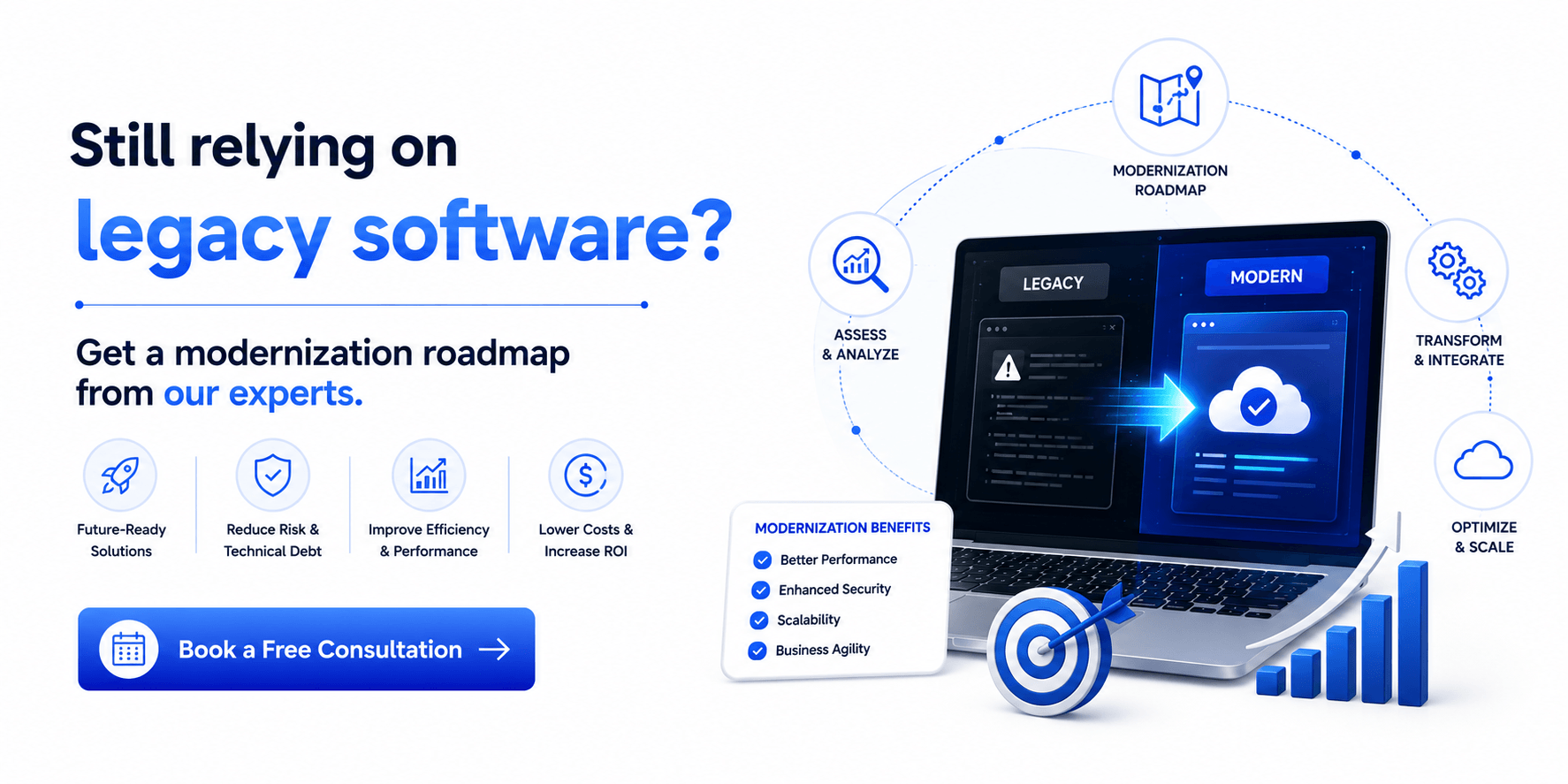
At first, legacy application modernization might sound like an IT buzzphrase. But in reality, it’s more or less about keeping what already works. It is something that your software needs – cloud migration, refactoring code, rearchitecting, API integration – and upgrading the parts that don’t, instead of starting from scratch.
Either way, the truth is, legacy system modernization services are something that you can’t afford to miss out on. Fair enough if you’re not ready today. But waiting will only make it harder.
How to know when your legacy application needs modernization
Wondering whether your legacy application is due for an upgrade? If your software checks off several of the points below, modernization should probably be your next priority.
Watch out for these signs:
- Your team fixes bugs more than it builds features
- Slow performance, downtime or users complaining
- Outdated frameworks = security and compliance risk
- Hard to connect with cloud tools or modern APIs
- Can’t scale as your user base grows
- Code’s so tangled, new devs dread touching it
And legacy application modernization doesn’t mean starting from zero.
What you have to do is pick what fits – rehost, replatform, refactor, etc. What you do NOT have to do is – wait until the system’s dragging you down to notice it’s happening.
Legacy application modernization strategies explained
1. Rehosting (lift and shift)
This is the easiest place to start. Rehosting (or ‘lift and shift’ as most people call it) just means moving your app to the cloud without messing with the code underneath. It is one of the go-to legacy application modernization strategies because it’s fast & cuts infrastructure costs. Ideal if your app still works fine but needs a better home.
2. Replatforming
This one goes a step further. The core stays the same but you’re making small adjustments along the way. Those adjustments could mean – better performance, tighter security or more compatibility with modern cloud setups. It is the best middle ground for modernizing legacy applications without the cost of a full rebuild.
3. Refactoring
Here’s where you actually get into the code. Refactoring cleans up technical debt and makes things easier to maintain, which matters a lot if you’re planning to bolt on APIs, AI, or automation later.
(Arguably one of the more effective legacy application modernization strategies for businesses thinking long term.)
4. Rearchitecting
Okay, this is a bigger move – redesigning the whole architecture, like turning a monolith into microservices. This usually isn’t a DIY job. A legacy application modernization company can help you figure out if it’s actually worth the investment based on your goals and budget.
5. Rebuilding
Sometimes the old code just can’t keep up anymore, and rebuilding from scratch with modern tech (while keeping the original business logic) is the better call. It would cost you more upfront, but it sets you up for the long haul and makes modernization of legacy applications easier than you can think.
6. Replacing
And sometimes, honestly, it’s just not worth fixing. Retiring the legacy system and switching to a modern SaaS tool can be the smarter, cheaper move – especially when modernizing legacy applications isn’t practical anymore, technically or financially.
How to choose the right legacy application modernization company
1. Assess industry experience
Start by checking if they’ve actually done legacy application modernization work in your industry before. Chances are, a partner who’s handled similar projects already knows the compliance challenges you’re about to run into – and that matters more than you’d think.
2. Review their technical expertise
Look for real skills across cloud consulting services, cloud migration, microservices, containerization, APIs, AI, DevOps, and security. Because in the end, that is what separates a working legacy application modernization solution from ones that don’t last.
3. Look for end-to-end modernization services
Ideally, you want a company that covers everything – assessment, strategy, migration, testing, deployment, support. Full-service legacy software modernization services just mean fewer gaps along the way, it always comes with handoff issues.
4. Ask about their modernization approach
Just be wary of anyone pushing a “one-size-fits-all” process. The good ones would look at your systems, your goals & your budget first. And then recommend legacy application modernization solutions that fit – whether that’s rehosting, refactoring, rearchitecting or something else entirely.
5. Check client success stories
Always ask for references. Before you make a decision, review these things –
- client testimonials
- case studies
- and references
Steps to modernize legacy applications successfully
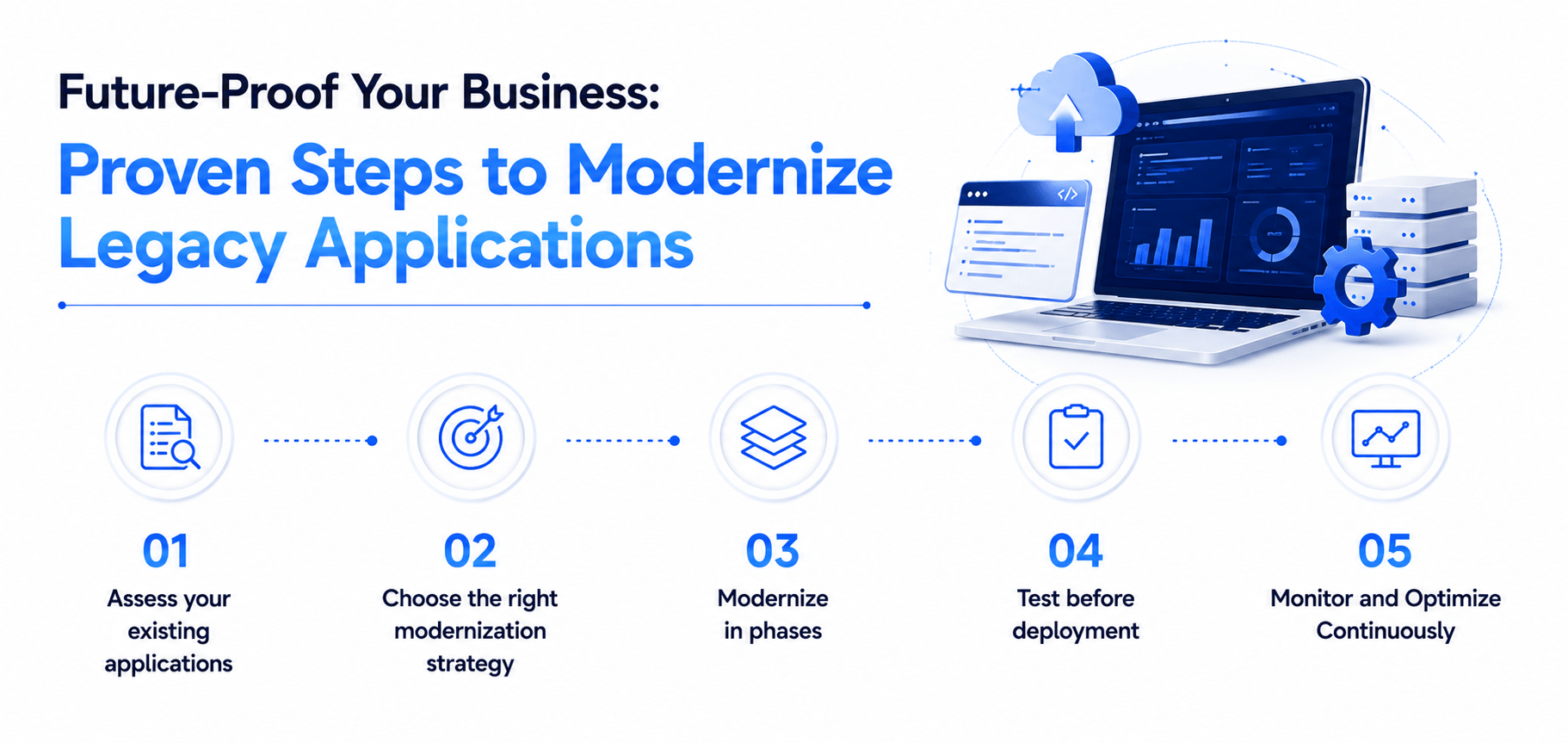
So how to modernize legacy applications?
Below are all the steps that you have to follow in order to successfully modernize your legacy application
1. Assess your existing applications
First of all look at what you’re working with. Dig into – the technical debt, performance bottlenecks, security risks, and figure out which features are business-critical. This is the starting point for how to modernize legacy applications the right way.
2. Choose the right modernization strategy
Pick what fits your goals and budget. No point overspending if you don’t need to. As we have already discussed, the common legacy system modernization strategies include rehosting, replatforming, refactoring, rearchitecting, rebuilding, and replacing.
3. Modernize in phases
Do NOT try to do everything at once. Rolling things out in stages means less downtime, fewer risks, and room to fix problems before they snowball.
4. Test before deployment
Before anything goes live, test it properly – performance, security, compatibility, all of it.
5. Monitor and Optimize Continuously
After the launch, keep monitoring, keep listening to user feedback, keep making changes. This is why modernize legacy applications is a question businesses should think about beyond the initial migration. Because it is not a one-and-done thing. It’s ongoing if you actually want to stay competitive.
Best practices for legacy app modernization every business should follow
1. Define clear business objectives
Don’t just modernize because the tech feels old. That is not a reason. Figure out what you actually want out of it. Faster releases? Lower costs? Better performance? Pick something measurable so you can tell if it worked.
2. Prioritize security & compliance
Build it in from day one… as a priority throughout the project. Regular checks go a long way.
3. Focus on scalability, not just today’s needs
Sure, fix what’s broken now, but also think ahead. Long term scalability matters as much as your today’s needs.
4. Keep documentation up to date
Nobody documented anything, and now nobody knows how it works. So keep everything documented. Always write it down as you go.
5. Measure success with KPIs
Uptime, deployment speed, cost, user satisfaction – track it. Numbers will tell you if the work actually paid off.
At the end of the day, these are pretty much the best practices for legacy app modernization that actually hold up in practice. Follow them and legacy application modernization stops being a gamble – and frankly that’s the difference a good legacy software modernization company makes.
Top legacy application modernization tools to know
- AWS Application Migration Service – makes migrating to AWS easier than doing it manually.
- Azure Migrate – Handles the assessment and the actual migration if you’re moving to Microsoft Azure, which saves you a step.
- Google Cloud Migrate – Gets your workloads over to Google Cloud without much disruption.
- Docker – Packages up your app so it runs the same everywhere (a must for portability).
- Kubernetes – Takes care of scaling and managing your containers so you’re not doing it manually every time.
- SonarQube – Analyzes code quality, security vulnerabilities & technical debt.
- Jenkins – Keeps your CI/CD pipeline running so deployments are faster and less error-prone.
- Terraform – Automates infrastructure provisioning across cloud environments.
The role of AI in legacy application modernization
You know what’s the scariest part of legacy application modernization? Not knowing what you’re dealing with. AI fixes that first.
Below are the key ways AI contributes to successful legacy application modernization:
1. AI-powered code analysis
AI scans through legacy codebases and flags technical debt, outdated dependencies and security holes.
2. Intelligent code transformation
It can suggest cleaner code, convert old languages into modern frameworks and even write documentation for systems that never had any to begin with. Huge time saver.
3. Smarter migration decisions
AI looks at your architecture, dependencies, workloads, and basically tells you: rehost this, refactor that, rearchitect the rest.
4. Predictive testing & risk detection
So before you go live, AI catches the bugs and compatibility issues that’d otherwise blow up mid-migration.
Basically, updating old software isn’t the headache it used to be anymore, it’s gotten way more manageable. And that’s what makes room for AI App Development going forward.
Business benefits of legacy system modernization
-
Improved performance
Modern apps just run better. They are faster, they are smoother. And way less lag for users.
-
Enhanced security
Ditching outdated tech means stronger security and an easier time keeping up with compliance requirements.
-
Lower maintenance costs
Replacing aging infrastructure and reducing technical debt minimizes ongoing maintenance and support expenses.
-
Greater scalability
When workloads grow or business needs shift, a modernized app can actually keep up instead of falling apart.
-
Faster innovation
Once you’re on modern architecture, plugging in AI, cloud services, APIs (all of it) just happens quicker and it means you’re moving at the speed the market expects.
These are the real benefits of legacy system modernization people talk about – better performance, tighter security, lower costs, real scalability.
And if you’re weighing legacy app modernization benefits against sticking with what you’ve got, it’s not really a close call. It’s also worth noting that many businesses partner with a trusted mobile app development company in USA to round out their digital transformation.
Common challenges in legacy system modernization
1. Outdated code & technical debt
Legacy applications were built on aging tech. And there’s often little or no documentation. So even small updates take forever, delaying digital transformation services and it makes innovation much harder than it needs to be.
2. Data migration risks
The risk of data migration is a major challenge. You can’t just copy years of data over because that’s how you end up with loss.
3. Integration complexity
Legacy systems weren’t made for the cloud or APIs, so it helps to have a real legacy app modernization approach, therefore things connect instead of clash.
4. Cost and organizational resistance
Budgets are tight, teams resist change. And this is exactly why legacy software modernization services and a good legacy application modernization strategy matter. So you get long-term value.
The annual cost of maintaining legacy systems
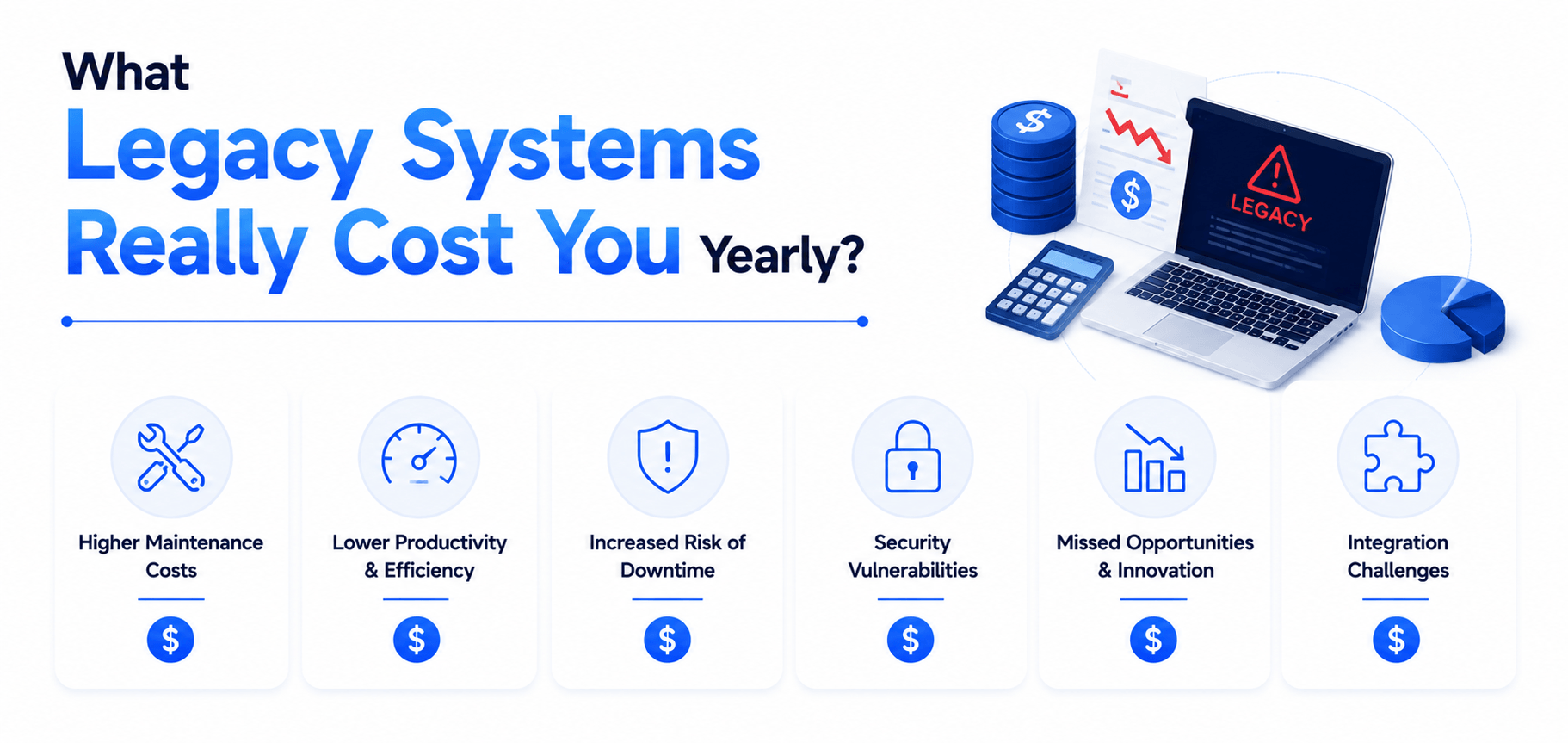
The cost of maintaining legacy systems is something a lot of businesses badly underestimate. It’s not just routine maintenance, it adds up fast. For many businesses, the expense falls between $40,000 – $55,000 a year, and larger enterprises? Even more.
Here’s roughly where that money goes:
| Cost Area | Estimated Annual Cost |
| Infrastructure & Server Maintenance | $8,000–$12,000 |
| Security Updates and Compliance | $6,000–$10,000 |
| Bug Fixes and System Maintenance | $10,000–$15,000 |
| Software Licensing and Support | $5,000–$8,000 |
| Specialized IT Talent | $11,000–$15,000 |
| Total Estimated Annual Cost | $40,000–$55,000 |
These costs don’t account for indirect losses like –
- downtime
- slower productivity
- missed innovation opportunities
- security incidents
So it makes sense why businesses are turning to legacy application modernization now, before these costs get out of hand.
Legacy application modernization trends in 2026
With the moving technology, there are so many new trends. And if you are a business, trying modernize legacy applications and stay relevant in 2026, take a look at these.
1. AI-powered modernization
AI is helping developers –
- analyze code
- automate testing
- identify technical debt
In fact it’s speeding up migration projects too, so that teams don’t have to do everything manually.
2. Cloud-first adoption
Organizations continue moving legacy workloads to the cloud in order to improve scalability, security & operational efficiency.
3. Microservices and containerization
Instead of replacing entire applications (which were often costly) businesses are adopting legacy system modernization approaches, that break monolithic systems into smaller, independently deployable services, so that things are more flexible, and it just works better for teams that are scaling.
4. GenAI for code transformation
Generative AI’s a big help now. Basically, it turns old code into modern languages, writes the docs, and points out what needs cleaning up.
What does the future of legacy application modernization look like?
-
AI will automate more of the modernization process
AI-powered tools are going to handle more code analysis, testing, documentation – and migration tasks. This would help development teams modernize applications faster while reducing manual effort.
-
Cloud-native architectures will become the standard
Traditional infrastructure is on its way out. Cloud-native’s easier to scale, easier to secure, easier to maintain… why wouldn’t you switch?
-
Continuous modernization will replace one-time upgrades
Continuous modernization is replacing those upgrades that take years to complete.
-
Security will remain a top priority
You know how cyber threats are evolving. So to fix this, future modernization efforts will prioritize built-in security (and compliance).
Why businesses choose Techugo for legacy application modernization
Legacy apps take more than a code update to modernize. You need a great strategy, technical chops – and a partner who gets your business.
At Techugo, we help startups, enterprises & global brands turn aging systems into secure, scalable, high-performing solutions – all with minimal disruption to how you run things.
We’re a mobile app development company with over a decade of experience building future-ready apps using Flutter, React Native, Kotlin, Swift, Node.js, Python, AI, and cloud platforms like AWS, Azure, and Google Cloud. So whether you’re moving to the cloud or integrating modern APIs, our team builds modernization solutions that fit your needs.
From the first strategy conversation all the way to deployment and ongoing support, Techugo’s with you every step of the way as your partner for legacy application modernization.
The sooner you modernize, the sooner you start saving. Get in Touch and let’s get started—our experts are here to help.
FAQs
1. What is legacy application modernization?
Legacy application modernization means upgrading outdated software so it’s faster, more secure, easier to maintain, and compatible with modern technologies like the cloud and AI.
2. What are the best legacy application modernization strategies?
Legacy application modernization strategies include – rehosting, replatforming, refactoring, rebuilding, or replacing applications. The best option depends on your business goals and existing systems.
3. Why is the cost of maintaining legacy systems so high?
The cost of maintaining legacy systems includes ongoing maintenance, security updates, infrastructure, licensing, and specialized support. These expenses usually increase as the software gets older.
4. When should a business invest in legacy software modernization?
If your software is difficult to maintain, expensive to run, vulnerable to security risks or slowing down the growth of your business… it’s time to consider legacy software modernization.

Get in touch
We'd love to hear from you.