

 SA
SA
 KW
KW
 IE
IE AU
AU UAE
UAE UK
UK USA
USA
 CA
CA DE
DE
 QA
QA ZA
ZA
 BH
BH NL
NL
 MU
MU FR
FR















📌 Key Takeaways
- Online grocery shopping is booming in Saudi Arabia.
- Features & complexity of the app drive development costs.
- Grocery apps need multiple user platforms.
- Models include supermarket, marketplace, and quick commerce.
- Development costs start from SAR 75,250.
The trend of going to the grocery store is slowly dying out in the Middle East, and especially in Saudi Arabia. Thanks to the convenience that is brought by the influx of online shopping and internet penetration. And one of the prominent examples is Nana, a Saudi-based quick commerce grocery delivery app that is paving the way for everyday services.
So, this naturally raises the question,” how much does it cost to build a grocery app like Nana in Saudi Arabia?” But for a more practical breakdown, let’s first understand what the app is all about.
What Is The Grocery App Nana?
Built on the factors of convenience and on-demand shopping, Nana is a grocery delivery app and a quick commerce platform taking over the Saudi market. According to the information on the official website, Nana is home to 22,000+ products with a delivery time of 20 Minutes. Just by looking at the sheer numbers, it is quite visible how big an impact this platform is making.
And here, the value proposition is quite straightforward: bring multiple everyday purchasing needs into one mobile experience.
Thus, if you are planning an app like Nana for your business endeavour, it means you are not just building a shopping cart. It is important to take care of factors like:
- Grocery Stores & Suppliers
- Customers
- Delivery Partners
- Administrators
- Payment Providers
- Store Managers
Ready To Build Your Grocery Delivery App In Saudi Arabia?
Get A Free QuoteTurn your grocery app idea into a scalable digital platform. Get a customised estimate for grocery delivery app development in Saudi Arabia today.
Why Are Businesses In Saudi Arabia Investing In Grocery Applications?
If you look at the global and Middle East markets, you will come to the conclusion that digital commerce and mobile shopping are expanding rapidly. Well, this is not a coincidence.
According to market research on this, the online grocery market size was $67.6 billion in 2024. However, in the year 2026, it is estimated that the market size will reach an enormous figure of $80.8 billion. And by the year 2033, the market size estimates suggest that it will reach a staggering amount of $992.4 billion. So, from the period 2025 to 2033, the Compound Annual Growth Rate (CAGR) amounts to 36.8%.
If you go a layer deeper, a list of other factors is encouraging businesses to move ahead with this idea, which involves:
- Convenience is becoming a major differentiator
- Mobile-first shopping
- Growing demand for quick commerce
- Digital Payments
- Repeat Purchasing
Types of Grocery Delivery Applications
Before you go on to ask about the cost to develop a grocery delivery app, first it is important to know what types of software you can get. So, let’s look at the most common types of grocery delivery applications that perform well in Saudi Arabia:
1. Supermarket Grocery Application
In simple words, it is a dedicated supermarket food market platform that can be built for a single supermarket or grocery chain. Think of it as a complete grocery chain and putting it into a mobile experience.
Your consumers have the luxury of browsing products and checking whether they are available or unavailable. Further, you can make payments, choose your preferred delivery slot, and get groceries at home. As simple as that.
2. Grocery Marketplace Application
Instead of selling products from a single supermarket, an app of this type connects several grocery stores, supermarkets, specialty stores, and possibly other retailers with consumers.
Consumers access the app, select a store or search for a product, review the catalog, make the order through the app, and receive the order through this app’s network of delivery services.
This is somewhat like a shopping mall website, just that it specializes in grocery shopping.
3. Quick Commerce Grocery Application
If the traditional grocery delivery system focuses on convenience, then quick commerce focuses heavily on speed. With the aim of solving everyday delivery problems in a very short time and with the design to fulfill needs, quick commerce grocery applications were built.
The operational model involves strategically located dark stores, micro-fulfillment centres, warehouses, or existing retail locations.
4. Hyperlocal Grocery Application
A hyperlocal grocery app concentrates primarily on a geographical area, rather than attempting to cover the whole country from the start.
The concept is simple: it helps local consumers to find the nearby grocery store and get quick service.
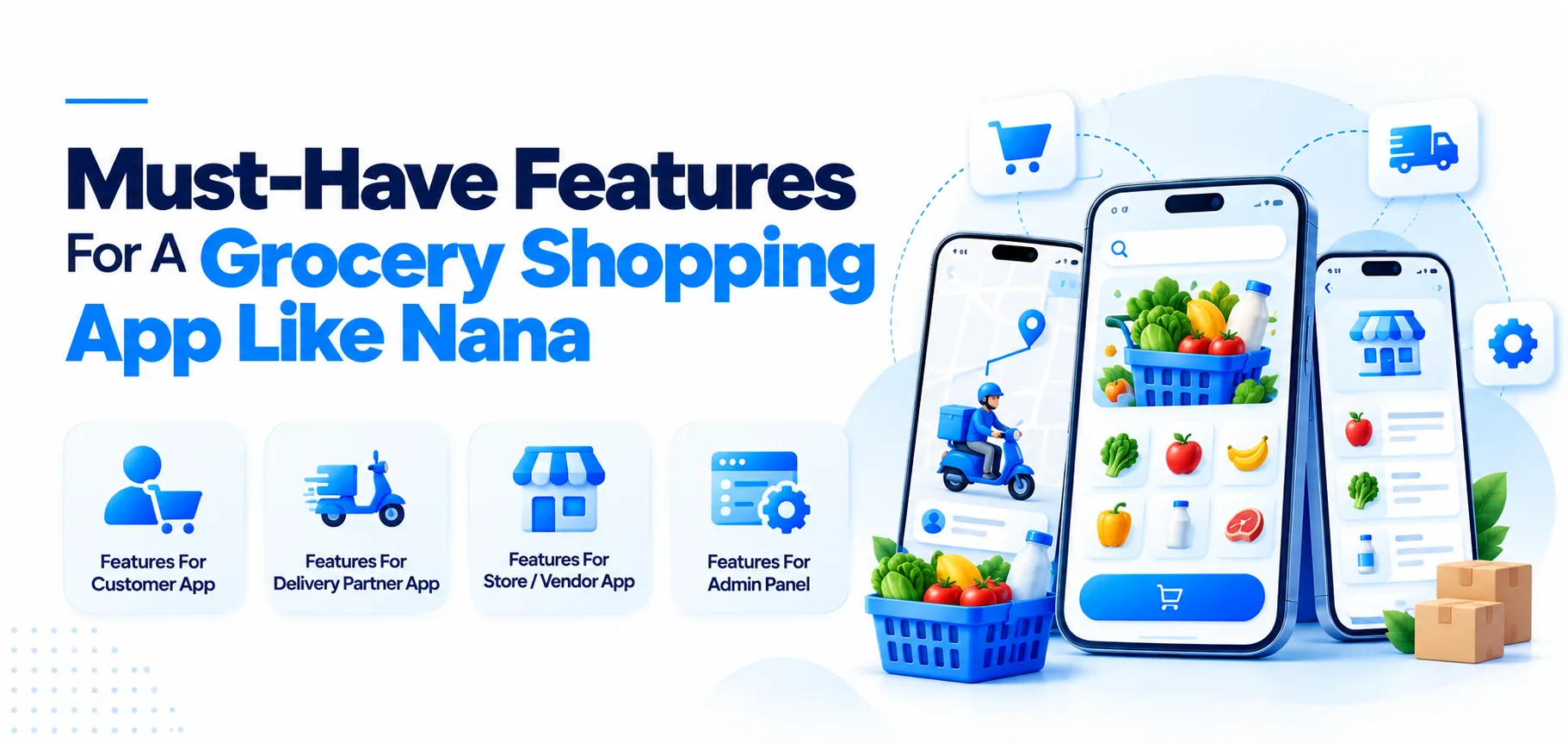
Must-Have Features For A Grocery Shopping App Like Nana
Before we get into this, note that the features you want for grocery ordering apps directly impact development cost. A simple grocery app may be completely different from an app like Nana, which works on a sophisticated backend infrastructure.
1. Features For Customer App
- User Registration & Login
- Arabic & English Language Support
- User Profiles
- Location Detection
- Product Details
- Shopping Cart
2. Features For Delivery Partner App
- Delivery Partner Registration
- Profile Management
- Online/Offline Status
- Order Alerts
- Order Acceptance
- Customer Contact Details
3. Features For Store / Vendor App
- Add Products
- Accept or Reject Orders
- Manage Promotions
- Update Prices
- Manage Staff
- Track Order Status
4. Features For Admin Panel
- Vendor Management
- User Management
- Inventory Management
- Coupon Management
- Driver Management
- Payment Management
Cost To Build A Grocery App Like Nana In Saudi Arabia
Want to know the truth about cost? There isn’t one universal cost for a grocery app. However, the estimates of time as well as the cost to build a grocery delivery app like Nana look like this:
| App Type | Estimated Cost (SAR) |
| Basic MVP | SAR 75,250 – SAR 225,700 |
| Mid-Level Complexity | SAR 225,700 – SAR 526,800 |
| Enterprise Grade | SAR 526,800 – SAR 790,200+ |
How Long Does It Take To Develop A Grocery App Like Nana?
If you are planning for a grocery ordering app like Nana, one of the questions you will probably have is: How long will it take to develop? Well, here it is:
| App Type | Estimated Timeline |
| Basic MVP | 1 – 2 Months |
| Mid-Level Complexity | 2 – 7 Months |
| Enterprise Grade | 7 – 14+ Months |
What Factors Affect The Cost To Build A Grocery Delivery App Like Nana?
When you consider the cost and how big of an impact it has on the development process, it is important to consider the factors that affect it. Therefore, take a look at the factors that impact cost:
1. Number of Platforms: Depending on your particular business model, you may need to develop different software or front-end applications for your customers, delivery persons, and vendors, and also an admin dashboard and possibly a web application.
2. UI/UX Design: Users must be able to find products, add them to cart, place an order, and track their delivery without getting confused or frustrated. Personalised screens for aspects like the home screen, product and search filters, easy category navigation, smooth cart interactions, and more.
3. Number of Features: Features such as AI-powered product recommendations, subscription-based ordering, dynamic pricing, personalized offers, and more require additional testing and development.
4. Backend Architecture: What users see on the app is only one part of the overall system. Behind the scenes, a grocery delivery platform needs a powerful backend to keep everything running smoothly.
5. Arabic & English Localisation: Are you looking to launch a grocery shopping app in Saudi Arabia? An important factor you should not miss is support for both English and Arabic, leading to a better user experience. But it will cost you more than the usual apps.
6. Security & Compliance: Details like personal information, addresses, payments, and order data. So, protecting them is an important part of the mobile app development process. However, it does add to the overall cost of grocery apps in Riyadh.
How To Reduce Grocery App Development Costs?
Building a grocery app doesn’t really mean spending large sums of money from day one. The final cost depends on the app’s features, design, technology, integrations, development team, and how complex your business model is. So, here are some practical ways to keep grocery app development costs under control.
1. Begin With An MVP: The best way to reduce or control development costs is by developing an MVP. Instead of launching with every other feature available in the market, focus on the functionality customers actually need to place and receive an order. And once the food app is gaining traction and users understand what each feature is for what purpose, you can introduce advanced aspects as well.
2. Prioritise Features Carefully: In a single version, it is important to understand that every feature doesn’t need to be added. For example, AI-powered recommendations, subscription plans, loyalty programs, advanced analytics, and voice search can be useful, but they may not be essential during the first launch.
3. Choose Cross-Platform Development: If you want to launch on both Android and iOS, building two completely separate native apps can increase development time and cost. A cross-platform development approach can allow developers to build much of the application from a shared codebase.
4. Keep The Design of The First Version Simple: A clean and straightforward design can make grocery shopping easier for customers. Focus on simple navigation, clear product categories, easy search, visible pricing, and a frictionless checkout experience. Later on, you can always introduce more sophisticated animations.
5. Use Ready-Made APIs & Services Where Appropriate: Development costs and time do increase when app developers in Saudi Arabia build them from scratch. For certain functions, it is best to integrate reliable third-party services instead. This includes maps, payment processing, SMS verification, analytics, and push notifications.
How To Choose A Grocery App Development Company In Saudi Arabia?
In the Saudi Arabian region, you need a team that understands not only mobile app development but also the local market, customer expectations, payment preferences, logistics, and regulatory requirements.
1. Check Their Grocery App Development Experience
You should evaluate the experience of the organization based on the portfolio of previous work. Do they have experience in creating grocery applications, eCommerce portals, food delivery software, or any on-demand applications? Experience in similar projects counts, as grocery applications require not only simply showing the range of products.
2. Look For Saudi Market Knowledge
It may be possible that an app development company has a good knowledge base, but it may not be suited if the right acumen regarding the Saudi market is not possessed by the firm. Moreover, your service provider needs to have insights into the preferences of consumers existing in Saudi Arabia, the payment options available, and methods of setting up deliveries.
3. Evaluate Technical Expertise
To function effectively, a grocery app typically requires the collaboration of multiple components. Users desire flawless mobile usability, while the store supervisors, the delivery services, and the executive teams are in need of their own set of tools.
4. Make Sure They Can Build A Scalable App
You might start with a single store or a limited delivery area, but your plans could change quickly once the app gains traction. That’s why scalability should be discussed from the beginning. Ask the development company how the architecture will handle more users, stores, products, orders, and delivery partners as the business blossoms.
Launch Your Grocery App In Saudi Arabia
Build a seamless grocery ordering experience with Arabic-English support, secure payments, delivery tracking, and scalable technology.
Future Trends In Grocery Application In The Middle East
In the Middle East, customers are no longer looking at grocery platforms simply as digital versions of supermarkets. They expect that the platforms will understand their preferences, make shopping more convenient, and who knows what. So, as technology continues to advance, several trends are likely to shape the future of grocery delivery applications.
1. AI-Powered Recommendations
By examining previous orders, shopping habits, and preferences of the customer, artificial intelligence can enhance and personalize the grocery shopping experience for everybody. Instead of suggesting the same products to everyone, the app can recommend only the items that are apt for an individual customer.
2. Smart Ordering
Selecting and buying the same items for the household, and that too repeatedly, is often a consumer choice. Therefore, showing them previously bought items is a useful trend that saves time from unnecessary scrolling.
3. Voice Shopping
As voice recognition technology continues to improve, grocery apps may start to include voice technology for the purposes of product searches, reordering, and grocery-list creation, among others. Hence, the experience of food delivery app development is on the rise.
4. Predictive Inventory
AI and data analytics are helping companies in Riyadh, Jeddah, and other Saudi cities predict demand based on previous sales, seasonal trends, customer behaviors, etc. This would allow shops to predict demand effectively, manage inventory better and pursue reliable grocery app development.
5. Faster Fulfillment
Companies will likely invest in organizations that need appropriate inventory placements, quick order-picking processes, and effective last-mile delivery. For these reasons, grocery e-commerce businesses will work to enhance not only their client-facing application but also the logistics behind every order.
6. Personalised Promotions
This future trend makes buying groceries more personal than ever. Grocery platforms will have the power to offer personalised promotions and recommendations, thanks to analysing purchasing behavior and preferences.
7. Super Apps
Rather than operating as standalone grocery stores, some platforms are gradually adding other everyday services and product categories to their ecosystems. Hence, the future of grocery delivery app development points to applications that may evolve into broader lifestyle platforms, enabling customers to manage a wider range of everyday purchases from a single application.
Get A Grocery Ordering App From Techugo
Building a grocery ordering application, and that too from scratch, is not an easy task to do. You need a mobile app development company in Saudi Arabia that is experienced and can make a real difference.
But luckily for you, Techugo has built mobile applications for the Middle East market like Alba Cars, Taleem, Waqti, and more.
Final Thoughts
So, how much does it cost to build a grocery app like Nana in Saudi Arabia?
The realistic starting price may range between SAR 75,250 and SAR 790,00+. The price mainly depends on the complexity. A basic grocery app will be found on the lower end of the price range, whereas the multi-app and multi-vendor AI-enabled quick commerce platform will qualify as something that is much more expensive.
The most important thing is not to include all the features in your first product launch.
Start with a clearly defined customer platform, build an MVP around the important shopping and delivery workflows, verify the business model, and then invest in advanced capabilities as your user base grows. Thus, knowing the cost to develop a food delivery app is essential in Saudi Arabia.
FAQs
Q) How much does it cost to build a grocery app like Nana in Saudi Arabia?
The cost to build a grocery app like Nana in Saudi Arabia typically ranges from SAR 75,250 to SAR 790,200+, depending on the app’s complexity, features, platforms, integrations, and backend infrastructure.
Q) How long does it take to develop a grocery delivery app like Nana?
Development time depends on the scope of the application. A basic MVP may take 1-2 months, a mid-level grocery application may require 2-7 months, and an enterprise-grade platform can take 7-14+ months to develop.
Q) What features are required for a grocery app like Nana?
These can include user registration, product search, shopping carts, location detection, order management, delivery tracking, inventory management, payment management, promotions, coupons, and vendor management.

Get in touch
We'd love to hear from you.