

 SA
SA
 KW
KW
 IE
IE AU
AU UAE
UAE UK
UK USA
USA
 CA
CA DE
DE
 QA
QA ZA
ZA
 BH
BH NL
NL
 MU
MU FR
FR










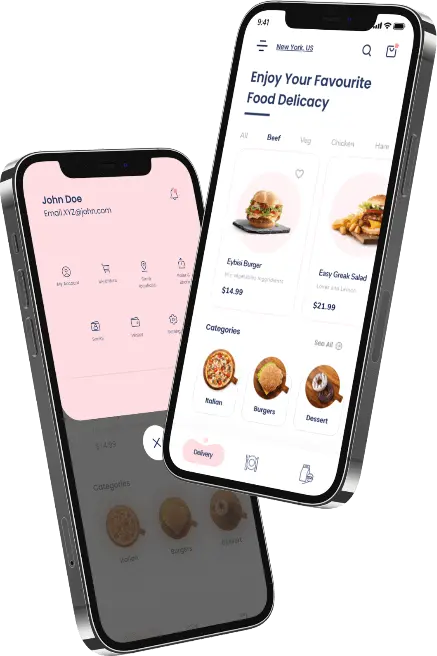





The fast growth of food delivery app development in Qatar keeps on increasing without any signs of slowing down. People are changing (or have changed) how they order food and this has not happened all at once; it has built up over the past few years as convenience has become increasingly important. As people continue to be busy, they want to get services quicker than before (not just food), and they expect everything to be available on their phone. It is pretty much that simple.
Due to this change in ordering habits, it is obvious to see why many businesses want to build an app like Rafeeq in Qatar. Rafeeq did not just create an app for ordering food; they studied the way their users wanted to order food (what they wanted) and got the food to their users quickly, easily, and in accordance with the local customs. As a result of this understanding, Rafeeq created a very strong place for itself.
The good news is there is still room for the market to grow. There are still opportunities available and there are still plenty of new ideas being introduced based on how to fix real problems and provide a “better” solution than what is currently available. You are not too late to enter this market; however, being too random could be detrimental.
If you are looking at getting involved in the food delivery app market or just want to know how all of these apps work, you have come to the right place. This blog will provide you with a good overview of the food delivery app market as well as the type of business strategy you should follow to ensure you create and develop a successful food delivery app like Rafeeq.
Understanding the Success of Rafeeq in Qatar
Rafeeq like app development Qatar has become a common discussion and it is happening because Rafeeq did something very simple… but very right. It understood the market and it delivered what people actually needed, not what businesses thought they needed.
Users in Qatar expect speed and they want reliability but they also want ease. Rafeeq focused on all three and because of that, it slowly became a go-to option for many users because it delivers a smooth experience, not just food.
The platform kept things simple, the app was easy to use, and the ordering process did not feel complicated. And because users did not have to think too much while ordering, they kept coming back… again and again.
Key Factors Behind Rafeeq’s Popularity
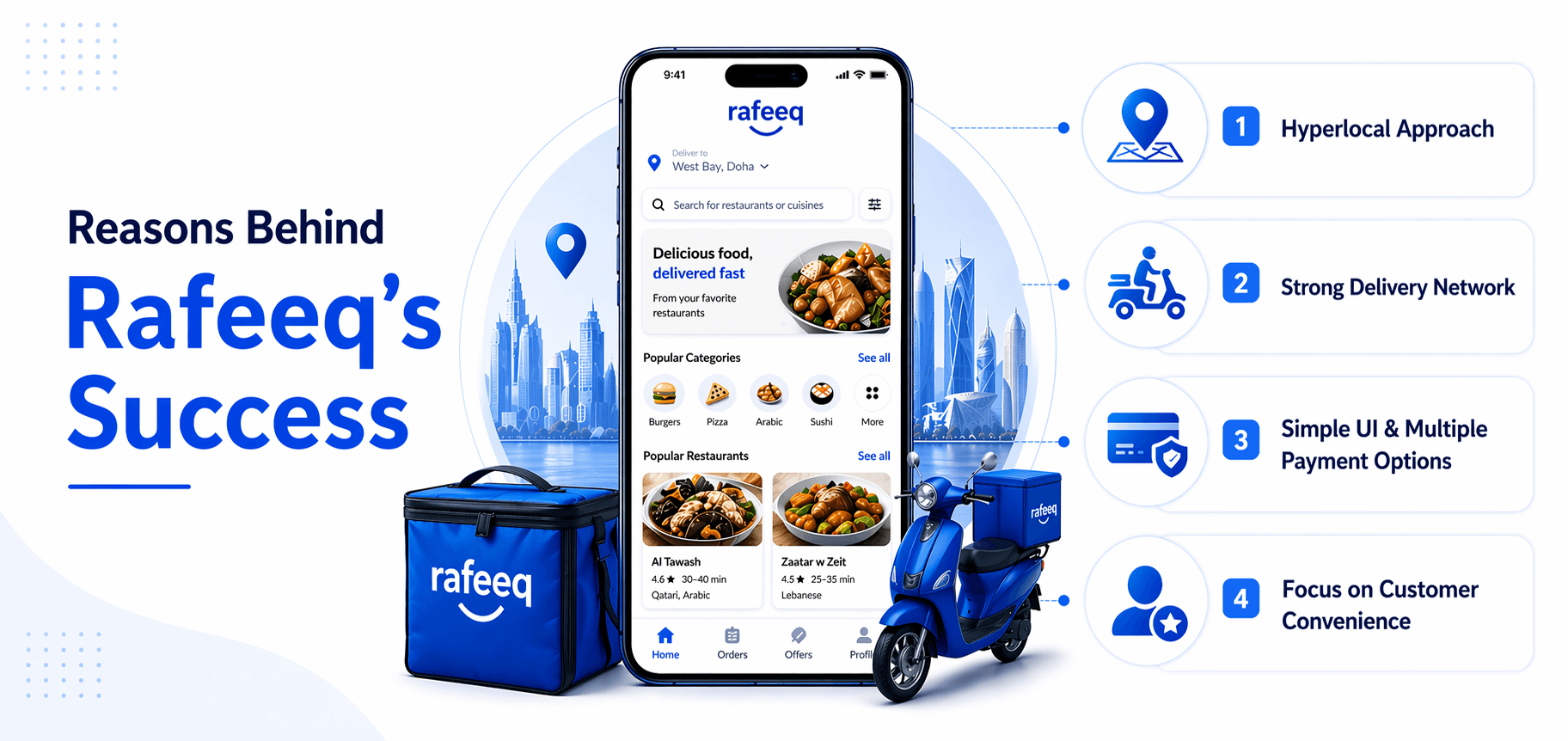
1. Hyperlocal Approach
Rafeeq worked closely with local restaurants, and it made sure that users could find options that were nearby. This reduced delivery time, and it improved overall satisfaction… which matters a lot in an on-demand food delivery app Qatar market.
2. Strong Delivery Network
Rafeeq focused on building a reliable delivery system and that helped in maintaining consistency. Orders were delivered on time and delays were reduced, so users started trusting the platform more.
3. Simple and Clean User Experience
The app interface was not confusing, and it was designed in a way that anyone could use it without effort. You open the app, you browse, you order – that’s it. No confusion, no extra steps.
4. Multiple Payment Options
Rafeeq understood that users prefer flexibility, so it offered different payment methods. Whether it is card, wallet, or cash, users had options… and that made the process easier.
5. Focus on Customer Convenience
Everything was built around the user from tracking orders to getting updates. And because the experience felt smooth, users stayed loyal.
So when businesses think about building a similar platform, it is not just about copying features but about understanding why those features worked, and how they were used to solve real user problems… because that is where the real success comes from.
Why Qatar is a Profitable Market for Food Delivery Apps
Food delivery app development in Qatar is getting attention for a reason and it is not just hype. The market is growing, users are active, and the demand has been consistent over the years… not temporary.
People in Qatar are already comfortable using mobile apps for their daily needs, so when you think about launching an on-demand food delivery app in Qatar, you are already entering a market where the audience is used to it, so you don’t need to change their behavior.
One important thing to notice is that Qatar has over 99% internet penetration and smartphone usage is also extremely high. So almost every potential user is already online and they are used to ordering, browsing, and paying through apps, which makes adoption easier, in fact, much easier than in many other markets.
At the same time, reports suggest that the online food delivery market in Qatar is expected to grow steadily at around 6–8% annually in the coming years. It may not look aggressive at first but it shows something important, i.e., stability, and stable markets are often more profitable in the long run.
Market Trends Driving Growth
1. Busy Lifestyle and Urban Living
People in Qatar live fast-paced lives and cooking is not always practical so they rely on apps because it saves time and it fits into their routine.
2. Strong Expat Population
A large part of the population consists of expats who often prefer ordering food that matches their taste which ultimately increases demand for variety and apps that offer more options tend to perform better.
3. Rise of Digital Payments
Cash is still used but digital payments are growing quickly, and because payments are becoming smoother, users are more comfortable placing frequent orders.
4. Demand for Niche Offerings
Users are not just ordering regular meals now; they are exploring healthy food, vegan options, and premium dining. So there is space for new apps that target specific segments… not just general ones.
Must-Have Features of a Rafeeq-Like Food Delivery App
When you build an app like Rafeeq in Qatar, features are not just checkboxes… they are the backbone of the experience, and they determine whether users stick around or abandon the app. You see, it is not enough to just have a menu and order button because users want much more than that. Let’s break down the main features for each part of the app, and why they matter.
User Panel Features
Your users are the heart of the app and if they struggle, nothing else matters. So here’s what they really need:
-
Easy Registration/Login
Users want to sign up quickly (like through email, phone, or social login) and they want it to work every time they log in. If they experience issues with sign-up, they leave immediately, so make sure that registration or sign-up is smooth and simple.
-
Smart Search & Filters
People want to find their food fast. So filters for cuisine, price, delivery time, and even ratings are quite essential and users love them. Without this, users scroll endlessly and they might give up.
-
Real-Time Order Tracking
Tracking is not just nice, it is expected. When users can see exactly where their order is, and when it will arrive, trust builds… and repeat orders happen naturally.
-
Multiple Payment Options
Cash, card, wallet, mobile pay – all should be there. People have preferences and if you don’t offer them, they will go somewhere else.
-
Ratings & Reviews
Reviews help new users decide, and ratings keep restaurants accountable. And because users see other opinions, they feel safer ordering… which increases engagement.
Restaurant Panel Features
Restaurants are your partners, so their experience matters too:
-
Menu Management
Restaurants should update items, prices, and availability easily. If it is complicated, they will struggle, and your app suffers.
-
Order Notifications
Instant alerts for new orders keep everything running smoothly. Late acceptance = unhappy customer, and that is something you cannot ignore.
-
Pricing Control
This feature lets restaurants manage discounts, offers, and special deals, which eventually encourages them to promote through your platform, which increases revenue.
-
Analytics Dashboard
Not just restaurants, every business wants to know data to make decisions in their business and when restaurants are aware of what sells, peak times, popular dishes, etc, they can improve and plan a strategy. This also keeps them loyal to your app.
Delivery Partner Panel Features
Delivery partners are crucial, and their workflow needs to be seamless:
-
Route Optimization
Drivers, of course, need the fastest route and apps like Rafeeq use GPS smartly to suggest best routes in real-tile, and reduce delays, leading to lower costs and fast delivery.
-
Order Status Updates
Partners can mark statuses like pickup, on-the-way, and delivered, which syncs with user tracking and makes everyone informed.
-
Earnings Tracking
Delivery partners want transparency like how much they earned today or this week, what commissions they earned or tips, etc and features designed to track earnings help them track earnings as well as keep them motivated and loyal towards their work.
Admin Panel Features
The admin panel is the control center, and it is where the app owner keeps everything in check:
-
User & Vendor Management
Admins should manage accounts, approve vendors, block users if needed to keep the platform secure and trustworthy for users as well as vendors.
-
Commission & Payment Control
Admin decides commission rates, processes payouts, and monitors financial flows. Without this, revenue tracking becomes messy.
-
Performance Analytics
From orders per day to revenue, app performance metrics should be available in real-time so that decisions are informed.
-
Promo & Offer Management
Admin can create deals, coupons, or seasonal discounts easily. And when users see offers, they are more likely to order.
So, when you combine all these features, your Rafeeq-like app is not just functional… it becomes reliable, scalable, and user-friendly. And that is why so many entrepreneurs invest in Rafeeq clone app development or food delivery app development in Qatar, because with the right features, your platform can really compete and win in the local market.
How Businesses Can Make Money By Building a Food Delivery App in Qatar
When you build an app like Rafeeq in Qatar, it is like you’re developing a single app but opening up multiple ways to earn and that is what makes it sustainable. You see, apps like Rafeeq are designed to generate revenue from several streams, and each one adds up… if done correctly.
1. Commission
By implementing the commission model, your app can earn a share from every order placed on the platform, and that adds up quickly. So, every time a user orders food, a small portion goes to your app. This is why Rafeeq clone app development for iOS or Android works so well and it promises continuous revenue through transactions, and because orders happen daily, income keeps flowing without much extra effort.
2. Delivery Fee
Another simple but effective way to earn is by charging a delivery fee from customers on each order. Most apps in Qatar and the Middle East follow this model because it is easy to implement and predictable. So, whenever someone orders, you earn a small fixed amount, and over time, it creates a steady income stream for your Rafeeq app development in the Middle East platform.
3. Subscription Plan
You can also provide users with a subscription plan, and this is where it gets interesting. Offer unlimited free deliveries, special discounts, or other premium facilities in exchange for a monthly or yearly fee. And the beauty of this model is that it creates consistent revenue – you know that a portion of your users will pay regularly and that helps in planning growth. Businesses love this because it balances occasional order fluctuations.
4. In-App Advertisement
Another option is in-app advertisement, and it is surprisingly effective if done right. You can show relevant ads to users while they browse the menu, check offers, or track their order. Many apps, including BBdaily-like platforms, use this for a passive revenue stream. It is not the main income, but it adds up over time, and because users spend time on the app, advertisers are willing to pay.
5. Partnership
Finally, partnerships with restaurants can bring in extra revenue. Think about listing restaurants in premium slots or showing their promotions on your app, in return, you charge them a monthly fee. This works well in Qatar because restaurants are always looking for visibility, and it helps your Rafeeq clone app development generate income while offering value to partners. It is like creating a win-win – restaurants get more orders, you get steady revenue.
So, if you combine all these streams such as commission, delivery fee, subscriptions, ads, and partnerships, your Rafeeq-like app is not just a platform, it becomes a full-fledged business model. And that is why many entrepreneurs in Qatar are investing in food delivery app development in Qatar, because the potential is real… and repeatable.
👉Keep in mind – your app is not just for users, it is for restaurants and delivery partners too, and that’s a big benefit because when restaurants see you as a partner who brings more orders and visibility, they stick with you, they trust you, and they even invest in better services. Delivery partners get structured workflows, payments on time, and optimized routes, which improves efficiency. and when everyone benefits, your app becomes more than just a tool; it becomes a system that adds value across the board. And this, frankly, is why investors and entrepreneurs are so drawn to food delivery app development in Qatar.
How to Start a Food Delivery Business in Qatar: Step-by-Step Process
How to start a food delivery business in Qatar? Well, it is not just about having an app… it is about planning, execution, and understanding the market so that everything falls into place. You see, the opportunity is there, but success comes when you follow a step-by-step approach. And, if you choose the right mobile app development company in Qatar, things get much easier because they guide you technically and strategically.
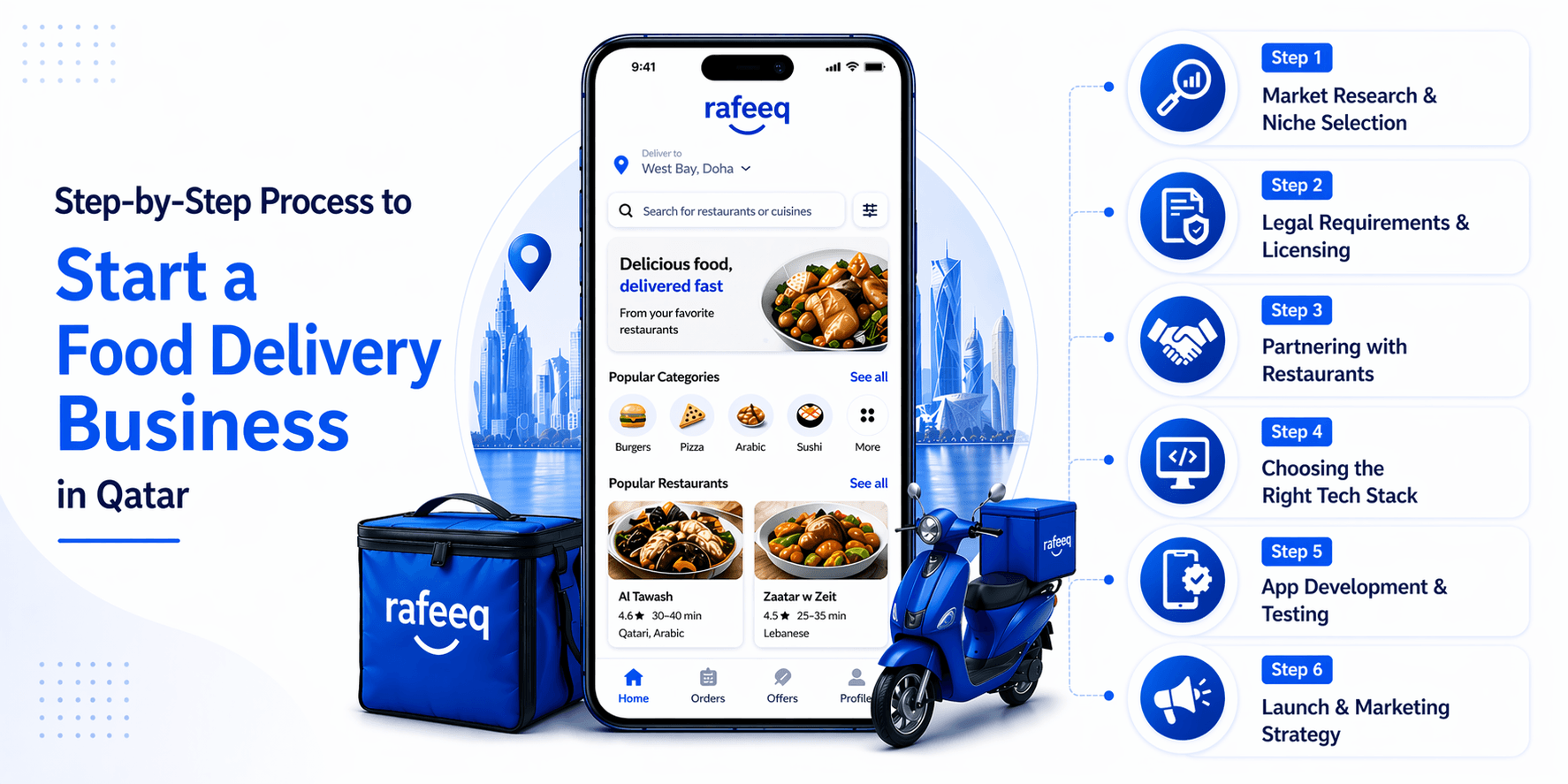
Step 1: Market Research & Niche Selection
Market research comes before anything else such as –
Who are your users?
What kind of food do they want?
Are they ordering daily meals, fast food, healthy options, or premium cuisine?
When you understand this, you choose a better niche, and the niche you pick will define the type of restaurants, delivery setup, and even pricing you adopt.
Step 2: Legal Requirements & Licensing
Qatar has quite specific regulations for food businesses and you cannot skip this. You will need trade licenses, food permits, and sometimes health clearances for your kitchen or delivery partners, so, before launching, make sure you comply, otherwise you risk fines or closure… and nobody wants that.
Step 3: Partnering with Restaurants
Your app depends on restaurants and strong partnerships. They are key, so look for quality restaurants, negotiate commissions, and even offer incentives to onboard them. Since your success is linked to theirs, keep the relationship transparent and mutually beneficial.
Step 4: Choosing the Right Tech Stack
Next comes the tech part where things can get tricky. You need a strong backend, smooth UI/UX, real-time tracking, and secure payments. The app will handle multiple users, restaurants, and delivery partners at once so reliability is critical here. Choosing the right stack and even the right mobile app development company in Qatar can save you months of headache.
Step 5: App Development & Testing
Once tech is ready, build the app, but don’t just launch it. Test everything – order flow, payment, tracking, notifications. Test as if you were the user, the restaurant, and the delivery partner because problems show up differently from each perspective. Fix them before launch, or else users will notice.
Step 6: Launch & Marketing Strategy
Now comes the ‘Congratulations’ step when you finally launch your app and get congratulated for the same. Here you can use social media, influencer collaborations, local ads, and special promotions to get users to try your app but meanwhile, keep analyzing apps. Improve and update features based on users feedback to win their trust and retain them because staying active is the only way to survive… and grow.
So when you follow these steps carefully, your Rafeeq-like platform in Qatar can succeed. It is not easy of course but with the right strategy, the right features, and the right tech partner, it can become profitable.
Cost to Build a Food Delivery App in Qatar
When you talk about cost to build food delivery app in Qatar, people immediately start guessing numbers… and that’s the tricky part because it depends on what you want, how you build it, and who builds it. It is not a fixed price, so you have to think it through, and understand the pieces that make cost go up or down.
So, let’s break it down because if you don’t, your budget becomes confusing, and nobody wants that especially when you are planning a Rafeeq-like app.
Now, these are not exact figures but are ranges because every project is different but at least they give you a sense of what to expect:
| App Type / Complexity | Estimated Cost (QAR) | Timeline |
| Basic Food Delivery App | 40,000 – 80,000 | 2–3 months |
| Mid‑Level On‑Demand App | 100,000 – 180,000 | 3–5 months |
| Advanced Multi‑Restaurant Platform | 200,000 – 350,000+ | 5–8 months (or more) |
1. Basic Food Delivery App
If you go simple with essential features only: user login, menu browsing, order placement, and simple tracking, the cost tends to be on the lower side which is good if you want to launch quickly and test the market but of course, it is limited in features.
2. Mid-Level Food Delivery App
When you add real-time tracking, multiple payment options, ratings, push notifications… and the price goes up. This is the version most startups start with because it is balanced (not too basic, not overly complex).
3. Advanced Rafeeq-Like Platform
Advanced version of food delivery app includes almost everything such as advanced analytics, AI recommendations, dynamic pricing, loyalty programs, multiple user roles, and much more. This is the kind of app that competes directly with established players, and it costs more obviously… but also earns more because users stay longer and order more often.
What Affects the Cost?
There are a few major factors that determine the final cost, and they all matter because they change your budget completely:
- App Complexity and Features
- Design and UI/UX
- Backend and Server Infrastructure
- Third-Party Integrations
- Development Team Location
Why Cost Varies So Much
The reason cost changes so much is simple: features, quality, and expertise. If you go with a very cheap option, you may save money upfront, but the app can break, users can complain, and you lose credibility which costs you more in the long run. But if you invest thoughtfully with a reliable on-demand app development company or experienced offshore team, you get something that works well and scales.
Future Trends in Food Delivery Apps in Qatar
The food delivery market in Qatar is growing fast and if you want to stay ahead, you need to watch the trends.
Apps are becoming smarter and hyper-personalized (not just about ordering), and are predicting what users want and when they want it.
-
One big trend is AI-powered recommendations.
From suggesting meals based on past orders to optimizing delivery routes, AI is changing the game. That’s why working with an experienced AI app development company can make a huge difference, because they know how to integrate smart features without slowing down the app.
-
Another trend is hyperlocal delivery,
where apps focus on speed and nearby restaurants, and also niche offerings like vegan, organic, or premium meals.
-
Contactless delivery and subscription models
They are also becoming common, because convenience and loyalty drive repeat orders.
-
Third-party integrations
Finally, expect more integration with digital wallets, loyalty programs, and social features; these are the things that keep users engaged and returning. The market is highly competitive but apps that innovate smartly will win and grow steadily in Qatar for sure.
Choose Techugo – A Trusted Food App Development Company
You’ve already decided to invest in food delivery app development in Qatar,, now what you need to do is to take action by reaching out to the right partner.
Techugo has more than a decade of experience in on-demand delivery app development, and the food delivery app is no exception. We know how to turn ideas into apps that work, not just in theory, but in the real market.
Gastronomica’s MilkBun – A Testament to Techugo’s Success
👉Take a look at its Success Story
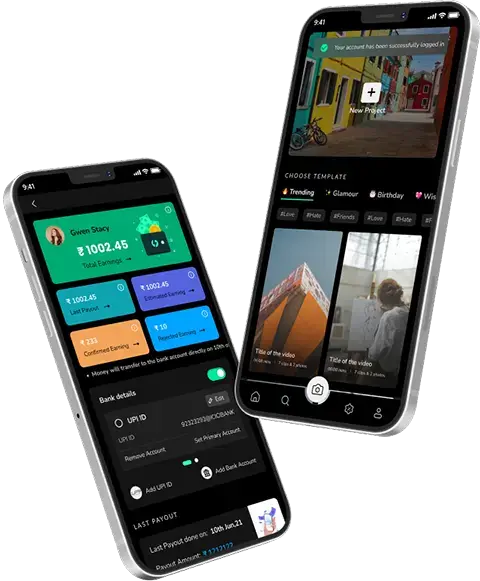
Gastronomica’s MilkBun is a perfect testament to what we do. The app was developed for a leading food brand, and it went beyond just listing menus. Users could order easily, track deliveries in real-time, and enjoy a smooth, intuitive experience.
Within a month, the app surpassed 10,000 users, and customer engagement grew 67% in just the second month. The app was shortlisted for the Restaurant and Bar Design Awards 2016, showing that Techugo builds apps that deliver results.
With Techugo, you get strategy, design, development, and support, all under one roof. From defining features to ensuring scalability, we handle the technical complexity so you can focus on growing your food delivery business in Qatar.
So, whether it is a Rafeeq clone app development, a custom solution, or a multi-restaurant platform, choosing Techugo means working with a team that knows the market, understands users, and delivers apps that succeed.
Frequently Asked Questions
Q. How much does it cost to build a Rafeeq-like food delivery app in Qatar?
The cost depends on features, design, platform, and tech stack. A basic app may start from 40,000 QAR, while a full-featured, advanced platform can go up to 350,000 QAR or more, depending on complexity and integrations.
Q. What features should a Rafeeq-like food delivery app have?
Key features include user-friendly menus, real-time order tracking, multiple payment options, ratings & reviews, restaurant dashboards, delivery partner panels, and admin controls for analytics and promo management.
Q. How can I monetize a food delivery app in Qatar?
You can earn through commissions on orders, delivery fees, subscription plans, in-app advertisements, and partnerships with restaurants for premium listings or promotions.
Q. How long does it take to develop a food delivery app in Qatar?
Development timelines vary based on complexity. A basic app can take 2–3 months, mid-level apps around 3–5 months, and advanced multi-restaurant platforms may take 5–8 months or more.
Q. Why choose Techugo for Rafeeq clone app development in Qatar?
Techugo offers end-to-end food delivery app development in Qatar, combining strategy, design, and tech. Case studies like MilkBun show our ability to build scalable, user-friendly apps that deliver real results.

Get in touch
We'd love to hear from you.