

 SA
SA
 KW
KW
 IE
IE AU
AU UAE
UAE UK
UK USA
USA
 CA
CA DE
DE
 QA
QA ZA
ZA
 BH
BH NL
NL
 MU
MU FR
FR















📌 Key Takeaways
- Machine learning chatbots provide smarter, human-like conversations.
- NLP helps chatbots understand user intent and context better.
- Businesses use chatbots to automate support and improve customer experience.
- Chatbots continuously learn from interactions to improve accuracy.
- Advancements in AI are making chatbots more intelligent and personalized.
Have you noticed something interesting? Almost every website you visit, every app you use, and even the help section you open now feels like it’s ready to talk back to you instantly. No waiting, no searching endlessly, just a quick chat window that understands what you need in real time.
That’s not a coincidence. It’s AI-powered chatbots quietly becoming a standard feature everywhere you go online. And the way they work is simple yet powerful, you ask something, and instead of just giving random replies, they try to understand your problem and respond like a real conversation.
It almost feels like the digital world has learned to listen. Whether you are stuck on an app, exploring a service, or just looking for quick help, these chatbots are always there, making sure you don’t feel lost or delayed.
In a way, you’re no longer just interacting with websites or apps, you’re actually talking to them.
How does it help?
Let us closely observe the ongoing business trend. It is apparent that the world is keen on inculcating any kind of technological advancement and use it for achieving business growth. Whether it is Augmented Reality or Blockchain technology, every elevation is dedicated to acquiring a much larger objective.
And as far as machine learning chatbots are concerned, they are focused on creating gigantic business communication opportunities. So without any further ado, let us jump into the pool of innovation and make the most out of each and every opportunity.
What Is The Reason Behind Its Curiosity?
The huge glut of opportunities that it has to offer is the reason for its increasing popularity. But there are a lot of other factors, have a look.
Productivity- They provide quick access or assistance to the important information. Their efficiency is remarkable.
Curiosity- There is no doubt in the fact that the novelty of chatbots sparks a lot of curiosity. They want to explore and enhance their ability to try a lot of new things.
Entertainment- They amuse the users by making them laugh, giving them funny tips. Overall, they are a great option, if someone is looking forward to killing time.
Relational and Social factors- These dialogue systems act as fuel to initiate a lot of conversation. But that is not all, it also enhances the complete social experience. They also promote emotional stability, as they help to avoid loneliness. People suffering from or going through any kind of mental trauma can converse without even being judged.
What Are The Different Types Of Chatbots?
A conventional tool that automates communication is known as a chatbot. In simpler terms, it is an area of automation that has the capability to beautifully integrate with the live chat software.
Are you aware of the world’s most popular robot, Sophia? Well, the point I want to establish is that chatbots can also have robotic bodies. And on the other hand, they can also be simple programs that offer better communication with an app or a website. With the help of the chat interface, users can easily interact with them. They have a strong grip over a wide variety of services ranging from functional to fun.
There are two types of chatbots. Have a look-
Rule-based bot
It is the standardized version and is known for following the scripted actions. These actions are entirely based on keywords. They are an extremely popular tool all the routine user service requests, as they are easy to build. But the simplicity doesn’t stop from completing the basic tasks.
AI-powered bot
Now, this type is the one that is turning a lot of heads. It uses machine learning technology in order to follow a more natural conversation. And the kind of advancement we are witnessing right now in the field of artificial intelligence proves that we are going to see a lot of complex machine learning chatbots.
Difference Between Traditional Support and AI Chat Support
In the past, customer support was completely manual, where users had to rely on emails, phone calls, or live agents to get their issues resolved. It worked well when the number of users was limited, but in 2026, businesses are serving a global audience around the clock. Handling every query manually has become almost impossible, and this is exactly where AI chat support has transformed the experience by offering fast, scalable, and intelligent assistance anytime.
| Aspect | Traditional Customer Support | AI Chat Support |
| Response Time | Often delayed due to human dependency | Immediate, real-time replies |
| Availability | Restricted to business hours | Available 24/7 without interruption |
| Scalability | Limited by team size | Can handle thousands of users at once |
| Operational Cost | High due to staffing needs | Cost-effective after implementation |
| Consistency | Responses may vary between agents | Uniform and consistent answers |
| Personalization | Basic and dependent on agent experience | Advanced personalization using AI insights |
| Traffic Handling | Difficult during peak loads | Efficient even during high demand |
| Learning Capability | No self-improvement system | Continuously improves through machine learning |
How AI Chatbots Understand User Queries in Real Time
AI chatbots today don’t just “reply”—they actually understand what you are asking in real time. When you type a question, they quickly break it down, analyze intent, and match it with the most relevant response within seconds. This is what makes the conversation feel natural and instant.
Here’s how they understand your queries:
- Natural Language Processing (NLP): Breaks your sentence into meaningful parts and understands human language structure.
- Intent Recognition: Identifies what you actually want – information, support, booking, or help.
- Context Analysis: Remembers previous messages to keep the conversation connected.
- Machine Learning Models: Learn from past conversations to improve future responses.
- Entity Detection: Detects key details like names, dates, products, or issues in your query.
- Real-Time Data Processing: Matches your input with the most relevant answers instantly.
- Sentiment Analysis: Understands your tone, whether you are frustrated, happy, or confused.
- Continuous Learning: Improves accuracy over time based on user interactions.
Just Read : AI Chatbots in Hotels & Restaurants: How They Are Redefining Guest Experience in the Hospitality Sector
The Connection Between AI Chatbots and Customer Satisfaction
AI chatbots have a direct impact on customer satisfaction because they remove the biggest frustration users usually face …waiting. When you get instant answers, quick solutions, and 24/7 support, your overall experience feels smooth and effortless. You don’t have to repeat yourself or wait in queues, which naturally makes you feel more valued and understood.
And that ease and responsiveness customers feel, it automatically builds trust. A happy customer will come back and is more likely to recommend the service and even spend more. In simple words, improved chatbot experience results in higher satisfaction, greater trust, and eventually more revenue from business.
How Chatbots Reply Instantly to Your Queries
AI chatbots feel instant because they don’t “think” like humans in real time—they process your message through a fast, structured pipeline that quickly breaks down, understands, and matches your query with the best possible response. This entire cycle happens in milliseconds using AI models, trained data, and real-time computing systems.
Chatbots work mainly on a combination of intelligent AI technologies that help them understand, process, and respond to human language in real time. Instead of relying on a single method, they use different dialogue systems to handle conversations more effectively based on the user’s query and complexity.
Types of Dialogue Systems
- Rule-Based Systems
These follow predefined rules and keywords to deliver fixed responses. They are best suited for simple FAQs and structured queries. - Retrieval-Based Systems
These systems pick the most relevant answer from an existing database of responses based on user input. They are more flexible but still depend on stored data. - Generative Systems
These use advanced AI and machine learning to create new responses in real time. They can understand context and generate human-like conversations. - Hybrid Systems
These combine rule-based, retrieval-based, and generative approaches to ensure better accuracy, speed, and more natural user interactions.
Conclusion
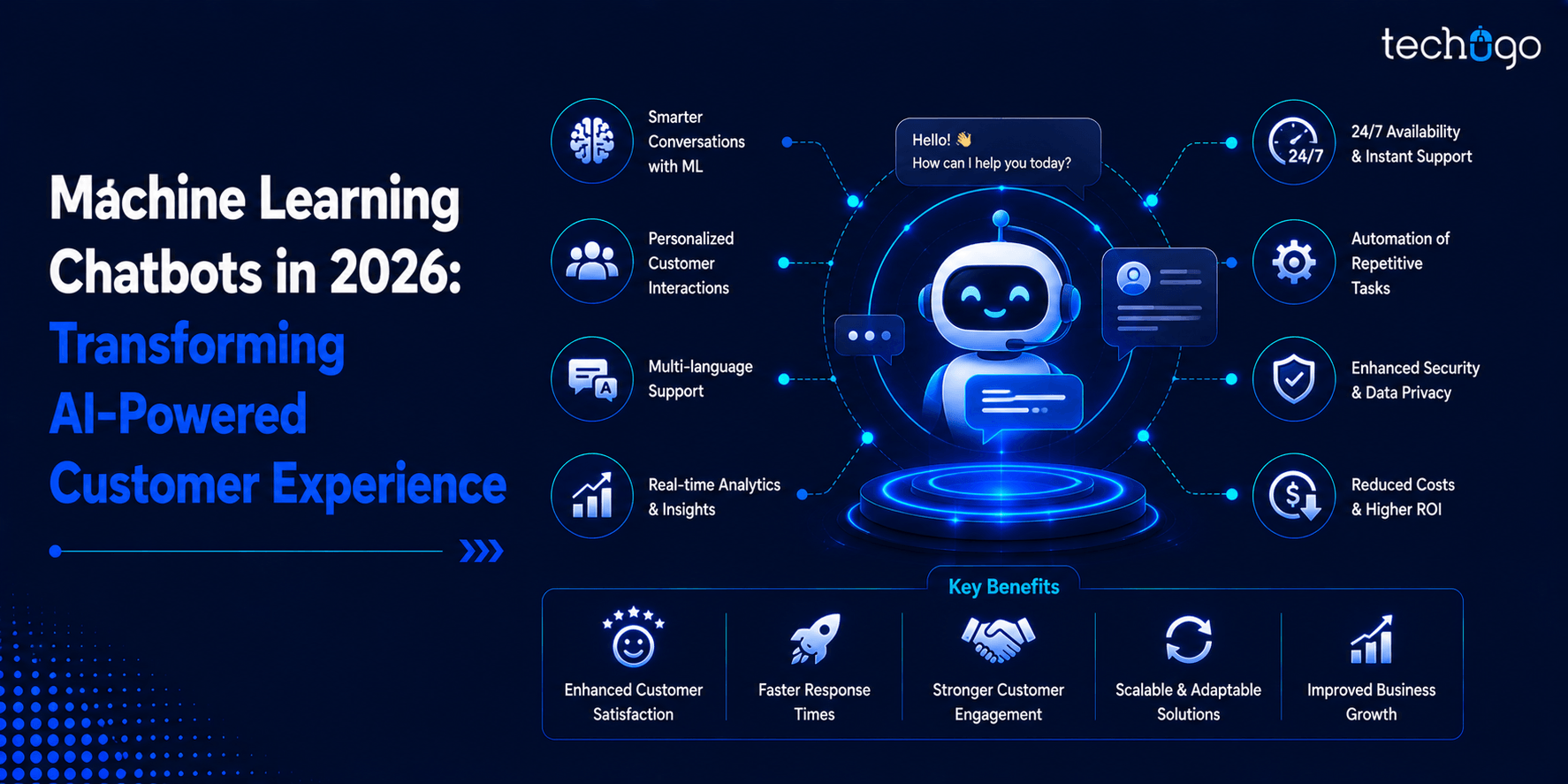
In 2026, machine learning chatbots are now an essential part of digital experiences. Whether on websites or through apps, these AI chatbots are delivering a more seamless AI-powered customer experience providing instant responses, real-time assistance and even more human-like interactions.
The emergence of conversational AI and smart chatbot solutions has enabled businesses to reach users more quickly and effectively than ever. It is no longer support — it’s seamless, always on communication — that instils trust and drives engagement.
To sum up, machine learning chatbots are not just hype — they are a necessity if you want your business to grow in today’s digital environment. And with experts like Techugo, you can create robust solutions for AI Chatbot and chatbot development services that elevate your customer experience.
FAQ
1. How do AI chatbots improve business customer service?
AI chatbots handle queries instantly, reduce waiting time, and ensure consistent support, leading to better customer satisfaction.
2. Do AI chatbots require continuous maintenance?
Yes, chatbots need updates and training to improve accuracy, which is part of long-term chatbot optimization services.
3. Can AI chatbots work without internet connectivity?
No, most AI chatbots require internet access because they rely on cloud servers, APIs, and real-time data processing.
4. Do chatbots support multiple languages for global users?
Yes, modern AI chatbots can support multiple languages using NLP and language translation models, making them suitable for global businesses.
5. Can AI chatbots generate leads for a business?
Yes, chatbots can collect user data, qualify leads, and guide users toward sales or inquiry actions.

Get in touch
We'd love to hear from you.