 SA
 KW
 IE
 AU
 UAE
 UK
 USA
 CA
 DE
 QA
 ZA
 BH
 NL
 MU
 FR







 Android
 iOS












📌 Key Takeaways
- Claude works best as a supervised assistant for document-based admin work, not independent clinical decisions.
- Claude for Healthcare launched on January 11, 2026, bundling HIPAA-ready access, healthcare data connectors and workflow samples.
- Claude isn’t HIPAA-compliant by default; you need a signed BAA, HIPAA settings on and covered features only.
- BAA details trip up buyers: older agreements may not carry forward, and some features sit outside coverage.
- Qualified professionals must check every output (citations, codes, coverage) against source records.
AI is taking on yet another stage with the advent of Claude for Healthcare by Anthropic in January 2026. Healthcare organizations now have another AI tool in their hands to help them make complex tasks easier. But there’s a key question that comes to mind: How much can healthcare organizations rely on Claude when it comes to handling their confidential patient information and medical procedures?
The growing adoption of AI in Healthcare makes it increasingly important for healthcare organizations to understand the capabilities, limitations, and safety requirements of these technologies. Some of the tasks Claude can be helpful with include drafting prior authorization documents and creating summaries of patient records. There are some other tasks too which Claude is capable of doing. However, not all healthcare tasks can be done by an AI tool. It becomes important for us to know what Claude can do, what it cannot do, and how healthcare organizations can use it safely.
How Claude AI Is Transforming Healthcare Workflows
For developers of clinical software products, the Claude Developer Platform allows them to implement features such as ambient scribing and chart review. However, workflow design, validation, and EHR integration determine the safety of the product. This makes Healthcare App Development particularly important, as developers must ensure that AI-powered features work reliably within existing clinical systems. . But there are three essential requirements for the safe use of Claude.
Not sure which Claude features your BAA covers?
Our team can review your planned workflow against covered capabilities before any PHI goes in.
First of all, there should be a signed Business Associate Agreement (BAA) between the healthcare organization and Anthropic company, as well as proper HIPAA settings and usage of those functionalities that are included in the BAA.
Secondly, the AI-generated output (citations, medical codes, insurance coverage details, etc.) has to be reviewed by the qualified healthcare professionals.
Thirdly, there should be validation of the workflow through the usage of the internal documents of the healthcare organization, noting any possible errors or limitations before wide-scale implementation of the technology.
This paper explores critical problems of the health systems, life sciences, and clinical software development industry together with solutions for these issues.
What Are the Practical Use Cases of Claude AI in Healthcare
Prior authorizations, claim denials, portal messaging, and chart review pull data from many scattered sources. Anthropic states that authorization reviews, in particular, can require hours.
Directing Claude to examine the workflows related to documents allows a person to confirm the findings. These use cases for Anthropic’s Claude AI service are mentioned in its January 2026 launch documentation:
1. AI-Assisted Authorization Preparation – Claude pulls coverage criteria, compares them with clinical and patient criteria and gathers supporting documents for an approval/rejection by a human.
2. Claim appeals and Documentation – Claude gathers documentation and creates a first draft of an appeal that people then confirm.
3. Portal message triage and care coordination – Claude organizes portal messages and referrals to identify urgent ones. However, clinical decisions remain the responsibility of clinicians.
4. Medical Record Summarisation and Chart Review – Banner Health made its BannerWise assistant available to 55,000+ employees, starting with oncology chart summarization.
5. Medical Coding and Provider Information Verification – ICD-10 and NPI lookups help with accurate billing, credentialing, and directories.
6. Clinical Research and Trial Documentation- Claude can assist with drafting clinical trial protocols, tracking recruitment progress, monitoring research sites, and identifying gaps in regulatory documentation for review by research teams. is this correct?
Among life sciences companies, Anthropic developed connectors for Medidata, ClinicalTrials.gov, bioRxiv and medRxiv, Open Targets and ChEMBL. The uses include preparing trial protocols, monitoring recruitment and performance of sites, as well as identifying shortcomings in regulatory documentation. However, the regulatory and clinical personnel will still need to examine each draft.
For developers of clinical software products, the Claude Developer Platform allows to implement features such as ambient scribing and chart review. Workflow design, validation, and EHR integration determine the safety of the product, thus making custom development so critical.
Can Claude AI Help With Medical Documentation and Patient Records?
Many patients get their lab reports, tests, and medical files, which they do not comprehend. This makes them use AI healthcare chatbots before or after visiting their medical practitioner. But with no safety measures put in place, there is a risk of misunderstanding the data provided, making wrong conclusions, and misleading oneself. The personal health functions of Claude are designed to solve this problem by making people understand their medical information and be ready for their doctor’s appointment.
How Can Claude Support Medical Research and Clinical Data Analysis?
According to the announcement made by Anthropic on January 11, 2026, Claude Pro and Max subscribers in the US can now link their personal health information to Claude using its supported integrations. Claude will analyze their medical history, explain their test results in easy-to-understand language, detect patterns among fitness and medical metrics, and assist the user to form questions for their doctors. Anthropic launched HealthEx and Function connectors alongside the announcement.”
How Can AI Support Patient Communication and Engagement?
Privacy controls are also part of these integrations which gives users the power over their health data. Users have to provide permission before accessing their information, select the kind of information they want to share, and modify or even withdraw permissions at any time. Anthropic claims that user’s personal health data accessed using these integrations will not be used for model training. Claude is also supposed to demonstrate uncertainty, add disclaimers, and encourage users to seek advice from qualified healthcare professionals.
What Claude AI Cannot Safely Do in Healthcare
In regard to the healthcare provider, the above features can help the patients come prepared when visiting the physician or the clinic. But clinicians must treat the summaries created by artificial intelligence as preparation tools and not the medical information. Clinicians are supposed to cross-check all the information with the original medical records. It is also essential to differentiate Anthropic’s two kinds of healthcare services. The company’s HIPAA-ready services are meant for healthcare providers and payers while the other personal health integrations run on different consumer product arrangements.
Availability at present (November 2026): In Anthropic’s most recent help documents, health and fitness features are still marked as beta and only available in the United States. To use Apple Health with Claude, one needs to have an eligible Pro, Max, or Ultra plan on iOS. For Android, one has to have a compatible plan and a device that runs on Android 14 or higher to access the Health Connect feature. Claude can view information about health and fitness but cannot make changes to the health records.
Data Privacy, HIPAA Compliance, and Security Risks of Using Claude AI
Claude does not come HIPAA-compliant by default. This is a status that will be reached in your organization through the appropriate contract and configuration.
Use a HIPAA-enabled interface with a signed BAA and within the scope of the BAA’s covered capabilities. Anthropic offers a BAA for its first-party API and Enterprise offerings.
Claude AI vs Other AI Models for Healthcare Applications
Claude belongs to the category of Large Language Models (LLMs), which can understand and generate human-like text using patterns learned during training. While these models can process large volumes of healthcare documentation and retrieve relevant information, their outputs still require verification, particularly when they involve clinical or patient-related information.
| Area | Covered under Anthropic’s BAA | Not Covered |
| API | Messages, Token counting, Models, Org management, Compliance | Batch, files, skills (beta), Code Execution, Computer code. |
| Enterprise Plan | Features covered once the primary owner activates HIPAA | Standard Enterprise without activation. |
| Claude code | Eligible via the API console with zero data retention. | Configurations inside the documented setup. |
The BAA will not make you compliant on its own. Access control, minimum necessary data handling, employee education and audit trails continue to be your responsibility. Make sure that your privacy officer and counsel approve before any PHI is entered into the system.
“In July 2025, CNN reported that FDA employees said Elsa, an internal tool built on Claude, had cited studies that do not exist. The FDA disputed that characterization.”
The way to deal with the issue is to ensure that the task is matched to the evidence and that a healthcare professional is involved if the response has an impact on patient care. As the studies below indicate, Claude does great on limited tasks but poorly on specialist knowledge.
1. Diagnosis in dentistry- Pairwise differences in accuracy did not reach statistical significance. Claude’s consistency (kappa 0.714) was higher than ChatGPT’s (0.560).
PMC- https://www.ncbi.nlm.nih.gov/pmc/articles/PMC12823890
Frontiers abstract: https://www.frontiersin.org/journals/oral- health/articles/10.3389/froh.2025.1686090/abstract
2. Specialized knowledge- Free Claude-3 and ChatGPT-4 versions, custom questions adapted from a textbook (Methods and Appendix B). The 9-point gap had p = 0.042.
https://pmc.ncbi.nlm.nih.gov/articles/PMC12372857/ (DOI: 10.7759/cureus.88591)
3. Pediatric dosages– 101 nurses, a nine-question survey, Claude-3.0 and ChatGPT-4o at 100% versus 93.14% for nurses. (PMC: https://www.ncbi.nlm.nih.gov/pmc/articles/PMC12602315/
4. PubMed: https://pubmed.ncbi.nlm.nih.gov/40057653/ )
In real life, you should use Claude where answers can be verified from a document, from a list, or from an insurance policy. You must never use it for autonomous diagnosis, autonomous dosing, or critical alarms that require verification by a clinician.
Anthropic says Claude is designed to include contextual disclaimers, acknowledge its uncertainty and direct users to healthcare professionals, but that does not remove your duty to check its output.
There is a risk involved in developing or implementing a clinical AI without first establishing if the application falls under the medical devices category. Health technology organizations need to assess the regulatory requirement prior to any development and should consult an expert for regulatory advice. FDA categorizes the software depending on the purpose, functionality, and role in the clinical decision-making process rather than the AI itself.
Data Privacy, HIPAA Compliance, and Security Risks of Using Claude AI
The FDA issued the CDS guidance on January 6, 2026 and re-issued it with a minor correction on January 29, 2026. The January 29 version is current as of November 17, 2026.” The guidance describes the functionalities of a CDS that may be eligible as non-device software per the 21st Century Cures Act and those that will continue to fall under the regulation of a medical device. The guidance specifies how some clinician-focused software may be considered non-device software if certain criteria are met under the Act.
Real-World Challenges of Implementing Claude AI in Healthcare
The growing use of Generative AI in Healthcare also raises important regulatory questions. Organizations must evaluate whether an AI-powered application qualifies as a medical device based on its intended purpose, functionality, and role in clinical decision-making.
Other noteworthy events took place on August 18, 2026, when the CDRH of the FDA released a discussion paper entitled Considerations for the Regulation of Generative AI-Enabled Medical Devices. The document discusses the possibility of the two-axis risk assessment model application, the competency-based premarket evaluation approach, clinical validation, and post-market surveillance, along with questions concerning foundation models and agentic AI systems. The public consultation phase was closed on October 19, 2026. Still, the document is non-binding and is not an actual regulation, draft guidance, or final guidance.
How Healthcare Organizations Can Safely Integrate Claude AI
When it comes to the regulatory framework for healthcare developers, the classification depends on the functionality and intended purpose of the software. Developing reliable Healthcare AI Solutions requires businesses to balance clinical workflow improvements with patient safety, data privacy, and regulatory compliance. Through reliable AI integration solutions, businesses can develop applications that support clinical workflows while keeping regulatory requirements in mind.
For instance, an app that summarizes patient records, organizes clinical documentation, or retrieves relevant medical literature with citations may be treated differently from software that recommends treatments, analyzes medical images, or generates clinical alerts. These examples are not definitive regulatory classifications, as the intended use and applicable statutory requirements determine the outcome.
Developers should clearly document the software’s intended purpose, maintain transparency around AI-generated recommendations, allow independent evaluation by qualified clinicians, and seek an FDA regulatory assessment before deployment.
AI tools for healthcare professionals
Often, there will be a number of alternatives to choose from in the healthcare sector that include medical scribes, clinical search engines, and artificial intelligence assistants that can serve healthcare purposes.
However, it becomes difficult to make a choice among them when their functionalities overlap. The correct way is to focus on the task at hand rather than picking an alternative because of its branding.
Specifically-designed software performs well in solving specific problems while Claude can be chosen where the need is for linking information from various documents.
| Tool | What It is | Physician Use (Off Call Survey, Dec 2025) |
| Open Evidence | Medical – specific AI search for physicians | 45% |
| ChatGPT | General purpose assistant, with healthcare offerings from Open AI | 15.6% |
| Abridge | AI medical scribe | 5% |
| Claude | General purpose assistant with healthcare connectors and enterprise control | 3% |
The survey covered 1,000 physicians and is nearly a year old, so treat it as a snapshot of habits, not a ranking of quality.
How Can Healthcare Organization Start a 90-Day Claude AI Pilot?
The typical use case for a new Claude AI healthcare applications may have large goals, but it will lack defined objectives and performance metrics. Without these things, it becomes very difficult to track progress and to see whether the tool has made things more efficient or has done anything else worthwhile.
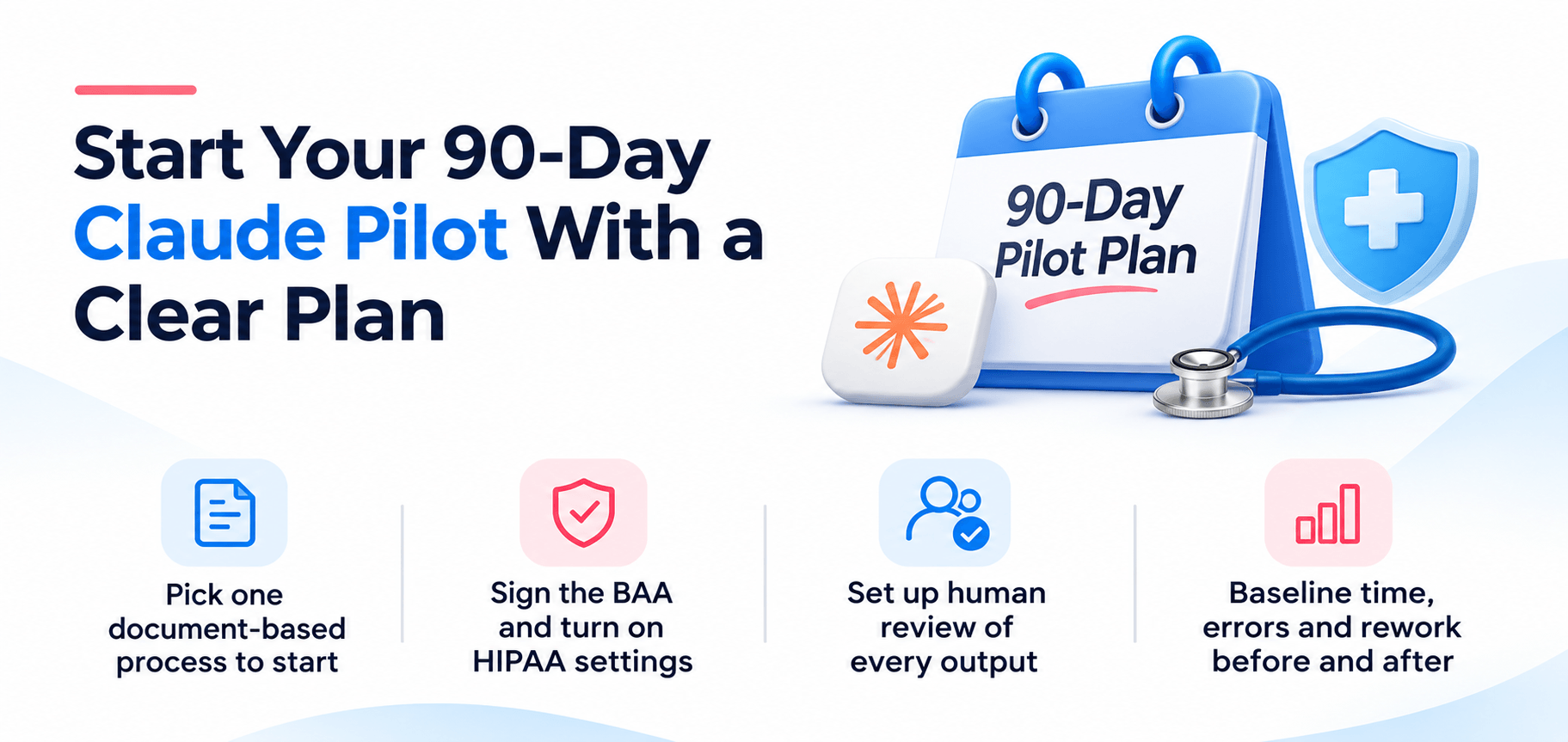
It would be wiser to run a pilot test of 90 days duration and see if you can make measurable progress towards specific objectives before implementing the tool on a larger scale.
1. Select one process – Prior auth packets, denials appeals, and chart summaries tend to be good starting points because all you have for inputs is documentation.
2. Define the terms of use – Begin by signing the BAA, activating the HIPAA setting and turning off everything that is not on the covered list.
3. Establish the human review process – Who will check outputs? What will they check – like all citations, codes and coverage rules.
4. Baseline performance – Measure time spent on a case, error rate in human review, rework needed and user feedback pre and post.
5. Document all failures – Every incorrect output or one which lacks support. This will be the validation data.
Ready to run your first 90-day pilot?
We’ll help you pick the right process, set the review steps and define the success metrics.
When not to use Claude AI
Do not use an alternative approach for any of the following:
1. You need to rely on the accuracy and precision of conventional coding. For instance, when implementing an algorithm, calculation, or a rule-based engine.
2. The task is critical to safety and occurs in real-time, meaning you cannot rely on human oversight.
3. Your PHI data needs to be outside of the secure perimeter.
4. A pre-packaged product that solves the problem and has the necessary approvals and certifications exists.
5. You do not have a clinician to whom you can delegate the task of verifying accuracy and undertaking regular reviews.
The Future of Claude AI in Healthcare: What to Expect Next
Claude for Healthcare is not a new product offering from Anthropic. Instead, it is a combination of workflow samples, HIPAA access, and connections to healthcare data in addition to Claude models. The products of Claude regarding Healthcare and Claude for Life Sciences were announced at the same time on January 11, 2026.
In terms of an Enterprise plan, the user is able to connect to different resources such as the CMS Coverage Database (both Local and National Coverage Determinations), the ICD-10 database (for codes of diagnoses and procedures), the National Provider Identifier Registry, as well as the huge PubMed database with more than 35 million medical articles.
Moreover, Anthropic has given several samples of Agent Skills for prior authorization and FHIR (Fast Healthcare Interoperability Resources) development. Even though the skills are not yet prepared to be implemented straight away and require customization, they can be adjusted to your particular payers and their records and reviews process.
How Can Techugo Help Build AI-Powered Healthcare Software?
Claude AI in Healthcare is developed in collaboration with our partners, including healthcare providers, life science companies, and clinical software companies. As experienced developers of AI-powered healthcare solutions, systems integration, and workflow automation, we begin with understanding your requirements – whether it concerns optimization of prior authorization, claims appeal management, generating summaries of clinical notes, or trials documentation.
Our experiences also include the use of Cal / Cal360 which is a healthcare and wellness service that operates in the US. Cal360 AI Calorie Counter of its live product makes use of image recognition technology and voice input in order to recognize meals. Every single day, the artificial intelligence in this platform goes through over 18,000 food images and creates over 25,000 diet and workout suggestions.
It’s our team who develops an integration strategy of your current clinical and payer systems, performs human review to provide accurate AI integration services and conducts pilot projects based on the objectives set. Besides, we’ll make sure you’re well aware of HIPAA-compliant configuration and BAA since the beginning.
Should you implement the first pilot project of Claude AI, or continue its scaling in the future, Techugo can help in development.
Conclusion
Using Claude in healthcare can be considered safe and valuable at this point in time only in situations where it performs supervised document-based tasks, like preparing documents for prior authorization, working on claims appeals, creating chart summaries and documentation for trials. Currently, it cannot be trusted to make clinical decisions by itself, and there is a reason behind it according to research.
The way forward is realistic. Start by signing BAA and staying within covered functionality, always have a competent professional review any generated documents, stick to the side of the FDA line which keeps clinicians in control and prove your value in a limited 90-day pilot before expanding further.
FAQs
1. Is Claude HIPAA-Compliant for Healthcare Organization?
Anthropic provides a BAA for their First Party API plan and for their Enterprise plan, but it is contingent upon you signing it, enabling the HIPAA settings, using only the covered functionality and adhering to HIPAA regulations on your own end.
2. Can Claude diagnose patients?
It is not to be used for diagnostic purposes without supervision. It yields good results for limited tasks and poor results for specialty-level questions, and any technology replacing human clinical decision-making is tightly regulated.
3. How Can Doctors Use Claude in Healthcare?
Yes, for tasks they can verify, such as summarizing literature, drafting documentation and preparing for appointments, with the clinician making the final decision.
4. Does Claude train on patient data?
Anthropic says it does not use users’ health data to train models for its personal health integrations. For organizational use, confirm retention and training terms in your BAA and contract.
5. What can health systems automate first?
Prior authorization preparation, claims appeals, message triage and chart summaries are the best-documented starting points.
6. Can life sciences teams use Claude for trials and submissions?
Yes, for protocol drafting, trial operations tracking and regulatory gap analysis, with qualified staff reviewing everything.