

 SA
SA
 KW
KW
 IE
IE AU
AU UAE
UAE UK
UK USA
USA
 CA
CA DE
DE
 QA
QA ZA
ZA
 BH
BH NL
NL
 MU
MU FR
FR















📌 Key Takeaways
-
- AI chatbots provide 24/7 patient support and automate routine healthcare tasks.
- Healthcare chatbots have helped increase appointment bookings by up to 47%.
- They improve scheduling, symptom checking, medication reminders, and patient follow-ups.
- AI chatbots can support better patient engagement, with some programs reporting 90%+ engagement rates.
-
- Strong data security, HIPAA compliance, and human oversight are essential.
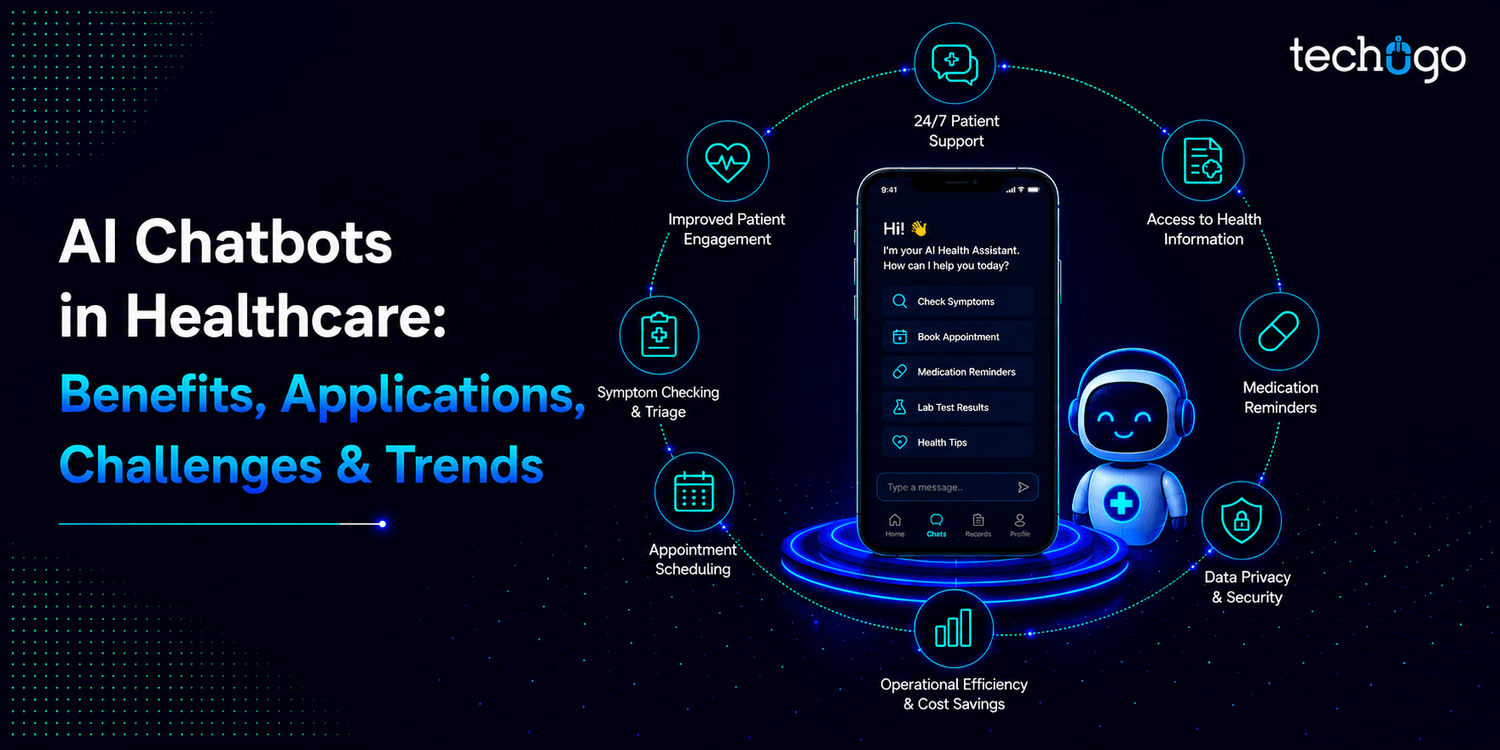
AI-powered chatbots and virtual assistants are changing the way hospitals, clinics, and healthcare organizations connect with their patients and manage day-to-day operations. They use both natural language and machine learning to perform tasks, answer questions, and triage patients… all available 24/7.
In the last couple of years, the healthcare chatbot industry has experienced tremendous growth; North America currently is leading the way, as most providers have begun using these tools to improve access and to ease the burden of staffing levels.
Research indicates that AI chatbots can help increase the number of appointment bookings (for example, Weill Cornell Medicine’s 24/7 chatbot improved digital appointment bookings by 47%), as well as improve patient engagement rates (some programs claim 90%+ engagement and 97% adherence to care plans).
By automating appointment reminders, self-service Q&A, symptom checks, and other basic follow-ups, chatbots allow healthcare teams more time to care for their patients and provide patients with faster, more convenient access to services.
Key benefits of AI chatbots in healthcare
Chatbots are used for different healthcare functions. Many use them as 24*7 assistants, while some consider them as digital receptionists.
For example, studies of AI symptom-checkers have found they correctly identify the patient’s condition in 99% of cases (versus 100% for doctors) and, when used together with physicians, gave safe advice 97% of the time.
Mental health is another growing area: a Dartmouth study of “Therabot” (an AI therapy chatbot) found users with depression saw a 51% reduction in symptoms and anxiety patients saw a 31% reduction, outcomes comparable to traditional therapy.
Key benefits of healthcare AI chatbots include:
24/7 Patient Engagement
Patients can get access to information and support at any time and improve self-care. Chatbots provide instant answers to FAQ, medication guidance, or symptom triage when clinics are closed. Many report a “judgment-free zone” where patients share concerns freely with a bot. Studies show especially older adults find chat interfaces easy to use (low cognitive load).
Administrative Efficiency
Automating routine tasks saves staff time. For example, a healthcare organization can utilize an AI scheduling assistant to manage booking and cancellation requests outside of normal business hours, which reduces the number of phone calls. Plus, bots can verify patients’ insurance coverage, check the availability of appointments in real time (via EHR integration), and assist with prescription refills without any human intervention. These improvements reduce the workload of staff, cut down on organizational costs, and increase the amount of time staff have available for patient interaction.
Improved Access & Reach
By relieving access bottlenecks, chatbots extend care to more patients. For example, with multilingual bots, non-English speaking patients will be able to access resources for care and therefore reduce the gaps in care. Also, during COVID-19, chatbots allowed clinics to respond to surges of patient inquiries (for which they could not accommodate via telephonic communication) due to their increased volume capacity.
Data Collection and Personalization
AI chatbots development company can log structured health data (such as symptoms, mood, vitals) in real time. This data enriches patient EHRs and care plans, for example, conversational bots can screen patients for risks and feed responses into providers’ systems. This allows personalized follow-up. Insights from chatbot interactions also help identify gaps in care and guide resource planning.
Applications and use cases of AI chatbots in healthcare
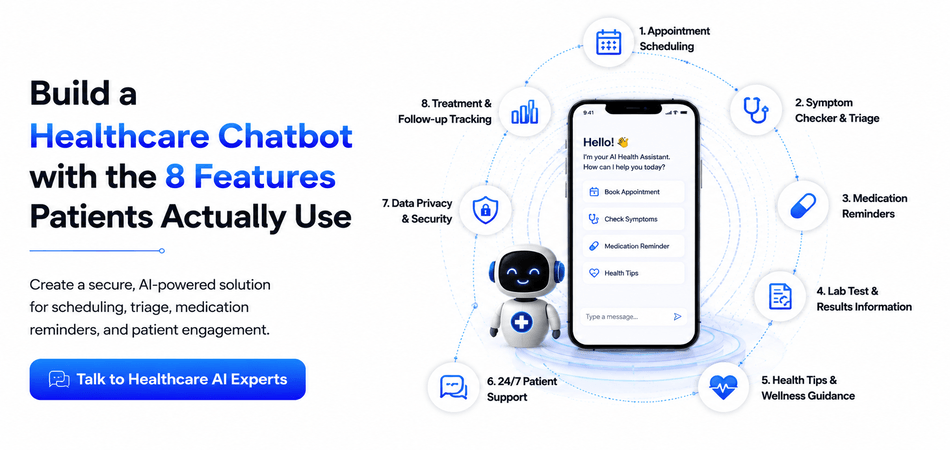
Healthcare chatbots are applied across the patient journey. Core use cases include:
1. Appointment Scheduling & Registration
AI chatbots in healthcare act as scheduling assistants. They allow patients to book, cancel, or reschedule appointments at any time through web chat. They send reminders and updates as well. They can be connected with EHR and scheduling systems to write appointments automatically in calendars.
2. Patient Triage & Symptom Checking
Healthcare AI chatbots can collect details before a patient meets a doctor. It asks structured questions and then it can suggest the next step or connect the patient with a professional. Ada Health and Buoy platforms have shown strong accuracy levels. And many hospitals have been using chatbot-based intake because it saves clinicians time.
3. Health Education & Q&A
It also works as a digital health coach. A coach that answers questions about medications, illnesses, diet, fitness, etc. Sometimes, it explains medical reports in easy language so that patients can easily understand their conditions.
4. Medication Management
AI-powered chatbots in healthcare remind patients about their medicines and at the same time, track missed doses. They can also support refill requests. They can be integrated with EHR and pharmacy systems to make it easy to manage many routine administrative tasks.
5. Chronic Disease Management
AI chatbots in healthcare help track symptoms and collect health updates on a daily basis from people with diabetes, hypertension, or COPD. They motivate patients to adopt healthy habits and monitor their progress. Sometimes, they even flag unusual changes. Consequently, patients stay more involved in their care and healthcare providers can work to reduce avoidable readmissions.
6. Mental Health & Emotional Support
Many AI chatbots focus on mental well-being. For example, apps like Woebot or Wysa provide conversational CBT and stress management tools. Users often interact late at night or weekends, when human therapy isn’t available. Clinical trials (e.g. Dartmouth’s Therabot) have shown large symptom reductions (depression and anxiety) with AI chatbot interventions. While not replacing clinicians, these bots extend support and reduce provider burden.
7. Patient Intake and Registration
Most leading healthcare companies are already using AI chatbots to automate patient intake and registration. Bots let them collect demographic details, insurance info, and the reason for the visit, before the appointment. This reduces paperwork and speeds up check-ins.
8. Remote Patient Monitoring (RPM) Assistance
In telehealth programs, AI chatbots support remote patient monitoring by reminding patients to log their vital readings. They remind them to answer follow-up questions. And if there are unusual trends, the chatbot can flag them for providers. Since monitoring is continuous, healthcare teams can intervene earlier when needed.
Challenges, risks and regulations behind AI-powered healthcare chatbots
While promising, healthcare AI chatbots face significant challenges:
Data Privacy & Security
AI chatbots in healthcare deal with sensitive information about patients; hence, they need to follow HIPAA-compliant healthcare app development and other privacy laws. The systems need encryption, secure infrastructure, and strong access controls. Because weak APIs or poor data storage can lead to breaches and penalties.
Accuracy and Clinical Safety
A healthcare AI chatbot system can sometimes give outdated/incorrect advice and it may even hallucinate information. So human oversight and proper clinical validation are still important, especially when the chatbot is involved in diagnosis or treatment decisions. In some situations, these tools are also subject to FDA regulations.
Bias and Equity
AI-powered chatbots in healthcare are trained on data, and if that data was limited or biased, the results can be too. So the chatbot should support different languages and patient groups, and it should be tested carefully to provide fair care.
Regulatory Compliance
HIPAA is only one part of the regulatory picture. Administrative chatbots face fewer restrictions. But those offering medical advice can be treated as medical devices. The FDA and state governments have been updating AI rules, and healthcare providers need to keep pace.
User Trust and Acceptance
Most patients are still cautious about sharing personal health information with AI. Clear disclosure and the option to speak with a real person make the experience more comfortable. Also, digital literacy varies – some older or rural patients may find chat interfaces challenging. Hybrid models (AI + live care) and patient education are often needed for adoption.
Integration and Workflow
An AI chatbot in the healthcare industry works best when it fits into existing EHR systems and workflows but if the integration is poor, staff may have to repeat tasks. And the technology ends up creating more work instead of saving time.
Current Trends in AI chatbots in healthcare
The future trends in healthcare chatbots mirror broader AI advances:
Generative AI and LLMs
The rise of sophisticated generative models (like GPT-4 and beyond) has led to new possibilities. These models can handle more complex, open-ended conversations, and are being explored for specialized healthcare use. For instance, custom LLM development services allow hospitals to fine-tune models on medical literature or their own data, creating smarter virtual assistants. We’re seeing “AI companions” that blend symptom-checking with empathetic conversation. However, as noted, regulators and experts caution about using general LLMs in high-stakes care without robust safeguards.
Voice and Multimodal Assistants
Voice-enabled AI apps (like Alexa, Siri) are entering healthcare. Examples include voice bots for note-taking (scribes) and patient intake via call. The Conversational AI market report highlights voice assistants that help clinicians (transcribing notes) and let patients call in to schedule appointments or refill prescriptions. These tools improve accessibility for patients who prefer speaking to typing. In the near future, we’ll likely see more integration of chatbots into telemedicine platforms as on-demand “virtual receptionist” and possibly even in-hospital robots or kiosks.
Virtual Health Coaching and Agents
There’s growing interest in “AI agent” models that continuously engage patients. These go beyond single interactions; they proactively check in, triage issues, and even coordinate between specialists. For example, chronic care management bots that integrate with wearable devices and call patients when alarms trigger. Custom AI agent development services are emerging to build these end-to-end virtual care pathways.
Specialized Clinical Bots
Instead of general symptom-checkers, expect more disease-specific chatbots. Oncology, diabetes, and mental health chatbots tailored to protocols and team workflows can provide more accurate guidance. Integration with electronic health records (EHR) and medical devices will deepen: e.g., a cardiology app bot that pulls a patient’s latest echo report and adjusts its recommendations accordingly.
Telemedicine & Remote Care Integration
The expansion of telehealth means chatbots will often be part of virtual care ecosystems. The Conversational AI report notes that growing telemedicine usage drives chatbot adoption for virtual patient interactions. We’ll see more “digital front doors” for health systems – patients begin care via a chatbot and are triaged to video visits or e-visits as needed. Telemedicine apps in USA will increasingly bundle AI chat features for efficiency and 24/7 support.
Multilingual and Accessibility Focus
AI allows rapid scaling to new languages. Chatbots already offer multi-language support (Spanish, etc.). Future versions may handle regional dialects or use voice translation. This trend will improve health equity by reaching non-English-speaking communities.
Analytics and AI Insights
Chatbots generate rich data on patient concerns and behaviors. Advanced analytics on this data (often incorporated in a broader AI platform) can identify population health trends. We can expect health systems to use chatbot logs to spot gaps in education or emerging health issues in real time. Tools that integrate chatbot analytics with EHR data will emerge, driving more proactive interventions.
Regulatory Evolution
Anticipate new guidelines and standards. In the U.S., the FDA is likely to update its approach for AI-based clinical tools. We may see certification programs or best-practice frameworks for safe AI chatbots (similar to what has emerged for digital therapeutics). Healthcare providers will need to stay abreast of policies from HHS, FDA, and state boards regarding AI.
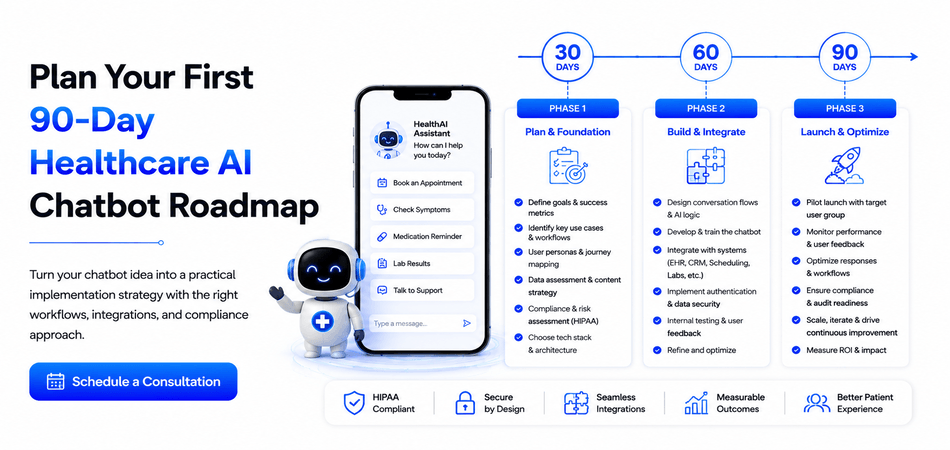
Best practices to implement AI-powered healthcare chatbots
We as a leading healthcare app development company, suggest that every healthcare organization should follow the below-mentioned practices to safely and effectively adopt chatbots:
Human-in-the-loop Design: Always incorporate easy handoff to human staff. For example, chatbots should flag critical issues and connect patients with nurses or physicians. This aligns with studies advising built-in clinical oversight.
EHR and Workflow Integration: Choose solutions that integrate tightly with existing EHR, telehealth and practice management systems. Bots that write to the EHR (scheduling, documentation) provide the most value. Integration via FHIR apps APIs or HL7 dramatically improves efficiency and patient satisfaction.
Patient Transparency: Clearly inform patients they are talking to an AI tool, not a human. This builds trust and ensures proper expectations. Likewise, provide opt-out or escalation options at any time.
Data Security and Compliance: Ensure the chatbot platform is HIPAA-compliant. This means encrypted data storage/transit, robust authentication, and BAAs with any vendors. Conduct security audits and regular vendor risk assessments (e.g. using healthcare vendor risk management tools).
Evaluation and Metrics: Track key metrics as part of the deployment. This includes patient satisfaction scores, engagement rates, no-show reduction, call volume changes, and clinical outcomes. MGMA suggests measuring new patient volume via AI scheduling, call deflection rates, patient-reported satisfaction and ROI. Continuous monitoring allows adjustments and demonstrates value.
Ethics and Bias Checks: Regularly test the chatbot with diverse patient scenarios to ensure accuracy and fairness. Get feedback from clinicians on answer quality. Implement an AI ethics review process or committee for new health tech deployments.
Training and Maintenance: Chatbots need ongoing updates. Medical knowledge evolves, so the bot’s content and algorithms should be kept current. Many health chatbots are connected to knowledge databases or ML models that can learn over time (with safeguards). Engage clinical staff to update Q&A libraries and verify new features.
User Experience: Design chatbot conversations to be natural and empathetic. Simple, jargon-free language and menu options help ensure all patients can use the system. Testing the chatbot with real patient groups helps refine its tone and usability.
By following these practices, healthcare organizations can harness the productivity of AI scheduling assistants and chatbots while maintaining patient safety and satisfaction.
To sum up
AI chatbots in healthcare are maturing, from being experimental novelties to practical tools that improve access and efficiency. They offer significant benefits and still support clinicians, not replace them.
Companies that are planning to adopt chatbots must reach out to experienced AI-powered mobile app development companies in USA and consult with their experts about compliant, patient-centric solutions.
Hospitals and clinics can future-proof their patient engagement strategies and still stay aligned with regulations like HIPAA and emerging AI guidelines.
The ongoing AI revolution promises richer conversational tools, and those who move early in this space will likely gain a competitive advantage in patient satisfaction and operational efficiency.
FAQs
Q1. How are AI chatbots used in healthcare?
AI chatbots help with appointment booking, symptom checking, patient triage, medication reminders, health education, and follow-ups. They also support administrative tasks and improve patient communication.
Q2. Are AI healthcare chatbots HIPAA compliant?
They can be, but only if they are built with proper security measures such as data encryption, secure access controls, and HIPAA-compliant infrastructure.
Q3. Can AI chatbots replace doctors or healthcare staff?
No. AI chatbots are designed to support healthcare professionals by handling routine tasks and providing basic assistance. Critical medical decisions still require human expertise.
Q4. What should healthcare organizations consider before implementing an AI chatbot?
They should focus on HIPAA compliance, EHR integration, human handoff options, data security, and continuous monitoring to ensure safe and effective patient interactions.

Get in touch
We'd love to hear from you.